



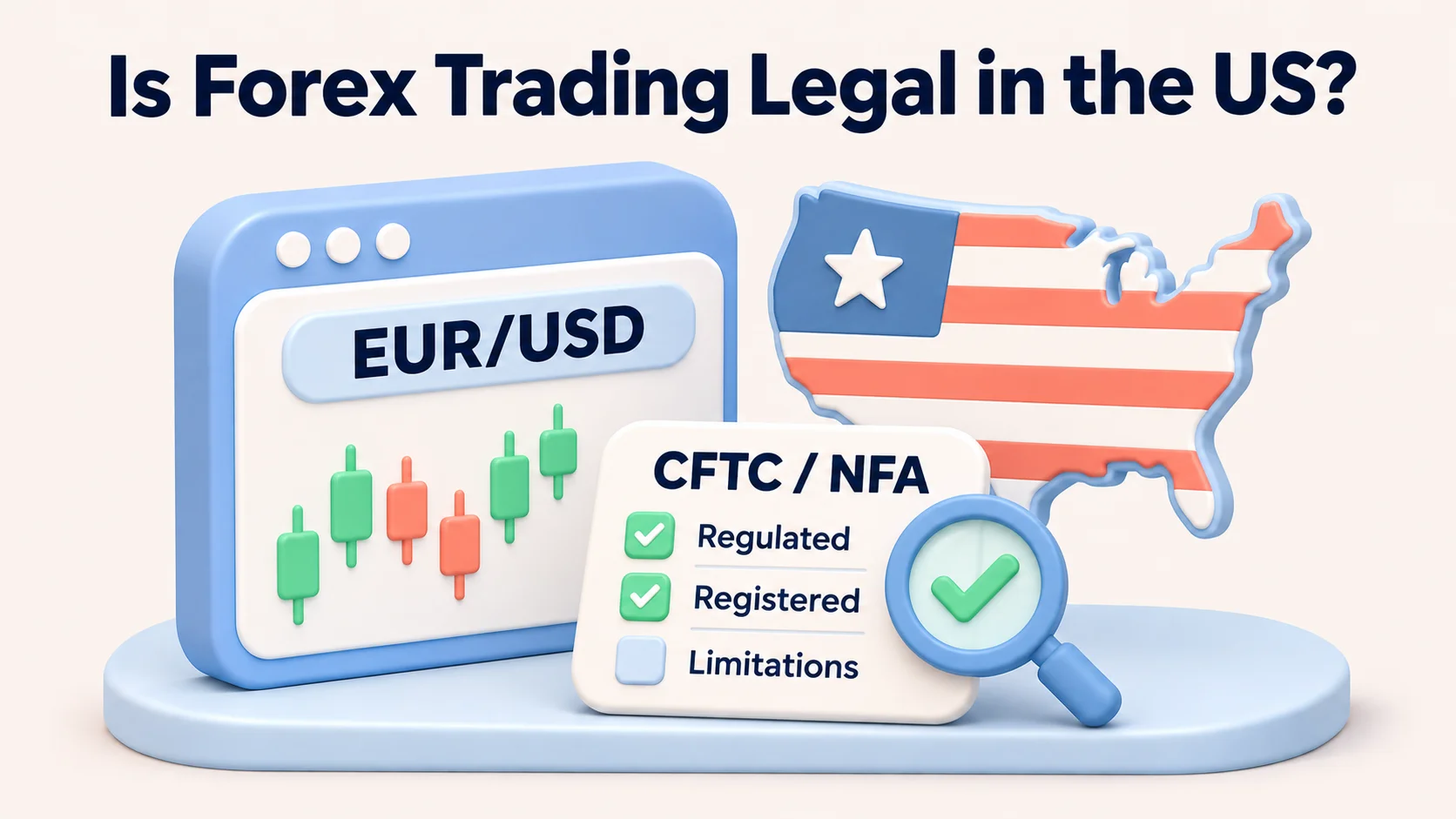
Yes, trading forex is legal in the United States, but not every type of forex contract or broker offer is available to an ordinary US retail trader. The relevant question is what product are you trading, who is your legal counterparty, and under which rules does that firm operate? US retail over-the-counter (OTC) forex, exchange-traded currency futures and ordinary currency conversion are different activities. A foreign broker's marketing claim or license from another country does not establish that its leveraged forex account can legally be offered to US residents.
For a typical individual considering leveraged OTC forex, start with the Commodity Futures Trading Commission's (CFTC) retail forex framework and the National Futures Association's (NFA) BASIC register. Whether a particular account is available also depends on the legal entity, state of residence, eligibility and current account agreement. This is an educational summary, not a determination about any individual's account.
Which kinds of forex trading are legal in the US?
The word forex is used for several products with different regulatory treatment. Calling an app a "forex platform" does not identify the product being traded or the company responsible for it.
| Activity | What the customer is actually doing | US regulatory point | Practical consequence |
|---|---|---|---|
| Leveraged retail OTC forex | Entering a margined currency transaction off-exchange, generally against a dealer | The CFTC retail forex rules apply to covered transactions; relevant counterparties include authorized RFEDs/FCMs and certain otherwise regulated financial institutions under their own regimes | Verify the exact counterparty and appropriate permission; the trading platform alone is not a license |
| Exchange-traded currency futures | Trading standardized currency contracts on a regulated futures exchange | Exchange, clearing and futures intermediary rules apply rather than the same OTC dealer arrangement | Check the futures account, exchange contract, margin method and broker's futures permissions |
| Cash currency exchange or genuine delivery | Converting dollars into another currency, or a qualifying transaction with actual currency delivery | Ordinary currency conversion and qualifying delivery transactions are not automatically the same as leveraged retail OTC forex | Do not apply a leveraged dealer's margin rules to a bank conversion without checking the activity |
| Forex or currency CFDs advertised overseas | Taking a contract-for-difference exposure rather than buying currency or a listed futures contract | A foreign CFD license or offshore account is not proof the product may be offered to US retail residents | Check product-specific US permissions and residency restrictions; do not treat a CFD offer as a US retail forex account |
The NFA's forex regulatory guide explains the distinction between covered retail forex and transactions that result in qualifying actual delivery. A position described as "spot forex" on a leveraged trading app may still fall under the retail forex framework; the label spot does not, by itself, establish an exemption.
Who can legally offer retail forex to US customers?
The CFTC's retail forex framework provides for registered retail foreign exchange dealers (RFEDs) and certain futures commission merchants (FCMs) to act as retail OTC forex counterparties. Other categories of otherwise regulated US financial institutions, such as certain banks, may operate under their own primary regulator's rules. This is not permission for any brokerage brand to take US retail forex deposits.
For an RFED or covered FCM forex dealer, check the firm's current CFTC registration and NFA forex-dealer approval. An introducing broker may introduce customers without being the counterparty that holds their trading account. A commodity trading advisor may provide advice or exercise discretionary authority subject to applicable registration and exemptions; a commodity pool operator runs a pooled vehicle. These roles are not interchangeable with an RFED. The firm's account agreement should identify who executes the transactions, holds the customer funds and provides the trading service.
There is an important qualification to older descriptions of SEC-regulated broker-dealers. The SEC's temporary Rule 15b12-1 for retail forex expired on July 31, 2016. A company's registration as a securities broker-dealer is therefore not, on its own, enough to conclude that it can offer the particular leveraged retail forex transaction you are considering. Product-specific permissions and the exact legal structure must be checked.
Does using an offshore broker make forex illegal?
Do not assume that an offshore firm can lawfully solicit and serve US retail customers simply because its website accepts a US address, advertises large leverage or names a foreign regulator. Equally, a foreign incorporation or licence alone is not proof that every activity of that firm is illegal. The question is whether the specific contracting entity, its offer and its transactions comply with the laws that apply to the US customer. US resident eligibility, applicable exemptions and cross-border solicitation can require legal analysis. Avoid deposits until the US regulatory position and contract are clear.
Are professional and institutional forex accounts different?
Yes. Some CFTC rules distinguish a retail customer from an eligible contract participant (ECP), a defined legal status based on criteria such as assets and entity type. A label like "professional trader," prior market experience or a high-income claim does not by itself establish ECP status. A provider that serves eligible institutions may not offer the same product to an ordinary retail resident. Any claimed exemption needs to be verified against the actual statutory criteria and account documents.
What US rules affect leverage, hedging and trading costs?
For Forex Dealer Members, NFA Financial Requirements Section 12 sets minimum security deposits at 2% of notional value for transactions involving the specified major-currency group and 5% for other transactions, subject to any temporary higher requirements. As reviewed on November 13, 2026, that rule lists currencies including the euro, Japanese yen, pound sterling and other named major currencies. Brokers may require more margin; a minimum deposit rule is not an entitlement to receive maximum leverage. The rule's latest listed amendment became effective March 18, 2026.
| Hypothetical USD-notional position | Illustrative minimum security deposit | Implied leverage before stricter broker requirements |
|---|---|---|
| $100,000 EUR/USD exposure | 2% = $2,000 | Up to 50:1 from that minimum |
| $100,000 position subject to the 5% category | 5% = $5,000 | Up to 20:1 from that minimum |
These are arithmetic illustrations, not account quotes or margin recommendations. On the first example, a 1% adverse move against $100,000 of exposure would produce approximately a $1,000 trading loss before spreads, commissions, financing and any currency conversion effects. That is half of the illustrative $2,000 security deposit, demonstrating why apparently small exchange-rate moves matter when leverage is high. Dealers can liquidate positions when margin is insufficient, and losses may exceed the initial deposit in some circumstances.
US retail account order handling can also differ from offshore platforms. NFA Compliance Rule 2-43(b) requires applicable forex dealers to offset positions using first-in, first-out rules, limiting the practice of holding opposite positions in the same pair in one account. A hedged grid advertised overseas may therefore behave differently on a US retail account. Verify the dealer's latest execution, offset and order policies rather than assuming a trading robot works the same everywhere.
Legal availability does not make a strategy inexpensive. Retail OTC forex costs can include variable bid-ask spreads, per-side commissions, overnight financing and slippage. The dealer is usually the customer's counterparty rather than a centralized exchange order book. Read the CFTC forex customer advisory for the associated platform, leverage and funding risks.
How to check whether a US forex offer is authorized
- Identify the actual product. Is the account offering leveraged retail OTC forex, listed currency futures, conversion, a CFD or some other derivative? Check contract specifications rather than marketing labels.
- Read the contracting company name. Locate the exact legal entity in the customer agreement, risk disclosure and deposit instructions. Record its legal address and any registration numbers.
- Check the primary US record. Start with CFTC's registration-check guide and search the exact company in NFA BASIC. Check current registration type, NFA membership, forex-dealer or futures permissions as relevant, and regulatory history. An NFA number without active appropriate status is insufficient.
- Match the actual website and account. Compare the firm's official contact details and trading names with the account documents and the website sending the funding request. A separately licensed company in the same group does not authorize another subsidiary.
- Confirm who can open the account. Ask the contracting entity about US residency, state restrictions, retail versus ECP classification, permitted products and the current margin and order rules. A license does not guarantee approval in every state.
- Understand custody and dispute routes. Read deposit, withdrawal, insolvency and dispute procedures. An OTC forex account should not be assumed to enjoy ordinary bank-deposit insurance or SIPC securities-account protection. Registration reduces some regulatory risks; it does not insure against trading losses.
For a detailed register walkthrough, see FXRanking's guide to checking broker regulation. For a product-specific comparison rather than a legal conclusion, consult the US retail forex broker guide. Those articles serve different purposes and neither replaces checking the current legal entity.
What US forex trading rules do not guarantee
Even a correctly registered dealer cannot promise profits, stable spreads, a fixed execution price or the return of every deposit in an insolvency. OTC forex prices and execution depend on the dealer's market conditions and contractual order rules. Stop orders can slip, market gaps can accelerate losses, and a trader can owe more than an opening deposit in some circumstances. The CFTC has warned about unregistered offshore firms, manipulated trading displays and requests for additional money before a withdrawal.
A social-media contact who promises guaranteed forex returns, asks for payment in cryptocurrency only, requests remote access to your device or charges "tax" before allowing a withdrawal is a serious warning sign. The CFTC provides a complaint route. FXRanking's forex scam-warning guide explains the evidence worth preserving if you suspect deception. A complaint is not proof of fraud, and ordinary trading losses are different from a scam.
Risk warning: Leveraged forex and currency futures are high-risk products. A small market movement can cause a large loss; you may lose all your margin and potentially more. An authorized firm, a regulated platform or a risk-control order does not guarantee profits, a particular execution price or recovery of funds after a failure. Do not trade money you cannot afford to lose.
FAQs
Is forex trading legal in the United States?
Yes. US law permits forex activity, including regulated retail OTC forex and exchange-traded currency futures, but the relevant permissions depend on the product, counterparty, client type and applicable rules. A platform or foreign licence alone does not establish eligibility for a US retail resident.
Can a US resident trade forex with an offshore broker?
An offshore website accepting a US address is not proof that the specific entity may lawfully offer its leveraged forex product to US retail residents. Check the contracting entity, applicable US permissions or documented exemptions, account terms and state eligibility. Do not assume every offshore business or activity is automatically illegal.
Which regulator oversees forex trading in the US?
The CFTC oversees covered retail forex and the NFA conducts registration and member oversight of relevant derivatives firms. Regulated banks and other institutions may fall under additional primary regulators, while currency futures involve exchanges and futures rules. Start with the product and exact legal entity.
Does a US forex broker have to be NFA registered?
RFEDs and covered FCMs acting as retail OTC forex dealers generally need relevant CFTC registration and NFA forex membership or approval. Certain otherwise regulated financial institutions may be counterparties under separate regimes. Check the precise capacity; an NFA ID alone does not prove current dealer permission.
Is forex trading with 1:500 leverage legal for US retail traders?
Do not assume international leverage advertising applies to US retail OTC accounts. NFA security-deposit minimums generally correspond to 50:1 for specified major-currency transactions and 20:1 for other transactions, with the possibility of stricter broker or temporary requirements. Check the actual account and currency pair.
Are forex CFDs legal for US retail traders?
A foreign CFD broker license or a platform that lists currency CFDs is not evidence the contract can be offered to US retail residents. A forex CFD is not identical to regulated US retail OTC forex or exchange-traded currency futures. Obtain a product- and entity-specific US eligibility determination before assuming access.
Is currency exchange at a bank the same as forex trading?
No. Converting cash or arranging genuine currency delivery is not automatically the same as entering a leveraged retail OTC currency derivative. The legal classification depends on transaction structure and delivery terms, not just the word forex.
Can a US resident trade currency futures instead of OTC forex?
Exchange-traded currency futures are a different permitted market with their own exchange contracts, futures intermediaries, margin calculations and account approvals. Check the specific futures broker and contract; a futures permission does not establish permission to offer retail OTC forex.
Can I lose more than my deposit trading forex in the US?
Potentially. Leverage amplifies changes in the account value, and the CFTC cautions that some customers can be liable for additional losses beyond their initial deposit. Check the dealer’s legal risk disclosures, liquidation policy and the financial exposure you accept.
How do I check if a forex broker is permitted to serve me?
Read the agreement for the exact contracting entity, identify the product, search the firm’s current CFTC registration and NFA BASIC record when relevant, inspect forex permissions and history, then confirm the official website, US residency, state restrictions and account terms. Registration is not a guarantee of safety or profitability.

Amy Baily