



4 Best Binary Options Brokers in 2026
Time to read: 10 minutes
Posted: 22 Jun 26
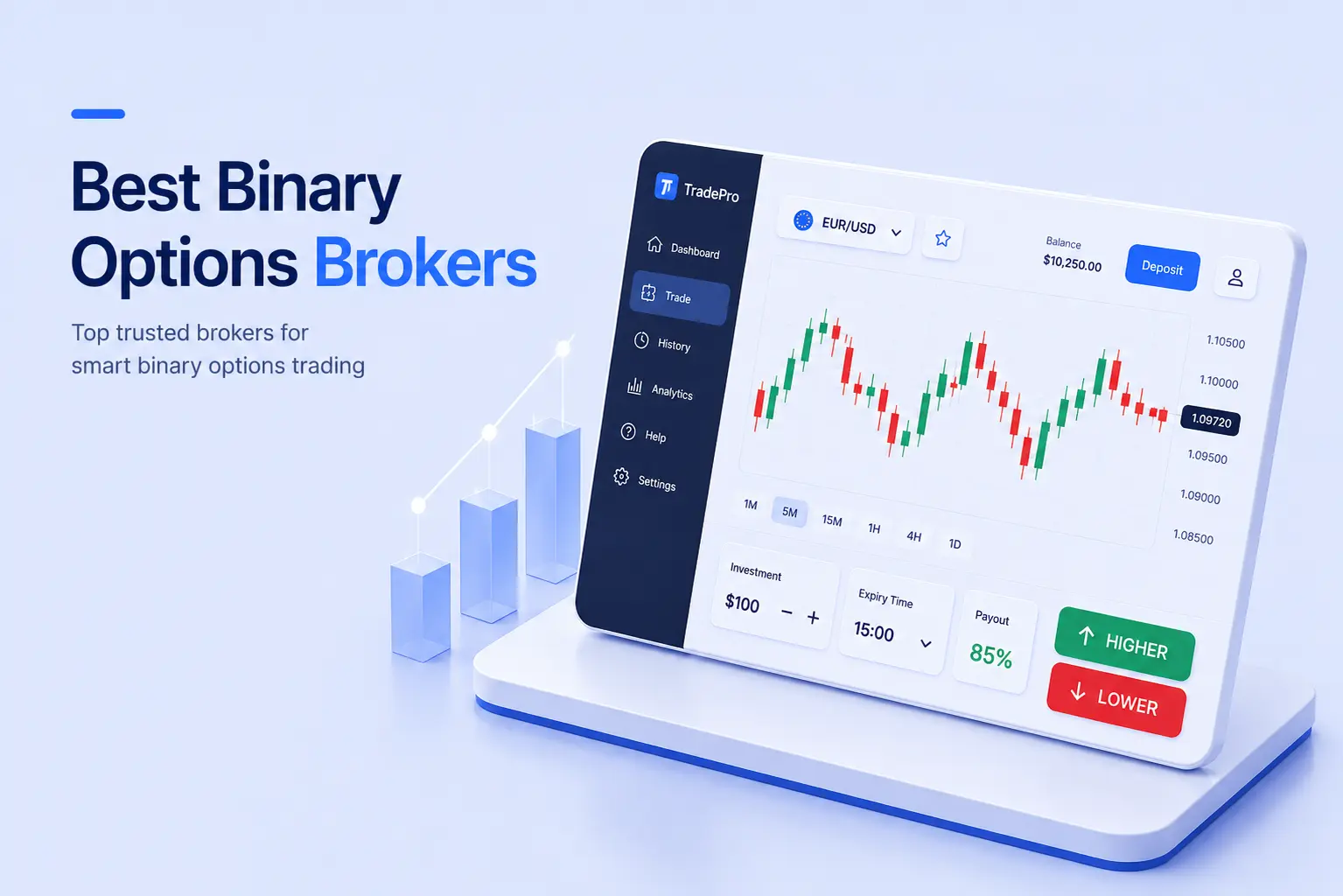
Top Picks (Quick Summary)
- Kalshi, Best for event contracts: A strong fit for traders who want exchange-style contracts that settle at $1 when the forecast is correct.
- Interactive Brokers, Best for professionals: Built for traders who already work with forex, futures, options, ETFs, and advanced order tickets.
- Deriv, Best for flexible trading: A practical choice for traders who want low entry costs, several contract types, and access to forex, indices, commodities, crypto, and derived markets.
- Pocket Option, Best for beginners: The simplest platform in this group, with a $5 minimum deposit, $1 trades, fast expiry choices, and social trading tools.
Comparison Table of Top Binary Options Brokers
Key Costs and Pricing Snapshot
Kalshi prices contracts from $0.01 to $0.99. A correct contract settles at $1. The math is direct: buy lower, settle at $1, and the difference is the gross gain before fees. This is closer to exchange trading than to a traditional binary options payout.
Interactive Brokers uses a professional fee model. ForecastEx contracts have $0 broker commission and a $0.01 exchange fee per contract. Kalshi and CME event contracts add a $0.01 broker commission plus a $0.01 exchange fee. That small fee structure suits active traders who understand contract size and order routing.
Deriv starts with a $5 minimum deposit and allows small trades from $1. Its pricing depends on the contract type, market, duration, and volatility. A trader who moves between forex, commodities, crypto, and derived indices gets more flexibility than on a single-market platform.
Pocket Option also starts low, with a $5 minimum deposit and $1 trade size. Its main cost advantage is simple access. The platform gets beginners from chart to trade ticket quickly, which helps when learning expiry timing.
Why These Brokers Made the List
This list is not five versions of the same broker. Each name solves a different trading problem.
Kalshi removes the broker-side binary format and uses regulated event contracts instead. Interactive Brokers belongs here because professional traders often need more than a quick up or down button. They need platform depth, market access, product permissions, and reliable account tools. Deriv earns its place through range. Pocket Option earns it through speed and simplicity.
Best Binary Options Brokers — Detailed Reviews
Kalshi
Kalshi is not a classic binary options broker. It is an event-contract exchange where traders buy Yes or No contracts on real outcomes.
The contract price usually sits between $0.01 and $0.99. A price near $0.40 means the market is pricing the outcome around 40%. If the contract resolves correctly, it pays $1. If not, it settles at $0.
This model suits traders who follow macro events. Inflation releases, interest-rate decisions, crypto price levels, election outcomes, weather events, and economic data can all become tradable themes. The skill set is different from 60-second forex trading. Here, the edge comes from understanding probabilities, event rules, and market sentiment.
Kalshi is strongest for traders who want defined risk and transparent contract pricing. It is weaker for traders who want rollover, double-up, or classic chart-based binary options on currency pairs.
Interactive Brokers
Interactive Brokers is the advanced option. It gives event-contract access inside a much larger trading environment that includes forex, stocks, futures, options, ETFs, indices, and commodities.
The platform range is deeper than the others in this list. ForecastTrader gives a direct route into event contracts, while IBKR Desktop, IBKR Mobile, and Trader Workstation serve broader market activity.
That depth has a trade-off. Beginners may find the account setup, product permissions, order tickets, and platform choices more demanding. Experienced traders, on the other hand, get better control over execution, fees, contract selection, and wider portfolio exposure.
Interactive Brokers fits traders who already think in terms of bid and ask, liquidity, contract settlement, and risk per position. It is not the fastest learning path, but it is the most complete professional setup in this group.
Deriv
Deriv gives traders room to experiment. The minimum deposit is $5, the minimum trade amount starts from $1, and durations range from 1 second to 1 year.
The market list is broad enough for different trading routines. Forex traders can focus on major pairs during London and New York hours. Commodity traders can watch gold and oil around news events. Traders who prefer 24/7 movement can look at crypto or derived indices.
Deriv is useful when a trader wants more than one contract style. It also supports manual trading, bot trading, mobile access, and API use. That makes it a better fit for traders who like to test ideas and compare results across different markets.
There is no traditional rollover or double-up setup in this comparison. The platform is better used with clear entries, fixed stake sizes, and pre-planned exits.
Pocket Option
Pocket Option is the easiest starting point for many beginners. The platform is visual, fast, and simple. A trader can open the chart, choose an asset, select the expiry, set the amount, and place a trade without learning a complex terminal.
The $5 minimum deposit and $1 trade size lower the pressure on new accounts. Trade durations start from 3 seconds and extend to several hours. That range is wide, although beginners should treat very short expiries with care because one tick can change the result.
Social trading is another reason Pocket Option attracts new users. Watching other traders can help with timing and market rhythm. Copying without understanding the setup is a weak approach. Better traders use social tools as a learning aid, then build their own rules.
Pocket Option works best for small-stake practice, quick chart access, and simple technical setups such as support and resistance, moving-average crosses, RSI confirmation, and breakout retests.
How Rollover and Double-up Work in Practice
Rollover changes the time side of a trade. When the market moves against a position, but the setup still has a valid reason to recover, rollover extends the expiry. It does not fix a bad entry. It only gives a valid trade more time.
Double-up changes the size of a trade. It adds another position based on the current setup. A trader might use it after a strong breakout, a clear trend-continuation candle, or a clean retest of support or resistance.
Pocket Option also offers rollover and double-up style tools. The rule is the same across platforms: use them for planned trade management, not for revenge trading. When a position is already wrong, adding time or size usually makes the loss larger.
Who Should Choose Which Option?
- Choose Kalshi if the plan is to trade event outcomes instead of standard chart-based binary options. It suits traders who follow economic data, crypto levels, political events, sports, weather, and other scheduled outcomes.
- Choose Interactive Brokers if advanced platform tools matter. It is the strongest option for professional traders who already use forex, futures, options, stocks, ETFs, and multi-asset strategies.
- Choose Deriv if flexibility is the priority. It works well for traders who want low trade sizes, several contract types, and access to forex, commodities, indices, and cryptocurrencies.
- Choose Pocket Option if ease of use is the main concern. It is a practical starting point for beginners who want a simple platform, $5 minimum deposit, $1 trades, and quick expiry choices.
How to Choose the Right Binary Options Broker
Start with the product structure. Classic binary options pay a percentage return when the trade finishes in the money. Event contracts settle at a fixed value, usually $1 or $100, depending on the venue. The screen may look simple in both cases, but the pricing logic is different.
Then look at the trading conditions. A good broker should have clear minimum deposits, clear trade sizes, stable platform access, transparent expiry rules, useful charts, and responsive support.
Asset choice matters too. Forex traders need liquid pairs and active sessions. Crypto traders need weekend access and volatility control. Event traders need contract rules, settlement dates, and enough volume to enter and exit at fair prices.
Finally, match the broker to the trader’s own habits. A beginner does not need a professional terminal on day one. A professional trader does not need an oversimple platform that blocks deeper analysis. The right broker should make the strategy easier to execute, not harder.
Final Verdict
Kalshi is the better route for traders who prefer regulated event contracts. Interactive Brokers is the professional pick because it places event trading beside a full multi-asset platform. Deriv stands out for flexibility, while Pocket Option gives beginners the smoothest first step into quick binary-style trading.
The best choice depends on the trading plan. For event outcomes, Kalshi and Interactive Brokers are stronger. For broad market testing, Deriv works well. For simple practice, Pocket Option is the easiest place to start.
Our Review Process & Updates
Each broker was reviewed from a practical trader’s point of view, starting with registration and ending with the first trade setup. The process checked how long it took to open an account, reach the platform, understand the order ticket, choose an asset, set an expiry, and prepare a position. Kalshi took about 7 minutes after identity verification to reach the trading flow, Interactive Brokers took around 15 to 20 minutes for the application plus 1 day for approval, Deriv took about 5 minutes, and Pocket Option took less than 1 minute for basic registration. The review also compared minimum deposits, trade sizes, payout models, rollover rules, double-up tools, platform access, support, tradable assets, and forex-style trading conditions. This article is updated when key facts change, including regulation, minimum deposit, minimum trade amount, payout limits, trade duration range, supported assets, fees, platform access, or general trading conditions.
Risk Warning
Binary options, event contracts, CFDs, forex, and leveraged derivatives are high-risk products. A trader can lose the full stake on a binary options or event-contract position.
Use small position sizes, protect account equity, and avoid emotional trade decisions. Rollover and double-up should support a planned setup only. They should not be used to chase losses.
FAQs
Which broker is best for beginners?
Pocket Option is best for beginners who want a simple layout, $5 minimum deposit, $1 trades, and quick access to short expiry trading.
Which broker is best for professional traders?
Interactive Brokers is best for professional traders because it combines event contracts with forex, futures, options, stocks, ETFs, and advanced platform tools.
Do these brokers offer rollover?
Pocket Option and Capitalcore offer rollover or rollover-style tools. Kalshi, Interactive Brokers, and Deriv do not use traditional binary options rollover in this comparison.
Are binary options suitable for forex traders?
Binary options can suit forex traders who understand trend direction, support and resistance, volatility, session timing, and expiry selection. The risk is high because the result depends on the price at expiry.

Chad Powell
A trading writer covering Forex and cryptocurrency markets, with a focus on risk management, technical analysis, broker platforms, and capital preservation. His content emphasizes practical trading concepts, crypto security, and scam awareness, helping traders make informed decisions and approach the markets with realistic expectations.