



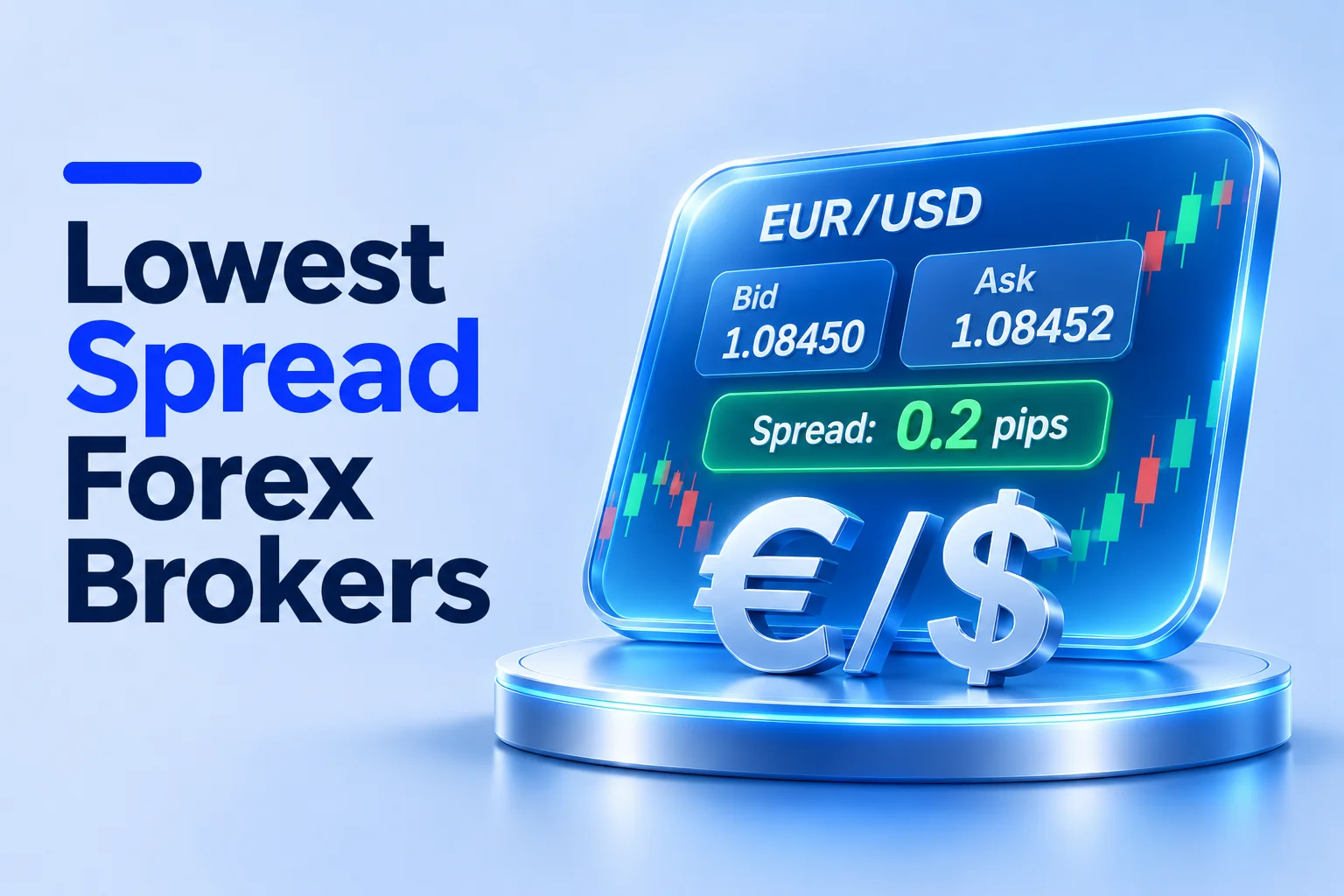
For US retail forex traders, the most useful low-spread shortlist is tastyfx, FOREX.com and OANDA Corporation, but there is not enough like-for-like historical average-spread evidence here to name a verified lowest-cost winner. tastyfx Zero+ has a clearly specified per-lot commission, FOREX.com RAW charges on the US-dollar notional value of each trade, and OANDA Core charges by currency units. Their spread-only alternatives avoid a separate dealing commission. These differences change the answer even when two accounts display the same spread.
This comparison covers the US contracting entities and the account models described in their published US terms, not similarly named accounts at international affiliates. The fee disclosures were checked on 7 November 2026. A published minimum is not an average, a median is not a mean, and a historical quoted spread is not proof of a trader's fill. Until a documented EUR/USD sample covers matching accounts and hours, the brokers below are options to compare, not a ranking from cheapest to most expensive.
Low-spread forex brokers: US account and cost comparison
The published commission is verifiable for each named account. The average EUR/USD spread needed to compute a defensible, observed all-in ranking is not consistently verifiable across these same accounts and a single dated sample window. A dash in the average column means not established for this comparison, not zero.
| US contracting entity | Account or pricing model | Published dealing commission | Repeatable EUR/USD average for same account and window | What the available evidence supports |
|---|---|---|---|---|
| tastyfx, LLC | Standard | $0 | Not established | EUR/USD minimum of 0.8 pips, not a measured average. US account pricing. |
| tastyfx, LLC | Zero+ | $5 per standard lot per side; $10 round trip for one lot | Not established | Minimum of 0.0 pips is a floor, not typical execution. Zero+ commission terms. |
| GAIN Capital Group LLC (FOREX.com) | Spread-Only | $0 on forex | Not established | Its US price page describes a prior-month median rather than a mean. US pricing methodology. |
| GAIN Capital Group LLC (FOREX.com) | RAW | $7 per $100,000 of USD notional per side | Not established | USD notional changes with the currency pair and rate; it is not universally $7 per standard lot. US trading-cost schedule. |
| OANDA Corporation | Spread-only | No separate dealing commission | Not established for a captured, account-matched month | The US historical spread tool describes time-weighted means but needs a recorded instrument, account and dated output. |
| OANDA Corporation | Core spreads + commission | $0.70 per 10,000 currency units per side; $14 round trip for 100,000 units | Not established | At least $10,000 initial deposit or maintained balance is required for enrollment. OANDA Corporation core terms. |
Scope matters: tastyfx, LLC identifies itself as an NFA Forex Dealer Member (ID 0509630); the FOREX.com US regulatory page names GAIN Capital Group LLC (NFA 0339826); and OANDA Corporation's US legal page gives NFA 0325821. Those are US entity disclosures, not a promise that every account, platform or promotion is available in every state or to every applicant. Verify residency, account classification, approval and trading permissions before comparing live quotes. US eligibility must not be inferred from a search result or a global broker brand.
What would count as a genuine lowest-spread comparison?
The meaningful figure is an account-specific historical average bid-ask spread plus the complete opening and closing commission, expressed in the same currency and size. It should be calculated for the same pair, same market hours and same sampling period across brokers. The word “lowest” cannot be supported by selecting one firm's zero-pip minimum against another firm's monthly mean.
A repeatable EUR/USD sample specification
- Fix the instrument and size. Use EUR/USD and 100,000 EUR of base-currency notional, quoted in pips. A pip is $10 for a 100,000-EUR EUR/USD position. If reporting 10,000 units, a pip is $1.
- Fix the measurement window. For example, capture every available eligible 15-minute quote interval in the full October 2026 trading month, with exact start and end timestamps and a documented ET time-zone convention. Keep an all-hours mean and a separately labeled active-hours mean. Do not quietly remove the 5 p.m. ET rollover interval.
- Name the account and US entity. Standard and Zero+ at tastyfx are different pricing schedules; FOREX.com Spread-Only and RAW are different; OANDA spread-only and Core differ. Record platform/server where quotes change and the actual approved client category.
- State the sampling rule. Report whether the statistic is a time-weighted mean, a quote-weighted mean, median or observed executable quote. Record missing periods, spread spikes and whether opening and closing prices are both included. Do not rename FOREX.com's median “average spread”.
- Add commissions in the correct unit. Convert the two commissions for opening and closing the defined notional to dollars and then pip equivalents. Hold the illustrative EUR/USD rate constant if converting the FOREX.com USD-notional commission, or document the rate on each leg for an observed trade.
- Separate quoted cost from realized cost. Slippage, requotes, partial fills, funding, conversion and deposits or withdrawals require their own recorded evidence. A quote series alone cannot establish actual fill quality or expected trading profit.
OANDA's US historical-spread tool describes time-weighted means for the last month and the last three months, both including 24 hours and excluding 5 p.m. to 7 p.m. Eastern. That is a useful disclosed method, but an instrument-specific, date-stamped export tied to the applicable spread-only or Core account is still needed before inserting its numbers here. FOREX.com's US price history uses the prior full calendar month's median and separately identifies minimums; even a captured median could not simply be ranked against OANDA's arithmetic mean. tastyfx's US pricing grid gives minimum spreads without an equivalent named monthly mean and sample method. The missing inputs are substantive, not a rounding issue.
Evidence decision: no broker in this article is assigned a numerical average EUR/USD spread or the title “cheapest”. A fully comparable observed all-in cost table should be added only after the above samples and dated account schedule can be retained. The commission and eligibility comparisons remain useful without disguising those gaps.
How total forex trading cost works
The spread is the difference between the bid and ask. For a trade opened and later closed at unchanged midpoint prices and equal spreads, the combined entry and exit spread cost equals one full quoted spread. It is not two full spreads. Actual spread exposure changes if the quotes are wider at exit or the fills differ from the quoted midpoint. A broker may add a commission at both ends, and rolling a position past the daily cutoff adds a distinct financing debit or credit.
Basic comparison: estimated round-trip dealing cost = (round-trip equivalent quoted spread in pips × dollar pip value) + commission to open + commission to close. An overnight position then adds the actual financing debit or subtracts any financing credit; a filled trade also reflects slippage and any currency conversion. Deposits, withdrawals, account-maintenance fees and rebates belong in a trader-specific holding-period or monthly total, not hidden in the spread figure.
Worked example: the same 100,000-EUR EUR/USD trade
The following is arithmetic using hypothetical spreads, not historical broker averages, actual quotes or execution tests. Assume a USD account, unchanged EUR/USD midpoint of 1.1000 at opening and closing, one standard EUR/USD lot (100,000 EUR), a $10 pip value, no market move, one full quoted spread across the round trip, no rollover, no slippage, no rebates and no conversion charge. The assumed spread can be different for each account solely to show how commissions affect the outcome.
| Hypothetical pricing scenario | Assumed spread | Spread expense | Two commissions | Illustrative total |
|---|---|---|---|---|
| Spread-only account, any provider | 0.9 pips | $9.00 | $0.00 | $9.00 |
| tastyfx Zero+ commission schedule | 0.3 pips | $3.00 | $5 + $5 = $10.00 | $13.00 |
| OANDA Corporation Core schedule | 0.3 pips | $3.00 | $7 + $7 = $14.00 | $17.00 |
| FOREX.com US RAW commission schedule | 0.2 pips | $2.00 | $7.70 + $7.70 = $15.40 | $17.40 |
The tastyfx charge above follows its $5 per lot per side schedule. OANDA's charge follows its $0.70 per 10,000 units per side, equivalent to $7 on 100,000 units for each leg. FOREX.com's USD-notional rule works differently: 100,000 EUR at 1.1000 equals $110,000, so $110,000 ÷ $100,000 × $7 = $7.70 per side under the example's constant-rate assumption. Its US fees explanation confirms this precise calculation. All spread values in this table were selected for illustration and were not sourced from these brokers.
A trader comparing a spread-only account against tastyfx Zero+ needs an average spread reduction greater than 1.0 pip merely to recover Zero+'s $10 round-trip commission on this one-lot example. The equivalent break-even advantage is 1.4 pips against OANDA Core and about 1.54 pips against FOREX.com RAW at an EUR/USD exchange rate of 1.1000. These are commission-equivalence thresholds, not forecasts of which account will deliver that saving. Trade volume and rate changes alter the exact cash total.
Smaller trade: 10,000 EUR instead of one standard lot
For 10,000 EUR/USD units, one pip is $1. At an assumed 0.2-pip spread, spread expense is $0.20. OANDA's published Core commission for that size is $0.70 at each end, making the hypothetical direct cost $1.60 for one round trip. OANDA illustrates this same arithmetic in its US Core pricing guidance. For an actual decision, the trader still needs the spread displayed for the approved Core account at the intended trading time, not a theoretical 0.2-pip assumption.
Broker-by-broker cost and eligibility trade-offs
tastyfx: clear Zero+ commission, missing comparable monthly mean
tastyfx, LLC is a useful option for a US trader who wants an explicit per-lot charge and a choice between spread-only and commission-based pricing. Its US account table lists Standard at $0 commission with EUR/USD spreads from 0.8 pips and Zero+ at $5 per standard lot per side with spreads from 0.0 pips. These are minimums, not averages or guaranteed entry prices. Its Zero+ description also restricts the product to selected currency pairs and describes the need for an active Standard account to open Zero+.
The limitation is that $10 in commission on a one-lot round trip must be offset by sufficiently tighter observed spreads. A zero-pip quote on a marketing page cannot prove that happens over an entire month. The separate Prime model on the pricing table requires a $50,000 minimum account balance or deposit threshold stated there, so Prime pricing cannot stand in for what an ordinary Standard or Zero+ customer pays. tastyfx's US regulatory disclosures identify the local operator and show why global IG pricing is not a substitute for tastyfx client terms.
Practical fit: consider Zero+ when trading supported pairs frequently and when repeatable quotes demonstrate more than a 1.0-pip average improvement over the relevant spread-only alternative on a one-lot EUR/USD trade. Prefer to investigate Standard if the per-side commission does not clear that threshold. Neither choice should be based on a claimed instantaneous 0.0-pip minimum.
FOREX.com: RAW pricing needs a USD-notional calculation
GAIN Capital Group LLC, trading as FOREX.com in the United States, publishes a distinct Spread-Only account and RAW pricing. The US fee schedule lists no forex commission on Spread-Only and a RAW charge of $7 per $100,000 of USD notional traded on each leg. Because the base currency of EUR/USD is EUR, the example rate matters. At 1.1000, one lot incurs $15.40 in commission across two legs, not $14.00.
FOREX.com's published US trade-price methodology labels its “Typical” historical spread as a median for the previous full calendar month and its “As low as” figure as a minimum. The page has a last-updated label dated 30 September 2026 in the version reviewed, but a recoverable account-and-pair value and unambiguous start and end dates were not recorded for a normalized mean sample. A median is valuable context, but it cannot be substituted for a time-weighted mean from another broker. Its page also warns that the published figures may not apply to some managed or introducing-broker accounts and that MetaTrader pricing can differ.
Practical fit: RAW makes sense to investigate only when its narrower captured average spread is enough to pay its USD-notional commission for the intended pair and trade size. A US trader who mainly wants a simple statement of spread-only trading costs can inspect the separate no-commission account first. The US regulation page identifies GAIN Capital Group LLC, rather than a non-US FOREX.com company, as the relevant operator.
OANDA: transparent Core commission and historical spread methodology, with an eligibility threshold
OANDA Corporation supplies both spread-only pricing and Core spreads plus commission under its US account arrangements. Its account comparison distinguishes the pricing methods, while the Core pricing terms require a deposit or maintained balance of at least $10,000 and charge $0.70 per 10,000 currency units on each leg. A 100,000-unit round trip thus carries $14 in commission before any spread cost. That eligibility condition makes Core irrelevant to a trader unwilling or unable to meet the requirement.
OANDA's US historical spread display is more useful as a method than a marketing minimum because it defines time-weighted averages and separates the late-day 5 p.m. to 7 p.m. Eastern period. However, the currently retrievable content does not supply a retained, date-stamped EUR/USD mean for both the precise US spread-only and Core arrangements on a common window. A live tool's default instrument or moving “last month” label must not be used as an uncited account-matched historical statistic.
Practical fit: Core deserves a closer cost calculation for eligible, frequent traders who can obtain comparable account-specific average quotes. Spread-only is easier to evaluate for a smaller trader without the Core balance requirement. Separately, OANDA's US financing terms show that overnight charges or credits can change the result for anyone who holds positions beyond the New York trading-day cutoff.
Why spread and commission do not capture every trading cost
Overnight rollover and financing
Spot forex positions held beyond the daily rollover generally incur an interest adjustment that can be a debit or a credit depending on the pair, trade direction and rates. OANDA Corporation describes a daily cutoff of 5 p.m. Eastern and notes that Wednesday adjustments often reflect three days of financing around the weekend. Its published US formula and daily rates should be checked separately for the exact instrument and holding dates. tastyfx also lists overnight funding across account types. None of the intraday dealing examples above includes rollover.
Slippage, spread widening and rejected orders
Historical quotes are not realized fills. News releases, illiquid sessions and the transition around 5 p.m. Eastern can lead to wider bids and asks. An executed price can also differ from the price visible when an order was submitted, and stop orders do not remove that uncertainty. FOREX.com's US explanation of NFA midpoint spread cost distinguishes the recorded execution from the bid-ask midpoint when a market order is received. A believable execution-quality comparison needs timestamped orders, requested and filled prices, order types, volumes and a repeatable period. No such first-hand execution study underpins this article.
Account currency, conversion and payment charges
If trading profit or loss, fees or the account balance require currency conversion, the exchange rate and any markup can add a second cost. FOREX.com's US pricing explanation lists a standard conversion adjustment of plus or minus 1.0% from the market rate for applicable settlements, while noting that EUR/USD trades in a USD-denominated account do not incur that charge under its illustrated scenario. Confirm the rule for the actual account currency and instrument. Bank wire fees, withdrawals, third-party payment charges, inactivity terms and qualifying volume rebates should be entered separately on a monthly cash-flow sheet rather than presumed free.
A convenient monthly cost comparison is: sum all recorded spreads and entry/exit commissions, add financing debits and slippage losses, subtract financing credits or documented rebates, then add account conversion and net funding/withdrawal costs. Compare the same trading activity and balances at each broker. The lowest spread at a single instant does not determine the lowest monthly bill.
How to choose without mistaking “zero spread” for “zero cost”
Start with the broker entity that can legally contract with you. Then choose the precise account and pairs you plan to trade. Obtain a like-for-like average EUR/USD spread for a stated month, hours and platform. Convert all commissions into dollars and pip equivalents for the same lot size. Finally, account for trading frequency and overnight holding. A low-dealing-cost account can still be more expensive over a month if its rollover, conversions or payments are larger for your activity.
For readers principally comparing no separate dealing commission rather than the narrowest all-in spread, FXRanking also has a commission-free forex broker guide. That page addresses a different fee model and includes brokers and entities that should not automatically be treated as eligible for US retail residents. It is not a substitute for the US scope and spread-sampling tests on this page.
Decision checklist
- Trading occasionally: compare actual spread-only quotes first, since an account with extra commissions needs a material observed spread advantage to win.
- Trading EUR/USD frequently: obtain the account-specific mean during your normal session and calculate the two-sided commission, rather than treating “from 0.0” as your expected price.
- Holding overnight: request both long and short rollover schedules for the intended dates and include the likely debit or credit.
- Trading in another base currency: recalculate the cash pip value, USD-notional fees and account conversion rules instead of copying the one-lot EUR/USD example.
- Comparing several months: retain the quote series, broker schedule and entity terms before declaring a stable cost advantage. A single quiet session is not a reliable average.
Bottom line
tastyfx, FOREX.com and OANDA Corporation are credible US-account pricing structures to investigate, not a proven first, second and third by average spread. tastyfx Zero+ is easiest to express as a commission per standard lot; FOREX.com RAW requires converting each leg to USD notional; OANDA Core has a clear per-10,000-unit charge and a $10,000 participation threshold. The most valuable next evidence is not another minimum-spread claim. It is a saved, instrument-, account- and time-matched monthly mean spread sample for each eligible US entity, with the round-trip fee added consistently.
FAQs
Which forex broker has the lowest average spread for US traders?
No verified winner is named here. A fair answer needs account-matched EUR/USD average spreads across the same dated hours, plus commissions and US entity eligibility. The sources reviewed do not provide a comparable, retained mean-spread series for all the listed US accounts.
Is a zero-pip forex spread really free trading?
No. Zero is frequently a minimum spread rather than a monthly average. tastyfx Zero+ charges $5 per standard lot per side, OANDA Corporation Core charges $0.70 per 10,000 units per side, and FOREX.com US RAW charges $7 per $100,000 of USD notional per side. Spreads can widen and separate charges can apply.
How much does a 100,000 EUR/USD round trip cost?
At $10 per pip, a hypothetical spread of 0.9 pips and no commission costs $9 in dealing costs. If a hypothetical commission-based account instead quotes 0.3 pips and charges $5 per lot on each side, that is $3 of spread plus $10 commission, or $13. Neither spread is presented as a historical broker average.
Why does FOREX.com RAW charge more than $14 for a EUR/USD lot at 1.1000?
Its US fee is $7 per $100,000 of USD notional traded on each side, not $7 per 100,000 EUR. One 100,000-EUR trade at an EUR/USD exchange rate of 1.1000 has $110,000 notional, so the illustrative two-sided charge is $7.70 + $7.70 = $15.40 before spread cost, assuming the same rate at exit.
Is OANDA Core Pricing available without a $10,000 account balance?
OANDA Corporation’s current US enrollment guidance requires an initial deposit or a maintained balance of at least $10,000 for its Core spreads plus commission model. Verify the condition and account approval directly. Its spread-only pricing is a separate option.
Does the lowest spread mean the cheapest overnight forex position?
Not necessarily. Financing or rollover can change the cost or create a credit when a position crosses the 5 p.m. Eastern daily cutoff. Add that to the spread, entry/exit commissions, slippage, conversion and payment fees for your exact holding period.
Can a UK or offshore broker spread figure be used to rank US retail accounts?
Not without establishing that the specific legal entity and account serve the US retail trader. Broker brands may use different subsidiaries, spreads, commissions, investor protections and eligible products in different countries. Only the applicable US account contract belongs in a US retail comparison.
How should an average spread be measured?
Specify the instrument, US legal entity, account, platform, trade size, exact date range and market hours. Capture quotes at regular documented intervals, record whether the statistic is a mean or median, retain gaps and rollover periods, and add the correct two-sided commission in pip equivalents. Realized slippage requires separate execution records.

Chad Powell
Chad Powell has spent more than five years trading Forex and cryptocurrency, building a practical understanding of how markets move and the challenges traders face. He writes about technical analysis, risk management, trading discipline, broker platforms, crypto security, and fraud prevention.