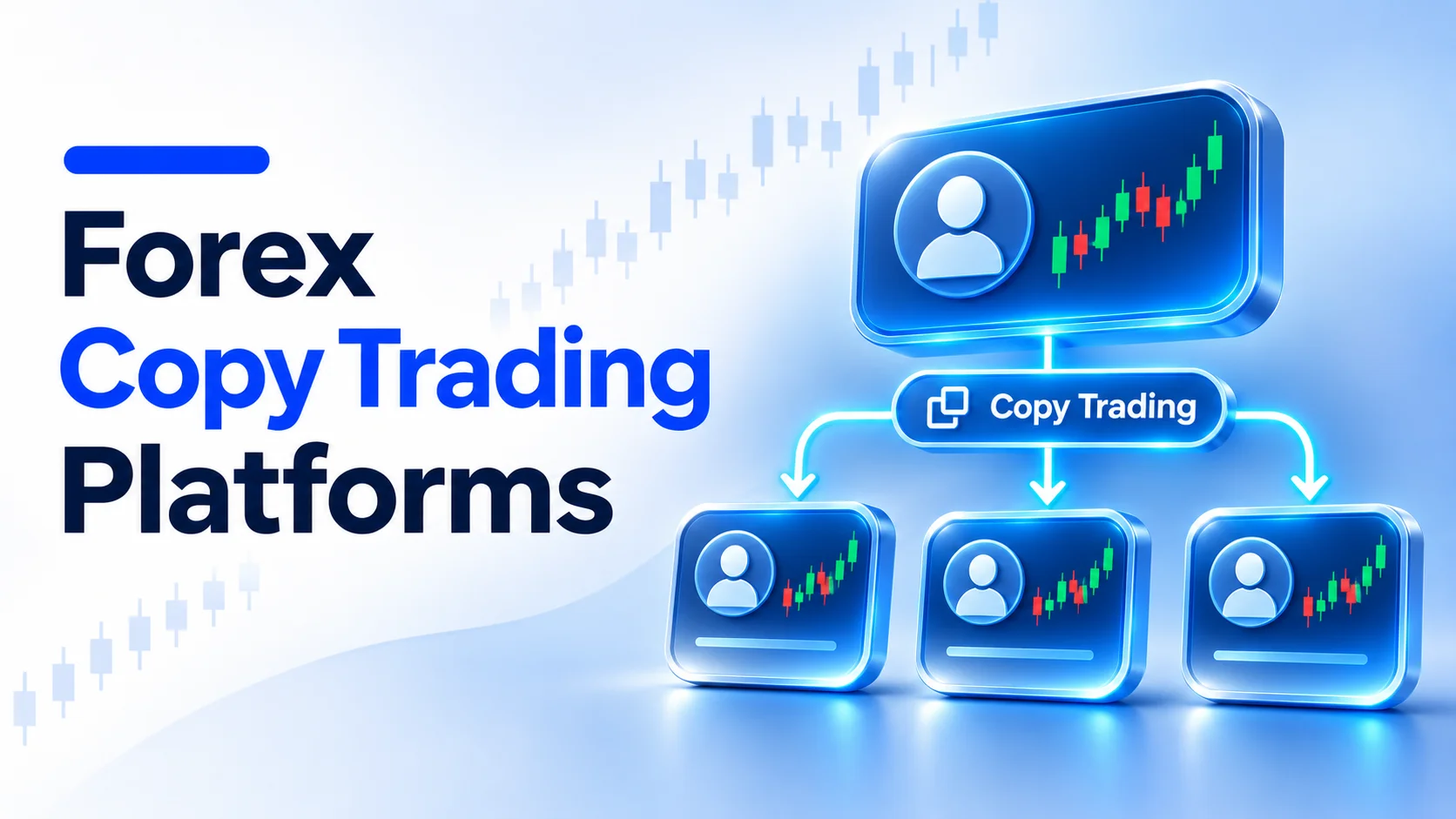
For US residents looking to automatically copy another trader's forex positions, none of the widely promoted services reviewed here is a confirmed, ready-to-use US retail spot-forex copy-trading recommendation. eToro's US CopyTrader is available to eligible customers, but it copies stocks, exchange-traded funds (ETFs) and cryptoassets, not spot forex. cTrader does not support US residents. MetaTrader Signals has forex-copying technology, but access through a US broker and compliance with that account's trading rules have not been established for a specific live subscription. ZuluTrade needs the same broker-by-broker eligibility check.
That is the key difference between forex copy trading platforms and the best forex brokers for copy trading advertised internationally. A platform can demonstrate automatic copying without providing a lawful, compatible route for a particular US customer. This comparison looks at who can use each service, how copying works, what it costs, which controls are real, and where performance claims fall short. It is an eligibility-first comparison, not a ranking based on untested profits or simulated execution.
Forex copy trading platforms: US eligibility first
The feature and product distinctions below are based on the US eToro product page, cTrader's US restriction notice, MetaQuotes Signals rules and ZuluTrade's account-linking conditions. A software feature is not proof that a US retail forex account can use it. The status reflects public documentation reviewed on 7 November 2026, not an individually approved account.
| Platform | Product actually copied | US retail status | Key costs | Main control or restriction |
|---|---|---|---|---|
| eToro US CopyTrader | Stocks, ETFs and cryptoassets; not retail spot forex | Available to eligible US customers, with state and account restrictions; not a US forex-copy option | No extra CopyTrader service charge; underlying transaction fees can apply; $200 minimum copy allocation | Allocation, stop-copy function and loss threshold; small orders can be omitted |
| MetaTrader Signals (MT4/MT5) | Forex and other symbols supported by the connected broker | Conditional, not verified: MetaTrader accounts exist at US brokers, but US broker approval for a chosen signal and legal account compatibility need written confirmation | Provider-specific signal subscription plus broker spread, any commission, financing and optional hosting | Account equity allocation, slippage tolerance and equity stop; US FIFO and anti-hedging rules matter |
| cTrader Copy | Broker-enabled cTrader strategy instruments, typically forex and CFDs | Not offered to US residents under cTrader's published restriction | Strategy fees can include performance, management and trading-volume components, plus brokerage costs | Equity-based copying; separate copy account; stopping a strategy closes copied positions |
| ZuluTrade | Forex and other instruments offered by a compatible connected broker | US retail forex access not verified; generic worldwide account-linking language is insufficient | Platform may carry no subscription charge, but broker and account-specific charges remain; no uniform all-in rate verified | Per-strategy allocation, copy ratio, take profit, trailing stop and ZuluGuard options |
| FOREX.com Europe + Pelican | Third-party strategy copying through European FOREX.com accounts | Not a verified FOREX.com US offering; the disclosed service is for the European account arrangement | Platform and connected-account terms need to be checked for the relevant European entity | Pelican account and linked eligible broker account required |
For an eligible US customer, eToro is the clearest documented copy-investing route in this list, not the best forex-copy route. For a US resident whose non-negotiable requirement is automated spot-forex copying, the correct conclusion is that the public evidence here does not establish an eligible, turnkey choice. Avoid offshore CFD sign-up paths that present international product access as if it applied to US residents.
eToro US CopyTrader: a genuine copy feature, but not forex
eToro launched CopyTrader for US investors in October 2025. Its US announcement and current US product description identify stocks, ETFs and cryptoassets as the copied products. That excludes treating its global currency-CFD marketing as a US forex account benefit.
Costs and entry: The US CopyTrader page sets a $200 minimum per copied investor and a $1 minimum for each resulting position. CopyTrader adds no separate feature fee. However, normal instrument charges still apply. The US fee schedule lists a 1% fee on crypto purchases and a separate 1% fee on crypto sales. Copying a crypto trader can therefore produce materially higher turnover costs than copying an ETF portfolio. The stock and ETF fee treatment is different, and eligible account fees should be checked in the trade preview.
Controls: US users can choose the investor, set an allocation, add or remove money, stop copying and use a copy-level loss threshold. The service lets users review the copied investor's disclosed holdings and performance. An allocation or stop threshold controls instructions to the platform, not the underlying security's price or the speed of its next executable trade.
Limitations: eToro says CopyTrader is unavailable in New York, Nevada, Hawaii, Puerto Rico and the US Virgin Islands, and may restrict access based on suitability responses. Securities transactions are carried out through eToro USA Securities Inc.; digital-asset transactions use separate eToro entities. Crypto holdings do not acquire SIPC protection by appearing next to securities in the same app. A portfolio may also deviate from its leader because small fractional positions cannot be opened or a particular asset is unavailable. The US CopyTrader guide identifies these product and entity distinctions.
Verdict: Worth examining for eligible US readers who want to copy conventional investment portfolios and accept the underlying market risks. It does not meet a search for automated spot-forex positions.
MetaTrader Signals: forex-copy technology with an unresolved US account gate
MetaQuotes operates a Signals service in MetaTrader 4 and 5. Its published rules describe subscriptions that send a provider's transactions to a follower's trading terminal. The follower chooses the signal independently. MetaQuotes provides the technology, while the connected broker executes the follower's transactions.
There is a real platform foothold in the US: FOREX.com US lists MT4 and MT5 accounts, and OANDA US lists MT4. This confirms that US brokers support MetaTrader software. It does not confirm that a given US account may activate and lawfully follow a particular paid signal. Published account marketing and the generic MetaQuotes terms are not a broker-specific permission letter.
Costs: A selected signal can carry its own subscription charge, paid separately from the broker's trading costs. Add the follower account's spreads, commissions where applicable, rollover, any currency conversion and hosting charges. For context, FOREX.com US distinguishes spread-only and RAW accounts, including RAW pricing at $7 per $100,000 traded under the published schedule. That is a broker-pricing example, not a price for MetaTrader Signals or proof that the service is enabled on RAW accounts. Do not assume that a paid subscription includes trading fees.
Controls: MetaTrader's MT5 subscriber settings describe allocating a share of account funds, limiting tolerated price deviation and stopping copying when equity crosses a chosen threshold. The terminal needs a continuing connection or suitable hosting to mirror signals reliably. A quoted signal provider's fills are not guaranteed in a follower's account.
US compatibility: US retail forex accounts are subject to position-offsetting and first-in, first-out (FIFO) requirements. FOREX.com's US MetaTrader FAQ explains its FIFO handling. A strategy that depends on simultaneous opposing long and short positions in the same pair, different leverage assumptions or unavailable symbols may fail, be altered or not execute as shown. Ask the US contracting broker whether the exact Signals service, strategy and order pattern are permitted before paying a third-party provider.
Verdict: A technically plausible research avenue for experienced US forex traders, but not an independently verified US copy-trading product. A broker offering MetaTrader alone is not sufficient evidence to recommend copying.
cTrader Copy: detailed fee controls, no US-resident access
cTrader Copy links a provider's trading strategy to a separate follower copy account and calculates volumes based on the ratio of their equity. Its technical explanation covers automatic position adjustment and missed trades when a follower lacks the required instrument or margin. The important eligibility fact comes first: cTrader explicitly says US residents are not supported.
For eligible non-US users, cTrader's strategy fee rules permit up to 40% performance fee calculated with a high-water mark, up to 10% annual management fee and up to $10 per $1 million of copied volume per side. These are published maximums, not the price of every strategy. Some strategies are free, and broker spreads or commissions are additional. Strategy-specific charges appear before copying starts.
Copy accounts cannot place their own manual trades. Ending a copied strategy closes its open copied positions, and the closing trades can incur execution costs or crystallize losses. cTrader's FAQ also warns that a strategy's stop-loss and take-profit orders are not copied as independent orders; instead, the provider's closing action is mirrored. That difference matters if the provider is disconnected or the follower has different margin conditions.
Verdict: A useful comparison benchmark for transparent fees and copy-account mechanics outside the US. It is not an eligible workaround for US residents, regardless of which international broker advertises cTrader Copy.
ZuluTrade: broker-agnostic design does not settle US eligibility
ZuluTrade connects strategy leaders and followers and advertises forex and other instruments. The service overview describes integrated and externally linked brokerage accounts. Its pricing FAQ says users need not pay a ZuluTrade platform subscription charge under its displayed model, but also makes broker connection subject to geographic restrictions. That cannot be read as confirmation of US retail spot-forex service.
Controls: ZuluTrade's user guide describes investment amount, copy ratio, strategy take-profit amounts and trailing stops. ZuluGuard provides a strategy-level monitoring and exit mechanism. A protective rule may close open trades, but a rapid market move can produce a worse exit than the threshold suggests.
Costs: The actual spread, broker commission, overnight financing and any connection-specific commercial terms depend on the selected account. “No subscription fee” is not the same as “free trading.” A pricing comparison requires a US-eligible broker that explicitly supports the service, the relevant legal entity and a written account fee schedule. We have not verified that combination. The platform's non-US regulatory wording should not be mistaken for CFTC or NFA authorization.
Verdict: Review only as an international copy-trading platform until an eligible US broker and actual order-copying access are independently confirmed. Do not fund an overseas CFD account solely to bypass a US restriction.
Why the FOREX.com Europe copy offer and generic trade copiers do not solve the US question
FOREX.com's Ireland and Europe copy-trading FAQ describes Pelican Exchange Europe as the third-party provider for European accounts. The fact that FOREX.com also operates in the US does not transfer that service to GAIN Capital Group LLC's US customer accounts. Availability must be established for the precise contracting entity, not the parent brand.
Likewise, software sold as a “trade copier” may simply relay orders between accounts that a customer already controls. That differs from choosing a public strategy leader and automatically reproducing that person's trades. Proprietary-trading evaluation accounts, crypto exchange bots and third-party forex CFD copy systems may have different permissions, fee structures and legal relationships. Do not combine their performance rankings as though they were like-for-like US retail forex products.
For related background, the FXRanking cTrader broker comparison describes international platform options. Its international broker descriptions should not be read as evidence of US eligibility. The eToro review also needs to be read alongside the distinct US CopyTrader product terms.
Calculate the real cost of copying a forex strategy
A strategy's gross return is not the follower's net return. The follower pays for fills at their own broker, may miss an order or enter at a different price, and may face separate signal or strategy-provider fees. Compare a one-month trade history and use actual notional size, holding period, account currency and entity terms.
| Cost | What to measure | Why it matters |
|---|---|---|
| Spread and slippage | Entry and exit bid-ask spreads; difference between provider and follower fill | High turnover magnifies small price gaps |
| Broker commission | Charge per side, per lot or per traded notional on the exact account | Raw spreads may still have a higher all-in cost |
| Signal or strategy fee | Subscription, high-water-mark profit share, annual management or per-volume fee | A positive gross strategy result may become negative after fees |
| Overnight and conversion | Rollover credits or debits, financing, account-currency exchange | Holding period and account currency affect realized returns |
| Infrastructure and exits | Connection or VPS charge, spread on forced close, missed trades | Copying reliability and exit behavior have an economic cost |
Illustrative calculation, not a measured provider result: On a standard EUR/USD lot of 100,000 units, one pip is roughly $10 when the account's profit currency is USD. A 1.2-pip full bid-ask spread therefore represents about $12. Add any broker commission and copier or strategy fee. If a follower's execution differs by another 0.4 pip in total, that is roughly $4 more. Do not apply the example unchanged to non-USD quote currencies, smaller lots or pairs with different pip values.
A performance fee deserves separate scrutiny. For example, a 20% fee on a $100 net gain before strategy fees would reduce that gain by $20 if the agreed high-water-mark calculation and other conditions apply. A high-water mark can limit repeated fees on a recovery, but it does not protect the initial capital from market losses. A monthly charge on portfolio equity applies even during a flat or losing period.
Controls that matter more than the copy button
Before comparing screenshots of winning leaders, identify which safeguards the actual follower account supports:
- Position sizing: Set a fixed allocation and check whether each trade scales by equity, fixed lot or a copy ratio. Reject a provider whose usual lot size would exceed your margin capacity.
- Maximum exposure: Check aggregate exposure to EUR/USD, correlated USD pairs and multiple strategies. Two different leaders can open nearly identical risk.
- Loss and drawdown threshold: Understand whether the control stops new copying, closes open positions or both. A triggered exit can slip.
- Stop and take-profit behavior: Establish whether the follower stores broker-side protective orders or only waits for the leader's closing signal. The difference is material during outages.
- Pause, stop and unwind: Confirm what happens to existing positions when a leader disappears, changes instruments or a subscription ends. Some systems close positions immediately, potentially realizing losses and fees.
- Account compatibility: Test symbol mappings, minimum lots, leverage, margin, short-sale rules and US FIFO handling. A simulated copy that breaks an order rule is not proof of live suitability.
No single control guarantees a defined maximum loss. Platform automation, execution at the brokerage and risk limits operate at different points in the workflow. A limit that blocks new entries cannot undo slippage on positions already open.
How to read copy-trader performance without mistaking it for a forecast
Start with the underlying account record and the strategy's risk taken, not its headline return or follower count. A one-month gain earned with extreme leverage is not comparable with a three-year track record that has survived adverse market conditions. Different platforms calculate return on different bases, so their leaderboards are not standardized investment results.
- Look for a continuous, dated history with deposits, withdrawals and open trades separated from realized profit.
- Check maximum equity drawdown, not only closed-trade drawdown. Hidden floating losses can make an apparently high win rate misleading.
- Compare leverage, average position size, maximum simultaneous trades, overnight exposure and concentration by currency pair.
- Calculate net performance using your own likely spreads, fees, slippage and account size; a leader's execution is not your execution.
- Inspect months with adverse moves and any strategy changes. A new leader can have a compelling return from a statistically short or unusually favorable sample.
- Check what happens if the provider stops trading, withdraws funds or is removed from the system. Closed positions and subscription refunds differ by platform.
MetaQuotes' Signals rules explicitly warn that copied results can differ because of trading conditions and communication failure. cTrader's copying documentation separately details missed orders caused by unavailable instruments, margin and minimum-volume constraints. That is why historical results remain evidence of prior trading activity, not verified follower profitability.
A US trader's eligibility and due-diligence checklist
Before paying a service or linking an account, confirm the contracting broker and whether it is authorized to offer retail forex in the US. Use the NFA BASIC registration and disciplinary database to check the firm and any relevant people. The matching legal name and current registration matter more than a generic “regulated” badge. Verify whether a strategy manager or adviser claims a regulated service and what registrations or exemptions apply to its actual activity.
Request a written answer from the US broker to these specific questions:
- Is this exact copy platform or signal subscription permitted on this legal entity and account type?
- Can the strategy place, offset and close its specific positions under US FIFO and anti-hedging requirements?
- Does the system support the same symbols, lot sizes, order instructions and account leverage as the leader?
- What are the account spreads, commissions, rollover charges, third-party fees, cancellation terms and any hosting costs?
- What happens to open positions if the leader stops, the connection drops or the service is terminated?
If the broker cannot answer the first question clearly, do not infer permission from a downloaded MT4 or MT5 terminal, an app-store listing or a platform's international terms. Never provide a strategy leader with your brokerage password or bypass account residency checks. If you want exposure to currency markets without automatic copying, a properly authorized US forex account with manual execution and explicit position sizing is a different product and can be assessed on its own terms.
Which copy trading platform fits the requirement?
For US stocks and ETFs: eToro US has documented CopyTrader access for eligible residents, subject to state, account and product restrictions. Its $200 allocation floor and lack of a separate copying fee make the pricing understandable, but market risk remains. It is not spot forex copying.
For US retail spot forex: This review found no confirmed turnkey winner among eToro, MetaTrader Signals, cTrader Copy, ZuluTrade and the European FOREX.com Pelican service. MetaTrader is worth investigating only after the US broker confirms specific signal permission. cTrader is explicitly unavailable to US residents; ZuluTrade's international compatibility claims do not resolve US eligibility. Do not substitute a non-US CFD product for the service you actually intended to use.
For eligible non-US forex and CFD traders: cTrader Copy provides comparatively explicit fee types and position mechanics. ZuluTrade offers flexible leader and strategy controls, but the selected licensed broker, country and account schedule decide the real suitability. Both still require comparison of follower net returns, total costs and exit behavior.
A safer selection process begins with an eligible contracting entity, moves to the copier's exact order rules and total costs, and evaluates historic performance last. No copy service removes execution risk or turns another trader's past returns into a guarantee.
FAQs
Is forex copy trading legal and available in the United States?
US availability depends on the exact brokerage, contracting entity, service and strategy. The international platforms compared here do not establish a ready-to-use US spot-forex copy service. Confirm permissions with the US broker and review its NFA BASIC entry before linking an account. A broker offering MetaTrader software alone is not proof that every paid signal is authorized.
Can US residents copy forex traders on eToro?
No, eToro US CopyTrader is for eligible stocks, ETFs and cryptoassets, not spot forex. The feature is not available in every US state and may be restricted by account suitability. Its $200 minimum copy allocation is not a forex account minimum.
Can US traders use cTrader Copy?
cTrader states that its services are not offered to US residents. Its international cTrader Copy strategy fees and broker listings do not override that restriction. Do not use a foreign residence or offshore CFD account as a workaround.
Does MetaTrader Signals work with FOREX.com or OANDA US?
Both brokers publish US MetaTrader account support, but that does not verify permission for any particular Signals subscription. The broker must confirm availability and strategy compatibility in writing, including FIFO, offsetting, symbol mapping and platform connection rules. Subscription fees and broker execution costs are separate.
How much does forex copy trading cost?
The full price combines broker spreads, commissions, rollover, slippage, any provider subscription, performance or management fee, and possible hosting charges. eToro US charges no extra CopyTrader feature fee but its underlying asset fees still apply. cTrader Copy publishes strategy fee ceilings, which do not mean that every strategy charges those amounts.
What happens when a copied strategy hits a stop-loss or is cancelled?
The result depends on the service. Some systems mirror the leader’s exit instead of lodging an independent protective order; others close all copied positions when the user stops copying. Price gaps and disconnections can cause exits away from the intended threshold. Check the exact follower-account rules before using live funds.
Are copy-trader performance rankings reliable?
They can describe historic activity, but they do not predict follower returns. Review the full dated equity record, floating losses, leverage, strategy changes and your likely net costs. The follower may enter later, pay different spreads or fail to copy a trade.

Stephen Bennet
Stephen Bennet is a Forex reviewer and financial analyst with more than 25 years of experience in the financial markets. He specializes in reviewing brokers, evaluating trading platforms, and explaining the Forex market in a clear and practical way. Through independent, trader-focused analysis, Stephen helps readers compare providers, understand key risks, and choose platforms with greater confidence.