



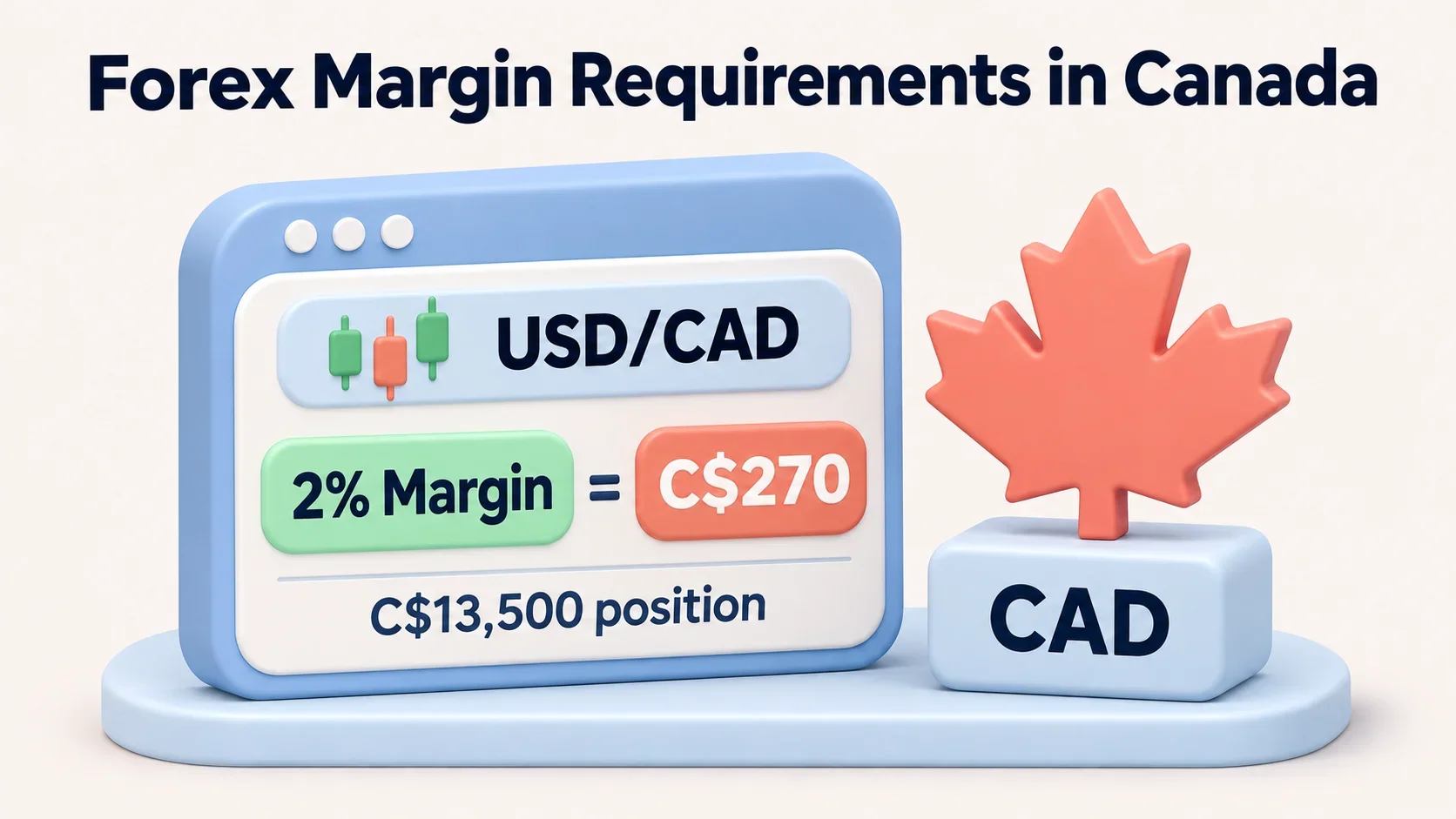
Forex margin requirements in Canada are the collateral a trader must maintain to open and hold a leveraged currency position. There is no single percentage that applies to every Canadian forex trade. The amount depends on the currency pair, the type of product, the Canadian dealer, the account's base currency, position size and the applicable margin rules.
For a concrete example, the Canadian margin schedules published by OANDA and FOREX.com show 2% for USD/CAD in relevant CAD-based forex accounts, equivalent to 50:1 maximum leverage for that instrument under a flat margin rate. That is not a universal Canadian leverage allowance. Other currency pairs carry higher requirements, and the amount displayed when an order is placed can differ from a simple published table.
How forex margin requirements work in Canada
When a dealer quotes a 5% margin rate, a trader generally needs collateral equal to 5% of the relevant position value. The trade is still exposed to price movements on the full position—not just the collateral. A 5% requirement is equivalent to 20:1 leverage; a 2% requirement is equivalent to 50:1. Neither ratio prevents the loss of account equity.
CIRO's risk-margin schedule versus a dealer's margin requirement
The Canadian Investment Regulatory Organization (CIRO) publishes foreign-exchange spot risk-margin schedules for Canadian- and US-base-currency accounts. Under the relevant dealer rules, these rates are used when calculating margin on specified unhedged foreign-exchange exposures. The schedule can be revised following currency-volatility changes; the publicly listed release dated 8 August 2025 took effect on 13 August 2025.
That schedule is a regulatory input, not a promise that every Canadian dealer will offer identical retail forex or CFD leverage. Dealers may require more collateral, apply position-size tiers or use different platform calculations. Other derivatives and non-leveraged currency exchange products also have different funding and risk mechanics. Start by establishing exactly which product the Canadian entity is offering.
Initial margin, maintenance margin and available funds
Initial margin is the collateral necessary to open a trade. Ongoing or maintenance margin is what must remain available while it is open, according to the account agreement. Equity includes the account value after unrealised gains or losses; free margin is broadly equity remaining after used margin, subject to the dealer's calculation. When equity falls relative to required margin, the dealer may restrict new trades or liquidate existing positions.
Canadian dealer terms are not interchangeable. FOREX.com Canada, for example, says its positions must remain fully margined and describes automatic liquidation where equity no longer satisfies its requirement. Another dealer or platform may calculate or sequence liquidation differently. Do not assume a separate UK retail CFD close-out threshold or a US forex margin rule applies to a Canadian account.
Canadian forex margin examples
The following examples are taken from Canadian-facing dealer materials reviewed on 13 November 2026. They describe different account and platform conditions, not a ranking, guaranteed live dealing terms or proof of eligibility in every province.
| Canadian dealer and product scope | Example or method | Practical strength for checking margin | Important limitation |
|---|---|---|---|
| OANDA (Canada) Corporation ULC; Canadian leveraged forex/forex CFDs | USD/CAD: 2% in its CAD-account instrument schedule (50:1 equivalent) | Publishes instrument margin information and shows margin used in supported OANDA order tickets | Instrument rates and platform/sub-account calculations differ; OANDA says it does not accept Alberta account applications |
| GAIN Capital – FOREX.com Canada Ltd.; FX products in CAD-based accounts | USD/CAD: 2%; EUR/USD: 5% on its Canadian margin table | Separate CAD- and USD-account tables allow a trader to check the relevant account base currency | Its EUR/USD figure for a USD-based account is 3%, not the same as CAD-based; larger trade tiers and MetaTrader requirements can change live collateral |
| CMC Markets Canada Inc.; Canadian forex CFDs | Tiered margin is visible by instrument and position size in Product Overview and on the order ticket | Allows inspection of the current trade-size-dependent requirement rather than relying on a generic ratio | A fixed pair-specific percentage was not independently established for this table; its CFD offer in Alberta is restricted to accredited investors |
Read the OANDA Canada margin information, FOREX.com Canada margin table and CMC Markets Canada forex FAQ for the respective methods. CIRO's dealer directory identifies the Canadian firms, but dealer listing alone does not verify an individual resident's province, account classification, product permission or onboarding outcome. These are examples for understanding margin—not broker recommendations.
How to calculate the margin needed for a Canadian forex trade
For a simple flat-rate trade, required margin = position value in the account currency × margin rate. When the trade is denominated in a different currency, convert the relevant notional value into the account currency using the dealer's applicable rate. Position tiers, hedges, instrument-specific rules and ongoing repricing can change the actual amount.
Worked example: USD/CAD with a CAD trading account
Suppose a Canadian trader plans to buy US$10,000 of USD/CAD with a CAD-based account. For the illustration only, assume the conversion rate is USD/CAD 1.3500, the margin rate is a constant 2%, and the dealer uses this converted notional for the margin calculation. There are no other positions or charges in this example.
| Calculation | Illustrative amount | Why it matters |
|---|---|---|
| Position size | US$10,000 | Full currency exposure, not the cash margin |
| Convert position value to CAD | C$13,500 | US$10,000 × 1.3500 CAD per USD |
| Opening margin at 2% | C$270 | C$13,500 × 0.02 |
| Starting account equity | C$1,200 | Hypothetical funds, not a dealer minimum deposit |
| Free margin immediately after opening | C$930 | C$1,200 − C$270, ignoring fees |
| Margin level immediately after opening | About 444% | C$1,200 ÷ C$270 × 100 |
At the same C$13,500 notional, a hypothetical 5% rate would require C$675 rather than C$270. The dealer's actual calculation may use a different valuation convention or live conversion and can change while the position remains open. Margin is not the maximum possible loss: market exposure is still based on the full position and losses can continue beyond the initially set-aside collateral.
Why the account's base currency matters
FOREX.com Canada's tables show EUR/USD at 5% for CAD-based accounts and 3% for USD-based accounts in the published schedule. This is a clear reason not to copy a margin percentage from another account or another branch of the same brand. Compare the quoted rate and the required collateral in your own account currency, not only the headline leverage ratio.
For calculations involving additional currency conversions, FXRanking's forex margin and leverage calculator can help estimate opening collateral. It is not linked to a dealer's live risk engine and cannot authorize a position.
Margin level, margin calls and forced liquidation
A common monitoring formula is margin level (%) = account equity ÷ used margin × 100. In the C$1,200-equity example above, C$270 of used margin gives roughly 444%. If an adverse price move produces a C$500 unrealised loss and used margin remains C$270, equity would fall to C$700 and the margin level to about 259%. This is a simplified illustration: live margin, currency conversions, spreads and financing can all move during the trade.
A falling percentage tells a trader the collateral buffer is narrowing; it does not by itself reveal a universal Canadian liquidation threshold. For example, FOREX.com Canada's margin explanation warns that trades can be closed if the account reaches its margin close-out level, without requiring an advance warning. Its requirements also describe maintaining full margin. Traders should establish the exact trigger, account grouping, order of liquidation and slippage terms for their own platform.
An ordinary stop-loss can help define an intended exit but may fill at a worse price during a gap or thin market. Depositing more collateral after a margin warning is not a dependable emergency plan when prices are moving rapidly. See FXRanking's broader forex leverage and margin guide for the relationship between position sizing and losses.
Canadian regulation and province-specific eligibility
The Canadian Securities Administrators explain that forex trading is generally regulated as a security or derivative depending on provincial legislation. A firm offering relevant forex services must have the appropriate registration for the province and be a CIRO member. Checking the dealer's national identity does not replace checking provincial permissions, client category or the precise contract being offered.
| Where the client lives | What can change | What to verify before using a margin quote |
|---|---|---|
| Ontario | Provincial registration and permitted derivative products | CSA registration entry for the actual legal firm, product and account category |
| Québec | Relevant derivatives-dealer requirements and French-language/contract documentation | Regulator record, product and dealer agreement for Québec residents |
| Alberta | Important provider restrictions: OANDA Canada declines Alberta applications; CMC Markets Canada limits CFD access to accredited investors | Written eligibility confirmation rather than a national broker page or leverage table |
| Other provinces and territories | Registration, suitability and product conditions can still vary | Same firm-and-province registration check plus current contract and margin terms |
To check a provider, start with CIRO's dealer directory, then search the CSA National Registration Search for the contracting firm's registration in your province. Match that firm to the legal entity printed on the account agreement. A CIRO directory listing is evidence of dealer status, not a standing recommendation or proof of account approval. Québec- or Alberta-specific documentation should take precedence over generic global marketing.
Margin is collateral, not the full cost of trading
The opening margin amount is generally not a spread or commission paid to the broker. It is collateral assigned to support the open exposure. A trade can still incur a bid/ask spread, per-trade commission under a particular account plan, currency-conversion charges, overnight financing and adverse execution.
- Spread and commissions: compare the same pair, position size, account type and market hour. A lower opening margin does not prove a cheaper all-in trade.
- Overnight financing: rolling a leveraged forex CFD past the relevant cut-off may create a charge or credit. For example, CMC Markets Canada's forex FAQ describes its tom-next holding-rate mechanism and pair-specific three-day financing conventions.
- Conversion: translating position value, profit or loss between USD and CAD can change required margin and actual costs.
- Size tiers: some dealer platforms increase margin on larger exposures or apply special rules to correlated or hedged positions.
- Funding and withdrawal: deposits do not remove market risk; check accepted payment methods, withdrawal charges and settlement times in the actual Canadian client agreement.
The right comparison is therefore the total exposure, live margin, full round-trip dealing cost and worst-case loss risk, not leverage in isolation. FXRanking's Canada broker comparison examines provincial and entity checks separately from the arithmetic explained here.
Checklist before placing a leveraged forex trade in Canada
- Identify the product. Confirm leveraged OTC forex or forex CFD terms rather than assuming physical currency conversion, futures and CFDs share a margin rule.
- Identify the contracting firm. Verify its CIRO listing, provincial registration, and the exact resident and retail-client eligibility of the account.
- Open the current instrument details. Check the pair, base currency, margin percentage, step tiers, and whether the platform recalculates margin daily or in real time.
- Convert notional exposure correctly. Use the provider's displayed currency-conversion convention and check the order ticket before confirming.
- Inspect the liquidation terms. Note the close-out trigger, whether warnings are sent, how open trades are selected and how the broker treats price gaps.
- Add all costs. Include spread, both sides of commission when applicable, overnight funding, conversion and possible execution slippage.
- Size for losses, not maximum leverage. Keep a buffer above required margin and remember that an ordinary stop cannot guarantee an exit price.
What Canadian traders should remember
For Canadian forex margin requirements, the most useful number is the actual current collateral amount for the exact pair, account currency and position size. CIRO's schedule is an important starting point, but Canadian dealer calculations and provincial eligibility determine whether a trader can use an account and what margin applies. Start with registration and product checks, then calculate exposure in the account currency, and finally examine the ongoing liquidation and total-cost rules.
Risk warning: Leveraged forex and CFDs are high-risk products. A small currency-price move can cause a large loss relative to posted margin. Rates can rise, spreads can widen, stops can slip and positions can be liquidated quickly. Losses may exceed initial margin and, depending on the contract, can extend beyond the amount originally deposited. CIRO membership and Canadian Investor Protection Fund coverage do not compensate for ordinary trading losses. Trade only if the product and potential loss are understood and affordable.
FAQs
What are forex margin requirements in Canada?
They are the funds a Canadian dealer requires to open and maintain a leveraged forex position. The rate depends on the currency pair, account currency, position size, product and dealer rules, and it can change.
What is the maximum forex leverage in Canada?
There is not one universal leverage ratio for every product and currency pair. For example, Canadian dealer margin tables show 2% for USD/CAD in certain CAD-based accounts, mathematically equivalent to 50:1. Other pairs and account arrangements can require more margin. Confirm your own dealer’s current quote.
How much margin do I need for a USD/CAD trade?
As a simplified illustration, a US$10,000 position at USD/CAD 1.3500 is worth C$13,500. At a 2% flat margin rate, the estimated opening requirement is C$270. The live order ticket may differ because of conversions, tiers and repricing.
Does CIRO set the same forex margin for every Canadian broker?
No. CIRO publishes relevant FX spot risk-margin schedules, but a dealer can impose stricter or instrument-specific requirements and different platforms may calculate ongoing margin differently. Verify the current terms for the exact Canadian entity and account.
Can I trade forex on margin in Alberta?
Do not assume an advertised Canadian account is open to Alberta residents. OANDA Canada currently says it does not accept Alberta applications, while CMC Markets Canada restricts its CFD offer there to accredited investors. Check the actual dealer and provincial permissions for the intended product.
Is forex margin a fee, and can I lose more than the margin?
Margin is collateral, not the broker’s dealing fee. Spreads, commissions and overnight financing may apply separately. Because profit and loss reflect the full leveraged position, losses can exceed the margin initially set aside; further liability depends on the contract and protections applicable to that client.
What is the difference between forex margin and margin level?
Required margin is the amount allocated as collateral. Margin level is a monitoring ratio, usually account equity divided by used margin multiplied by 100. A falling margin level means a thinner buffer, but the liquidation threshold depends on the dealer and platform.

Nathan Wong