Use this forex margin and leverage calculator to estimate the collateral required to open a currency position, or work backward from a chosen collateral amount to the implied leverage. Enter the currency pair, position size, pair price, account currency and leverage assumption. The two calculation modes answer different questions; neither supplies a broker-approved leverage limit or a live price.
The calculator tries to auto-fill the pair price and third-currency conversion using free dated reference rates from ExchangeRate.fun, with Frankfurter daily rates as a fallback. You can replace the pair price with your broker quote and enter a manual conversion. These feeds are indicative, not broker-executable bid/ask prices. The estimated opening margin is not a stop-loss or a cap on losses.
Forex margin and leverage calculator
Calculate required margin or implied leverage
This calculator requires JavaScript. If scripts are blocked by the website, use the formula and worked examples below.
Calculated estimate
- Instrument and pair price
- Pair-price source and effective date
- Position
- Position value in quote currency
- Conversion to account currency
- Position value in account currency
- Assumed or implied leverage
- Estimated opening margin or chosen collateral
- Equivalent percentage of notional
- Conversion source and effective date
Results are invalidated when inputs change. The calculator does not check broker margin tiers, financing, transaction fees, existing positions, available equity or maintenance-margin thresholds. Compare with the actual order ticket before trading.
How the forex margin formula works
Estimated opening margin = position value in account currency ÷ the entered leverage ratio. For the reverse calculation, implied leverage = position value in account currency ÷ the collateral amount entered. These formulas describe a simple flat-margin model. Actual firms may use a percentage margin schedule, separate tiers and changes for open positions.
First convert the trade size into base-currency units. A conventional FX lot contains 100,000 base-currency units, but contract and order-size conventions depend on the product. Multiply those units by the entered currency-pair price to express the notional value in the quote currency. Then convert into the account currency. The tool labels the factor as the amount of account currency per unit of quote currency, so the direction can be checked.
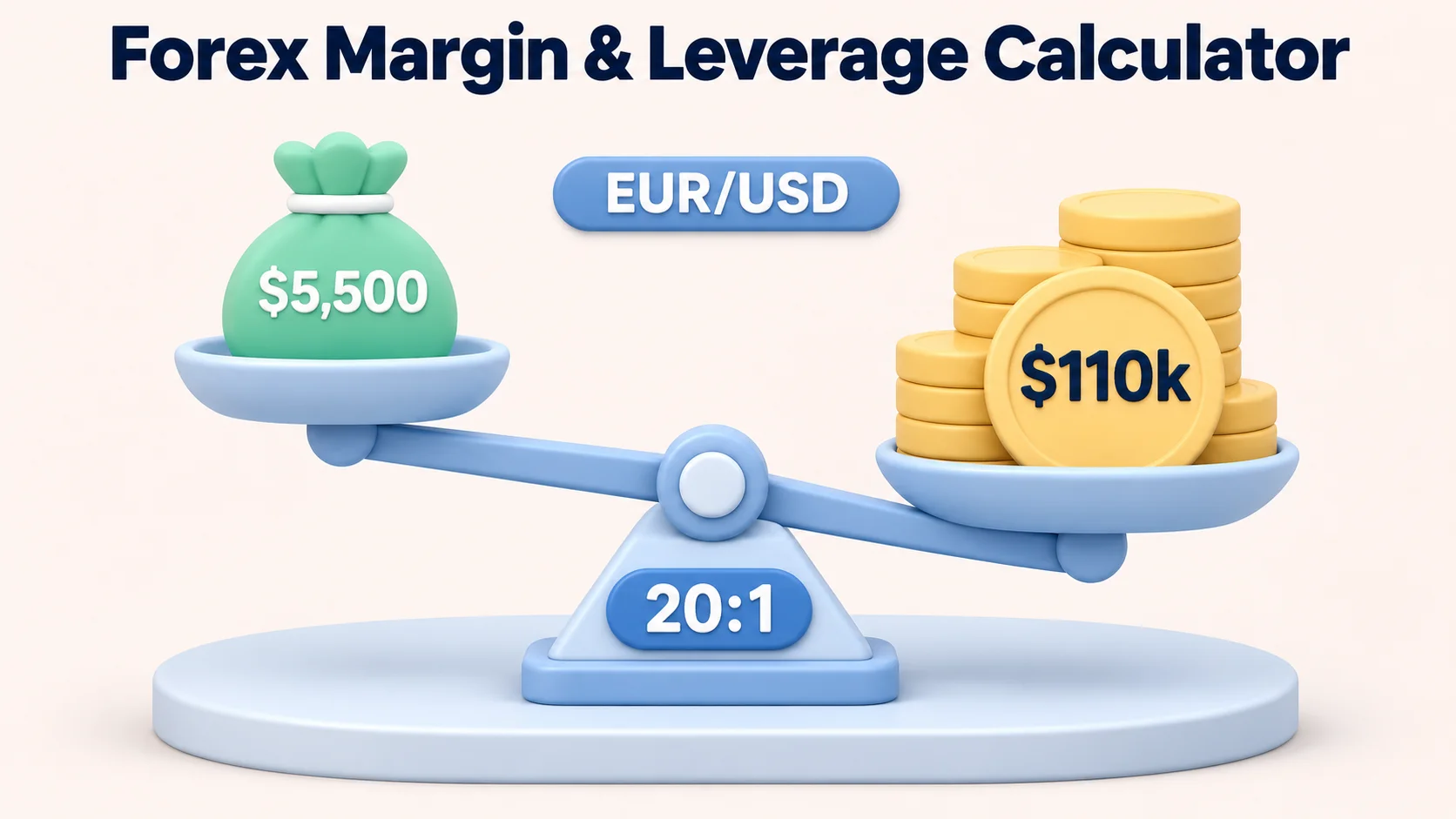
The leverage ratio describes how many units of underlying position value are supported by one unit of opening margin. A position worth $110,000 at 20:1 requires an estimated $5,500, equal to 5% of its notional value. At 50:1, the same exposure requires an estimated $2,200, equal to 2%. These ratios are arithmetic examples, not universally available leverage settings. The USD risk of the same exchange-rate movement is not reduced by increasing the leverage ratio.
Worked examples for three different account conversions
EUR/USD, account in USD
Enter one 100,000-EUR lot, an illustrative EUR/USD price of 1.1000, a USD account and 20:1 leverage. The position is worth $110,000; required initial margin is $5,500. Because USD is the quote and account currency, no second exchange rate is needed. A 1% move in the $110,000 notional value is approximately $1,100 before dealing costs. That is 20% of the opening margin in this static example, not 20% of the trader's entire account.
USD/JPY, account in USD
For 100,000 USD of USD/JPY exposure at a hypothetical 150.00 JPY per USD, the quote-currency notional is ¥15,000,000. The account is USD, the base currency. Dividing by the same entered price produces $100,000 in account-currency notional. At a chosen 25:1 ratio, estimated margin is $4,000. An external JPY-to-USD API rate would be inconsistent with the specific instrument price used in this example, so the tool uses the entered price's reciprocal.
EUR/GBP, account in USD
Consider 0.5 standard lot (50,000 EUR) at an illustrative EUR/GBP price of 0.86 GBP per EUR. The position is worth £43,000. With a separately checked, hypothetical conversion of $1.28 per £1, this is $55,040. At 20:1 leverage, estimated opening margin is $2,752. Selecting automatic conversion would use a potentially different dated free GBP/USD reference rate instead, and the result would change. The manual 1.28 figure is a worked assumption, not a verified current market rate.
How to calculate the leverage implied by a margin budget
Select Implied leverage, given collateral if the question is what ratio a specified position would imply for a given cash amount. In the EUR/USD example, $110,000 of notional exposure divided by a hypothetical $2,500 allocation produces 44:1. The tool also shows the corresponding 2.2727% notional percentage. It does not calculate how much a broker will lend, whether a ratio is permitted where you live, or whether your account's equity supports the trade.
A mathematically valid ratio is not necessarily available under the dealer's product or local rules. The available margin displayed in a real trading account also reflects unrealized profit and loss, other open positions and ongoing requirements. The collateral input in this calculator is not connected to any account.
Why the broker's margin requirement may differ
- Instrument-specific rates: Currency pairs and account types can have different minimum margin rates. A trader cannot pick an unrestricted leverage figure simply because it appears in this calculator.
- Tiered requirements: The margin rate can increase as exposure grows. FOREX.com's US margin guidance distinguishes initial and ongoing margin and describes step margins for larger positions. The simplified model here does not reproduce its product schedule.
- Different conversion practices: Dealers use different currency-conversion rules, including platform prices, bid/ask-side pricing and other account conversion bases. OANDA's US margin explanation distinguishes opening margin from margin closeout and warns that price changes alter the ongoing requirement.
- Existing exposure and equity: Several trades may share the same account equity. Free margin, maintenance margin and liquidation triggers depend on the dealer's account rules, not solely on one position's opening margin.
- Execution and financing: Spread, commission, swaps, gaps and slippage change realized account results. A margin figure is collateral, not a fee charged for holding the trade and not a loss guarantee.
For a fuller explanation of margin closeout, ordinary versus guaranteed stops, and jurisdiction-dependent retail protections, read FXRanking's forex leverage and margin guide. The forex risk-management guide explains why position sizing, stop distance and execution risk must be reviewed separately. This page is a standalone margin/leverage calculation, not a replacement for either risk planning or a pip-value calculator.
What the free exchange-rate sources do and do not cover
The calculator requests ExchangeRate.fun rates first. Its documentation says rates update hourly, but the response supplies only a calendar date, not the precise quote time. If the request fails or the date is unacceptable, it tries Frankfurter daily reference rates. Neither is a live dealer bid/ask stream or a promise of a trading fill, and browser/CMS restrictions can block requests. Weekends and holidays may make an otherwise valid reference several calendar days old. The calculator rejects dates outside its four-day freshness window and gives an error rather than guessing a missing cross-currency conversion.
The source and date appear in the calculator. You may enter a broker-specific pair price or select a manual account-currency conversion; manual prices are not independently validated. When account and quote currencies match, conversion is 1. When the account is the base, conversion is the reciprocal of the entered pair price, keeping the same instrument price consistent. An outdated auto-filled price is rejected until refreshed or manually replaced. The actual broker order ticket controls live opening margin.
What to check before placing a leveraged forex trade
Confirm the precise traded instrument and legal entity, actual lot contract, current pair price, account currency and the broker's current margin table. Check whether the requirement rises with position size and how it is recalculated while the trade stays open. Review free margin against all open positions, along with potential loss in cash at an adverse move and the order's likely execution costs.
In 2026, the most useful role of a leverage calculator is a transparent arithmetic cross-check. A lower margin figure can free account capacity, but it does not make the same position safer. If the calculator and order ticket disagree, follow the applicable broker's binding terms and investigate the conversion basis, market price, leverage cap and position tiers before proceeding.
Risk warning: Leveraged forex trading can produce rapid, substantial losses. Opening margin is not the maximum loss, a protective stop does not always fill at its requested price, and losses may exceed deposited funds depending on the instrument, jurisdiction, legal entity and account agreement. The calculator uses a free dated indicative reference rate or your manually entered price and conversion, plus your leverage or collateral assumptions. It does not verify broker eligibility, live market pricing, margin-closeout levels, financing costs or suitability. Treat the output as an educational estimate, not a live trading instruction.
FAQs
How do you calculate forex margin from leverage?
Convert the currency position into your account currency and divide its notional value by the assumed leverage ratio. For example, $110,000 of EUR/USD exposure at 20:1 calls for approximately $5,500 initial margin in a flat-rate model. Actual broker requirements may be tiered or instrument-specific.
What is the difference between margin and leverage?
Margin is collateral required to support a leveraged position. Leverage is the ratio of position value to the margin supporting it. At 20:1, the basic model allocates 5% of notional value as opening margin. Margin is not a trading fee or a maximum loss.
How is leverage calculated from an amount of collateral?
Divide the position value expressed in the account currency by your chosen collateral allocation. A hypothetical $110,000 position divided by $2,500 produces 44:1. That implied ratio is arithmetic only and may not be available or permitted at the broker.
Does the margin calculator use live exchange rates?
No live broker-dealer quotes are supplied. The calculator attempts to auto-fill the pair price and any necessary cross-currency rate using free indicative ExchangeRate.fun rates, with Frankfurter daily rates as a fallback. It labels the rate date and provider, and allows manual broker-price overrides. Neither feed guarantees executable bid/ask pricing.
How is margin calculated for USD/JPY in a USD account?
If the account currency equals the pair base currency, the calculator converts JPY quote notional back into USD using the reciprocal of the entered USD/JPY price. A 100,000-USD position therefore has $100,000 notional exposure; at 25:1 the basic estimate is $4,000 opening margin.
Why does a broker show a different required margin?
The broker may apply symbol-specific margin percentages, exposure tiers, different position contract specifications or different price and conversion rules. Some margin schedules also change for larger trades or during market stress. The broker order ticket and account agreement control the actual requirement.
Is estimated margin the maximum potential loss?
No. Margin is the collateral supporting a trade, not a stop-loss. An adverse exchange-rate move, widening spread, gaps or slippage can cause losses far beyond opening margin. Whether losses can exceed deposited funds depends on jurisdiction, instrument, legal entity and account terms.

Stephen Bennet
Stephen Bennet is a Forex reviewer and financial analyst with more than 25 years of experience in the financial markets. He specializes in reviewing brokers, evaluating trading platforms, and explaining the Forex market in a clear and practical way. Through independent, trader-focused analysis, Stephen helps readers compare providers, understand key risks, and choose platforms with greater confidence.