Spread betting and contracts for difference (CFDs) are two ways to trade price movements without buying the underlying asset. For a UK retail trader, their market exposure and leverage risks can be almost identical. The decisive differences are how a position is sized, how a provider charges for it, which contracts are available and the tax treatment of the particular activity.
Neither is inherently cheaper or safer. A financial spread bet normally uses a cash stake per point; a CFD uses a number of contracts or units. Both can have bid-offer spreads, overnight financing, dividend adjustments and margin calls. For many private individuals in the UK, ordinary spread-betting winnings are outside capital gains tax, while gains on retail CFDs are generally within the capital gains regime. That distinction is subject to important exceptions and professional review. It does not compensate for a poor trade or high financing costs.
This is a comparison of financial spread betting and CFDs offered to eligible UK clients, not sports betting, direct share ownership or offshore products. The Financial Conduct Authority (FCA) expressly includes financial spread betting within its retail CFD framework, even though a spread bet and a CFD have different commercial and tax features.
Spread Betting vs CFDs: The Main Differences
| Question | Financial spread betting | CFD trading |
|---|---|---|
| How do you size a position? | Choose a stake, such as £2 for each index point. | Choose units, lots or contracts, each with a defined value per price movement. |
| Do you own the asset? | No. It is a derivative on a quoted market. | No. A CFD gives contractual price exposure, not ordinary share or asset ownership. |
| Where do trading costs appear? | Usually in the spread, plus funding and any instrument-specific charges. | Spread and funding; some CFDs, notably share CFDs and certain forex accounts, charge explicit commission. |
| How do UK retail leverage rules compare? | Within the FCA's retail CFD restrictions when within their scope. | Within the same retail restrictions when within their scope. |
| What about tax for a UK individual? | Ordinary personal wagers are normally outside CGT, with losses generally not relievable; commercial circumstances can change treatment. | Retail CFD gains and losses generally enter the capital gains calculation unless treated as trading income or another rule applies. |
| How long can a contract run? | Daily funded and dated or forward bets exist; the specific contract determines expiry and rollover. | Rolling cash CFDs and dated or futures-style CFDs exist; not every CFD is open-ended. |
| Where is it available? | Concentrated in eligible UK-facing accounts and some other permitted markets; never assume access worldwide. | Available in more jurisdictions, but rules, products and account entities vary significantly. |
| What suits it? | A trader who understands the £-per-point ticket and whose UK tax position makes an ordinary spread bet appropriate. | A trader who needs specific unit-based instruments, share-CFD features, compatible software or the relevant CFD contract terms. |
The table is a starting point, not a universal provider schedule. For example, a CFD's minimum contract size can make an apparently similar trade too large for a small account. A spread bet can permit finer control, but only if the provider's permitted minimum stake and market point size allow it.
How Do Spread Bets and CFDs Work?
Financial spread betting: pounds per point
You choose a market, direction and stake. A long bet gains or loses the stake multiplied by the movement between the opening buy price and closing sell price. A short bet works in reverse: you sell first and later buy back. On an index with a £2-per-point stake, a 25-point favourable change in the relevant exit quote changes the trade value by £50. A 25-point adverse change creates a £50 loss.
The provider defines what one point means for each market. One forex point is not necessarily the same as a pip, and index, commodity and share contracts can use different point sizes. The stake entry is therefore not meaningful until you have checked the market information sheet.
CFDs: contracts or units
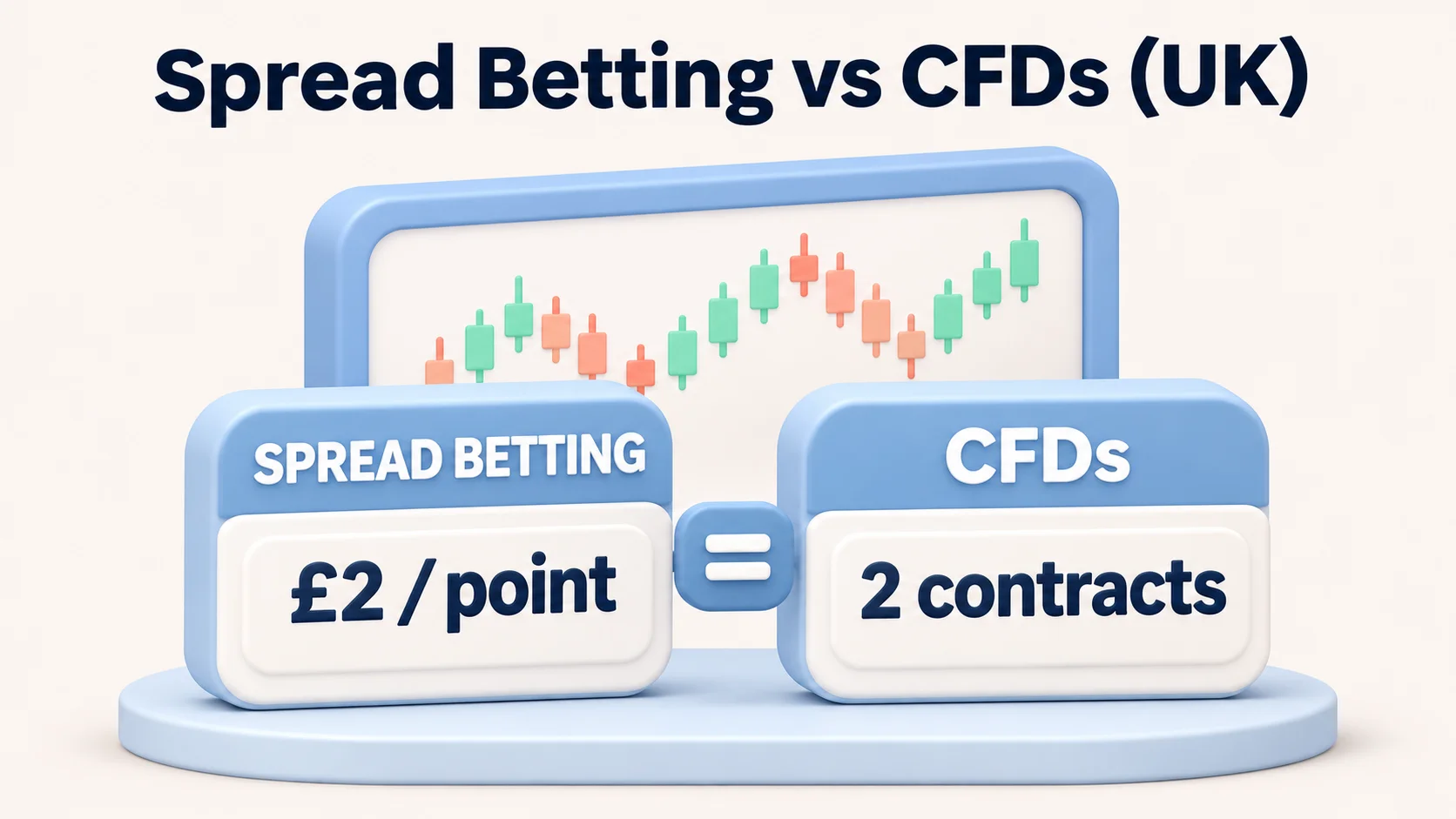
A CFD pays or charges the difference between the contract's opening and closing value, multiplied by the number of units and their price-point value. For an index CFD defined as £1 per index point per contract, two contracts provide the same £2-per-point sensitivity as the spread bet above. But another index, forex lot or share CFD may use a completely different contract multiplier, quote currency or minimum size.
For a share CFD, 100 contracts each corresponding to one share ordinarily track the price change on 100 reference shares, without granting ownership or voting rights. For an FX CFD, the lot specification, base currency, pip value and conversion into account currency determine the actual cash change. Do not use the numerical lot size as a substitute for calculating exposure.
Both products are usually over-the-counter agreements with a provider, not direct trades on the stock exchange. Some share CFDs offer a direct-market-access order interface, but that does not turn the customer's CFD into ordinary ownership of the shares.
Worked Example: The Same UK Index Trade
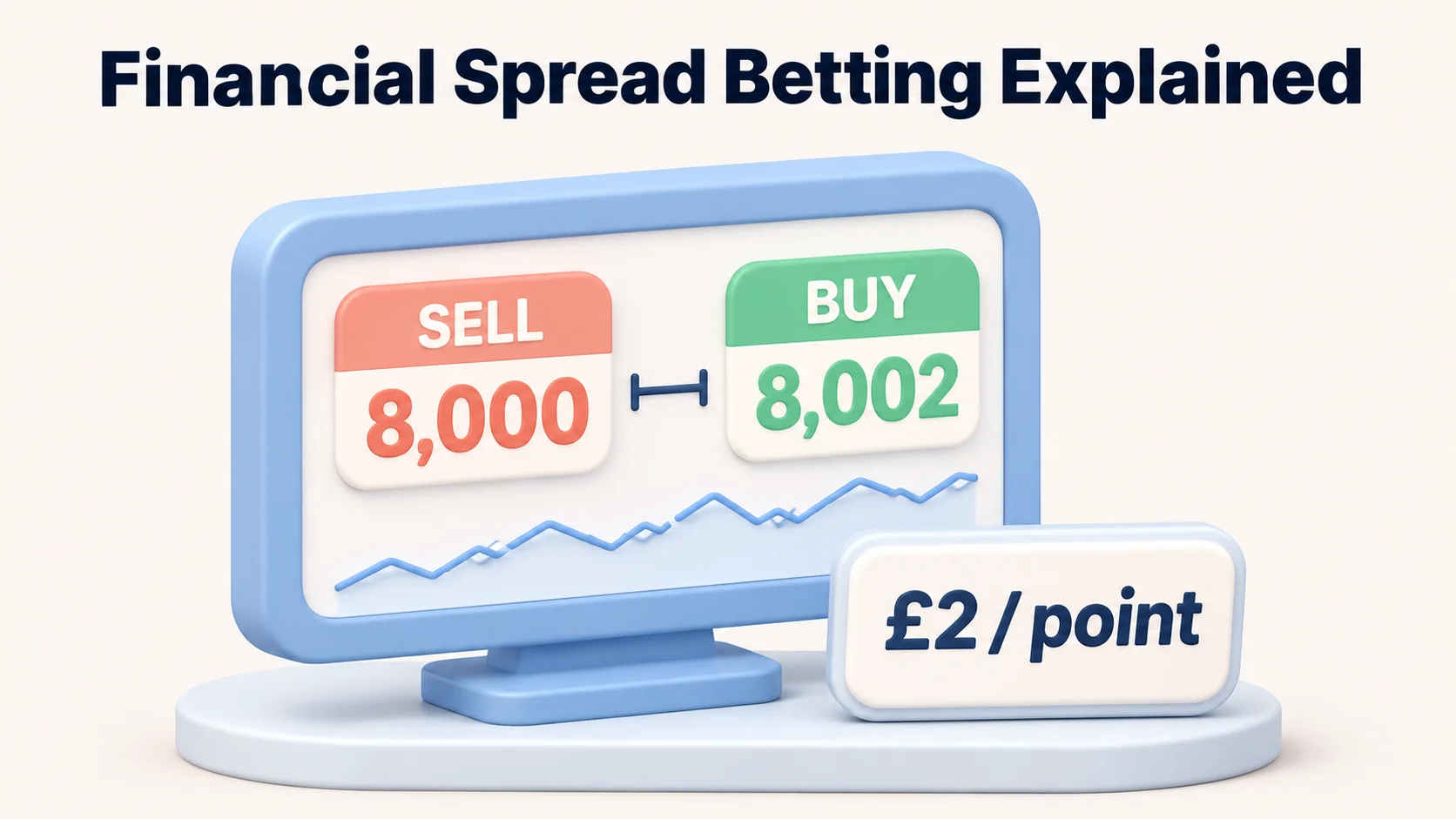
Assume a hypothetical major share index has a sell quote of 8,000 and buy quote of 8,002. The spread is two points. Compare a £2-per-point long financial spread bet with two index CFD contracts, each defined for this example as £1 per point. Both are opened at the buy price of 8,002. Assume identical prices, no separate CFD commission and no overnight holding charges. These are illustrative figures, not a live quote or broker tariff.
| Measure | Spread bet | Index CFDs |
|---|---|---|
| Position size | £2 per index point | 2 contracts × £1 per index point |
| Buy entry | 8,002 | 8,002 |
| Indicative exposure | 8,002 × £2 = £16,004 | 8,002 × 2 × £1 = £16,004 |
| Close immediately at sell 8,000 | (8,000 − 8,002) × £2 = −£4 | (8,000 − 8,002) × 2 × £1 = −£4 |
| Close later at sell 8,052 | (8,052 − 8,002) × £2 = +£100 | (8,052 − 8,002) × 2 × £1 = +£100 |
| Close later at sell 7,952 | (7,952 − 8,002) × £2 = −£100 | (7,952 − 8,002) × 2 × £1 = −£100 |
The £4 immediate-exit loss is the cost of crossing the two-point spread at an unchanged quote. In the later examples, the full entry-to-exit price difference already includes that spread. Do not deduct the same £4 a second time. The eventual net result would then need adjustments for any commission, financing, currency conversion or other applicable fees.
For a major equity index subject to a 20:1 UK retail leverage limit, an illustrative initial margin at 5% of £16,004 would be £800.20, for either position if both contracts are treated alike and the same percentage applies. The £800.20 is collateral, not the maximum possible trading loss from that position before an account-level safeguard operates. The gain or loss follows the full £16,004 exposure. Providers use their own reference prices and account-level conditions when calculating margin.
This comparison shows the key point: a different label or sizing interface does not change the economic risk when the cash sensitivity and exposure are equal. Real quotes, contract multipliers, trading sessions, spreads and account currencies can nevertheless produce different outcomes.
Costs: Spread, Commission and Overnight Financing
The opening spread matters more than a zero-commission label
Spread betting is commonly advertised without a separate dealing commission. That does not mean the trade costs nothing. In the worked example, a two-point spread at £2 per point costs £4 to enter and immediately exit at unchanged market prices. Some CFD products also have spread-only pricing, while others add commission, often for share CFDs or selected low-spread forex accounts.
Consider two purely hypothetical quotes for the same £2-per-point index exposure. Product A has a two-point spread and no commission, giving a £4 immediate round-trip cost. Product B has a one-point spread, giving £2 of spread cost, but charges £5 in combined opening and closing commissions, producing a £7 total. Product B's narrower spread is not cheaper in this example. Neither cost structure is presented as a typical UK index CFD or spread-betting tariff.
Check the spread at the times you trade, not only a displayed minimum. Spreads can widen during news events, thin liquidity and market closures. Some share CFDs charge a percentage commission with a minimum ticket charge; the equivalent spread bet often builds more of the cost into its quoted spread. A fair comparison converts both products to the same monetary sensitivity, underlying, holding period and account currency.
Financing can outweigh the entry spread
Daily funded spread bets and cash CFDs typically have holding charges or credits when positions pass a specified overnight cutoff. A dated forward spread bet or futures-style CFD may instead reflect funding in its forward price, wider spread or rollover terms. Neither label guarantees free financing.
To show the scale, assume £16,000 exposure and an illustrative 8% annualised debit rate. One simple day of funding would be £16,000 × 0.08 ÷ 365 = approximately £3.51; three such days would be about £10.52. This is arithmetic, not a forecast or a provider's fee schedule. Actual funding may use a reference interest rate plus a markup, tom-next rates for forex, different day-count conventions, different long and short rates, or multiple-day weekend adjustments.
Long and short positions held at the same time can each incur charges even if their price exposures largely offset. In its October 2026 review of CFD firms' price and value practices, the FCA specifically highlighted overnight funding disclosure and costs on matched long and short positions as areas of concern. For a multi-day strategy, estimate total carry instead of ranking products by the entry spread alone.
Other adjustments that change the comparison
- Dividend adjustments: cash equity and index positions may receive or pay adjustments when constituents go ex-dividend. These are contractual credits or debits, not ownership of a share or receipt of an ordinary shareholder dividend.
- Currency conversion: a sterling-denominated spread-betting stake can be easier for a GBP account to track, while a CFD may settle in the market's currency and require conversion. Providers differ, and some allow more than one account currency.
- Borrowing and hard-to-borrow fees: short share CFDs or bets can have additional market-specific charges or restrictions.
- Stop orders and guaranteed stops: ordinary stops can slip during gaps; guaranteed-stop protection, where offered, may carry a premium or other eligibility conditions.
- Market data, inactivity, funding and withdrawal fees: these depend on the provider and account, not simply on whether you chose a spread bet or CFD.
Leverage, Margin Calls and UK Retail Protections
The FCA's UK retail measures restrict CFD and financial spread-betting leverage to between 30:1 and 2:1 depending on the underlying market. They also require account-level margin close-out at the specified 50% threshold, negative balance protection for retail clients and a standardised warning showing the firm's percentage of losing retail accounts. These requirements apply within their defined regulatory scope, and the protections are not identical for every offshore or professional account. See the FCA's permanent product restrictions.
Margin close-out is not a promised stop-loss price. A provider may close positions when account equity reaches the rule's trigger, with timing and execution subject to market conditions. Even a planned stop at a particular level can execute worse if prices gap. The FCA's retail negative balance rule protects qualifying clients against losses exceeding the total funds in the relevant CFD account; it does not prevent the loss of that account's balance, and it is not a £800.20 per-position loss cap in the example.
Electing professional status or trading through an overseas entity can change protections. The FCA has warned about firms encouraging retail clients to give up safeguards to access higher leverage. A promise of 200:1 or 500:1 should trigger an entity and eligibility check, not be treated as a better UK retail offer.
Check the contracting firm, authorisation and permitted service using the FCA Firm Checker, then read the actual customer agreement. The Financial Ombudsman Service explains when it may consider spread-betting and CFD complaints, including disputes involving advice, margin and order handling. Complaint eligibility and any FSCS compensation for firm failure are not guarantees of reimbursement for market losses.
UK rules also restrict which underlying assets retail clients may trade. For example, the FCA prohibits the sale of derivatives referencing specified cryptoassets to UK retail consumers. Do not assume a crypto CFD offered by a global brand is available through its UK retail entity.
UK Tax: A Real Difference, Not a Universal Exemption
For many UK individuals placing ordinary financial spread bets as personal wagers, profits are normally outside capital gains tax and the corresponding betting losses are not allowable capital losses. The HMRC Capital Gains Manual on financial spread betting explains that no asset is acquired or disposed of through an ordinary spread bet. Its Business Income Manual likewise says that a taxpayer placing a spread bet is not normally carrying on a trade, so profits are not ordinarily taxed as trading income and losses do not attract relief.
The exception matters. HMRC's spread-betting guidance says the outcome depends on the contract terms and the economic substance. It distinguishes personal wagering from a bet that arises in carrying on a trade. Commercial hedging and company transactions require particular care; HMRC addresses them separately in its guidance on CFDs and spread bets. It is misleading to promise that all spread-betting profits, for all account holders and uses, are tax-free.
For a private investor's ordinary retail CFD, HMRC's CFD guidance generally places realised profits and losses within the capital gains regime, unless they fall under trading income or another applicable rule. Eligible CFD losses may therefore enter the capital gains computation, subject to the applicable conditions and relief restrictions. The calculation can involve financing, dividend-equivalent adjustments and commission as well as the opening and closing price difference. This does not mean a CFD loss creates an automatic cash refund or a deduction from salary.
Neither contract normally involves an actual purchase of the referenced shares by the retail customer, so the usual share-purchase stamp-duty comparison is different from buying shares outright. But stamp duty and capital gains tax are not interchangeable concepts, and other taxes or commercial arrangements can alter the result. Tax residence, personal status, hedging purpose, legal form and changes in law all matter. Obtain an assessment from a qualified UK tax adviser before treating taxation as the reason to choose either product; this guide is general information and has not undergone that independent specialist sign-off.
Which Is Better for Different Traders?
Short-term index or forex speculation
Start with the exact monetary exposure and executable dealing spread. If an index bet and index CFD both give £2 per point on the same quote, their price risk is equivalent. The lower all-in fee, better-suited position increment and relevant platform features matter more than the label. Forex traders should compare pip values, lot sizes and conversion fees carefully rather than assuming one point equals one pip.
Holding positions over several days
Estimate the spread plus expected financing for the actual holding period, including weekend charging conventions. A forward with a larger entry spread may or may not be cheaper than a daily funded position. Look for documented rate formulas and a position cost calculator, but verify those figures on the correct account's deal ticket.
Trading individual shares
Compare a share spread bet's quoted spread and minimum stake with the share CFD's spread, commission minimum, contract size, stock-borrow cost and dividend adjustment rules. Some specialist CFD accounts have share-market order functionality that a spread bet may not. Neither provides voting rights or long-term shareholder ownership.
Using CFDs for a business or hedge
Contract documentation, accounting and tax treatment become more important than the convenience of a £-per-point ticket. A personal wager is not automatically an appropriate substitute for a documented commercial hedge. Get regulated financial and tax advice relevant to the entity and business purpose.
For a UK-facing provider shortlist rather than a product definition, see FXRanking's UK financial spread-betting broker comparison. The related spread-betting demo guide discusses practising with a genuine £-per-point ticket rather than mistaking a generic CFD demo for a spread-betting account. A demo can help with sizing and order-entry mechanics, but does not establish live spreads, slippage or real-money execution performance.
A Practical Decision Checklist
- Confirm eligibility: identify your tax residence, retail or professional classification, actual contracting entity and available product.
- Match risk: convert each product's stake or contract quantity into pounds of profit or loss per point and its full notional exposure.
- Compare all-in charges: model entry and exit spread, commission, three or more days of financing if relevant, conversion and stock-specific costs.
- Read the margin terms: check initial margin, account-level close-out, negative balance protection, trading hours, stops and gap risk.
- Check tax with a specialist: confirm whether this is an ordinary personal wager, an investment CFD or a trade or hedge with different treatment.
- Recheck at the deal ticket: a published minimum spread, market list or promotional leverage figure is not a confirmed executable price or proof of account eligibility.
Bottom line: for a UK retail trader seeking the same exposure, spread betting and CFDs are often closer in risk than their names suggest. Spread betting offers intuitive per-point sizing and a different ordinary-personal-tax position. CFDs can offer different contract increments, platform capabilities and a capital gains computation that may recognise eligible losses. The sensible choice follows documented total cost, position size and personal circumstances, not a promise of tax-free profits or higher leverage.
Risk warning: Financial spread bets and CFDs are complex leveraged products with a high risk of rapid losses. Spreads may widen, prices can gap past stop levels, financing can accumulate and forced margin closures may occur. FCA retail rules and negative balance protection do not prevent losing the funds in a qualifying trading account. Professional and overseas accounts can have different protections. Check the provider's current losing-account percentage and risk notice before trading; neither product guarantees returns. UK tax outcomes depend on individual and commercial circumstances.
FAQs
What is the main difference between spread betting and CFDs?
Spread betting normally uses a cash stake per point; CFDs use a quantity of contracts or units. Both create leveraged price exposure without ownership. UK personal tax treatment and provider fee schedules can differ.
Is spread betting cheaper than CFD trading?
Not necessarily. Compare all-in bid-offer spreads, CFD commission, financing, currency conversion and instrument-specific charges at identical monetary exposure. A zero-commission spread bet is not a zero-cost trade.
Is spread betting tax-free in the UK?
Ordinary personal spread-betting gains are normally outside capital gains tax, and losses are generally not relievable. Commercial activity, hedging, company transactions and other circumstances require professional UK tax review.
Do UK spread bets allow more leverage than CFDs?
Not for products within the FCA retail CFD framework. UK retail leverage is capped between 30:1 and 2:1 depending on the market, with margin close-out and negative balance protection requirements.
Can CFD losses be offset against gains for UK tax purposes?
Eligible losses on ordinary investment CFDs generally enter the capital gains calculation, subject to the applicable claim and relief rules. This is not an automatic tax refund, and trading-income or corporate treatment can differ.
Can a spread-betting loss exceed the opening margin?
Losses on a position can exceed its opening margin. Qualifying FCA retail negative balance protection limits total account losses to the account funds, not to the margin allocated to each trade. Offshore and professional arrangements may differ.
Is a spread-betting account the same as a CFD account?
No. A provider may offer separate accounts, contract specifications, markets, pricing and order tickets. Confirm the exact product, legal entity, retail status and fees rather than assuming features carry across.
Do both spread bets and CFDs charge overnight financing?
Daily funded spread bets and cash CFDs can both apply overnight funding. Dated or forward contracts can incorporate financing in their price or rollover instead. Compare the full holding-period cost.

Amy Baily
Amy Baily is a Forex education writer with over nine years of experience in trading and market analysis. She focuses on risk management, trading psychology, and the importance of maintaining a disciplined approach to the markets.