Financial spread betting is a leveraged way to speculate on a financial market rising or falling without buying the underlying asset. Instead of buying shares or a currency outright, you choose a direction and stake an amount, usually pounds per point, on the change in the provider's quoted price. A 30-point move at £2 per point changes the trade's value by £60, before any further charges. The same calculation works against you when the market moves the wrong way.
The attraction is straightforward position sizing and access to both rising and falling markets. The drawback is that small market movements can produce large losses relative to the cash posted as margin. Financial spread betting is not a simple or low-risk introduction to investing, and it does not confer ownership, voting rights or ordinary shareholder status. This guide covers the UK retail product, not sports betting, and explains the numbers before discussing providers.
What Is Financial Spread Betting?
A financial spread bet is a derivative agreement with a provider to pay or receive the difference between an opening and closing market quote, multiplied by a specified stake per point. Providers offer it on markets such as stock indices, foreign exchange, individual shares and commodities, subject to the account's eligibility and product schedule.
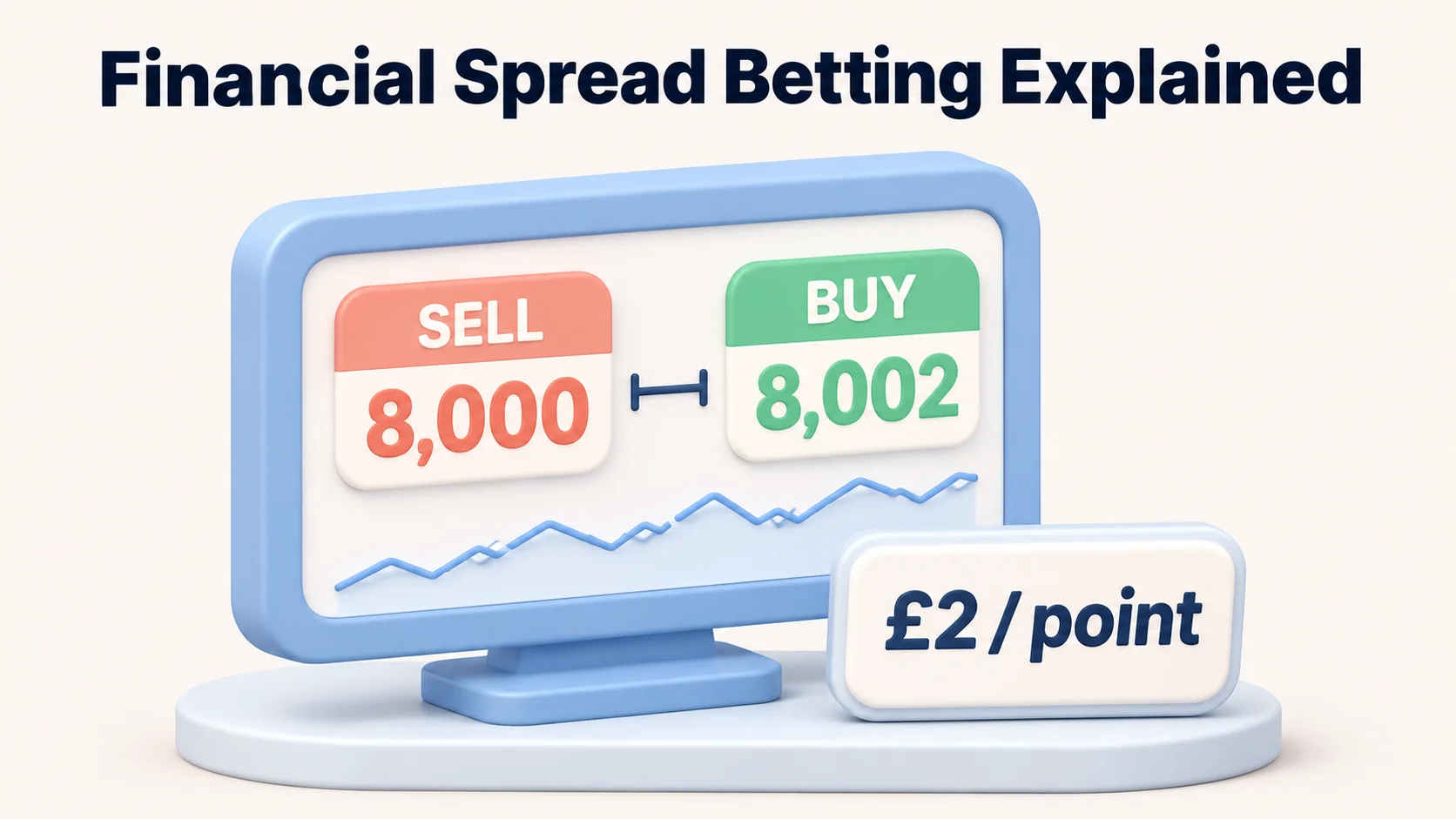
Each quote normally has two prices: the sell (bid) price, where a trader can open a short bet or close a long bet, and the buy (ask) price, where a trader can open a long bet or close a short bet. The gap is the spread. This is a trading cost, even when it does not appear as a separate line-item commission.
For example, a UK index quoted 8,000 sell / 8,002 buy has a two-point spread. At £2 per point, buying at 8,002 and immediately selling at an unchanged 8,000 quote produces a £4 loss. There is no need for the index to fall before the position starts at a loss.
The word betting causes confusion. Sports spread bets concern sporting outcomes, such as a team's points. Financial spread betting concerns prices of financial markets. It also differs from ordinary fixed-odds sports betting, where the stake and potential payout are determined differently. The financial product discussed here falls within the FCA's retail CFD product framework, which expressly includes financial spread betting; do not infer the same rights or mechanics from an unrelated sports product.
How Do Stakes per Point and Profit or Loss Work?
Two decisions matter most: which direction you take and how much each point is worth. A long (buy) spread bet gains when the available closing sell price rises above your entry buy price. A short (sell) bet gains when the closing buy price falls below your entry sell price. The market's quoted point size is instrument-specific, so a point on an index does not necessarily equal a pip on a currency pair.
Long-bet formula: (closing sell price − opening buy price) × pounds per point. Short-bet formula: (opening sell price − closing buy price) × pounds per point. These are gross trading outcomes based on executable quotes, before additional applicable fees or adjustments.
Worked example: a £2-per-point index bet
Assume a purely illustrative UK index quote of 8,000 sell / 8,002 buy. You buy at 8,002 and choose a stake of £2 per point. Later, you close using the provider's sell quote:
| What happens | Closing sell quote | Calculation | Gross result |
|---|---|---|---|
| You close immediately with no quote change. | 8,000 | (8,000 − 8,002) × £2 | −£4 |
| The closing quote moves in your favour. | 8,052 | (8,052 − 8,002) × £2 | +£100 |
| The closing quote moves against you. | 7,952 | (7,952 − 8,002) × £2 | −£100 |
| The adverse move becomes larger. | 7,802 | (7,802 − 8,002) × £2 | −£400 |
These are hypothetical prices, not tested fills or a live market quotation. They already reflect the difference between buying and selling, but they exclude overnight financing, guaranteed-stop premiums and other possible adjustments. A trader who doubles the stake to £4 per point also doubles every gain, loss and spread cost shown above.
A short bet uses the reverse logic. If you sell at 8,000 for £2 per point and later close by buying at 7,960, the gross gain is (8,000 − 7,960) × £2 = £80. If the closing buy price instead reaches 8,040, the gross loss is £80. Falling markets do not automatically make short selling profitable: the quote still has to move far enough in your favour to overcome the spread and any holding costs.
Margin and Leverage: Why the Deposit Is Not the Maximum Loss
Margin is the collateral required to open and maintain a leveraged position. It is not the total exposure and it is not a fee. The value of a point, the level of the underlying market, margin tiers and the applicable account rules determine how much cash is reserved.
Using the illustrative long bet at 8,002 and £2 per point, the indicative exposure is 8,002 × £2 = £16,004. At a hypothetical 5% initial margin rate, the required margin is £800.20. A 100-point adverse move costs £200 before other charges, even though the opening margin was about £800. At a 500-point adverse move, the gross loss would be £1,000 if the position remained open to that closing quote. A broker can close the trade earlier under its margin rules, but a forced exit is not a guarantee of execution at a particular price.
The 5% figure is realistic for some UK major-index retail products, not a universal rate. For instance, IG's UK margin schedule lists 5% for the FTSE 100 spread bet at its entry retail margin tier. Higher tiers, particular instruments, fast markets or broker-specific risk limits can require more. Check the exact spread-bet instrument and account before translating a margin percentage into pounds.
Margin is also continuously affected by trading losses, funding and other account activity. As free equity falls, the provider may issue a margin warning or close positions. Adding more money to keep a losing position open increases the funds at risk; it does not change the initial price direction.
What Does Financial Spread Betting Cost?
The full cost depends on how you trade, not just the minimum advertised spread. An account with a tight daytime spread can become expensive for someone repeatedly trading in volatile hours or holding a daily funded bet for weeks.
| Cost | How it affects a spread bet | What to check |
|---|---|---|
| Bid-ask spread | Opening at the ask and closing at the bid creates an immediate cost. | Typical spread during the hours and size you actually intend to trade |
| Overnight financing | Daily funded bets may incur a cash adjustment after the funding cut-off. | Underlying benchmark, provider markup, day count, long versus short and weekend treatment |
| Guaranteed-stop premium | Some providers charge to guarantee an agreed stop level, subject to conditions. | Trigger and refund terms, eligibility and distance rules |
| Currency or account charges | Conversions and certain non-trading charges can reduce net returns. | Account currency, conversion schedule, inactivity rules and any data fees |
| Price adjustments | Dividend or corporate-action adjustments can affect index and share positions. | The market-specific contract details rather than a general forex fee list |
One practical measure of the entry cost is spread in points × stake per point. A three-point spread at £5 per point costs £15 on an otherwise unchanged quote. A spread widening from three to six points doubles that immediate quote cost. Spread-bet pricing should not be confused with the commission schedule on a separate share CFD or trading account.
Worked example: a financing charge
Suppose a position has £16,000 indicative exposure and an entirely hypothetical net debit rate of 8% per year. A simplified one-day calculation would be £16,000 × 8% ÷ 365 = about £3.51. Three such daily adjustments would total about £10.52, before any price change. This is an illustration of how financing compounds your costs, not a quoted fee or rate from any broker.
Real formulas differ by market and direction. IG's UK overnight-funding explanation documents benchmark-linked calculations, instrument differences and potential three-day Friday adjustments. In its cost guidance, IG also distinguishes daily funded bets, which can have separate overnight funding, from futures and forward-style positions, where carrying costs are generally reflected in a wider dealing spread. Neither method is free of economic carrying cost.
What Happens if the Market Moves Sharply Against You?
A stop-loss order is a request to exit when a price threshold is reached, not a promise that a standard stop will fill there. Overnight gaps, news releases, illiquid trading sessions, wider spreads and trading halts can cause slippage. At £2 per point, an extra 35 points of adverse slippage adds £70 to the loss. A guaranteed stop can address execution-price risk if available and if its terms are met, but it introduces its own cost and restrictions.
For UK retail clients, the FCA's permanent restrictions limit leverage to between 30:1 and 2:1, depending on the underlying market. They also require account-level close-out at a 50% margin threshold and negative balance protection. The FCA expressly includes financial spread betting in this regime.
These protections are often misunderstood:
- 50% close-out is an account-level safeguard, not a precise stop on each position. The required equity and liquidation sequence depend on all open positions and the account's terms. Gaps can move the execution price.
- Negative balance protection limits qualifying UK retail losses to funds in the relevant CFD/spread-betting account, not just the margin reserved on one trade. It does not prevent losing all of those account funds, nor does it make the strategy safe.
- Leverage ceilings are product limits, not targets. A trader may choose a much smaller stake and lower effective leverage.
- Professional accounts can lose retail safeguards. Do not accept a change of classification purely to gain higher leverage without understanding the protection trade-off.
How Does Spread Betting Compare with CFDs and Buying an Asset?
| Feature | UK financial spread bet | CFD | Buying shares outright |
|---|---|---|---|
| What you hold | The bet settles the difference in a quoted market price. | The contract settles changes in market prices. | The holder owns shares in a company. |
| How position size is expressed | Usually a stake in £ per point. | Usually contracts, lots or units. | The number of shares and purchase price. |
| Leverage | Often leveraged, subject to retail limits. | Often leveraged, subject to retail limits. | Unleveraged if shares are paid for in full. |
| Trading costs | The spread plus possible financing and adjustments. | The spread and possibly commission or financing. | Dealing charges and ownership-related costs. |
| UK tax treatment | Special treatment depends on specific circumstances. | Different treatment depending on circumstances. | Different treatment depending on circumstances. |
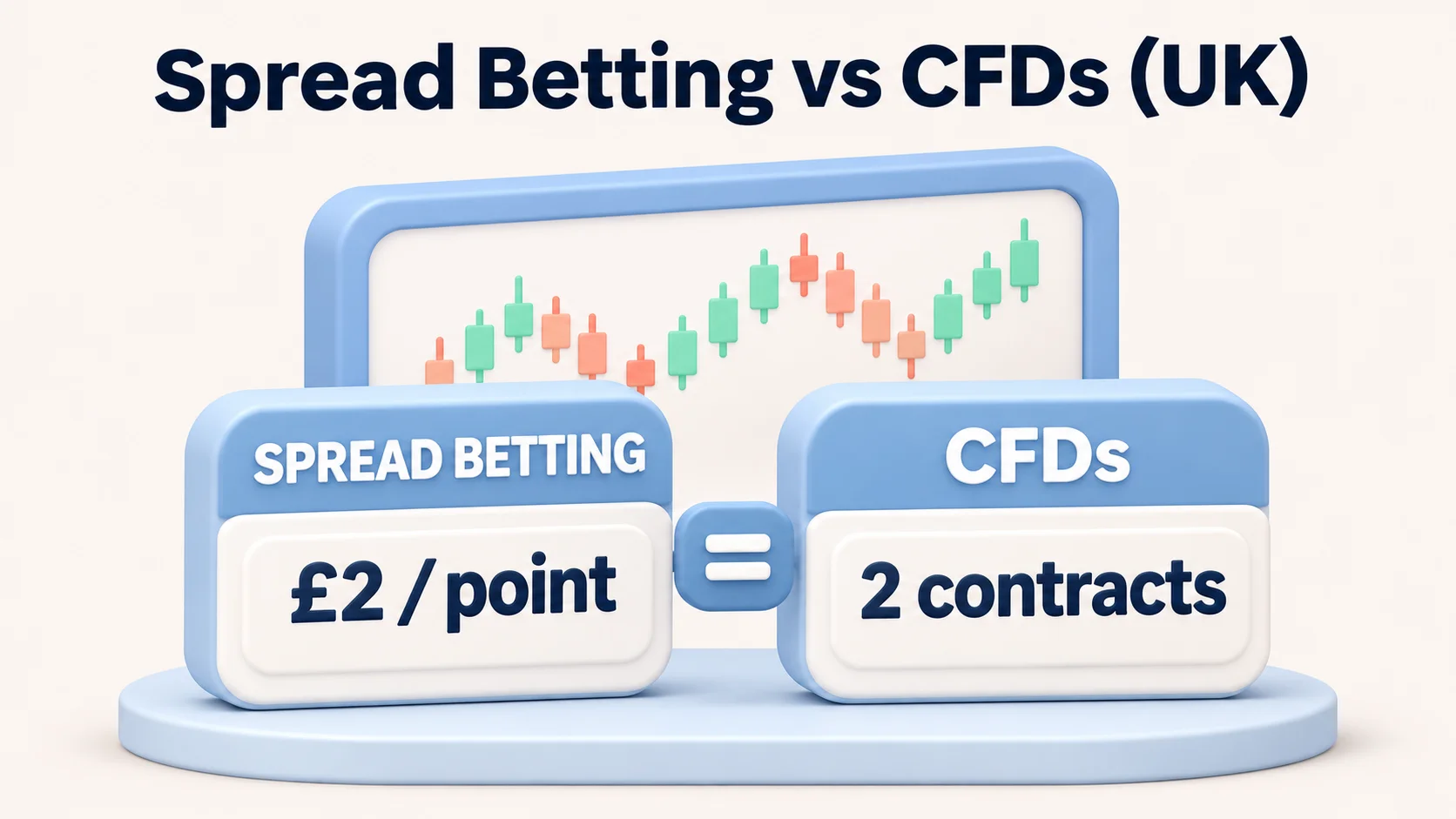
Spread betting may be expressed as £ per point while a CFD uses lots or contracts, but changing the ticket label does not remove exposure to the market. Ownership of real shares is a different arrangement with different rights. Before choosing, identify whether the selected platform login is actually a UK spread-betting account rather than a CFD account with similar-looking price charts.
Is Financial Spread Betting Tax-Free in the UK?
Do not choose a leveraged product on the assumption that every profit will always be tax-free. For a typical individual entering financial spread bets as wagers rather than as part of a trade, HMRC explains that no chargeable gain or allowable capital loss arises from the bet. Its financial spread-betting capital-gains guidance describes this treatment. HMRC's business-income guidance similarly says that a person merely placing bets is normally not trading for income-tax purposes, and losses normally give no corresponding tax relief.
That is not an unconditional exemption for every person, arrangement or transaction. HMRC's spread-betting exceptions guidance turns on the contract and its economic substance; trading or hedging contexts, companies, residence and other individual facts can change the analysis. Tax law and interpretations can change. This tax subsection requires review by a qualified UK tax specialist before publication and is general information, not personal tax advice.
How to Assess a UK Spread Betting Provider
A comparison is useful only when the account, entity and product match what the trader can actually open. FXRanking's UK spread betting broker comparison discusses provider differences in dealing costs, account route and demo access; the companies listed there should still be checked against current permissions and terms.
- Check the contracting firm. Use the FCA Firm Checker and Financial Services Register to confirm the legal entity, its permissions and contact details. A matching brand name is not enough, especially where an international group has several companies.
- Confirm eligibility and classification. UK residence, retail status and the particular spread-betting product matter. Do not assume that a CFD account, offshore entity or professional account offers identical protections.
- Read the product specification. Check stake increments, spread by session, minimum margin, tiered margin, dealing hours, maximum order size, guaranteed-stop availability and financing timetable.
- Calculate a realistic loss first. Work backwards from an affordable account loss and an adverse point move, rather than selecting the largest stake the platform allows.
- Understand complaint routes. The Financial Ombudsman Service may consider eligible complaints about spread betting or CFDs, including certain stop, margin or suitability issues. Compensation eligibility is a separate question and must not be confused with reimbursement for trading losses.
Can a Demo Account Help Before Trading Live?
Yes, but only for learning the mechanics. A useful financial spread-betting demo lets a trader choose pounds per point, read bid and ask prices, set stops, monitor margin, and distinguish open equity from available funds. FXRanking's UK spread betting demo-account guide compares advertised practice routes and their limitations. Check that the practice account specifically supports spread betting, not CFDs alone.
On a demo, rehearse the long and short calculations above, record the spread at different times, and examine what a 100-point gap would do at the intended stake. A simulation cannot reproduce all live slippage, overnight liquidity, trader decisions or broker execution conditions, so profitable demo results are not evidence of a durable live trading edge. For general market foundations, the beginner guide to forex trading also explains trading terminology, although forex accounts and UK spread-betting products are not interchangeable.
A Simple Pre-Trade Risk Checklist
- Is this a UK financial spread-betting account with a confirmed authorised firm, correct retail classification and the intended market enabled?
- What are the actual opening buy/sell quotes, the stake per point, and the value of a one-point move?
- How much would a 25-, 50- or 200-point adverse move cost, including a plausible gap beyond the stop?
- What margin is reserved, what funds remain available, and what account-level close-out threshold applies?
- What are the total dealing, overnight, weekend, stop and currency costs over the planned holding period?
Bottom line: Financial spread betting turns a price move into a cash result through the stake per point. That simplicity in the arithmetic should not be mistaken for simplicity in the risk. Someone unable to explain the spread, margin, forced close-out, financing and worst plausible account loss should stay with education and simulation rather than placing a live leveraged bet.
FAQs
What is financial spread betting in simple terms?
It is a leveraged agreement to gain or lose money when a financial-market quote moves. You choose to buy or sell and set a cash stake per point; you do not own the underlying asset.
How do you calculate spread betting profits and losses?
For a long trade, subtract the opening buy price from the closing sell price and multiply by the stake per point. For a short trade, subtract the closing buy price from the opening sell price. Account for spread and any additional charges.
Can you lose more than the margin on a spread bet?
Margin is only collateral. A large adverse move can create losses well above the amount initially reserved. Qualifying FCA-regulated UK retail accounts have negative balance protection, which concerns total account funds, not the single-trade margin.
How much leverage can a UK retail spread bet use?
The FCA retail limits for covered CFD-like products, including financial spread betting, range from 30:1 to 2:1 depending on the asset. Actual margin and eligibility can be stricter; check the UK provider and individual market.
Do spread bets have overnight fees?
Daily funded spread bets can incur overnight funding adjustments based on the exposure, benchmark rates and provider markup. Some forward or futures-style bets instead reflect carrying costs in wider spreads. Read the market-specific product schedule.
Is spread betting the same as sports betting or a CFD?
Financial spread betting concerns financial price movements and a cash stake per point, not sporting outcomes. It resembles a CFD economically, but the contract mechanics, sizing and potential UK tax treatment differ.
Is UK spread betting always tax-free?
HMRC does not provide a blanket exemption for every circumstance. HMRC generally treats an individual’s qualifying financial wager differently from a chargeable asset disposal, but trading context, hedging, legal form and personal circumstances matter. A qualified UK tax specialist should review individual cases.
Is a demo account enough to prove a spread-betting strategy works?
A demo is valuable for practising stakes, orders, spreads and margin without risking real money, but it cannot demonstrate how a strategy performs under all live execution conditions or behavioural pressures.

Nathan Wong
Nathan Wong is a Forex education contributor with 15 years of trading and market-analysis experience. He specializes in broker platforms, cryptocurrency, risk management, and trading psychology, creating practical content that helps readers make informed decisions and develop realistic expectations.