














































































































What Is Forex Trading?
Forex, short for foreign exchange, is the market where currencies are exchanged against one another.
Every forex instrument is quoted as a currency pair. EURUSD, for example, compares the euro with the US dollar.
If EURUSD trades at 1.1000, one euro is worth 1.10 US dollars.
A trader who expects the euro to strengthen against the dollar buys EURUSD. A trader who expects the euro to weaken against the dollar sells EURUSD.
Base and Quote Currencies
Every forex pair contains two currencies:
- Base currency: the first currency in the pair.
- Quote currency: the second currency in the pair.
In EURUSD, EUR is the base currency and USD is the quote currency.
The exchange rate shows how much of the quote currency is required to buy one unit of the base currency.
How Forex Trades Make or Lose Money
A forex trade gains or loses value as the exchange rate moves away from the entry price.
A long position gains value when the exchange rate rises. A short position gains value when the exchange rate falls.
The same movement creates a loss when price moves against the position.
The financial size of that profit or loss depends on the position size.
How to Start With Forex Trading: 11-Step Roadmap
Anyone asking how do I start forex trading should follow a structured sequence rather than opening a live account and learning through financial mistakes.
- Learn basic forex terminology.
- Understand leverage and margin.
- Learn the main forex order types.
- Choose a trusted/regulated forex broker.
- Practice on a demo account.
- Learn forex market analysis.
- Choose a trading style.
- Build one trading strategy and trading plan.
- Define risk-management rules.
- Backtest and forward-test the strategy.
- Move to small live positions and keep a trading journal.
Each step builds on the previous one. The goal is to understand the market first, control risk second and develop trading performance only after a repeatable process exists.
Step 1: Learn Basic Forex Terminology
Before learning trading strategies, a beginner needs to understand the terminology displayed on a forex platform.
Currency Pairs
Common major currency pairs include:
- EURUSD
- GBPUSD
- USDJPY
- AUDUSD
- USDCHF
Major pairs contain the US dollar and another major global currency. Cross pairs combine major currencies without USD, such as EURGBP or GBPJPY.
Pips
A pip is a standard unit used to measure forex price movement.
For most currency pairs, one pip is the fourth decimal place. A move in EURUSD from 1.1000 to 1.1010 equals 10 pips.
JPY pairs normally use the second decimal place as the standard pip (0.01). A move in USDJPY from 150.00 to 150.01 equals 1 pip, while a move to 150.10 equals 10 pips.
Bid, Ask and Spread
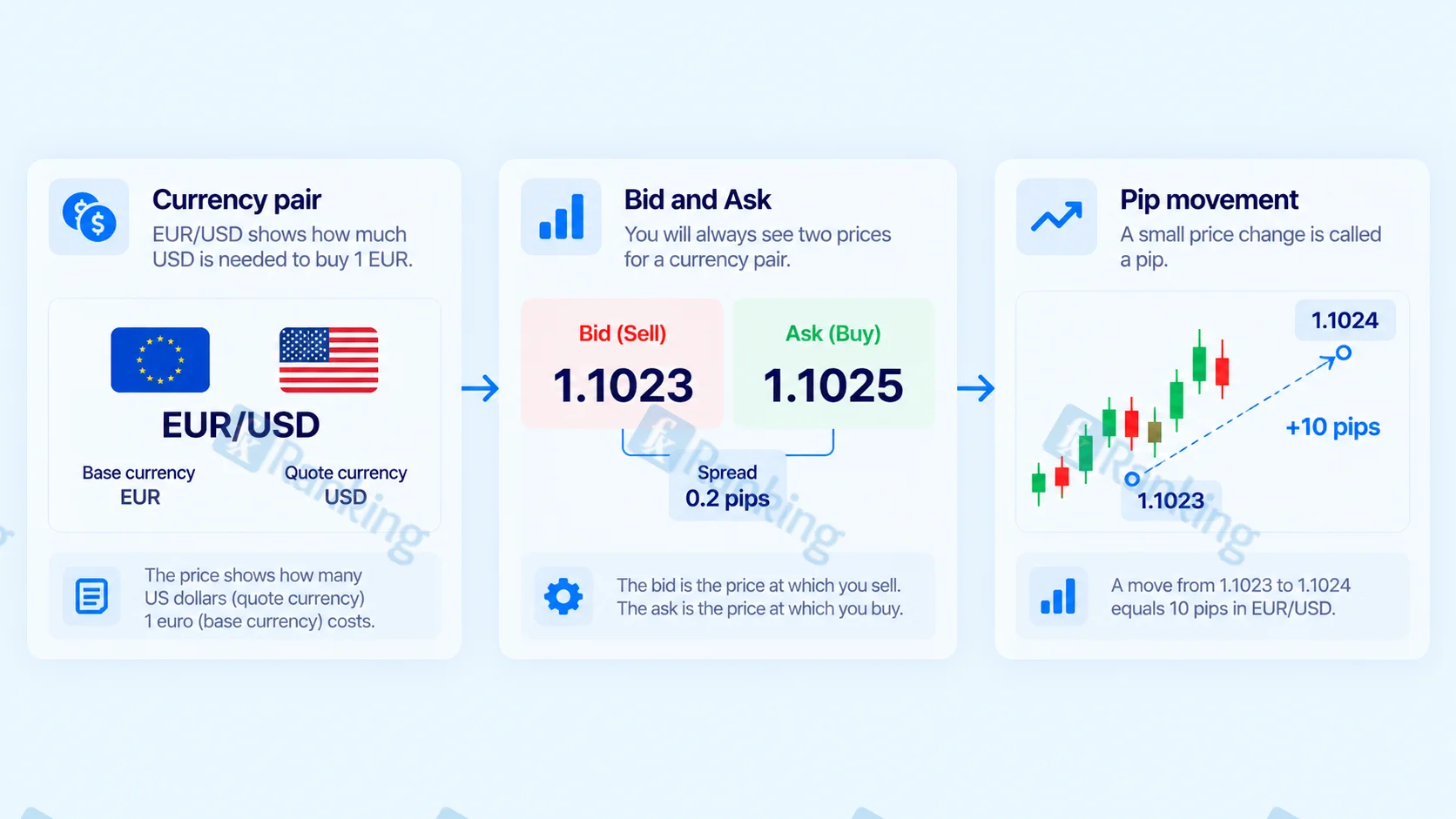
A forex quote contains two prices:
- Bid: the price at which the trader sells.
- Ask: the price at which the trader buys.
The difference between the bid and ask is the spread.
The spread is part of the cost of opening and closing a forex position.
Lot Sizes
Forex position size is commonly expressed in lots.
| Lot Type | Currency Units |
|---|---|
| Standard lot | 100,000 units |
| Mini lot | 10,000 units |
| Micro lot | 1,000 units |
Position size directly determines financial exposure. A larger position produces a larger profit or loss from the same price movement.
Swap and Overnight Financing
Forex positions held beyond the broker's daily rollover time are subject to overnight financing adjustments.
Financing depends on the currency pair, trade direction, interest-rate structure and broker conditions.
These costs become increasingly important as holding periods become longer.
Step 2: Understand Leverage and Margin
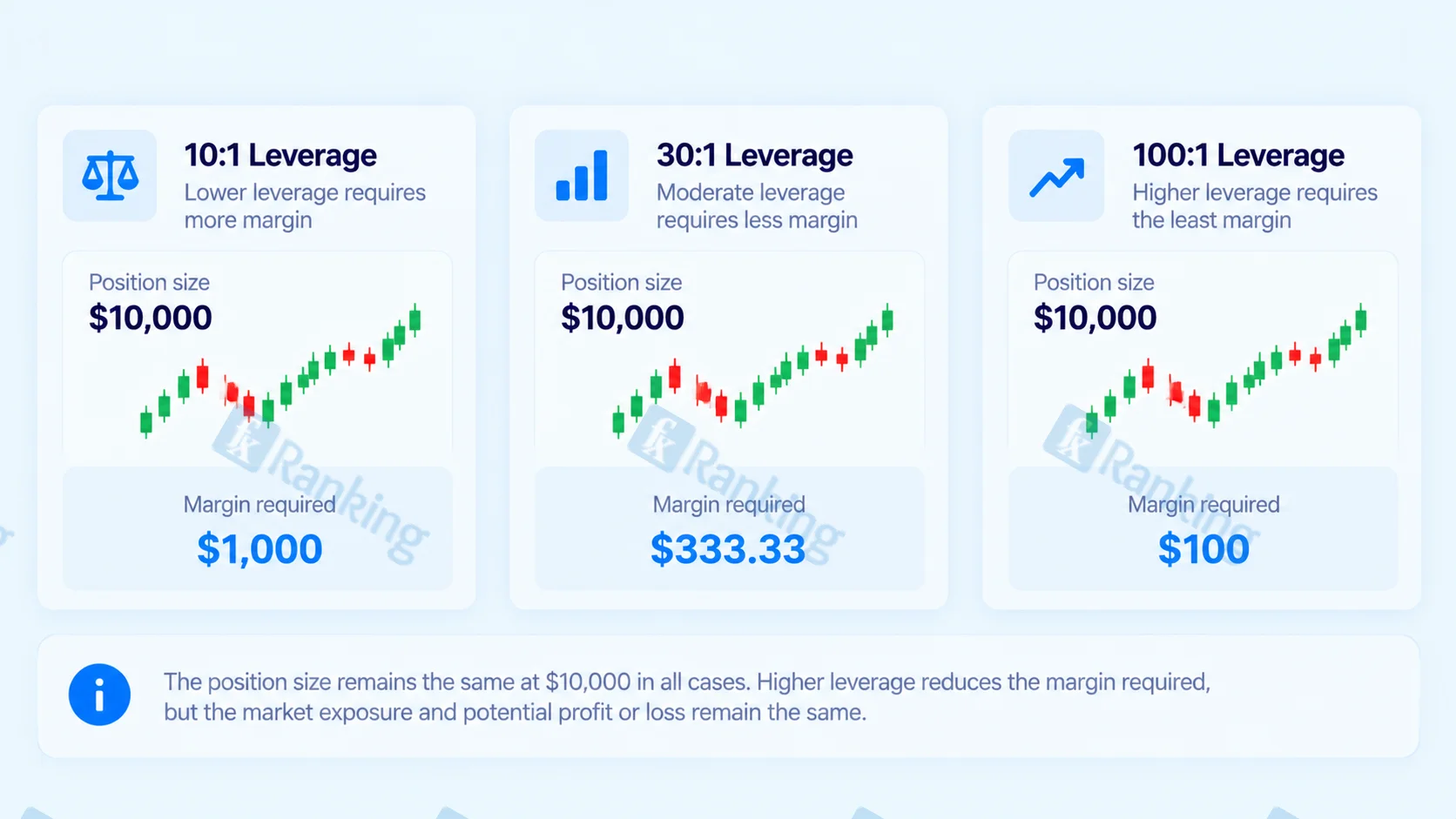
Leverage is one of the most important concepts for anyone learning how to start trading forex.
Leverage allows a trader to control a market position larger than the cash required as margin.
At 10:1 leverage, a $10,000 position requires $1,000 of margin.
At 30:1 leverage, the same $10,000 position requires approximately $333.33 of margin.
The smaller margin requirement does not reduce the size of the market exposure. A $10,000 position remains a $10,000 position regardless of the margin required to open it.
What Is Margin?
Margin is the amount of account equity allocated to support a leveraged position.
Margin is not the maximum possible loss. It is the capital requirement associated with maintaining the position.
Why Leverage Increases Risk
Leverage magnifies the financial effect of market movement.
A small price movement applied to a large leveraged position produces a larger change in account equity than the same movement applied to a smaller position.
The key risk question is therefore not how much leverage the broker offers.
The important question is how much account equity will be lost if the trade reaches its stop-loss.
Position size and stop-loss distance determine that amount.
Step 3: Learn the Main Forex Order Types
A trading idea becomes a market position through an order.
Beginners should understand the basic order types before entering a live trade.
Market Order
A market order instructs the broker to execute the trade at the best available price.
Market orders prioritize execution rather than a specific entry price.
Limit Order
A limit order waits for the market to reach a specified price.
A buy limit is placed below the current market price. A sell limit is placed above the current market price.
Stop Entry Order
A stop entry order becomes active after price reaches a predefined level beyond the current market price.
Stop entries are commonly used in breakout strategies.
Stop-Loss Order
A stop-loss defines the level at which a losing position exits when the market moves against the trade.
The distance between the entry price and stop-loss is also used when calculating position size.
Take-Profit Order
A take-profit closes the position when price reaches the predefined profit target.
Setting the stop-loss and profit target before entry creates a defined risk-and-reward structure.
Step 4: Choose a Regulated Forex Broker
Choosing the broker is a core part of getting started with forex trading.
The broker provides the trading account, pricing, platform, leverage and order execution.
Check Broker Regulation
A broker's regulatory license should be checked through the regulator responsible for the legal entity holding the trading account.
Large broker brands often operate several legal entities in different jurisdictions.
The relevant entity is the company named in the account agreement, not simply the trading brand shown on the website.
Compare Trading Costs
Forex trading costs include:
- Spreads
- Trading commissions
- Overnight financing
- Currency-conversion charges
- Deposit or withdrawal fees where applicable
Costs should be compared using the account type and currency pairs the trader actually intends to trade.
Compare Trading Platforms
Common forex platforms include MetaTrader 4, MetaTrader 5, cTrader and proprietary broker platforms.
A beginner needs reliable order entry, clear charts, stop-loss and take-profit controls, account-history reporting and a demo environment.
Review Funding and Withdrawal Conditions
Deposit methods, withdrawal procedures, processing conditions and account currencies should be reviewed before funding the account.
The broker's legal documents should clearly explain the account terms, trading conditions and risk disclosures.
Step 5: Start With a Forex Demo Account
A demo account is the correct environment for learning platform mechanics without risking real capital.
Demo trading should be treated as structured practice.
What to Practice on Demo
- Opening and closing positions
- Setting stop-loss and take-profit orders
- Calculating position size
- Reading bid and ask prices
- Monitoring margin
- Using market, limit and stop orders
- Following one trading strategy
- Recording trades consistently
What Demo Trading Does Not Replicate
Demo trading removes the financial consequences of mistakes.
Live trading introduces emotional pressure because profits and losses affect real capital.
A demo account therefore tests platform competence, strategy execution and risk procedures. Live trading adds financial psychology.
Step 6: Learn Forex Market Analysis
Anyone asking how can I learn forex trading needs to understand the main forms of market analysis.
Technical Analysis
Technical analysis studies price behavior through charts, market structure and indicators.
Common technical concepts include:
- Trends
- Support and resistance
- Breakouts
- Candlestick patterns
- Moving averages
- RSI
- MACD
- Fibonacci retracements
Technical analysis helps define price structure, momentum, entry levels and invalidation points.
Fundamental Analysis
Fundamental analysis examines economic forces affecting currency values.
Important factors include:
- Central-bank interest-rate decisions
- Inflation
- Employment data
- Economic growth
- Monetary-policy expectations
- Major political and economic events
Currency markets respond to changes in expectations as well as to the economic data itself.
Sentiment Analysis
Sentiment analysis examines how market participants are positioned and whether trading behavior is predominantly bullish, bearish or balanced.
Technical, fundamental and sentiment analysis answer different questions. A trading strategy should define which information forms part of its decision process.
Step 7: Choose a Forex Trading Style
A trading style determines how frequently decisions are made and how long positions remain open.
| Trading Style | Typical Holding Period | Main Characteristic |
|---|---|---|
| Scalping | Seconds to minutes | High trade frequency and strong sensitivity to spreads and execution |
| Day Trading | Minutes to hours | Positions normally close within the trading day |
| Swing Trading | Several days to weeks | Targets broader price swings with fewer trading decisions |
| Position Trading | Weeks to months | Focuses on longer-term market and economic trends |
Scalping demands fast execution and close attention to transaction costs. Longer-term trading reduces decision frequency but increases exposure to overnight market movement and financing charges.
Beginners should learn one trading style before combining several approaches.
Step 8: Build a Forex Trading Strategy and Trading Plan
A trading strategy defines the conditions under which a position is opened, managed and closed.
A trading plan defines how that strategy is operated consistently.
What a Forex Trading Strategy Needs
A complete strategy should define:
- Currency pairs
- Trading timeframe
- Market conditions
- Entry trigger
- Stop-loss placement
- Profit target
- Position-sizing method
- Trading-session rules
- Conditions that invalidate the setup
Example of a Rules-Based Setup
A simple trend-following framework could require:
- Price to remain above a defined moving average.
- Market structure to show higher highs and higher lows.
- Price to retrace toward a predefined support area.
- A bullish entry trigger to form at that level.
- The stop-loss to sit below the invalidation point.
- Position size to be calculated from account risk and stop distance.
The value of the example is the rule structure. Every trade follows the same decision process rather than relying on impulse.
What a Forex Trading Plan Should Include
The trading plan should define:
- Markets traded
- Trading sessions
- Strategy rules
- Entry and exit conditions
- Risk per trade
- Maximum total exposure
- Daily or weekly loss limits
- News-event rules
- Journal and review process
The trading plan establishes the decision process before market movement creates emotional pressure.
Step 9: Learn Forex Risk Management
Risk management determines how much damage a losing trade or losing sequence creates.
A strategy controls trading decisions. Risk management controls the financial consequences when those decisions are wrong.
Risk Per Trade
One widely used position-sizing framework caps the planned loss on each trade at a fixed percentage of account equity.
For example, a 1% risk limit on a $5,000 account sets the planned loss at $50 if the stop-loss is reached.
The position size is then calculated from that $50 risk limit and the distance between the entry and stop-loss.
Position Sizing
Position size should be calculated from:
- Account equity
- Percentage of equity at risk
- Stop-loss distance
- Pip value
The stop-loss identifies where the trade is invalidated. Position sizing determines how much money is lost if that point is reached.
Risk-to-Reward Ratio
Risk-to-reward compares the planned loss with the planned profit target.
A 1:2 risk-to-reward setup risks one unit to target two units of profit.
Risk-to-reward does not establish strategy profitability by itself. Win rate and trading costs also affect the final expectancy.
Total Account Exposure
Risk also needs to be measured across all open trades.
Three positions each carrying 1% planned risk create 3% combined planned exposure if all three stop-loss levels are reached.
Correlated positions require additional attention.
For example, long EURUSD and long GBPUSD both create short USD exposure, so both positions share part of the same underlying currency risk.
Step 10: Backtest and Forward-Test the Strategy
A strategy should be tested before real capital is used.
Backtesting
Backtesting applies the trading rules to historical market data.
A structured test should record:
- Number of trades
- Win rate
- Average winning trade
- Average losing trade
- Maximum drawdown
- Total return
- Risk-to-reward
- Consecutive losses
A meaningful backtest follows fixed rules. Changing the strategy after every losing trade destroys the consistency of the test.
Forward Testing
Forward testing applies the same rules to new market data as it arrives.
Demo forward testing shows how the strategy performs under current spreads, trading sessions and market conditions.
Backtesting measures historical behavior. Forward testing measures current execution.
Step 11: Move From Demo to Small Live Forex Trading
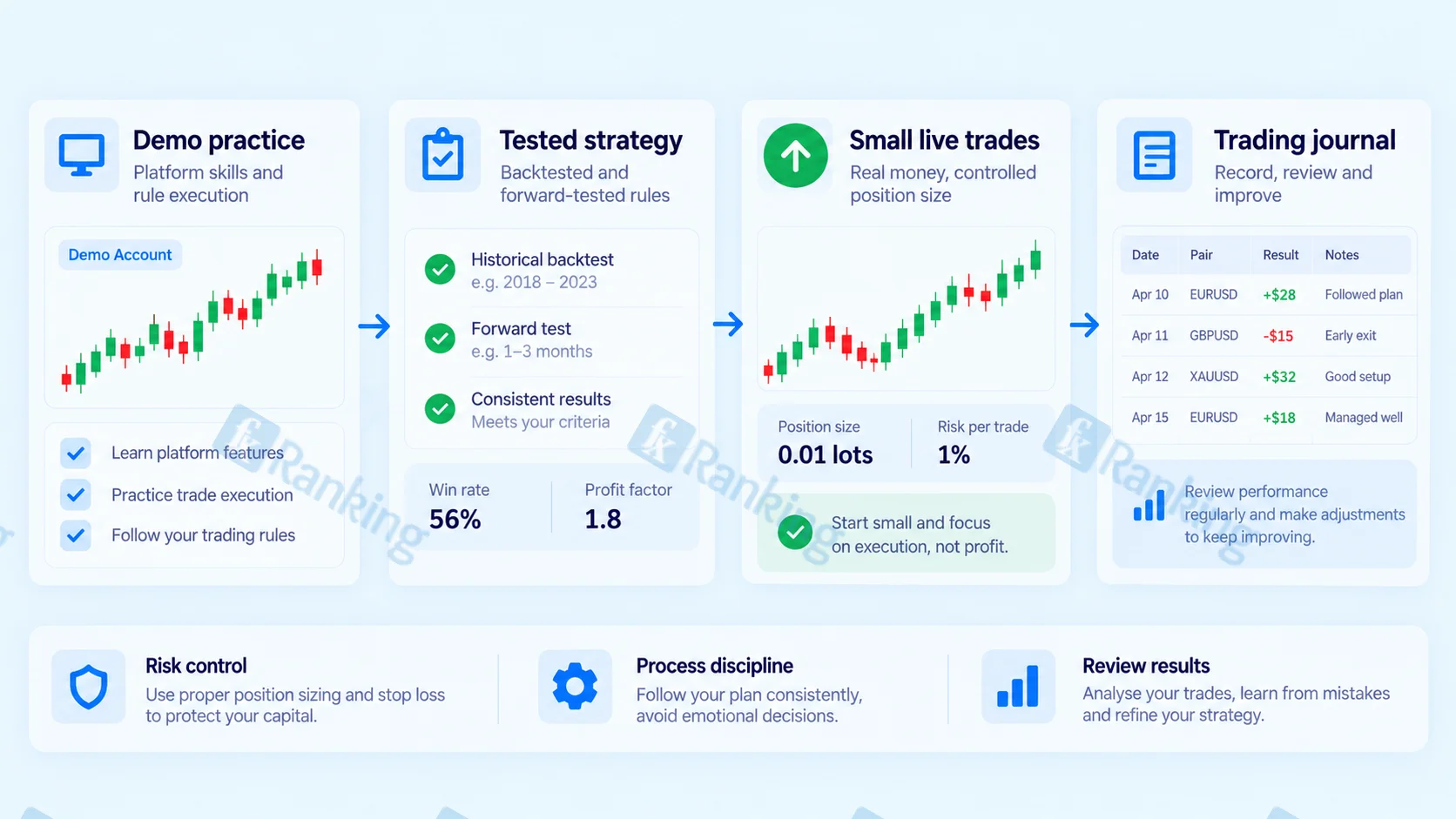
Moving from demo to live trading should be based on process rather than excitement after several winning trades.
When to Move From Demo to Live
Before live trading, the trader should be able to:
- Use the trading platform without execution mistakes.
- Calculate position size before entry.
- Follow one written strategy.
- Use stop-loss orders consistently.
- Record every trade.
- Complete a meaningful sample of backtested and forward-tested trades.
- Follow the strategy during losing sequences without changing the rules impulsively.
How Much Money Do You Need to Start Forex Trading?
The amount required to start forex trading is determined by the trading plan, position sizes, stop-loss distances and risk limits rather than by the broker's minimum deposit alone.
The account needs enough capital to support:
- The smallest practical position size
- The planned stop-loss distance
- The defined risk percentage
- Normal losing sequences
- Margin requirements
A broker allowing a very small minimum deposit does not make that balance suitable for every strategy.
Trading capital should also be separate from money required for essential living expenses, debt payments and emergency savings.
Start With Small Live Positions
The first live account should focus on execution discipline rather than income.
Small position sizes allow the trader to experience the emotional pressure of real gains and losses while keeping financial exposure controlled.
The objective is to execute the same process used during testing.
Keep a Forex Trading Journal
A trading journal records what happened, why the trade was taken and whether the trading plan was followed.
Each journal entry should include:
- Currency pair
- Date and time
- Direction
- Entry price
- Stop-loss
- Profit target
- Position size
- Trading setup
- Result
- Chart screenshot
- Whether the trading plan was followed
The journal separates strategy performance from execution mistakes.
A losing trade executed correctly provides useful data. A profitable trade that broke the trading rules does not represent good execution.
Common Beginner Forex Trading Mistakes
Using Too Much Leverage
High leverage allows large market exposure relative to account equity.
This makes normal price movement produce larger percentage changes in the account.
Trading Without a Defined Exit
A trade without a predetermined invalidation point has no fixed planned loss.
The risk remains uncontrolled until the position is manually closed or margin requirements force action.
Changing Strategy After Every Loss
Every trading strategy produces losing trades.
Constantly switching methods prevents the trader from collecting a consistent sample large enough to evaluate the strategy properly.
Increasing Risk After a Loss
Increasing position size to recover a previous loss changes the risk model and makes the next trade financially more important.
Normal drawdown then becomes escalating account exposure.
Trading Too Many Currency Pairs
Monitoring a large watchlist creates more potential signals but also increases decision load and correlation risk.
Beginners develop market familiarity more efficiently by concentrating on a small group of liquid currency pairs.
Following Signals Without Understanding the Trade
A signal does not explain why the trade exists, where it becomes invalid or how position size was calculated.
A trader should understand the setup and financial risk before entering the position.
Treating Forex as Fast Income
Forex trading is a risk-management and decision-making activity, not a guaranteed income system.
The beginner's first objective is consistent execution of a defined process.
What Beginners Should Understand Before Starting Forex Trading
Learning how to begin forex trading is primarily about building a repeatable decision process.
First, leverage controls market exposure. Lower margin requirements allow larger positions, but larger positions also make price movement affect account equity more strongly.
Second, position size controls financial risk. A strong market idea traded with excessive size still creates poor account management.
Third, a strategy needs written rules. Entry, exit and invalidation conditions should exist before the trade begins.
Fourth, risk management protects the account during losing periods. Losses are part of trading, while position size determines how damaging those losses become.
Fifth, testing comes before live trading. Backtesting provides historical evidence and demo forward testing shows how the strategy behaves under current conditions.
Sixth, one strategy is enough at the beginning. Consistent execution produces useful data. Constantly changing methods does not.
Finally, progress should be measured through process. A developing trader improves by following the plan, calculating risk correctly, recording trades and reviewing a meaningful sample of results.
That is the correct foundation for anyone learning how to start with forex trading: understand the market first, control risk before chasing returns and move to live trading only after a structured process has been tested.
FAQs
How Do I Start Forex Trading?
Start by learning currency pairs, pips, spreads, lot sizes, leverage, margin and order types. Then choose a regulated broker, practise on a demo account, learn market analysis, build one rules-based strategy and test it before moving to small live positions.
How Do You Start Trading Forex as a Beginner?
Start with education and demo trading rather than a live deposit. Learn platform execution, position sizing, stop-loss placement and one trading strategy before real capital is exposed.
How Much Money Do I Need to Start Forex Trading?
The required balance comes from the position sizes, stop-loss distances, margin requirements and risk limits in the trading plan. The broker's minimum deposit does not determine whether an account is adequately funded for a strategy.
How Can I Learn Forex Trading?
Learn forex trading in stages: market terminology, leverage and margin, platform mechanics, risk management, market analysis, strategy development, backtesting, demo forward testing and small live trading.
Should I Start Forex Trading on a Demo Account?
Yes. A demo account allows a beginner to learn the platform, practise order types, calculate position size and execute a trading strategy without risking real capital.
How Long Does It Take to Learn Forex Trading?
Trading progress should be measured by competence rather than a fixed number of weeks or months. A trader progresses after consistently following defined rules, managing risk correctly and building a meaningful sample of documented trades.

Jake Robins
Jake Robins is a Forex and cryptocurrency education contributor with over 10 years of experience helping readers better understand the financial markets. His work covers risk management, technical analysis, trading psychology, broker platforms, and scam awareness. Through clear, practical guidance, Jake helps traders approach the markets with greater discipline, caution, and confidence.