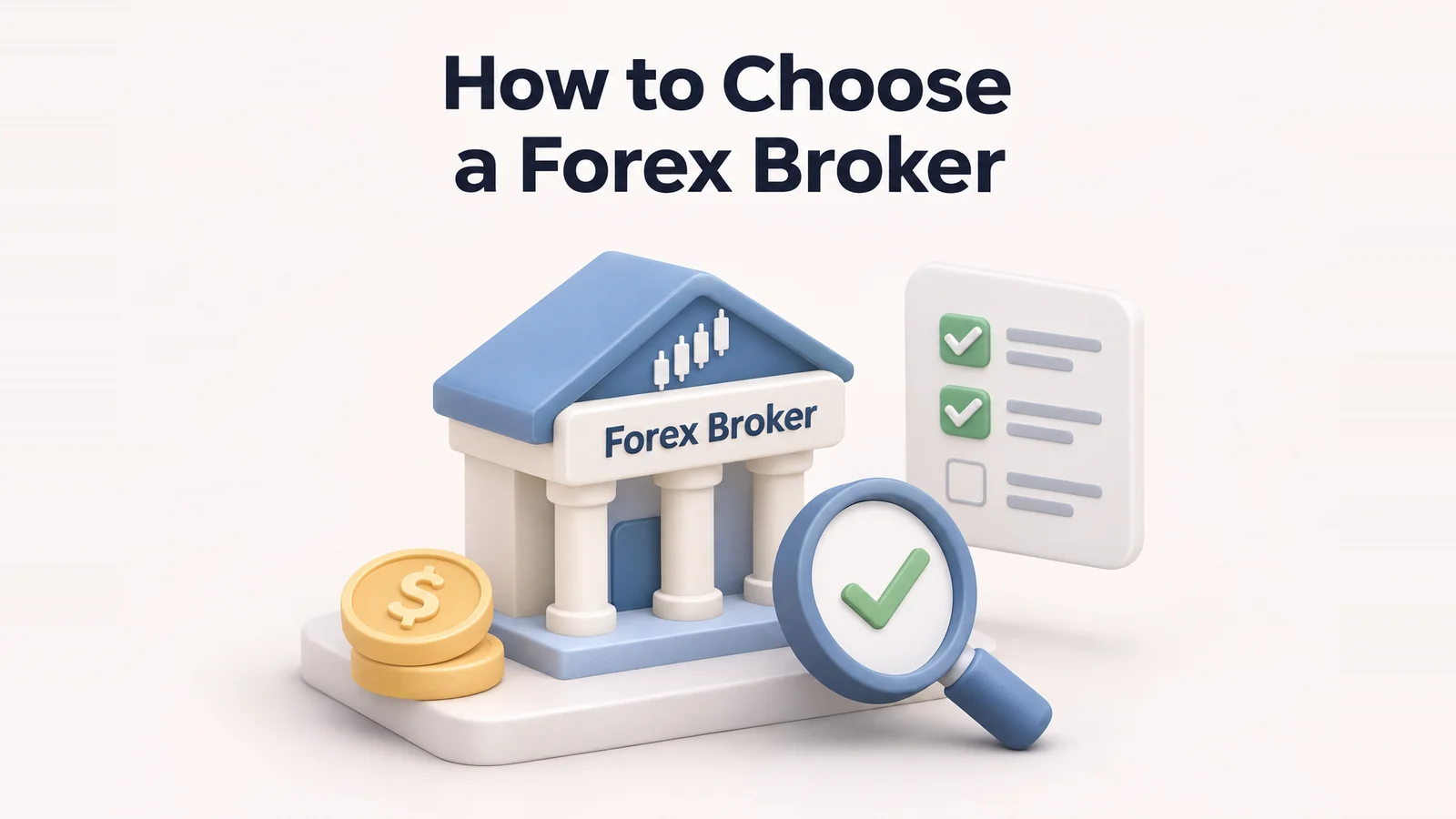
How to choose a forex broker: start with the legal company that will hold your account, not the brand's headline spread or leverage offer. Verify the company and its permission to provide your specific product in your country. Then compare the full cost of a realistic trade, read the execution and withdrawal terms, check the complaints process, and practise with a demo before risking money.
A broker may be reputable in one jurisdiction yet unsuitable for you in another. A group's UK, US, Australian and offshore entities can offer different products, pricing, leverage, client-money arrangements and dispute routes. The practical test is whether the entity on your account agreement meets your needs. For US residents in particular, do not mistake an offshore forex CFD account for an eligible US retail forex dealer.
The seven checks that matter most
The sequence below matters. A fast platform cannot compensate for a company that is not permitted to take your account, and a low advertised spread is meaningless if withdrawals or margin terms are unacceptable.
- Identity and authorisation: write down the legal company, registration number, regulator, permitted activity, country served, and name on the account agreement.
- Product and protection: establish whether you trade US off-exchange retail forex, UK-style rolling spot forex or CFDs, exchange-traded currency futures, or another instrument. They do not share identical rules or safeguards.
- Total cost: calculate spread, both sides of any commission, overnight funding or rollover, conversion, inactivity and withdrawal costs for your actual trade size.
- Orders and execution: obtain the order-execution policy, quote practices, stop-order rules, slippage and margin-closeout terms.
- Money in and out: review deposit ownership rules, available withdrawal channels, documentation, processing times and third-party bank charges.
- Platform and practice: test sizing, margin display, order entry, statements, mobile controls and support using virtual funds; understand what demo trading cannot prove.
- Accountability: locate the regulated entity's complaints contact, escalation route and available dispute-resolution scheme before depositing.
1. Verify the broker's legal entity, not just its logo
Start with the broker's legal disclosure, account application and client agreement. These should identify the company that accepts your application. A marketing website may list several regulators, but your account is normally governed by a particular contracting entity. Do not combine the permissions or protections of unrelated group companies.
US residents: check CFTC registration and NFA BASIC
For retail off-exchange forex in the United States, use the CFTC's registration-check guidance and the NFA BASIC database. Search the exact dealer name, inspect current registration and membership category, then review history and disciplinary information. The CFTC specifically urges consumers to verify a dealer before handing over personal information or funding an account. A BASIC search result or NFA identifier on its own does not establish that a business is currently an NFA Member authorised for your transaction.
Ask the broker which registered US company is your counterparty. Verify that your intended product is available under the US entity's account terms. US residents should not use an overseas CFD offer as a substitute for verifying lawful US retail forex access. Our US forex broker comparison provides a starting shortlist, while the CFTC-regulated broker guide explains the relevant regulatory category. Neither replaces a current BASIC search.
UK and Australia: check permissions, status and entity scope
In the UK, check the FCA Firm Checker for the firm and the specific service it has permission to offer. The FCA warns that clone firms may borrow a genuine firm's reference number and name, so cross-check contact information against the regulator's record rather than trusting an unsolicited message. In Australia, ASIC's Professional Registers let readers inspect an Australian financial services licensee and the services authorised by its licence.
Regulation is an important screening condition, not a promise that an account will avoid losses or that every claim will be compensated. The applicable client-money rules, retail protections and complaint eligibility depend on the precise legal entity, product and circumstances. An offshore entity affiliated with a regulated brand may carry different protections; check its own regulator and documents instead of transferring assumptions from another jurisdiction.
Keep a short verification record
| What to record | Evidence to check | Reason |
|---|---|---|
| Contracting company and country | Client agreement and account-opening disclosure | Identifies who owes obligations to you |
| Regulator, number and current status | Independent regulator register | Distinguishes active permission from a marketing claim |
| Permitted product and retail status | Regulator permissions and product-specific terms | Confirms that the offer is relevant to your account |
| Official website and contact details | Regulatory listing and verified broker contacts | Helps detect impersonation and clone websites |
| Complaint and client-money provisions | Signed terms, disclosures and regulator guidance | Establishes an escalation path before problems arise |
2. Identify what you will actually trade
Retail spot-like forex, a rolling spot/CFD position and an exchange-traded currency future can all create exposure to exchange rates, but their counterparties, margin rules, fee structures and governing protections differ. Start by reading the instrument description and risk statement, not by assuming that every product labelled “forex” is the same.
Check available currency pairs, minimum trade increment, order-size ceiling, trading sessions, restrictions during volatile markets, margin requirements and forced-closeout conditions. If you intend to hedge or hold trades for days, read the rules on offsets and financing. If you intend to use automated strategies, confirm permitted platforms and any restrictions on algorithms, order frequency or third-party tools. An account that requires larger trade sizes than your risk budget permits fails the suitability test even when its published spreads look attractive.
3. Calculate the full cost of a real trading plan
“Spreads from 0.0 pips” is a minimum, not a total-cost quote. A meaningful comparison uses the same pair, trading time, order size, account type, holding period and funding currency across brokers. Request the live or published typical spread methodology, commission schedule and rollover or financing policy from the exact entity. The FCA's October 2026 CFD-firm findings warn that overnight charges and their disclosure can be especially problematic for retail CFD clients.
| Cost | Question to ask | Where it appears |
|---|---|---|
| Spread | Is the figure a minimum, average or live quote, and when does it widen? | Product pricing page, platform quote, execution record |
| Commission | Is it per side or round trip, per lot or per notional amount? | Account fee schedule |
| Overnight funding | What is charged or credited by pair and direction, and on which rollover day? | Contract specifications and financing schedule |
| Currency conversion | Which rate and markup applies to deposits, trades and withdrawals? | Payments and currency terms |
| Non-trading fees | Are there inactivity, transfer, data or withdrawal charges? | Full fee schedule and banking terms |
| Execution impact | Could slippage, requotes or partial fills change the effective cost? | Execution policy and order history |
Worked example: spread plus commission
Suppose one EUR/USD standard lot represents €100,000, and a one-pip move is worth approximately $10 for that position. Consider two illustrative same-size round trips, with no market movement, price conversion, slippage or funding charges:
- Account A: 0.9-pip spread and no separate commission. The spread cost is approximately 0.9 × $10 = $9 for the completed round trip.
- Account B: 0.2-pip spread, plus $3.50 commission per side. Spread cost is roughly $2; commission is $7; combined trading cost is roughly $9.
The two examples cost the same before financing or execution differences. Neither quote represents an actual broker or a guaranteed live fill. If Account B separately charged $3 per night to hold this lot for two nights, its illustrative cost would increase to $15. That is why a cheaper-looking spread may not produce a cheaper holding strategy. For smaller order sizes, calculate pip value and commission on the actual position rather than copying standard-lot figures.
4. Read the execution policy and test the order controls
Find out whether the dealer is your counterparty, how it sources prices, how market and pending orders are handled, and whether an order can be partially filled, rejected or requoted. In US retail off-exchange forex, the CFTC's forex advisory explains that customers typically trade against the dealer rather than through a centralised exchange. In the UK, the FCA's dealing and execution rules require relevant investment firms to maintain execution arrangements; the applicable obligations depend on the service and client classification.
Ask how the broker treats stop orders in a fast market. A standard stop is generally an instruction to trade when its trigger is reached, not a guarantee of that fill price. Gaps, thin markets and order-routing conditions can produce slippage. Likewise, an advertised execution-speed number means little without its sample definition, measurement period, instrument and fill-quality evidence. When such evidence is unavailable, treat the claim as promotional rather than proven for your strategy.
Confirm margin-call thresholds, automatic closeout rules, hedged-margin treatment and whether negative balance protection is contractually provided to your class of client. UK retail CFD restrictions do not automatically apply to professional clients, US dealer accounts or offshore accounts. A platform's stop-loss control does not remove the possibility of losses beyond a planned amount where the account terms and market conditions allow it.
5. Check funding, withdrawals and the money trail
The safest funding path is one you understand before the first transfer. Confirm the recipient's legal name, permitted funding methods, account currency, deposit hold periods, minimum or maximum withdrawals, and whether withdrawals usually return to the original payment source. Look for identity checks and additional documents that can delay a transaction, especially after changes to personal details or payment methods.
Distinguish fees charged by the broker from intermediary-bank, card-network or currency-conversion charges. “No withdrawal fee” does not mean every bank transfer arrives free or at the exchange rate shown on the trading screen. Ask how long the broker takes to approve a withdrawal and whether any stated processing window excludes bank settlement time, weekends or compliance reviews.
For a new account, use the smallest practical deposit consistent with the broker's terms, if you decide to proceed, and understand the withdrawal workflow before committing more money. A small completed withdrawal can demonstrate that one payment route worked once; it cannot prove all future withdrawals will be processed in the same time or that the firm is safe. Never send an extra transfer to an unknown party because someone on a messaging app says it is a “release tax” or unlock fee. The CFTC's forex fraud guidance describes withdrawal obstruction as a warning sign.
6. Use a demo to assess usability, not live execution quality
A demo account is useful for comparing the screens you will actually operate. Rehearse the actions most likely to cause costly errors: changing order size, displaying pip value and margin, entering a stop and limit, amending an order, closing part of a position, reading trade history and exporting statements. Check whether the mobile app gives access to the same controls you need during a fast move.
Document the demo's currency, assumed balance, expiry date, available instruments, pricing model and platform version. Demo funds are virtual; a demo result cannot validate a live spread, liquidity, reject rate, slippage distribution or cash withdrawal. Some brokers make demo trading easier by simulating fills or omitting live-account friction. For beginners, our step-by-step forex trading roadmap provides broader practice and risk-planning context.
Ask the support team a concrete question while still on demo: “Which legal entity would accept an application from a resident of this country, and where are its execution, financing and withdrawal policies?” Compare the written reply with the legal documents. Useful support is specific, consistent and traceable, not simply quick.
7. Know how to complain before something goes wrong
Write down the formal complaints address, the entity responsible and the timeframe set out in the contract. Save the account agreement, fee schedule version, order identifiers, confirmations, withdrawal requests and support replies. If a trade or payment is disputed, these records help distinguish a pricing disagreement from a platform error or a possible scam.
United States: first identify the exact registered company. The NFA complaints portal applies to matters within NFA's jurisdiction, while the NFA customer arbitration programme describes a possible dispute route involving NFA Members and their associates. You can also consult the CFTC complaint and redress information. Eligibility depends on the matter, party and legal process; none of these routes guarantees recovery.
United Kingdom: start with the firm's complaints process. Where the complaint and consumer are eligible, the Financial Ombudsman Service can be approached following an unsatisfactory final response or, for most cases, once eight weeks have passed without resolution. Other complaint types can have different time limits. Check individual eligibility instead of assuming the Financial Ombudsman or the FSCS will reimburse trading losses.
Other jurisdictions: the dispute route can be a regulator, an external dispute-resolution scheme, a court or contract-based arbitration. Find it in the named legal entity's documents and check it independently. A foreign group company's complaint scheme may not cover an offshore account.
A decision scorecard you can actually use
Use pass/fail for permission and access, then compare trade-offs among the remaining candidates. A broker with excellent mobile charting should still fail if its regulatory identity or payment terms cannot be established.
| Criterion | Pass standard | If it fails |
|---|---|---|
| Exact entity is verified | Contracting name and permission match an official register | Do not fund |
| Legal access and product | Your country, retail classification and instrument are supported | Remove from shortlist |
| Published complete costs | All material fees can be calculated for your planned trades | Ask for written clarification; do not rank it as cheap |
| Execution and margin rules | Relevant policies are available and comprehensible | Delay account decision |
| Withdrawals and identity checks | Payment methods and material restrictions are documented | Do not make a substantial deposit |
| Demo and support | Platform actions suit your intended strategy; replies are consistent | Try a different platform or broker |
| Complaint route | Named legal entity offers a clear procedure and applicable escalation | Do not assume another group entity will intervene |
Red flags that should stop the selection process
- Unverifiable entity: no coherent legal name or the broker's quoted licence belongs to a different company or activity.
- Unsolicited pressure: demands to act today, promises of fixed returns, “guaranteed” trading systems or pressure to move from official channels to private chat.
- Inconsistent addresses: a clone domain, payment destination or telephone number differs from the regulator's or official company record.
- Cost opacity: no written spread/commission methodology, financing terms or withdrawal policy, despite repeated requests.
- Jurisdiction mismatch: unusually high leverage or an offshore CFD account marketed as universally available to US residents.
- Withdrawal obstruction: demands for new deposits or unusual third-party payments before returning money, without a credible contractual basis.
These are screening signals, not proof of misconduct in every case. Still, the safer response is to verify independently before proceeding. The FCA's clone-firm guidance explains why a familiar brand name and genuine licence number can be used deceptively.
How to choose between two brokers that pass the safety checks
For a beginner, prioritise small controllable order increments, an understandable platform, an honest demo, written funding terms and responsive support. A slightly wider all-in spread can be a reasonable trade-off for simpler execution and more manageable position sizing, provided the cost difference is understood.
For an active short-term trader, compare spread distribution during your typical session, per-side commissions, order types, stop handling and the firm's execution disclosures. Ask for a realistic cost of the complete round trip rather than a headline minimum. For a trader who holds positions overnight, financing and rollover conventions may outweigh small spread differences; review them by instrument and position direction.
For anyone selecting a broker from abroad, the key question comes first: which legal company would accept the application? A group's product range, complaint rights or protection statement from a different country should not drive your decision. If the answer is missing or contradictory, keep the broker off the shortlist.
The final decision
Choose the broker whose verifiable entity, product permissions, transparent costs and operational terms match the way you plan to trade. Record the source pages and date you checked them, since licences, fee schedules and eligibility can change. It is reasonable to decide that no broker meets your requirements.
The order is simple: verify, calculate, read, practise, then decide. Any promise that a high leverage limit, zero spread or attractive app makes trading safe should carry less weight than the signed agreement and regulator record.
Risk warning: Retail forex and leveraged forex CFDs are high-risk products. Currency movements and leverage can rapidly exhaust deposited margin; depending on the product, jurisdiction and account terms, losses may exceed your initial deposit. Orders, including standard stop-loss orders, may execute at worse prices during market gaps. Regulation reduces some risks but does not insure trading performance or guarantee that deposited funds can always be recovered. Only trade money you can afford to lose, and assess whether these products are appropriate for you.
FAQs
How should beginners choose a forex broker?
First verify the contracting legal entity and its permission to offer forex to clients in your country. Compare all-in costs and withdrawal terms only among eligible brokers. Use a demo to practise position sizing and order controls, but do not treat virtual fills as proof of live execution quality.
How can you verify forex broker regulation?
Search the exact contracting company on the relevant regulator’s official register. For US retail forex, use the CFTC’s registration guidance and NFA BASIC. In the UK, use the FCA Firm Checker and check the activity permissions. Confirm that the company named in your account terms matches the register, including its contact details.
Is a 0.0-pip forex spread really free trading?
No. A quoted minimum spread can apply only briefly, and raw-spread accounts often charge a commission on both the opening and closing sides. Also compare typical spreads, overnight funding, slippage, conversion and withdrawal charges. Calculate the cost for your intended pair, position size and holding period.
Does regulation guarantee the safety of forex funds?
No. Authorisation is an important screening check, but it does not remove trading risk or guarantee recovery in a firm failure. Client-money treatment, compensation eligibility, negative balance protection and dispute options depend on the legal entity, product, customer classification and jurisdiction.
Can a US resident use an offshore forex CFD broker?
Do not assume an offshore forex CFD offer is legally available to US retail customers. Verify the exact product and dealer registration through CFTC and NFA official resources and consult the US entity’s account terms. A regulated affiliate elsewhere does not establish US retail forex permission.
Can a demo account prove real order-fill quality?
A demo helps assess order-entry controls, position sizing and platform usability. It does not demonstrate real deposit or withdrawal processing, and virtual prices and fills may differ from live liquidity, slippage and rejection behaviour. Treat demo results as a software familiarisation check, not proof of execution quality.
What steps help when a broker refuses a withdrawal?
Save the withdrawal request, account statements, client agreement and all correspondence. Use the written complaints process of the specific legal entity, then check the applicable regulator or dispute-resolution body. For US registered forex firms, consult NFA or CFTC complaint information. Never send an unverified extra payment simply to unlock funds.
What matters more, a low minimum deposit or cheap spreads?
Neither should outrank legal eligibility and verifiable oversight. Once those are established, use your actual trade size and holding period to compare total costs, and check whether the broker permits suitably small positions. A low minimum deposit is unhelpful when position increments make prudent risk control difficult.

Chad Powell
Chad Powell has spent more than five years trading Forex and cryptocurrency, building a practical understanding of how markets move and the challenges traders face. He writes about technical analysis, risk management, trading discipline, broker platforms, crypto security, and fraud prevention.