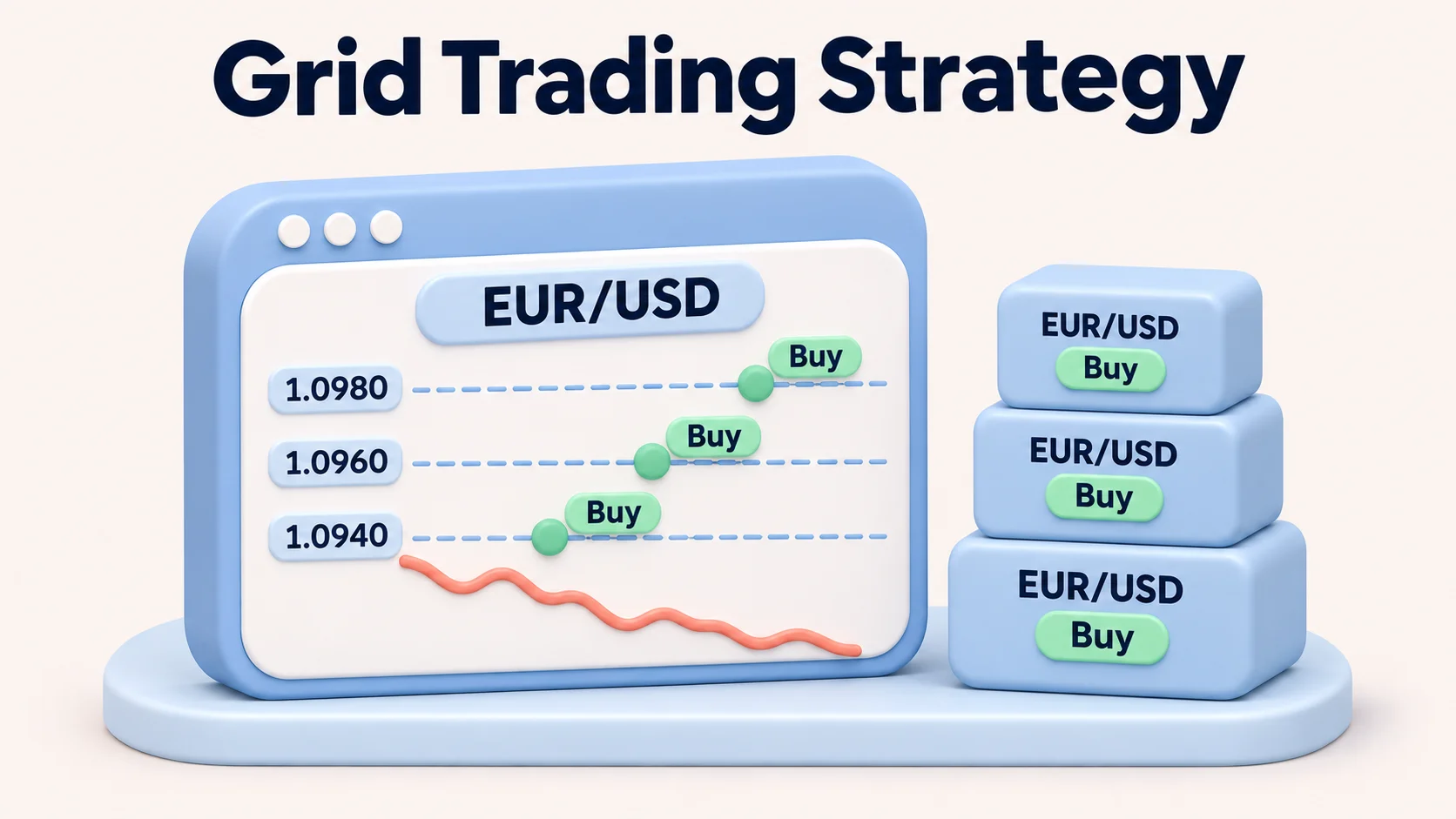
A grid trading strategy places several planned buy or sell orders at different prices, rather than relying on a single entry. A range grid generally buys at successively lower levels and seeks to sell each position after a rebound, or follows a corresponding short-side plan. The attraction is a repeatable set of rules. The danger is that positions can accumulate as price continues moving against the grid: small closed gains may sit beside much larger open losses.
Grid trading is an order-management framework, not a reliable way to make money and not a complete risk plan. It is most understandable in a sideways currency market, but the range can break without warning. The worked EUR/USD example below is invented for teaching the arithmetic; it is not a backtest, a trading signal or evidence of real execution. US readers must also check their broker's supported order types and forex account restrictions before applying any platform's grid illustration.
How Does a Grid Trading Strategy Work?
A trader chooses a reference price, how far apart orders will sit, how much each order will trade, the maximum number of open positions and what happens if the expected range fails. For a buy-the-dip range grid, each lower buy order can have a planned exit one grid interval above its entry. A short-side range grid reverses that logic, but a system that attempts to hold long and short positions at the same time has separate legal and platform restrictions.
Range grids versus directional grids
| Grid type | Order idea | What it depends on | Main failure mode |
|---|---|---|---|
| Long-only range grid | Stagger buys below a reference level; seek exits on rebounds. | Price returns upward after lower entries fill. | A sustained decline fills the ladder while losses compound. |
| Short-only range grid | Stagger short entries higher; seek exits as price falls. | Price returns downward after higher entries fill. | A sustained rally expands short exposure and loss. |
| Trend-following grid | Add positions at planned intervals in the direction of a move, with defined exits. | The trend continues sufficiently to offset costs and reversals. | A sudden reversal can hurt multiple positions at once. |
| Two-sided or “hedged” grid | Place orders on both sides and potentially carry opposing positions. | Account permits the intended netting or hedging behavior. | Opposing positions may be offset rather than held; costs and exposures are still real. |
Grid systems can also use fixed spacing (for example, 20 pips) or variable spacing linked to volatility. Neither setting solves the core problem: the market may move much farther than the selected ladder. More closely spaced orders increase the potential fill count and make spread and execution costs more important.
Hypothetical EUR/USD Grid: Three Orders and Their Total Exposure
Assume EUR/USD is near 1.1000, a trader has a hypothetical $5,000 USD account, and the plan is to use three 10,000 EUR buy-limit entries, 20 pips apart. EUR/USD has a conventional pip size of 0.0001; a 10,000 EUR position changes by approximately $1 per pip when the account's P&L is denominated in USD. To make the ladder arithmetic transparent, the prices below are idealized execution levels; live bid/ask quotes and order conditions can produce different fills.
| Order | Proposed buy level | Planned sell level | Size | Idealized gain if that exit fills |
|---|---|---|---|---|
| A | 1.0980 | 1.1000 | 10,000 EUR | 20 pips = $20 gross |
| B | 1.0960 | 1.0980 | 10,000 EUR | 20 pips = $20 gross |
| C | 1.0940 | 1.0960 | 10,000 EUR | 20 pips = $20 gross |
The planned $20 gain per completed round trip is before separately charged commissions and financing and is not a forecast. Real entry and exit orders execute against the relevant ask and bid; when grid levels are drawn using mid-prices, the spread must be included in the modeled fill prices. Do not subtract the same spread twice from a calculation already based on executable bid/ask fills.
Scenario 1: A rebound closes one trade, but the account has not earned $20
Suppose the price falls through all three buy levels and then returns to 1.0960. If order C closes there for an idealized $20 gross gain, order B is roughly at breakeven and order A is 20 pips below its entry, an unrealized $20 loss. The combined result is approximately $0 before costs, not a $20 net grid profit. Spreads, commissions or slippage can make that combined result negative. The example assumes orders actually fill at the displayed prices and ignores financing.
Scenario 2: A one-way decline leaves all three positions losing
If all three buys fill and EUR/USD instead falls to 1.0900, the mark-to-market arithmetic is:
| Open position | Distance below entry at 1.0900 | Illustrative unrealized P&L |
|---|---|---|
| A, from 1.0980 | 80 pips | −$80 |
| B, from 1.0960 | 60 pips | −$60 |
| C, from 1.0940 | 40 pips | −$40 |
| Total | Three 10,000 EUR positions | −$180 before costs |
That $180 is 3.6% of the initial $5,000 account, before trading costs. Three open entries create 30,000 EUR in gross currency exposure, worth about $32,700 at 1.0900, approximately 6.54 times the starting account balance in notional exposure. This is why a modest size per level is not the same as modest risk for the complete ladder. If EUR/USD continues to 1.0870, the same three positions would have an illustrative combined loss of $270 (5.4% of the initial balance) before costs, assuming no orders closed along the way.
For perspective, a hypothetical 2% margin requirement on $32,700 of notional exposure would equal about $654 of required margin. This is a simplified illustration, not a live broker quote or a promise that the account can support the positions. Actual margin depends on the broker, product, current quote, account and applicable rules. Margin is collateral, not a maximum-loss limit.
What do the spread and execution costs change?
A 20-pip gross target leaves little room if the market is expensive to trade. As a separate hypothetical mid-price illustration, assume an effective 1.2-pip round-trip spread cost and 0.4 pip of combined adverse slippage, with zero commission and zero financing. Then a 20-pip mid-price movement leaves about 18.4 pips, or $18.40, per 10,000 EUR position. That is not a quoted broker fee. Any commission, wider spread or overnight financing reduces the result further. When actual entry and exit prices already incorporate spread, count the spread only once.
The lesson is about the whole grid: a handful of completed $18.40 hypothetical trades would not necessarily offset the $180 open loss in the falling-price scenario. Reporting only closed winners or a bot's win rate hides that imbalance.
How to Set Up a Grid Without Ignoring the Exit
- Define the market condition. Identify the sideways price zone or trend assumption using rules written before trades occur. A range on a chart is an observation about the past, not protection against a breakout.
- Fix the grid width and spacing. Record the upper and lower levels, pip distance and what evidence would invalidate the setup. Wider spacing may reduce fills but does not remove large-trend risk.
- Cap the number and size of positions. Multiply the size of one order by every level that might fill. Include open trades in related currency pairs when measuring total exposure.
- Set the failure condition. Specify whether to cancel untouched orders, close existing trades or suspend new entries if price leaves the zone, losses reach a budget or margin use becomes excessive. A stop is a trigger for attempted execution, not a guaranteed loss ceiling.
- Model real costs and fills. Include bid/ask spread, per-side commissions if any, slippage, rollover or overnight financing, rejected orders and partial fills. Check what the broker does if take-profit and entry orders touch in rapid succession.
- Rehearse and review. Use a journal or demo environment to confirm order sequencing and exposure accounting. A simulation cannot prove the strategy will make money in a real account.
A forex position size calculator can help estimate one position's pip exposure under its stated inputs, but it does not model the correlated losses of a multi-entry grid or the account's actual margin engine. For the broader portfolio approach, see forex risk management techniques.
Manual Grid Trading vs a Grid Bot
| Method | Useful capability | Limitation to plan around |
|---|---|---|
| Manual orders | Trader can reconsider the range and reduce the ladder before adding exposure. | Monitoring many orders and exits is demanding; delays and mistakes are possible. |
| Broker-supported pending orders | Some entries and exits can remain at the venue without constant clicking. | Order-type support, maximum number, expiration, margin checks and contingent-order logic vary. |
| Automated script or expert adviser | Can enforce predetermined spacing, caps and logs consistently when operating correctly. | Data or connection outages, coding errors, rejected orders and duplicate execution can undermine the plan; automation does not remove market loss. |
A grid bot is software executing rules, not evidence that a strategy is profitable. A vendor's backtest or a screenshot of many small winners should be evaluated against the full equity curve, financing, the largest inventory build-up, market gaps and losing periods. For a practical testing framework, read how to backtest an algorithmic forex strategy. The CFTC's forex-fraud education also cautions against automated systems marketed with implausible results.
US Forex Rules, Margin and Order Handling
For a US retail trader using an NFA Forex Dealer Member, a two-sided strategy must respect NFA Compliance Rule 2-43(b). The dealer cannot carry offsetting forex positions in the same customer account and must generally offset on a first-in, first-out basis, subject to a specified exception for same-size transactions. An overseas tutorial that shows simultaneously open long and short EUR/USD positions cannot be copied into a US account without checking the actual netting and order behavior. A long-only grid, like the example above, avoids assuming an opposite open hedge, but still needs broker-specific acceptance and margin checks.
US leveraged OTC forex is not the same as exchange-traded currency futures or an offshore CFD account. The CFTC's retail forex advisory describes US dealer registration and warns that high leverage magnifies losses. Before attempting a strategy, establish the actual contracting dealer, customer classification, available forex product, platform rules and financing terms. No broker or automated platform is recommended by this educational example.
A buy-limit order generally seeks a fill at its specified price or better, but is not guaranteed to fill; an ordinary stop can execute worse than the trigger level. The SEC's investor bulletin on stop and stop-limit orders explains that principle for securities markets; forex traders must separately check their own dealer's contract and execution policy. A grid can lose more than an intended stop budget if prices gap, execution is delayed or positions are forcibly closed.
Is Grid Trading Suitable for Beginners?
Grid trading is easy to sketch but hard to control. A beginner can learn how limit orders, pip values, spreads and cumulative exposure work from a small hypothetical grid without placing live trades. Using a leveraged real-money grid before understanding simultaneous losses, forced liquidation and broker-specific order behavior is substantially more complicated than making one predefined trade.
For someone considering a real strategy, useful evidence includes a complete trade ledger with open and closed P&L, total notional exposure, margin usage, a documented stop condition and results after realistic spread, commission and financing assumptions. A smooth backtest or a high proportion of winning trades is insufficient. A range grid is generally a poor match for a strong directional move, and no model can ensure that a range will hold.
For other approaches that do not use an order ladder, explore FXRanking’s trading strategies guides and compare each method’s entry assumptions, costs and downside risk.
Bottom line: Use grid trading to understand staged entries and total-account risk, not as a shortcut to steady income. Plan the scenario where all levels fill and the market keeps moving in the wrong direction before considering the scenario where each small exit wins.
Risk warning: Leveraged forex trading can cause substantial losses, including losses greater than the intended stop distance when markets gap or orders slip. Multiple grid entries can concentrate risk, consume margin and trigger forced liquidation. Automated strategies add software and connectivity risks. Hypothetical examples, backtests and demo results cannot guarantee profitable live trading.
FAQs
What is a grid trading strategy in forex?
It is an order plan that places several currency trades at defined price intervals. A range grid seeks to capture moves back and forth inside a price zone, but positions can accumulate and lose heavily if price trends away.
Does grid trading work in a trending market?
A range grid is vulnerable to a sustained trend because more entries can fill without the expected rebound. A directional grid has different rules but still risks a sharp reversal and compounded exposure. There is no reliable performance guarantee.
How much can a three-level EUR/USD grid lose?
There is no fixed maximum without an enforceable exit and fill assumptions. In the article’s hypothetical 10,000-EUR-per-level grid, three long positions show a $180 unrealized loss at a EUR/USD price of 1.0900 and $270 at 1.0870, before costs. Worse fills can increase loss.
Why can a grid show winning trades while the account is down?
Each completed round trip may show a small gain while other grid positions are still open at a larger loss. Total account equity includes realized and unrealized P&L, spreads, commissions, financing and other charges.
Can a US forex account run a hedged grid?
A US NFA Forex Dealer Member may not carry offsetting forex positions in the same customer account under Rule 2-43(b), with the rule’s specified offset exception. Check the dealer’s FIFO/netting rules and supported order types rather than assuming an overseas hedged-grid example is eligible.
Is a grid trading bot safer than manual trading?
Not automatically. Bots can place orders according to rules but cannot predict prices or prevent slippage, outages, coding problems, margin calls or large trends. Review the full account risk and test order behavior before considering automation.
How do spread and fees affect grid trading?
Frequent entries and exits create repeated transaction costs. Model executable bid/ask prices and separately charged commissions, slippage and overnight financing; avoid counting the spread twice when the modeled entry and exit prices already reflect it.
What should be tested before using grid trading?
Define the rules and maximum open positions, then examine extended trends, price gaps, spread widening, failed order fills, financing, margin pressure and overall equity drawdown. Historical and demo tests do not establish future live results.

Amy Baily
Amy Baily is a Forex education writer with over nine years of experience in trading and market analysis. She focuses on risk management, trading psychology, and the importance of maintaining a disciplined approach to the markets.