A forex position size calculator estimates how many base-currency units or lots match a chosen account-risk budget and stop distance. Enter account equity, the percentage you plan to risk, the currency pair, stop distance and your broker's trade-size rules. The calculator below converts pip exposure into your account currency and rounds the suggested size down to the selected trading increment.
This is a planning calculator, not a live executable quote or order ticket. It attempts to load free indicative exchange rates automatically, while allowing you to override both the pair price and the conversion rate with your broker's quotes. The primary source is ExchangeRate.fun (which says it refreshes rates hourly), with Frankfurter's daily reference data as a labelled fallback. Neither source provides your broker's executable bid/ask or guarantees a fill. The tool does not submit orders or calculate margin requirements; spreads, gaps and execution costs can still increase realised losses.
Calculate your forex position size
Position size and planned risk
JavaScript is required for the interactive calculator. If it is disabled by the publishing platform, use the manual formula and worked examples below.
Estimated sizing results
- Intended risk budget
- Pair price used and source
- Quote-to-account rate used
- Risk cost per lot, including input commission
- Unrounded theoretical position
- Suggested position, rounded down
- Base-currency units
- Pip value of suggested position
- Planned price and commission loss
- Stress loss with additional adverse pips
The rounded result is not a trade recommendation. Risk estimates assume the planned entry and exit, stable conversion rate and the commission entered. They exclude any spread not already reflected in the stop distance, financing, fees beyond the entered commission and any change in conversion rates. The additional-pips check illustrates one adverse scenario, not a worst-case loss.
How the position size formula works
Start with a stop price that reflects where the trade idea is no longer valid. Decide what fraction of your current account equity you can afford to lose at that level. Risk is a planning choice rather than a universally safe percentage. CME Group's position-sizing education likewise begins with the stop location and a specific account-loss amount rather than the leverage a broker offers.
Planned risk budget = account equity × risk percentage ÷ 100. For a pair such as EUR/USD, the first currency (EUR) is the base currency, and the second (USD) is the quote. A movement of one pip changes the value of one base-currency unit by the pip size in quote currency. Convert that quote-currency change into your account currency before dividing the loss budget by it.
Raw base-currency units = intended risk budget ÷ (stop distance in pips × pip size × quote-to-account conversion rate). If you enter a round-trip commission per lot, divide the risk budget by the stop-movement loss per lot plus commission per lot instead. Then divide the result in units by your broker's base units per lot, and round down to an allowable lot increment. Both BabyPips' position size examples and Dukascopy's calculator guidance describe sizing as a relationship between stop distance, account-risk amount and currency exposure.
For most conventionally quoted currency pairs, one pip is 0.0001 quote-currency units per base unit. Where JPY is the quote currency, a pip is ordinarily 0.01. A broker can display fractional pips or use different conventions for metals and other contracts. The default lot size in this tool is 100,000 base-currency units, but that is a forex convention, not proof of any specific broker's contract or allowed order size. FOREX.com's pip calculator explanation distinguishes pip value from the margin needed to open a position.
Worked calculations for three account currencies
EUR/USD with a USD account
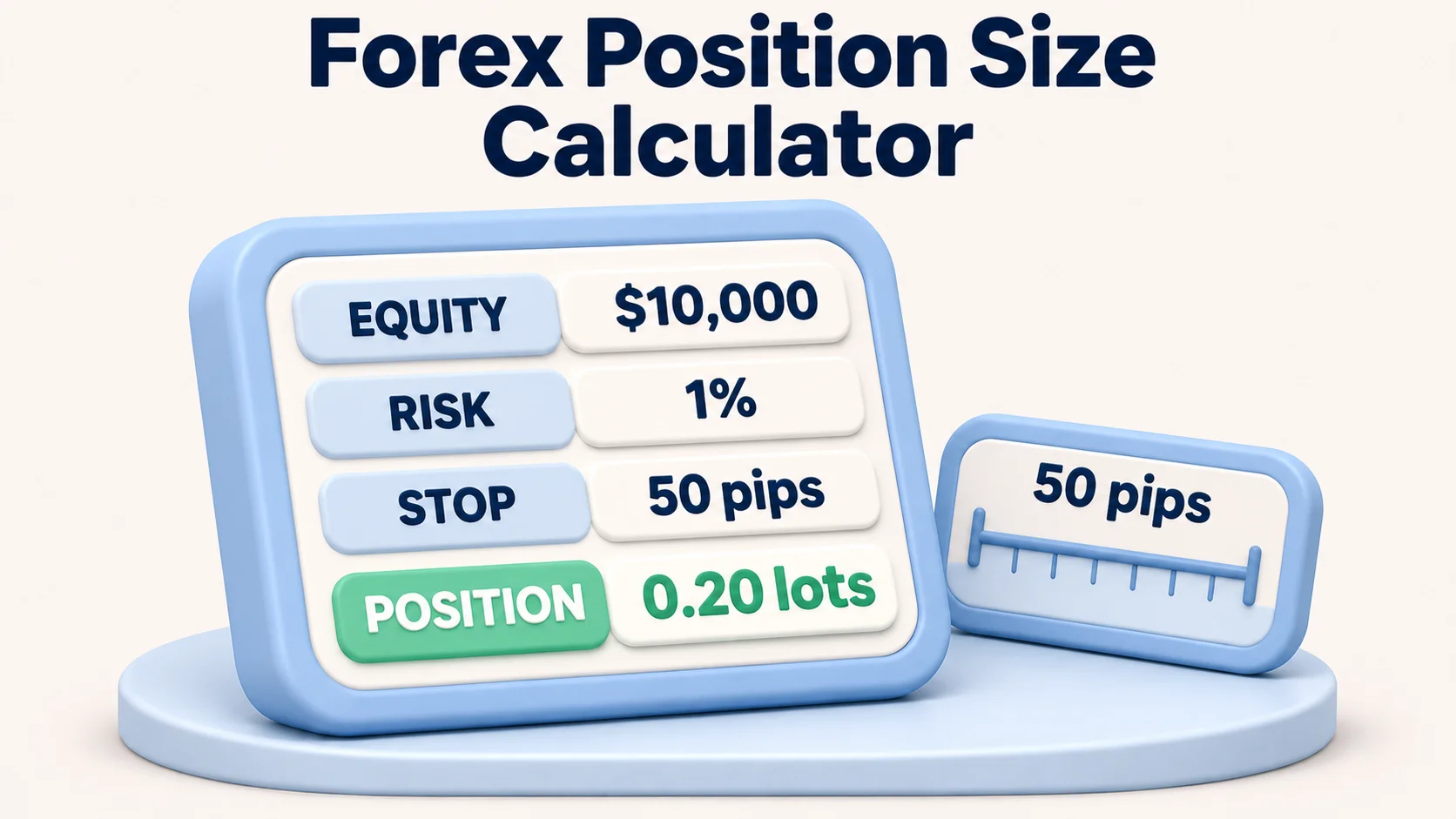
Assume $10,000 in equity, an intended 1% loss budget of $100, a 50-pip stop and no separate commission. With EUR/USD, a pip is $0.0001 per euro. At 50 pips, planned loss is $0.005 per euro; $100 divided by $0.005 gives 20,000 EUR, or 0.20 standard lots. This corresponds to $2 per pip before other costs. At a normal 0.01-lot increment, no further rounding is needed.
USD/JPY with a USD account
For a separate hypothetical example, assume the same $100 budget, a 40-pip stop and USD/JPY at an illustrative 150.00. Here 1 pip is ¥0.01 per dollar. The conversion from yen to USD is 1 ÷ 150, so loss per base unit over 40 pips is approximately $0.00266667. The raw size is 37,500 USD, or 0.375 lots. At 0.01-lot increments, round down to 0.37 lots (37,000 USD), giving an estimated $98.67 planned price loss, excluding fees. The conversion will change with the exchange rate and may differ between entry and exit.
EUR/GBP with a USD account
A cross-currency example needs an extra conversion. Assume $100 intended risk, 50 pips, EUR/GBP quoted in pounds and a purely illustrative rate of £1 = $1.28. A pip of EUR/GBP is £0.0001 per euro, or $0.000128 after conversion. Dividing $100 by 50 × $0.000128 gives 15,625 EUR, or 0.15625 lots. A 0.01-lot step rounds this to 0.15 lots, with estimated movement loss of $96 before commission. The $1.28 rate is an assumption, not a current GBP/USD quote.
What the calculator does not measure
Planned loss and realised loss are not the same number. An ordinary stop-loss instruction is triggered when a specified dealing price is reached under the broker's terms; it does not ensure that the order fills at that price. In a thin market, fast news move or weekend gap, an exit can execute farther away. FOREX.com's US execution guidance explains that a fast-moving quote can change before execution and the fill can be at the next available price.
For example, a 20,000 EUR/USD position planned around a 50-pip stop has a $100 price-movement risk under the assumptions above. If the actual exit is 80 pips adverse to entry, the price loss becomes $160 before commissions, financing or additional conversion costs. The tool's extra-adverse-pips field calculates a scenario like this. It cannot predict the worst possible gap, how bid and ask spreads change or whether a closing order will execute.
There are four additional checks before accepting any suggested size:
- Execution side and spread: Compare intended entry and stop fill on the correct bid or ask side. If the entered stop distance already incorporates spread, do not add the same spread again. If it does not, the calculated risk is incomplete.
- Actual contract and lot step: Verify the trading platform's minimum, maximum and increment. Some accounts express positions directly in units, while others use broker-defined lots; non-forex instruments have different contract sizes.
- Currency conversion and trading costs: An account not denominated in the quote currency needs a contemporaneous quote-to-account conversion. The result can change by settlement; commissions, financing and conversion markups add to trading costs.
- Margin and existing exposure: The tool does not estimate leverage or available margin and does not add the risk of existing or correlated positions. Passing a stop-loss budget test does not mean the account has enough margin.
The CFTC's retail forex advisory warns US customers that leveraged forex losses can exceed the initial deposit under the applicable terms. Risk figures are useful for planning, not a guarantee that loss will be confined to the chosen percentage. For related risk checks, see FXRanking's forex risk-management guide.
When to recalculate the trade size
Recalculate if equity changes, the stop needs to move, your broker changes the allowed lot increment, or the quote-to-account conversion becomes stale. Recheck near major announcements and before leaving a position over a market closure. If the rounded-down trade falls below the broker's minimum, the answer is no trade at that risk budget, not permission to increase the budget silently.
In 2026, the sensible use of a position-size calculator remains straightforward: decide on the stop and affordable loss, convert the pip movement accurately, round down to the trade size your account supports, and then consider adverse fills and the total portfolio. Neither a calculated lot size nor a stop-loss order makes a leveraged forex position safe.
Risk warning: Trading leveraged foreign exchange involves substantial risk, including rapid losses, stop-loss slippage, changing conversion rates and possible losses exceeding deposited funds depending on product and legal terms. Any automatically loaded rates are indicative references rather than your broker's executable quotations; worked trades remain hypothetical and no execution has been verified. A planned risk limit is not a guaranteed maximum loss.
FAQs
What does a forex position size calculator calculate?
It estimates base-currency units and lots from account equity, chosen risk percentage, stop distance, pip size and the currency conversion needed for the account. It is a planning estimate, not a guaranteed loss cap or a broker margin quote.
How is lot size calculated for a 1% risk budget?
Multiply current equity by 0.01, divide by stop distance times pip value in account currency, then convert units to lots using the actual contract size. Round down to the broker's permitted increment and check trading costs and margin separately.
Why does USD/JPY require a different pip calculation?
When JPY is the quote currency, a standard pip is ordinarily 0.01 yen rather than 0.0001 of the quote currency. A USD account trading USD/JPY must then convert the yen pip value into USD using an exchange-rate assumption, commonly the reciprocal of the entered USD/JPY price.
Can the calculator automatically fill the quote-to-account rate?
Yes. It attempts to fetch free indicative currency reference rates from ExchangeRate.fun and uses Frankfurter daily reference rates if the primary source fails. The date and source appear beside the inputs. If the sources are blocked, unavailable or stale, enter the correct rate manually. When account and quote currencies match, conversion is 1; when the account currency matches the base currency, it is the reciprocal of the entered pair price. These references are not executable broker quotes.
Why is the suggested trade smaller than the theoretical size?
The calculator rounds down to the specified lot step rather than rounding up beyond the intended budget. If even the minimum trade size would exceed the budget, the calculator shows zero lots instead of forcing a larger trade.
Does the calculator include spread, commission and slippage?
It can include an estimated round-trip commission per lot and display a user-selected adverse-pip stress scenario. It does not automatically estimate spreads, financing, execution gaps, conversion charges or the worst possible loss; the stop distance must reflect the prices and spread assumptions used.
Does this calculator work for gold, indices or futures?
It is designed for conventional spot-style forex pairs and base-currency lot contracts. Other instruments can use contract multipliers and tick rules that make this formula inappropriate. Use the actual instrument specifications and a purpose-built calculator instead.
Does the calculated position size include required margin?
No. Margin depends on the product, legal entity, leverage requirements, instrument, trading conditions and existing exposure. Calculate risk first, then check margin independently before placing a trade.

Stephen Bennet
Stephen Bennet is a Forex reviewer and financial analyst with more than 25 years of experience in the financial markets. He specializes in reviewing brokers, evaluating trading platforms, and explaining the Forex market in a clear and practical way. Through independent, trader-focused analysis, Stephen helps readers compare providers, understand key risks, and choose platforms with greater confidence.