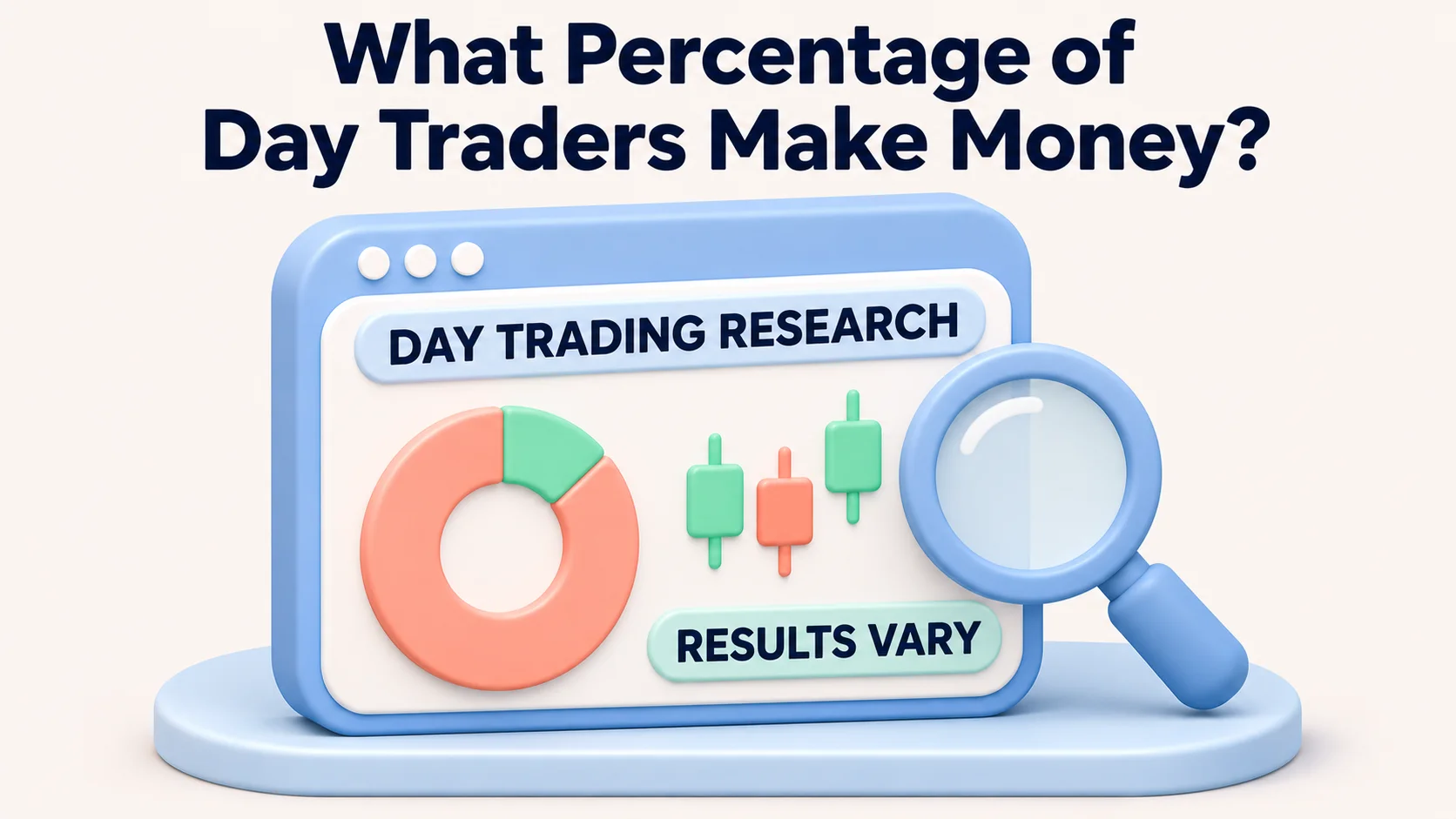
What percentage of day traders make money? There is no dependable single percentage for all day traders, and no verified current figure covering US retail forex traders specifically. Published studies point to difficult odds, but the answer changes depending on the market, period, participants, trading costs and what counts as success. A profit in one calendar year is not the same as consistent profits over several years, and neither guarantees an income sufficient to live on.
In one study of Brazilian equity-futures traders who persisted for more than 300 trading days, 97% lost money after exchange and brokerage fees. Research on Taiwanese stock-market day traders found that fewer than 1% achieved reliably positive abnormal returns after fees in a subsequent period. These percentages describe different outcomes in different historical samples; neither is a universal day-trading failure rate. The evidence is more useful when read alongside its definitions.
What Does the Day-Trading Success Rate Actually Mean?
People asking how many traders are successful may mean very different things. A trader can make money on a single trade, finish a month ahead, earn an annual profit after costs or produce repeatable excess returns. Someone with a small positive account return also may not earn enough to cover living costs, taxes or the time spent trading.
- Profitable trade: the exit value exceeds the entry value and relevant dealing costs for one position. This says little about the whole account.
- Profitable period: the trader finishes a defined month or year ahead after measured costs. A single good year might be luck.
- Predictably profitable: a study finds that previous success helps identify traders who subsequently earn positive returns after costs, beyond an appropriate benchmark. This is a stricter test.
- Trading for a living: profits are large, stable and accessible enough to cover expenses and risk. It is a higher bar than simply having a positive account.
Direct answer: Research supports the conclusion that sustained day-trading profitability is uncommon in the studied populations. It does not support an exact statement such as “97% of all day traders lose money” without identifying the particular sample and measurement.
What Do Individual Studies Show?
The most helpful way to compare evidence is to keep the instruments, observation periods and success definitions together.
| Study | Market and period | Reported result | What it does not show |
|---|---|---|---|
| Chague, De-Losso and Giovannetti, Day Trading for a Living? | Brazilian equity-index futures; entrants in 2013–2015, focusing on 1,551 traders who lasted more than 300 trading days | 97% of these persistent traders lost money net of exchange and brokerage fees; 47 of 1,551 (3.0%) had positive net profit | Not a success rate for all beginners, US stocks or US forex |
| Barber, Lee, Liu and Odean, The Cross-Section of Speculator Skill (2014) | Taiwan Stock Exchange; trading records from 1992–2006 | Fewer than 1% of the overall day-trader population reliably earned positive abnormal returns net of fees in subsequent trading | Not the percentage that earned any profit in one year, or a present-day US rate |
| Barber, Lee, Liu, Odean and Zhang, Learning, Fast or Slow (2020) | Taiwanese day traders; historical Taiwan stock-exchange records | About 97% of active day traders were classified as likely to lose in future trading using historical experience and performance | Not a measured 97% loss rate across US brokerage accounts |
Brazil: 97% of persistent futures day traders lost money
In Day Trading for a Living?, Fernando Chague, Rodrigo De-Losso and Bruno Giovannetti examined traders entering Brazil’s equity-futures market between 2013 and 2015. The working paper identifies 19,646 new day traders, of whom 1,551 continued for more than 300 trading days. Among that persistent group, 47 traders, or about 3%, had a positive average net trading result. The other 97% lost money after the costs measured by the researchers.
The 300-day condition matters. The result is about people who kept trading despite a lengthy period of activity, not everyone who briefly tried day trading. The researchers also examined whether results improved with experience and reported no evidence of learning in this dataset. That is a finding about those futures-market cohorts, not proof that learning is impossible in every market or for every person.
Taiwan: a profitable year is not the same as repeatable skill
In the 2014 study of Taiwanese stock-market day traders, Brad Barber and co-authors analyzed trading from 1992 through 2006. In an average year, around 277,000 participants traded more than NT$600,000 worth of shares intraday, and about 20% of this more-active group earned positive abnormal returns after measured fees in that year. Some profitable outcomes can occur by chance.
The researchers then asked a harder question: could past performance identify traders who would produce positive abnormal returns after costs in later trading? Their analysis estimated that fewer than 1% of the overall day-trader population could do so reliably. The 20% and fewer-than-1% figures are not contradictory: they use different tests and denominators. One describes a year's net outcome for an activity-filtered group; the other describes repeatability and skill across time.
A later Taiwanese study: 97% were predicted to lose in future trading
In Learning, Fast or Slow, published in 2020, Barber and co-authors sorted Taiwanese day traders by prior experience and profitability after trading costs. They found that only the most experienced previously profitable segment—less than 3% of active day traders on an average day—predictably earned positive future net returns. Their model classified approximately 97% of active traders as likely to lose money in future day trading.
The paper also reported that about 74% of trading volume was generated by traders with a history of losses. This speaks to continuing to trade despite prior poor results. It does not mean 74% of all account balances were lost or that 97% of US traders actually lost money in a particular calendar year.
Why the Market, Sample, Time Period and Costs Matter
Stock day trading, futures and retail forex are not identical
The Brazilian study involves exchange-traded equity futures, while both Taiwan studies analyze securities trading. US retail forex commonly involves off-exchange currency contracts with dealer-specific spreads, commissions, financing and counterparty arrangements. Futures use exchange margin and contract-specific tick values. Stocks and options have their own execution, settlement and account rules. The competitive environment, leverage, fees, available information and trader mix therefore differ.
These papers provide strong cautionary evidence about short-term speculative trading, but they cannot be combined to calculate a current US forex win rate. A search result or an advertising claim that simply repeats “97% lose” is omitting essential context unless it identifies the study and population.
Entry and survival selection affect the denominator
A study that follows only traders who remain active for 300 days excludes those who stopped earlier, including people who quit after losses and those who stopped for other reasons. An annual trading sample also includes occasional traders who trade very differently from people making multiple round trips every day. If a result is described as “one in 100 traders,” ask whether the denominator includes all first-time traders, those active on a particular day, or only traders above a minimum activity threshold.
Survivorship bias also distorts success stories. Traders who earn impressive returns may keep posting screenshots or offering courses, while those who stop trading become less visible. Neither visible winners nor visible failures form a representative survey of all trading accounts.
Costs and the time horizon can turn a gross winner into a net loser
Every short-term trade starts with an economic hurdle: bid-ask spread, any commissions, slippage, exchange or regulatory charges where applicable, and sometimes financing. A hypothetical trader earning $50 in gross gains while paying $20 in total trading costs has only $30 before any applicable tax. If gross gains fall to $15 with the same $20 cost, the outcome is a $5 net loss. These are illustrative arithmetic examples, not estimates of a real broker's rates.
For a fair comparison, ask whether the study includes commissions, trading taxes, exchange charges and realistic execution prices; whether it reports gross or net results; and whether it measures a day, a calendar year or performance across successive years. Even a positive net trading return may compare poorly with a diversified investment after adjusting for risk and time spent.
Why Studies Cannot Tell You Your Personal Chances
A historical result is not a probability assigned to an individual trader. The studies differ in product, market structure, available information, competition, sample dates and selection methods. Markets and trading technology have changed since the Taiwanese 1992–2006 data and Brazilian 2013–2015 entry cohorts. One successful period in a trading journal also cannot establish a repeatable edge.
For a more meaningful personal assessment, review a sufficiently long, complete record of all trades—not just winning screenshots. Track gross and net profits, commissions and spreads, average gain versus average loss, worst drawdown, position size, leverage, number of trading days, time invested and performance across changing market conditions. Include deposits and withdrawals correctly so a cash addition is not confused with trading profit. A demo record can help evaluate rules but cannot reproduce all live fills, liquidity, psychological pressure or financing terms.
If a coach, platform or trading group quotes a high success rate, ask for the market, dates, total number of participants, number of accounts excluded, net-return calculation and an independently documented methodology. A percentage without these elements does not establish a reasonable expectation of income.
What Should a US Reader Consider Before Day Trading?
US readers should first identify the instrument and account they intend to use. Retail forex, exchange-traded futures and stock trading have different costs, margin obligations and oversight. The FXRanking forex day-trading guide explains currency-session choices, spreads, order planning and risk sizing; it is not a source of verified population-wide profitability statistics.
FINRA's guidance on frequent intraday trading warns that active securities trading can result in substantial losses, particularly with margin. Margin-account requirements can change and firms may be at different stages of implementing the June 2026 intraday-margin framework, so the broker's currently applicable account rules matter. No account minimum, stop-loss setting or demo performance guarantees that a trading strategy is profitable.
Trading risk: Day trading is speculative. Repeated trading costs, leverage, slippage, gaps and forced liquidation can produce rapid or substantial losses, potentially beyond deposited funds depending on the account and product. Do not treat a research percentage as a promise of returns, and do not risk money needed for living expenses or emergencies.
Bottom line: Headline percentages are useful warnings, but a trading decision should rest on the study's market, costs, participant selection and definition of repeatability—not on one catchy number. No historical sample guarantees a personal outcome.
FAQs
What percent of day traders are profitable?
There is no reliable universal percentage. One Brazilian equity-futures study found 3% of traders who continued for more than 300 trading days made a positive net profit. A Taiwanese securities study found fewer than 1% achieved reliably positive abnormal returns after fees over time. These results measure different things and are not US forex success rates.
Do 97% of day traders really lose money?
The 97% figure is accurate for the 1,551 persistent Brazilian equity-futures traders in the cited study. A separate Taiwanese study classified about 97% of active traders as likely to lose in future trading. Neither finding establishes that 97% of every day-trading population loses money.
How many day traders make a living?
That requires more than a positive trading balance. Earnings must be large enough, sufficiently consistent and sustainable after costs and personal financial obligations. The Brazilian study found very few of its persistent futures traders earned amounts comparable with common wages; it does not provide a current US count.
What is the difference between profitable and consistently profitable?
Being profitable can mean finishing one trade, month or year ahead. Consistent or predictably profitable trading requires evidence of repeatable performance after costs across changing conditions, not a lucky period.
Does the less-than-1% figure apply to US forex traders?
The less-than-1% figure comes from research on the Taiwanese stock market using 1992–2006 data and a specific statistical test of reliably positive abnormal returns after fees. It cannot be applied as the measured rate for US forex traders.
Are these day-trading studies based on costs?
Each headline study evaluates performance net of specified fees or transaction costs. Their definitions are not identical and need not match the current spreads, commissions or executions of any particular US account.
Does practising for 300 days improve the odds?
Not automatically. The Brazilian paper reported no evidence of performance improving with experience in its persistent futures-trader sample. That does not show that training never helps anyone, but time spent trading alone is not proof of skill.
Can a high winning-trade percentage guarantee profits?
A high winning-trade percentage can coexist with an overall loss when losing trades are much larger than winning ones. Evaluate net profit after costs, average gains and losses, drawdown, leverage and results across enough market conditions.
Is the evidence specifically about US retail forex?
The cited empirical studies examine Brazilian equity futures and Taiwanese securities. US retail-forex traders face different products, counterparties and costs. These papers do not supply a verified, current, representative US retail-forex success percentage.

Nathan Wong
Nathan Wong is a Forex education contributor with 15 years of trading and market-analysis experience. He specializes in broker platforms, cryptocurrency, risk management, and trading psychology, creating practical content that helps readers make informed decisions and develop realistic expectations.