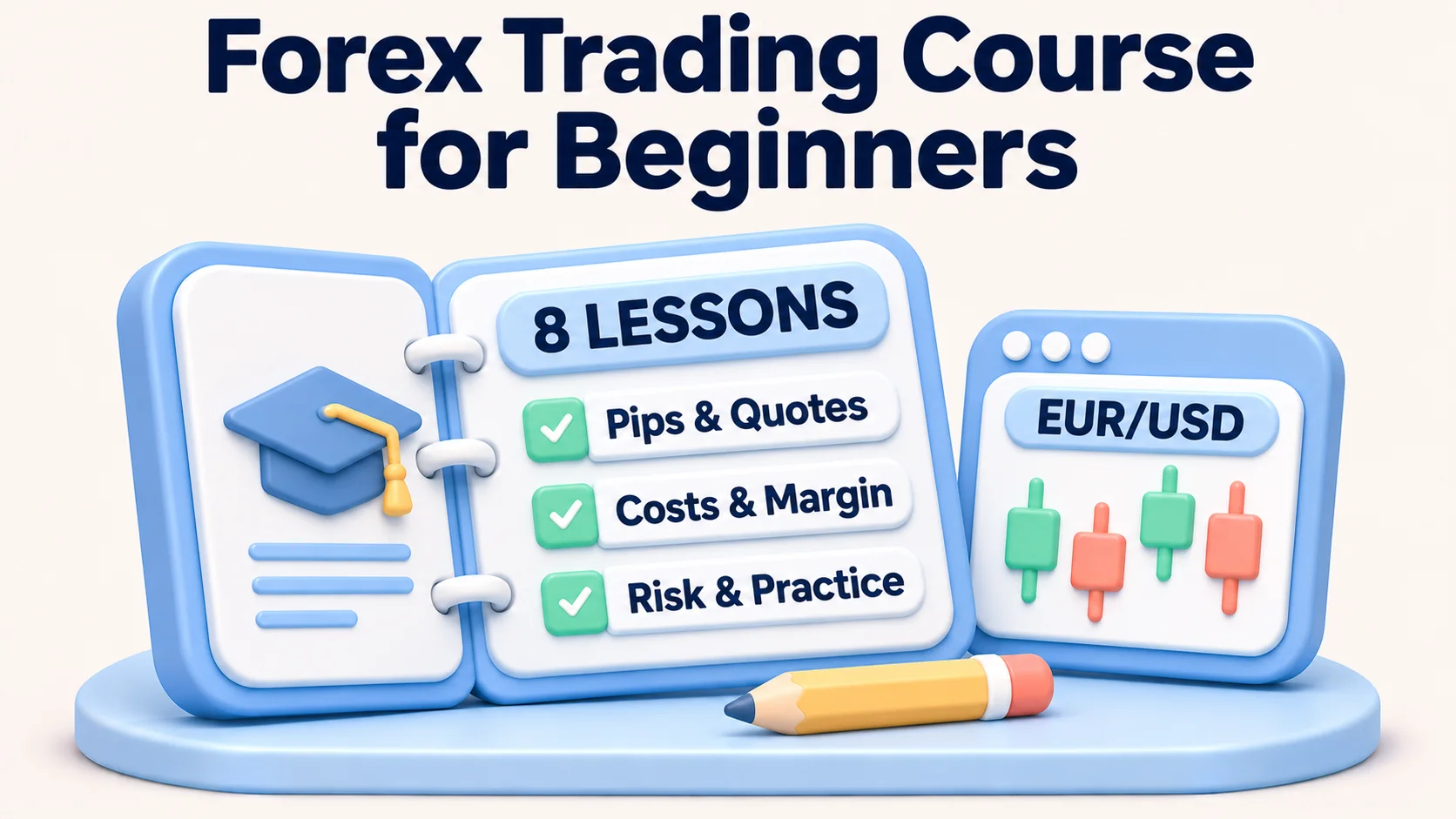
A beginner forex course should teach you to read prices, calculate costs, understand leverage and check a dealer before you ever consider a live trade. This self-paced, eight-lesson introduction is designed for US readers. It uses hypothetical examples and written exercises, not simulated profits or a promise that completing lessons will make trading suitable or profitable.
How to use this course: Work through lessons in order. Try each exercise before opening the answer, using pencil and paper or a spreadsheet. The activities do not require a funded account. If you cannot explain why a position can lose more than its initial margin, revisit Lesson 4 before attempting the final practice plan.
Risk warning: Off-exchange retail forex is leveraged and highly speculative. Prices can gap, spreads can change and stop orders do not guarantee a loss cap. You can lose your entire deposit and, depending on the circumstances and account agreement, owe more. This course is education, not personalized investment advice or a claim that trading is a dependable income source. Do not trade with money needed for living expenses.
Course outline: eight lessons and a final assessment
| Lesson | What you will learn | Evidence you can produce |
|---|---|---|
| 1. The forex market | Spot prices, OTC dealers and listed futures | Explain which product a sample account offers |
| 2. Reading a quote | Pairs, pips, bid, ask and trade sizes | Calculate a price move and pip value |
| 3. True trading costs | Spread, commission, slippage and financing | Build an all-in illustrative cost estimate |
| 4. Leverage and margin | Notional exposure, deposits and possible losses | Distinguish required margin from money at risk |
| 5. Orders and position sizing | Stops, limits, cash risk and imperfect execution | Size a hypothetical trade using a loss budget |
| 6. Dealer safety | US registration, contract terms and fraud signals | Complete a dealer-check worksheet |
| 7. Demo practice | Trading plans, observations and journal records | Complete a practice log without a live trade |
| 8. Review and next steps | Checking understanding and deciding whether to stop | Finish the capstone and answer key |
Lesson 1: Understand what forex trading is
Learning goal: identify the instrument, the counterparty and the source of price quotes
Foreign exchange is the exchange of one currency for another. Retail speculation usually focuses on the change in an exchange rate, such as EUR/USD, rather than exchanging cash for travel. The base currency is first (EUR); the quote currency is second (USD). If EUR/USD is 1.1000, one euro is worth $1.10 in that quote.
For a US resident, the word forex does not automatically name one legal product. An off-exchange (OTC) retail forex account is typically a contract with a dealer. The dealer provides prices and is the customer's trading counterparty. Exchange-traded currency futures are standardized instruments with specific contract sizes and expiries that trade on a regulated futures exchange. Futures have their own tick values, margin, commissions and clearing arrangements. Do not transfer pricing, leverage or protections from one product to the other.
The CFTC's retail forex customer advisory emphasizes the OTC dealer relationship and the risks of leverage and dealer-controlled pricing. To explore the wider market basics, use FXRanking's beginner forex roadmap as background reading. This course adds practice tasks rather than repeating the roadmap's entire account-opening sequence.
Practice 1: identify the product
Offer A states that all trades are off-exchange with the firm as counterparty. Offer B lists standardized EUR currency futures contracts with expiry months and exchange rules. Question: Which sounds like OTC retail forex, and which sounds like listed futures? What document would confirm the answer?
Check your answer: A describes OTC dealer forex; B describes listed futures. Verify each with the firm's actual client agreement, product specifications and applicable regulator information. A trading platform's appearance alone cannot identify the legal product.
Lesson 2: Read a quote and calculate a pip
Learning goal: turn a quoted move into a currency amount
A forex quote normally shows two prices. The bid is the price at which you can sell the base currency; the ask is the price at which you can buy it. The ask is generally higher. The difference is the spread, one component of trading cost.
A pip is conventionally 0.0001 for most pairs such as EUR/USD, but commonly 0.01 for pairs with JPY as the quote currency. A pip is a unit of price change, not a fixed dollar return. For a USD account trading EUR/USD, a position of 10,000 euros has a pip value near $1 because 10,000 × 0.0001 = $1. For 100,000 euros, one pip equals $10. For a pair whose quote currency is not USD, conversion to account currency is necessary.
Worked example: A hypothetical EUR/USD bid/ask is 1.10000/1.10015. Its spread is 0.00015, or 1.5 pips. Buying 10,000 euros and immediately selling at unchanged prices creates a $1.50 gross spread loss before commission and slippage. A movement from 1.1000 to 1.1025 is 25 pips, but an actual position's result also depends on entry/exit sides, size and costs.
Practice 2: do the arithmetic
Question A: USD/JPY moves from 151.20 to 151.55. How many pips is that? Question B: With EUR/USD at 1.08500/1.08520, what is the spread in pips and the spread-only cost on a 10,000-euro position?
Check your answers: A: 35 pips because 0.35 ÷ 0.01 = 35. B: 2 pips and approximately $2 because 10,000 × 0.00020 = $2. These are hypothetical quotes, not a broker's current prices.
Lesson 3: Calculate the cost of a trade before evaluating a strategy
Learning goal: estimate how far price must move to cover transaction expenses
Trading cost is not necessarily just the quoted spread. A trader may also pay commissions for opening and closing, experience slippage if the fill differs from the expected price, face currency conversion charges and incur overnight financing or rollover when a position remains open across a broker's daily cutoff. Some accounts advertise a tight spread but charge a separate commission; others quote a wider spread without a separately labeled dealing commission. Compare the same position size and holding period.
| Illustrative EUR/USD round trip | Assumption | USD cost on 10,000 EUR |
|---|---|---|
| Spread | 1.5 pips; $1 per pip | $1.50 |
| Round-trip commission | Hypothetical total | $2.00 |
| Adverse slippage | 0.5 pip total | $0.50 |
| Combined direct costs | Excludes financing and conversion | $4.00 |
Under these assumptions, a 10,000-euro position earns or loses about $1 for each pip of price movement. It would need roughly four favorable pips merely to offset the modeled $4 direct cost, before any financing, conversion or tax effect. Real commission conventions vary by broker and account, and slippage is uncertain, so this is a teaching exercise rather than an advertised fee or predictable break-even price.
Practice 3: compare two accounts on the same assumptions
Account A has a 1.8-pip spread and no separate commission. Account B has a 0.6-pip spread and a hypothetical $3 round-trip commission per 10,000-euro trade. Assume EUR/USD, a $1 pip value, no slippage and no financing. Which has the lower direct cost?
Check your answer: A costs $1.80 and B costs $0.60 + $3.00 = $3.60. A is cheaper under these exact assumptions, despite the wider spread. This does not establish which real account is cheaper under different sizes, sessions or charges.
Lesson 4: Understand leverage, required margin and loss
Learning goal: distinguish the deposit requirement from economic risk
Notional exposure is the position's market value. Margin or security deposit is the amount required to support that position. Leverage measures how much market exposure a smaller amount of account capital supports. A low deposit requirement is not a stop-loss setting and not an affordable-loss calculation.
For US off-exchange retail forex, the CFTC describes security-deposit thresholds of 2% for major pairs and 5% for other pairs; in simple terms, these correspond to notional-to-deposit ratios of 50:1 and 20:1. These figures are regulatory parameters, not recommendations to use maximum permitted exposure. Actual dealer requirements, concentration and maintenance policies may be more restrictive. A currency-futures margin requirement is a separate product calculation.
Worked example: A hypothetical USD-equivalent $10,000 forex position with a 2% opening requirement calls for $200 of initial security deposit. A 1% adverse change in the position's value is about a $100 trading loss before costs, or half the initial $200 deposit. The trader has not lost only 1% of the margin; the loss is calculated on the much larger notional exposure. Further price moves, widening spreads and forced liquidation can worsen the outcome.
Practice 4: separate margin from risk
A trader has $1,000 of equity and enters a $20,000 notional position requiring a hypothetical 2% opening deposit. Question: What is the $400 deposit, and how much is a 2% adverse price movement worth before fees?
Check your answer: $20,000 × 0.02 = $400 is required opening margin, not a loss cap. A 2% adverse change in the underlying position is about $400 before costs, or 40% of the initial $1,000 equity. In real markets the conversion and product details matter; do not assume the position would remain open through that full move.
Lesson 5: Use orders and position size as planning tools
Learning goal: state your maximum planned exposure without claiming it is guaranteed
A market order seeks prompt execution but the fill price can differ from the quote seen. A limit order specifies a price boundary, but may not fill. A stop order can trigger an exit after a specified level is reached, but fast markets, gaps or liquidity changes can cause execution beyond that level. The dealer's precise order definitions govern what actually happens.
One planning method starts with a cash loss budget: planned risk budget ÷ (stop distance × pip value per unit of trade size). The resulting position size is only a planning figure. A stop can slip and commissions and spreads can make the loss greater. The trader also needs to consider correlated positions and total margin use.
Worked example: A hypothetical $2,000 account allocates 0.5% of equity, or $10, to a practice trade. The planned stop is 20 pips from entry on EUR/USD. For a USD account, 10,000 euros has about $1 per pip. A 5,000-euro position has about $0.50 per pip, so a 20-pip move represents $10 before trading costs and slippage. If estimated costs must fit inside the $10 budget, the size must be reduced or the setup rejected. A 0.5% rule is an example, not a universal safe threshold.
Practice 5: set a smaller position
With a hypothetical $1,500 account, a 1% planned cash budget is $15. On EUR/USD, suppose the planned stop is 30 pips and costs are ignored for this first calculation. What is the approximate euro position size?
Check your answer: $15 ÷ 30 = $0.50 per pip, corresponding to about 5,000 euros (0.05 standard lot). Adjust downward for costs and uncertainty. Whether that size is available depends on the actual account's minimum and incremental trade size.
Lesson 6: Verify a US forex dealer and recognise course scams
Learning goal: investigate the exact legal company before providing money or documents
A brand name, high-quality website, foreign licence or familiar software platform does not prove that a company may accept a US resident for the exact product offered. Start with the legal name printed in the proposed client agreement. Use the NFA BASIC database to check the firm's registration, status and disciplinary information, and compare it with the CFTC's forex fraud guidance. Verify the relevant activity and account type rather than treating a registration number as universal permission.
Read withdrawal terms, funding methods, pricing, margin and liquidation rules, complaint routes and the treatment of customer money. The CFTC warns that some forex frauds advertise outsized guaranteed returns, encourage contact through private messaging apps, rely on offshore dealers or demand invented charges to release withdrawals. None of these tactics becomes trustworthy because a paid course, influencer or signal provider recommends it.
The CFTC also provides guidance on assessing trading education: prefer useful free resources before paying for seminars, scrutinize instructor backgrounds, examine the full fees and avoid guaranteed-return promises. That advisory discusses futures and options courses, so its warning signs are applied here as general course-selection principles, not as a claim that every forex course is regulated under the same rules.
Original worksheet: the six-box dealer and course check
| Question to research | What to record |
|---|---|
| 1. Who holds the account? | Exact legal name and address from the proposed agreement |
| 2. What is its authorization? | Date of the NFA BASIC lookup, status and relevant disciplinary disclosures |
| 3. What product is it? | OTC retail forex or exchange-traded currency future; applicable jurisdiction |
| 4. What are the costs? | Spread, commission, financing, funding and withdrawal terms |
| 5. How is money handled? | Deposit and withdrawal process, margin events and complaint route |
| 6. Is the course credible? | Instructor qualifications, independent sources, price and refund terms; no profit claims |
Practice 6: If a promoter says a foreign regulator approved its group company but the US client's agreement names another entity, has US eligibility been established? Answer: No. Verify the actual contracting entity and permitted US product independently. Do not send funds or sensitive information to resolve the uncertainty.
Lesson 7: Create a practice plan and journal
Learning goal: collect observations without confusing them with live results
A demo account can help you learn platform navigation, order entry, price changes and the discipline of writing down decisions. It does not recreate every aspect of live liquidity, emotions, slippage or order restrictions. Choose one widely traded pair, one observation session and clear rules for when not to open a position. If you are uncertain about the product or account terms, use paper examples instead of opening a demo.
For five hypothetical observations, record the setup, bid and ask, planned entry and stop, size, the projected spread/commission cost, a relevant economic event and the reason the proposed trade does or does not qualify. Do not change the plan after seeing the outcome. A sample of five observations is suitable for practicing the worksheet, not for proving that a strategy works.
| Journal field | Example entry (invented for illustration) |
|---|---|
| Instrument and environment | EUR/USD, paper exercise |
| Quote observed | 1.08740 bid / 1.08756 ask |
| Setup and invalidation | Range break; invalid below prior range |
| Cash budget and proposed size | $10 planned, 5,000 euros |
| Estimated trading costs | 1.6 pips plus hypothetical commission |
| Event or restriction | US data release pending; no entry under practice rule |
| Decision and reason | Stand aside because planned event-risk rule applies |
Review whether your reasons and arithmetic stayed consistent, not simply whether the next candle went up or down. If it is difficult to explain position size, effective cost or why a trade is invalid, repeat Lessons 2 through 5 before moving forward. FXRanking's day-trading guide explores how short holding times change costs and decision pressure; day trading is not a required progression for new students.
Lesson 8: Final assessment and a cautious next step
Learning goal: demonstrate understanding rather than claim proficiency
Complete these questions without checking the lesson text first:
- What is the difference between OTC dealer forex and listed FX futures?
- What is a 1.2-pip EUR/USD spread worth on a 10,000-euro position in a USD account, before other charges?
- Why can an account with a lower advertised spread be more expensive?
- Why is a $200 margin requirement not the maximum loss on a $10,000 position?
- What does a stop order not guarantee?
- Which exact company name should you verify in NFA BASIC?
- What does demo practice fail to establish about real-money execution?
- What is the appropriate response to an instructor promising guaranteed weekly forex profits?
Assessment answers
- OTC forex is generally a direct dealer relationship; futures are standardized, exchange-listed contracts with their own expiries, clearing and specifications.
- Approximately $1.20: 1.2 × $1 per pip.
- Separate commission, slippage, financing or conversion may outweigh the spread advantage.
- Loss follows notional exposure and price movement, not the amount initially deposited as margin.
- It cannot guarantee execution at its trigger price or a maximum cash loss.
- The contracting entity actually named in the account agreement, with its activity and status checked.
- It cannot prove live liquidity, execution, profitability or legal permission for a different account.
- Do not rely on or pay for the promise; verify qualifications, costs and claims independently.
Capstone exercise: Produce a one-page fictional trading plan showing (a) the product and dealer-verification questions, (b) a two-sided quote and spread cost, (c) a planned position and margin calculation, (d) a cash-loss budget and order assumptions, (e) a reason to stand aside and (f) a journal template. Make all prices and commissions visibly hypothetical. A coherent plan demonstrates basic understanding of course concepts; it does not certify trading ability, readiness or future returns.
Where to go next: Stay with paper exercises or a suitable demo until you can explain the calculations and risks without help. If you cannot independently verify an account provider, avoid opening the account. If you decide that leveraged speculation is unsuitable, stopping after the educational course is a valid outcome.
Course methodology and further reading
The instructional sequence separates product identification, arithmetic, risk, dealer verification and demo observation. The examples are original hypothetical calculations, not historical trade results, live broker quotes, completed account tests or investment recommendations. The lessons were prepared using publicly available US CFTC guidance, NFA registration tools and the course structures visible in current educational providers. Regulatory and broker terms can change, so check the dated primary information and current client agreement before acting.
Useful primary references include the CFTC OTC forex advisory, CFTC forex fraud page, NFA BASIC and the CFTC's guide to evaluating trading courses. For a broader conceptual introduction, revisit FXRanking's existing beginner roadmap; for broker evaluation, use its seven-check broker guide. These links provide education or verification routes, not endorsements of specific US brokers.
FAQs
Is this a real trading course or just an article?
It is a self-paced eight-lesson written curriculum with worked calculations, practice questions, answer keys, a dealer-check worksheet and a capstone. It does not include certified instruction, graded tutoring, progress accounts or a claim that completing it makes someone ready for live trading.
Can a complete beginner learn forex without paying for a course?
Basic terminology, pricing arithmetic and safety concepts can be learned from reputable free sources such as CFTC educational materials and well-structured introductory lessons. Paid tuition does not guarantee better results or trading profits.
How long should it take to learn the forex basics?
There is no reliable universal timeline. Reading a lesson is not the same as demonstrating understanding. Progress by checking calculations and explanations rather than measuring days or treating course completion as trading proficiency.
Is forex trading legal for US residents?
US residents can access certain regulated products and firms, but permissions depend on the actual contracting entity and instrument. OTC retail forex and exchange-traded currency futures have different rules. Verify the exact dealer and product using NFA BASIC, CFTC guidance and the account agreement.
What is the difference between pips and profit?
A pip is a quoted price increment, commonly 0.0001 for EUR/USD and 0.01 for USD/JPY. The cash impact depends on position size, quote currency, account currency and trading costs; a move in the expected direction does not guarantee net profit.
How do I calculate the trading costs of forex?
Start with spread measured in pips multiplied by the position’s pip value. Add any round-trip commission, slippage, currency conversion and applicable overnight financing. Check the actual account schedule and use consistent trade size and holding period.
Is a demo account enough to learn trading?
A demo can teach order entry and practice habits but cannot prove live execution, profitability or permission for a particular US account. Use demo results as practice observations, not evidence that a strategy will succeed with real money.
How much money should a beginner put into forex?
No fixed minimum is a safe or suitable amount for every person. An advertised minimum deposit is not a recommended budget. The course does not require funding; do not risk money needed for essential expenses, and understand all product and margin risks first.
What are the warning signs of a forex trading course scam?
Guaranteed returns, pressure to buy immediately, unclear instructor credentials, hidden recurring fees, requests to pay extra to withdraw funds and promotion of unverified offshore dealers are warning signs. The CFTC recommends independent checks before paying for instruction or trading.
Does an NFA registration number guarantee that a broker is safe?
Registration is not a safety guarantee. Verify the exact legal company, status, relevant activity and disciplinary record, then read product and account terms. Registration does not remove trading, pricing, solvency or execution risks.

Nathan Wong
Nathan Wong is a Forex education contributor with 15 years of trading and market-analysis experience. He specializes in broker platforms, cryptocurrency, risk management, and trading psychology, creating practical content that helps readers make informed decisions and develop realistic expectations.