An Indian exchange-traded currency-derivatives broker provides access to eligible currency futures and options through a recognised stock exchange. For an importer with a contracted US-dollar invoice, a long USD/INR futures position can help offset the rupee cost of a stronger dollar. Its main use is to manage a contracted exchange-rate exposure rather than take an unhedged currency position.
Worked example: hedging a US$10,000 import invoice
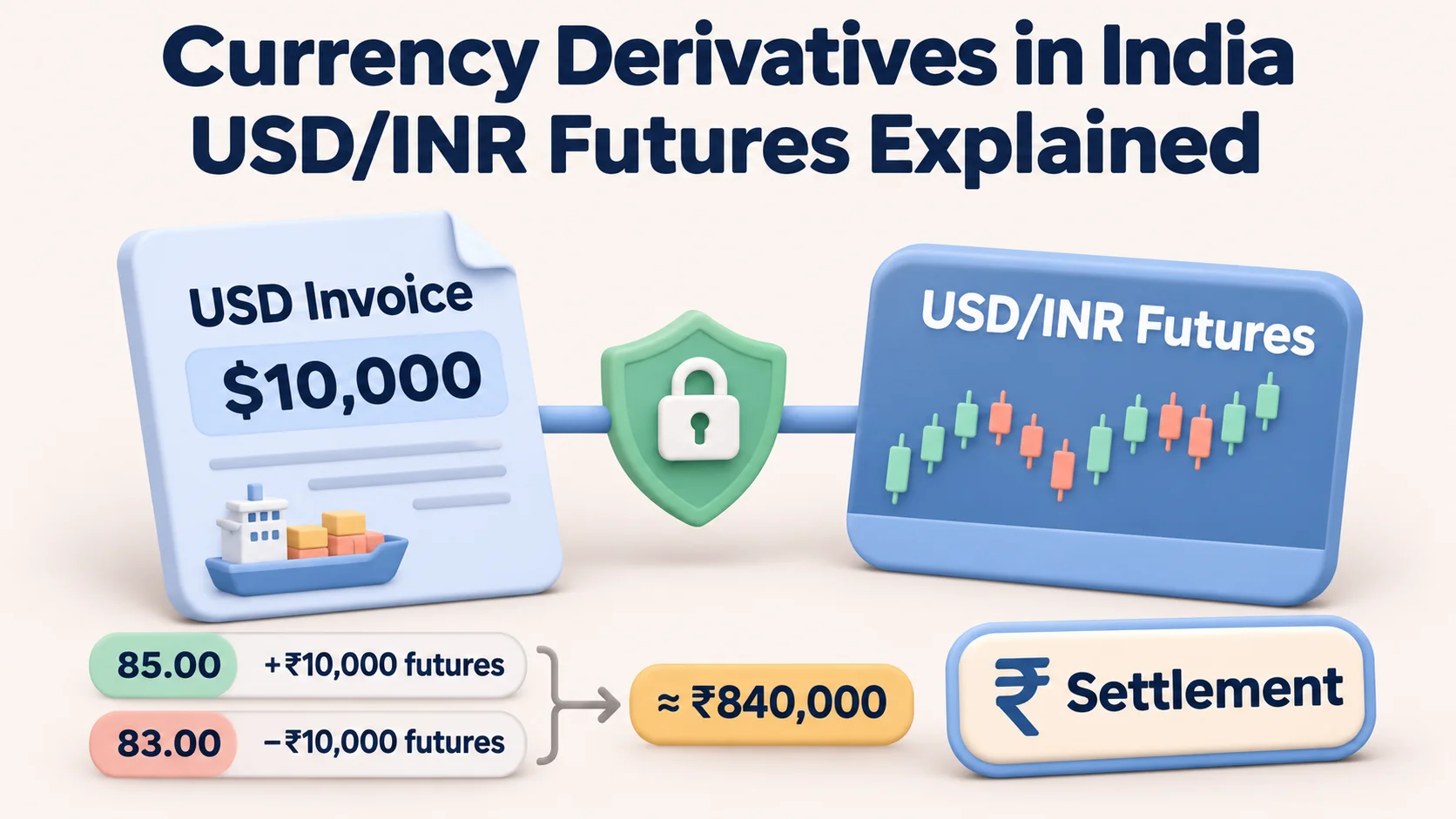
Assume an eligible Indian importer owes US$10,000 under a genuine contracted invoice. A standard NSE USD/INR futures contract represents US$1,000, so the importer buys 10 contracts at an assumed ₹84.00 per US dollar. The invoice payment and futures closeout occur at matching dates and rates in this simplified calculation. These rates are illustrative, not market quotations.
| USD/INR at payment | Cost of US$10,000 invoice | 10 long futures | Effective rupee outflow before costs |
|---|---|---|---|
| ₹85.00 | ₹850,000 | ₹10,000 gain | ₹840,000 |
| ₹83.00 | ₹830,000 | ₹10,000 loss | ₹840,000 |
Futures profit or loss equals 10 × US$1,000 × (closing USD/INR rate − ₹84.00). A ₹1 movement therefore changes the position's value by ₹10,000. In each matched-rate scenario, the futures result offsets the change in the invoice's rupee cost. Brokerage, spreads, taxes and differences between actual rates and dates can change the outcome.
The futures settle in Indian rupees, not US dollars. NSE USD/INR futures involve daily mark-to-market cash flows and rupee final settlement. The importer must buy US dollars separately through a permitted foreign-exchange channel to pay the invoice.
What a currency-derivatives broker provides
A broker executes eligible currency futures or options orders on the relevant exchange segment, administers margin requirements and handles the resulting clearing and settlement obligations. Access depends on the broker's registration and membership, the contracts currently enabled and the customer's permitted trading purpose. An exchange-traded currency contract is not the same product as an offshore leveraged spot-forex or CFD account.
NSE contract specifications cover INR pairs such as USD/INR, EUR/INR, GBP/INR and JPY/INR. The standard USD/INR futures tick is ₹0.0025 per US dollar (0.25 paise), equal to ₹2.50 for one US$1,000 contract. Published contract terms do not establish an individual customer's permission to trade.
RBI eligibility rules and the US$5 million threshold
For foreign-currency/INR derivatives, RBI foreign-exchange guidance identifies hedging exchange-rate risk as the permitted purpose. An import invoice can constitute an underlying contracted exposure, but the transaction must also meet the applicable FEMA directions, recognised-exchange conditions and account requirements. A view on the rupee's direction, without a qualifying exposure, is not a substitute for a hedge.
What changed in October 2026?
On 10 October 2026, RBI A.P. (DIR Series) Circular No. 25 reduced the threshold for specified INR derivative positions without having to establish the existence of an underlying exposure upfront from US$100 million to US$5 million equivalent of outstanding notional. For exchange-traded positions, that is one combined limit across all INR currency pairs and recognised stock exchanges, not a separate allowance for each exchange or contract. The circular also revised a separate threshold for qualifying hedges through authorised dealers.
A valid underlying exposure remains necessary. The revised threshold changes the conditions for establishing that exposure; it does not authorise unhedged currency speculation. The RBI Master Direction on Risk Management and Inter-Bank Dealings supplies the broader framework, while SEBI’s 5 November 2026 circular addresses the exchange-traded implementation.
How to verify an Indian currency-derivatives broker
- Check the legal entity. Match the broker's exact name and registration number against SEBI’s currency-derivatives broker register. Confirm current exchange membership and activation of the currency-derivatives segment.
- Confirm the contract and customer eligibility. Ask whether the intended USD/INR expiry is available, which documents or declarations support the contracted exposure and whether the account is enabled for that product.
- Compare full trading costs and cash requirements. Check entry and exit brokerage, exchange and statutory fees, bid-ask spread, margin, daily settlement and the broker's forced-closeout policy.
The RBI Alert List is a warning check, not a list of every unauthorised entity; absence from it does not establish authorisation. For named providers and a more detailed broker comparison, consult the separate FXRanking India broker guide.
Where a USD/INR futures hedge can fall short
Basis risk arises when the futures settlement price differs from the exchange rate used to purchase invoice dollars. Timing risk arises when the contract expires before or after payment. Liquidity and execution costs can affect the price obtained, while daily mark-to-market losses may require cash before the invoice is due. Incorrect position sizing can leave part of the invoice unhedged or create excess exposure. An authorised-dealer forward may suit some invoice dates more closely, subject to the applicable rules.
Risk disclosure: Currency futures are leveraged, and losses may exceed initial margin. A genuine commercial exposure and a registered broker do not eliminate market, liquidity or operational risk. Trading requires a contract-specific assessment of eligibility, costs and cash obligations.
FAQs
What does an Indian currency-derivatives broker do?
A registered exchange broker routes eligible currency futures and options orders, applies margin requirements and processes exchange settlement. Product access depends on current segment membership and account permissions.
Can an importer hedge a US-dollar invoice using USD/INR futures?
A genuine contracted dollar payable may qualify for an INR currency hedge, subject to FEMA/RBI requirements, the chosen contract and the customer’s eligibility.
How many USD/INR futures contracts represent US$10,000?
Ten standard NSE contracts: each represents US$1,000. The number needed for a practical hedge also depends on the invoice amount, timing and basis risk.
Does a currency futures broker deliver dollars to the importer?
No. NSE USD/INR futures settle in rupees. The importer purchases invoice dollars separately through a permitted foreign-exchange channel.
Does the RBI US$5 million threshold permit speculation?
No. The October 2026 revision concerns the threshold for establishing the existence of underlying exposure under specified facilities. An exchange-traded limit applies to combined outstanding INR currency positions across recognised exchanges; the underlying-exposure requirement remains.
How can a customer verify an Indian currency-derivatives broker?
Check the legal entity in SEBI’s currency-derivatives register, then confirm exchange-segment membership, the relevant product, account eligibility and the complete fee and margin schedule.
Why can the real hedge cost differ from the example?
The invoice conversion rate may differ from the futures closing rate, payment dates may not align, and brokerage, spreads, taxes or liquidity can change the result. Daily settlement also creates cash requirements.

Stephen Bennet
Stephen Bennet is a Forex reviewer and financial analyst with more than 25 years of experience in the financial markets. He specializes in reviewing brokers, evaluating trading platforms, and explaining the Forex market in a clear and practical way. Through independent, trader-focused analysis, Stephen helps readers compare providers, understand key risks, and choose platforms with greater confidence.