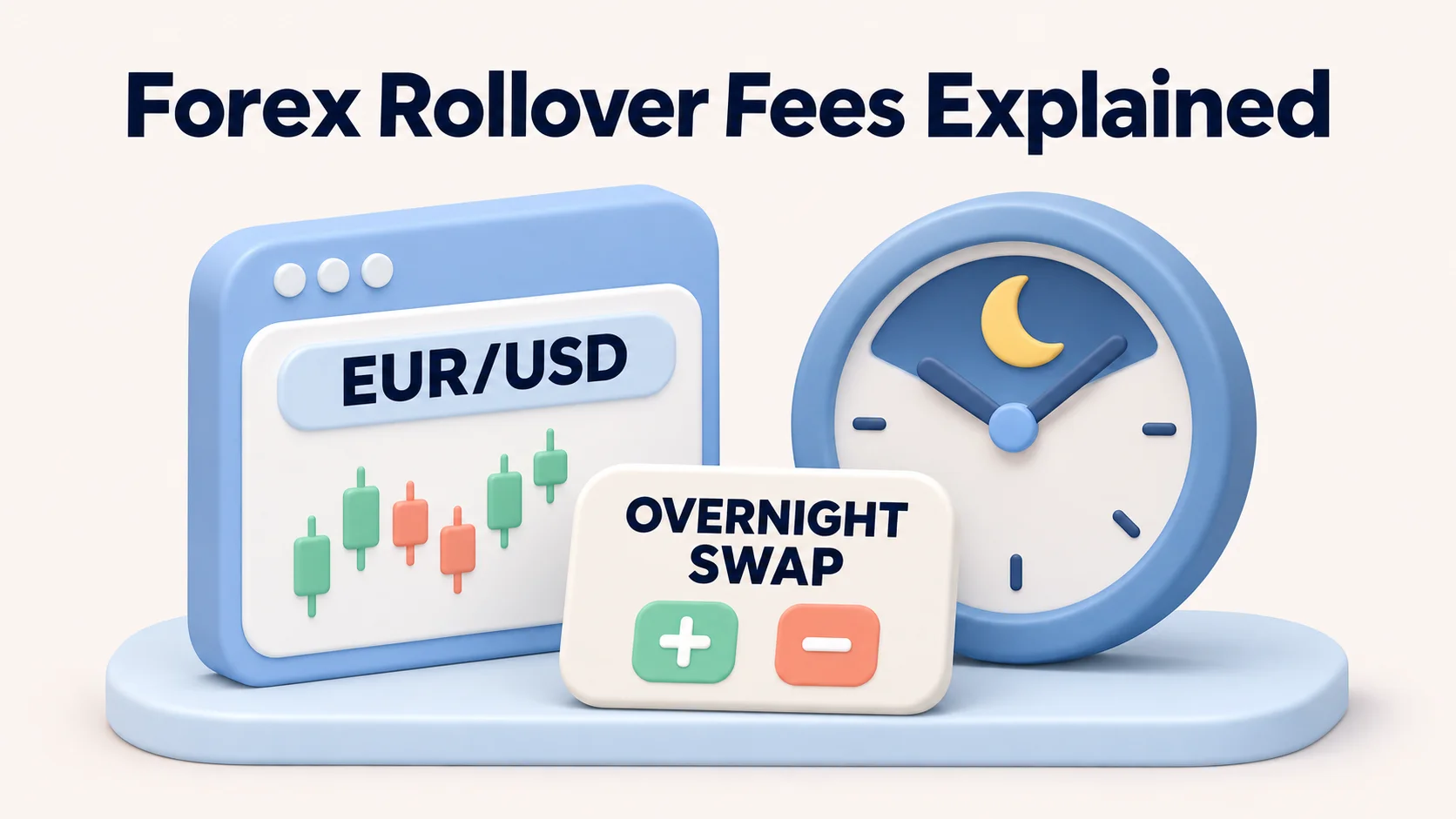
Forex rollover fees, also called swap charges or overnight financing, are the adjustments a broker can debit from or credit to an open forex position when it passes the broker's daily rollover time. The amount depends on the currency pair, whether you buy or sell, your position size, the current financing quote and the broker's charges. A position that earns a swap credit can still lose money from exchange-rate movements.
For a UK retail trader using a forex CFD or a rolling spot-style product, rollover is usually a holding cost to check separately from the spread and any commission. It can matter far more over a week than it does on a trade closed before the daily cut-off. However, not every product charges a visible daily swap: a dated forex forward may reflect financing in its quoted forward price instead.
What is a forex rollover fee?
When you buy EUR/USD, you take a position in the euro against the US dollar. Keeping that position open beyond the daily cut-off can involve carrying the currency exposure into the next trading day. Dealers commonly refer to the underlying tom-next (tomorrow/next-day) swap market when setting their overnight rate. The market rate reflects the pricing of the two currencies over the rollover period, while the retail provider may apply its own adjustment or administration charge.
Rollover is therefore not simply the difference between two central banks' headline interest rates. The market quote, buy-versus-sell direction, dealer adjustment and settlement calendar all matter. CMC Markets' UK forex FAQ explains its tom-next approach and a weekday schedule that changes for certain currency pairs. That is an example of one provider's product terms, not a universal rate or timetable.
| Term | What it means for a trader |
|---|---|
| Rollover / overnight swap | A financing debit or credit recorded when an eligible position stays open past the cut-off. |
| Swap long and swap short | Separate rates for a buy position and a sell position in the same pair. |
| Tom-next | Market pricing used to roll a short-dated currency settlement from one value date to the next. |
| Triple swap / three-day funding | Three financing days accounted for at one cut-off because of the settlement calendar; the day depends on the pair and provider. |
| Swap-free | An account or instrument arrangement with ordinary overnight swaps waived under stated conditions; it does not establish zero other charges. |
How forex rollover fees are calculated
The most useful starting point is the actual long or short rate displayed for your instrument, not a generic interest-rate estimate. Brokers present that rate in different units. The calculation also needs a position size, a count of applicable financing days and, sometimes, a currency conversion.
- Choose the correct rate: use the buy/long or sell/short value for your exact pair and account. A short swap may be positive when the long swap is negative, but neither direction is guaranteed to pay a credit.
- Confirm the unit: distinguish pips, platform points or an annualised percentage. For a five-decimal EUR/USD quote, one platform point is usually 0.00001, one tenth of a pip.
- Apply the position size: for a pip-based rate, multiply by the position's pip value; for an annualised rate, follow the broker's notional-value and day-count formula.
- Count the rollover events: include any three-day adjustment and public-holiday exceptions that fall while the trade remains open.
- Convert the charge: if the calculation is in USD but the account is in GBP, convert using the provider's applicable rate and check whether a separate conversion cost applies.
If the broker quotes swap in pips: indicative rollover adjustment = swap rate in pips × pip value for the position × applicable financing days. A negative result is a debit under the sign convention in the example below. A platform quoting in points needs the correct point-to-pip conversion first; do not multiply by the $10 pip value as though each point were one pip.
If the broker quotes an annualised percentage: an illustrative daily cost may be calculated as position value × applicable annual rate ÷ 365, but the exact provider formula, divisor, quote currency and sign can differ. The two methods describe alternative quotation conventions, not two fees to add together. CMC Markets' UK charges FAQ describes its own annualised-rate method and tells users to check the Product Overview for instrument-specific holding rates.
Worked example: a forex swap in pips
Suppose a trader holds a 0.20-lot long EUR/USD CFD, equivalent to EUR 20,000 of base-currency exposure, in a USD-denominated account. Assume the platform displays a hypothetical long swap of −0.9 pip per financing day. At this position size, one pip is worth $2, so one ordinary day's debit is −0.9 × $2 = −$1.80.
If the platform instead displays −9 points on a five-decimal EUR/USD quote, that is −0.9 pip, not −9 pips. This conversion prevents a tenfold calculation error. All rates below are invented for arithmetic illustration, not a live quote or a benchmark for any broker.
| Cut-off crossed | Financing days counted | Illustrative adjustment |
|---|---|---|
| Tuesday | 1 | −$1.80 |
| Wednesday (assumed triple-swap day) | 3 | −$5.40 |
| Thursday | 1 | −$1.80 |
| Total across three cut-offs | 5 financing days | −$9.00 |
In this hypothetical scenario the position is opened before Tuesday's cut-off and closed after Thursday's cut-off. Five financing days are charged across three observed daily cut-offs, because Wednesday accounts for the weekend settlement adjustment. The example assumes the swap rate, position size and conversion currency do not change. Real overnight rates can change daily, so multiplying today's rate by a whole future week is only an estimate.
What if the swap is quoted as an annual rate?
As a separate illustration, assume a GBP-denominated notional position of £12,000 and an illustrative net holding rate of 4.0% per year, using a 365-day divisor. Then £12,000 × 0.04 ÷ 365 is approximately £1.32 for one financing day, or £3.95 for three days before the broker's rounding convention. This is not a quoted UK broker rate. Some products have different long/short formulas and day-count methods; use the actual contract's financing specification.
When is rollover charged, and why is there a triple-swap day?
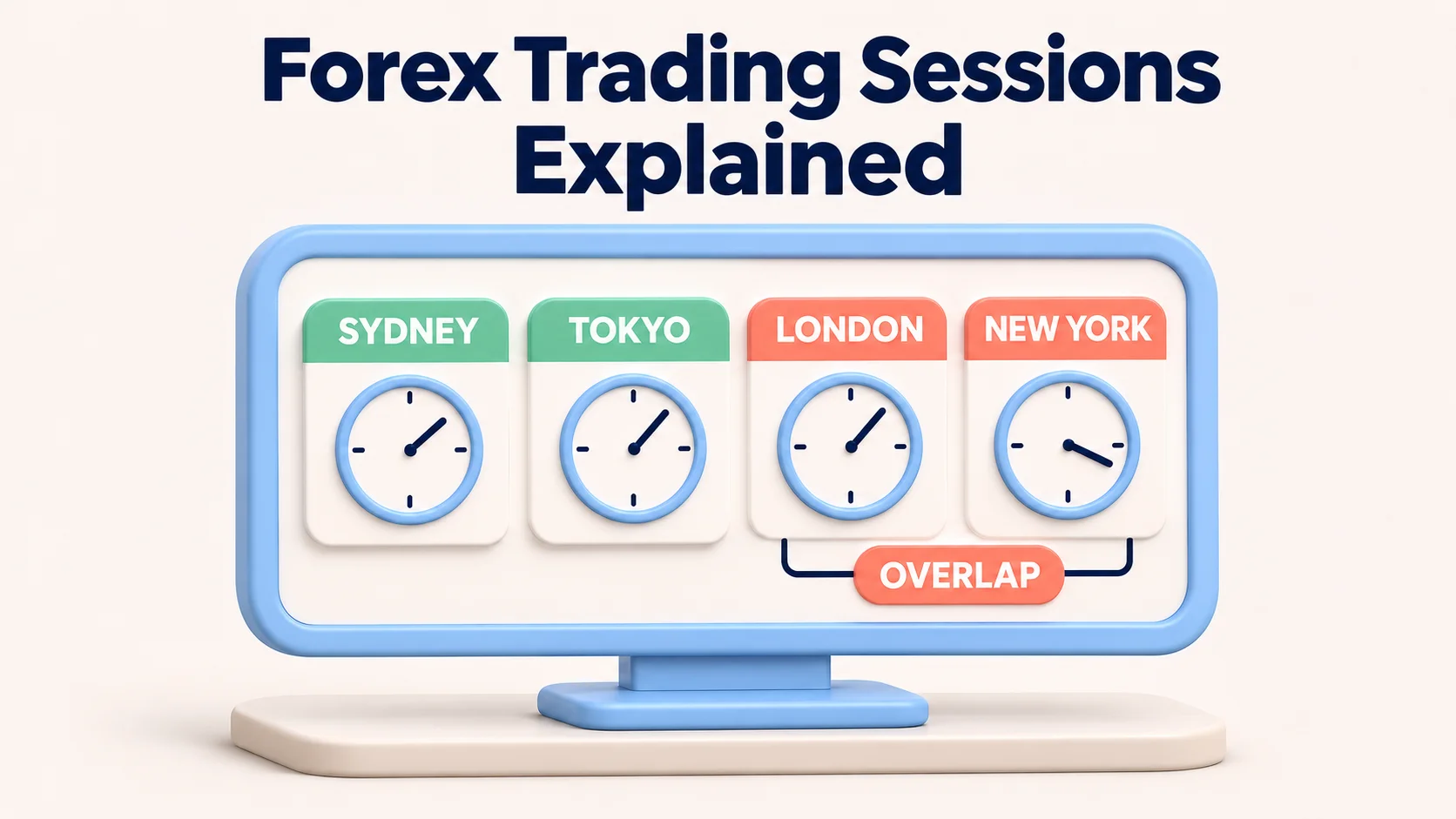
A broker usually evaluates open positions at a specified daily cut-off rather than at the moment a trader falls asleep. Some UK platforms describe a cut-off around 10pm London time for their forex CFDs or spread bets, but schedules can differ by provider, server time, daylight-saving changes, instrument and trading holidays. Check the published platform schedule instead of relying on one universal UK-clock rule.
Many major spot-style currency pairs follow a two-business-day settlement convention. On these pairs, rolling the settlement date across Wednesday can move the value date past the weekend, so the provider accounts for three days at the Wednesday cut-off. IG UK's forex CFD specifications describe a three-day Wednesday adjustment on its applicable positions.
Wednesday is not universal. CMC Markets' UK schedule places the three-day adjustment for USD/CAD, USD/TRY, TRY/CAD and CAD/TRY on Thursday, while listing Wednesday for other covered FX pairs. Public holidays can change value dates. The implication is simple: a Wednesday-only rule copied from another broker could underestimate a Thursday hold on USD/CAD. Look up the exact pair and provider before deciding when to close or keep a position.
Why rollover can be a debit or a credit
Forex financing reflects the cost and benefit of carrying both sides of a currency pair. A trader long the currency with the higher market funding return may sometimes receive a credit, but that outcome is not automatic. Dealers may include a markup on long and short rates; the market's tom-next bid/offer also matters. It is possible for both sides to show a debit after provider adjustments. Conversely, a displayed positive swap is not a promise of profit after spreads, commissions, conversion and currency-price movement.
A simple decision is to compare the actual long and short holding rates for the same pair, at the same time and on the same product. Check whether the screen shows a daily amount, annual percentage, pips or points. Do not compare a one-day credit in USD with an annual percentage charge in GBP as though they were the same unit.
What can make overnight trading more expensive?
- Position size: larger notional exposure usually produces a larger financing amount; margin deposited is not necessarily the base on which a holding cost is calculated.
- Holding period: repeated daily debits and occasional three-day adjustments accumulate. In a flat market, these can reduce returns even if the exchange rate barely moves.
- Changing rates: tom-next pricing, central-bank conditions, broker schedules and holidays can change the actual swap after a trade opens.
- Other costs: the bid-ask spread, trading commission, possible account-currency conversion and slippage are distinct from the financing adjustment.
- Hedges left open: holding offsetting long and short CFDs may leave two sets of spreads or funding charges. It does not automatically make the position costless.
- Leveraged risk: a small opening margin does not cap the market loss. Funding debits can also reduce account equity and available margin over time.
The UK's Financial Conduct Authority reported in October 2026 that overnight CFD financing charges and their disclosure remained areas of concern, including for matched or hedged trades. That is a market-wide supervisory warning, not a finding that every named broker mischarges clients.
Risk warning: Retail CFDs and rolling spot forex are high-risk leveraged products. Rapid price movements and financing costs can reduce your equity; retail safeguards do not prevent you from losing the money invested. The FCA CFD guidance explains the relevant product scope and UK retail protections.
Are swap-free accounts actually free to hold overnight?
Not necessarily. A broker may waive normal swap on an eligible account or instrument but charge a different administration fee, apply a time limit, restrict certain pairs or change eligibility. Check the actual account terms before assuming that an advertised swap-free feature has no replacement holding cost. For example, Exness's published swap guide distinguishes ordinary, triple and swap-free treatment within its own product rules; it does not establish which Exness accounts, if any, UK residents can open or what another broker would charge.
For a trader planning to hold a position for many nights, compare the full cost of the specific eligible product. That may mean comparing a conventional swap-bearing CFD with a swap-free arrangement carrying other conditions, or considering a separately priced forward product where available. The decision should depend on the documented contract and risk, not the label alone.
How to check and compare a forex rollover fee before trading
- Identify the broker's actual contracting entity, account type and instrument. Fees on another country's website or on professional products may not apply to a UK retail account.
- Open the instrument specification or trading ticket and record the swap long and swap short rate, its unit and the date/time checked.
- Confirm the daily cut-off, the three-day rollover weekday, holiday changes and what happens on positions opened or closed near that time.
- Calculate a one-day and a realistic holding-period example using your own trade size and account currency. Include spread, any commission and any conversion charges.
- Check the platform transaction history after an actual rollover against the disclosed calculation. A difference is a reason to request an explanation, not automatic proof of misconduct.
For related questions, see FXRanking's forex spreads guide for entry and exit costs, broker-fees explainer for the wider charging model, and UK swing-trading comparison for provider-specific holding-cost trade-offs.
FAQs
What is the rollover fee in forex?
It is a potential financing debit or credit applied when a forex CFD or rolling spot-style position remains open beyond the provider’s daily cut-off. The exact amount depends on the pair, long or short direction, position size and current broker terms.
How do I calculate my forex swap charge?
If the broker quotes a daily swap in pips, multiply that rate by the position’s pip value and the applicable financing days. Convert platform points to pips when necessary. If the broker quotes an annual percentage, follow that product’s notional and day-count formula instead. Use the correct account currency.
Why is forex rollover charged three times on Wednesday?
Many currency pairs have a two-business-day settlement convention, so a Wednesday rollover can include the weekend settlement adjustment. It is not a rule for every pair or broker: CMC Markets UK lists Thursday for USD/CAD and certain TRY pairs, and holidays can alter the schedule.
Can forex rollover be positive?
A long or short forex position can receive a swap credit under some market conditions. The market funding differential, the provider’s bid/offer quote and its adjustment determine the result. Any credit can be outweighed by spread, commission, price losses or currency conversion.
Do I pay swap if I close before the daily rollover time?
Ordinarily a position that is closed before the product’s relevant cut-off will not incur that cut-off’s overnight funding adjustment. But timing and product rules differ, and closing still involves a bid-ask spread and possible other charges or execution risk.
Does a swap-free forex account mean zero fees?
Not necessarily. A swap-free arrangement can have eligibility rules, alternative administrative charges, restrictions or holding-period conditions. Check the exact UK-facing provider and account documents; another entity’s swap-free marketing does not prove eligibility or total cost.
Is forex rollover the same thing as the bid-ask spread?
The spread is the gap between the dealing bid and ask, typically affecting the entry/exit economics. Rollover is a separate overnight adjustment where the product applies it. A low-spread trade can still be expensive to hold for several days.

Jake Robins
Jake Robins is a Forex and cryptocurrency education contributor with over 10 years of experience helping readers better understand the financial markets. His work covers risk management, technical analysis, trading psychology, broker platforms, and scam awareness. Through clear, practical guidance, Jake helps traders approach the markets with greater discipline, caution, and confidence.