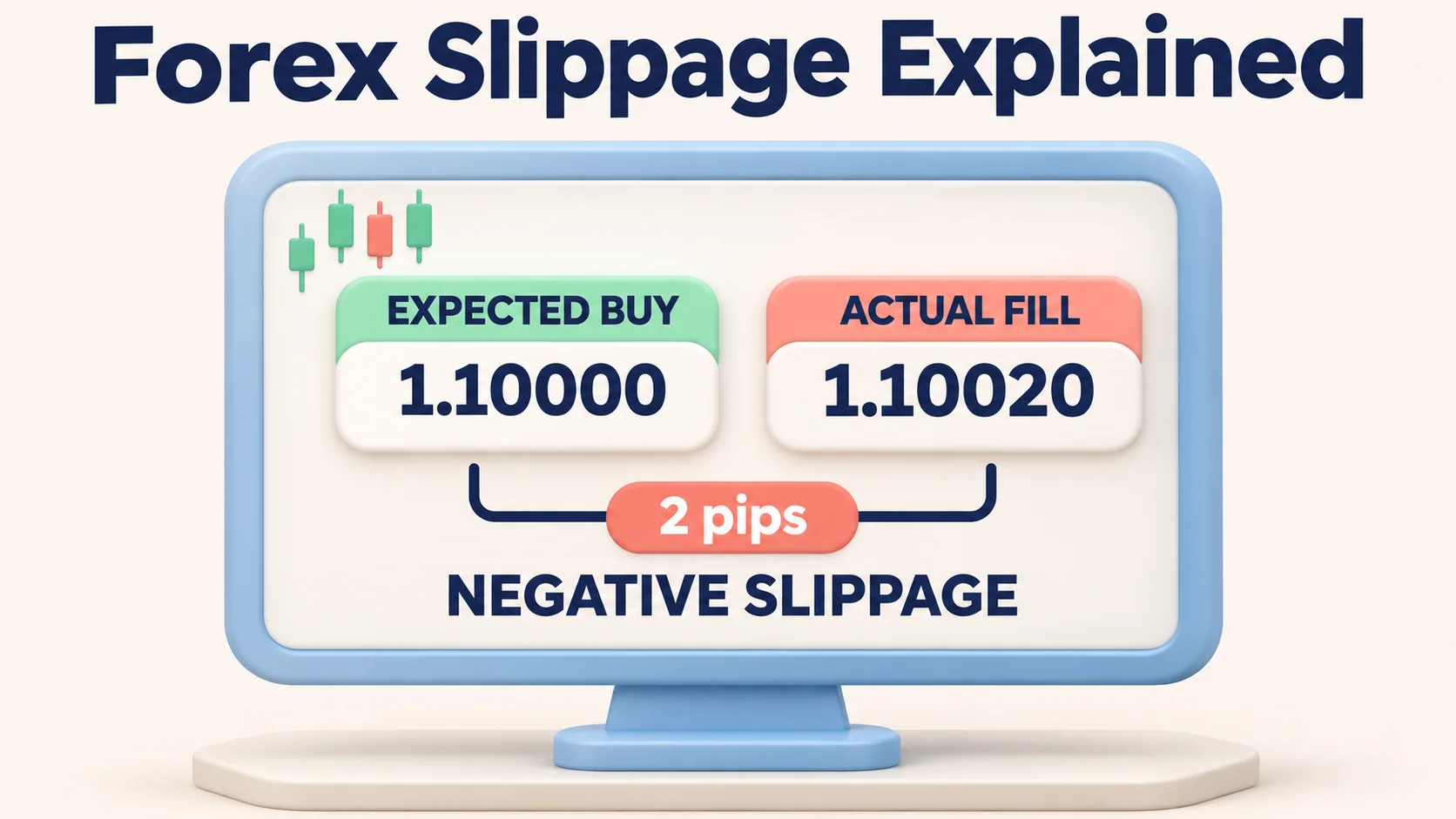
Forex slippage is the difference between the price a trader expects and the price at which an order actually fills. It can make a trade more expensive, but it can also improve the entry or exit price. The practical risk is that a quoted rate or stop-loss trigger is not necessarily the price at which a trade will be executed.
Slippage matters most when prices move quickly, liquidity is thin or the requested order is larger than the amount available at one quote. Understanding it requires three separate checks: which price triggered the order, which price filled it, and which costs were charged in addition to that price difference.
What is slippage in forex trading?
Slippage is measured against the relevant requested or expected execution price, not merely against a chart's last displayed midpoint. A forex broker normally quotes a bid (the price at which a client can sell) and an ask (the price at which a client can buy). Comparing a buy fill with an earlier bid, or a sell fill with an earlier ask, confuses the spread with slippage.
A market order requests execution at the available price. By the time the instruction reaches the execution system, that price can change. A standard stop order activates when a specified price condition is met, then seeks an execution under its terms. The stop price is a trigger, not a guaranteed fill. FOREX.com's US execution disclosure explains that fast-moving markets can cause orders to fill at the next available price rather than the original quote.
Positive versus negative slippage
Negative slippage means a worse price for the trader. Positive slippage means a better price. The direction of the order determines which is which: a buyer benefits from paying less; a seller benefits from receiving more.
| Order | Actual fill | Difference | Trader outcome |
|---|---|---|---|
| Buy | 1.10020 | 2 pips higher | Negative slippage |
| Buy | 1.09980 | 2 pips lower | Positive slippage |
| Sell | 1.09980 | 2 pips lower | Negative slippage |
| Sell | 1.10020 | 2 pips higher | Positive slippage |
For EUR/USD, one pip is normally 0.0001. All four outcomes above are illustrative, not observed trades or a prediction of typical broker performance. Positive price movement does not guarantee a better fill: the order may be rejected, requoted, partially filled or processed under a different execution condition.
Why does forex slippage happen?
Fast-moving news and price gaps
Central bank decisions, inflation data and unexpected headlines can move the available bid and ask before an order can execute. A price gap occurs when the next available quotation differs sharply from the prior one, sometimes following a weekend or a market reopening. A stop resting inside that gap may activate without any executable quote at its chosen level. Forex trading is not uniformly liquid every hour, and a continuous-looking chart does not establish that every intermediate price was available to trade.
Thin liquidity and order size
A price displayed for a small amount is not necessarily available for a larger transaction. When liquidity at the best price is insufficient, an order may be filled across several price levels, or a broker may reject or partially fill it according to its execution policy. A useful comparison therefore considers execution size, not just a broker's advertised minimum spread or average processing time.
Spreads, routing and processing conditions
A wider bid-ask spread changes the price at which a trader can enter or exit, but the spread and slippage are not the same charge. Slippage is the movement between the relevant reference price and execution price. The spread is the difference between the bid and ask at a given moment. Platform latency, connectivity, available liquidity providers, requoting rules and broker-specific execution models can affect whether an order fills, at what price and how much of it is executed.
The distinction matters when reading performance statistics. An execution-speed figure says little about the number or size of unfavorable fills unless the broker also defines the order types, dates, platforms, trade sizes and rejected orders included. In its published US execution scorecard, FOREX.com specifies that its figures cover eligible GAIN Capital Group LLC orders on specified FOREX.com platforms during a stated period and exclude MetaTrader orders. Those figures should not be generalized to every account or future market condition.
How much can slippage cost?
For a EUR/USD trade quoted in US dollars, a standard 100,000-euro position changes by approximately $10 per pip. A negative fill difference of 2 pips is therefore approximately $20 of additional entry or exit cost on that position. A 50,000-euro position has roughly $5 per pip exposure, making the same 2-pip difference about $10. These calculations exclude commissions, financing and any separately incurred spread cost.
Slippage cost for a EUR/USD position = unfavorable pips × dollar value per pip. The pip value can differ for other pairs, account currencies and position sizes. For a profitable price improvement, the same calculation describes a benefit rather than a cost.
A stop-loss gap can change the planned loss
Consider a hypothetical long EUR/USD position opened at 1.10000, with an ordinary sell stop set at 1.09500. If the next executable bid after a sudden gap is 1.09200, the stop may fill there instead of at 1.09500. For 100,000 euros, the planned 50-pip price loss is approximately $500, while the 80-pip executed loss is approximately $800. The 30 extra pips mean about $300 in adverse slippage, before other trading costs.
The example assumes a single fill at the stated price, an unchanged position size and no additional charges. It is not a maximum-loss estimate. In more severe conditions, the fill may be worse, or a position may be closed under margin-liquidation terms before a planned stop is reached.
Which forex order types are exposed to slippage?
Order names can vary across brokers, so the following comparison describes standard mechanics rather than a promise about any particular platform. FXRanking's guide to market, limit and stop orders explains the related entry and exit instructions.
| Order type | What the price does | Main limitation |
|---|---|---|
| Market order | Seeks a prompt fill at an available quote | Fill price can differ from the displayed price; execution can still be delayed, rejected or partial under the broker's terms |
| Ordinary stop-loss or stop-entry | Stop level activates the order; the resulting order seeks an available fill | The trigger is not a guaranteed execution price, especially across gaps |
| Stop-limit order | Activation places a limit order that will accept only the limit price or better | May remain unfilled while the market moves further against the position |
| Limit order | Buys at the limit or lower, or sells at the limit or higher | Price protection is exchanged for a risk of no fill or partial fill |
| Guaranteed stop-loss, where offered | Provider contract specifies the exit level if its conditions are met | Availability, eligible products, minimum distances, charges and account terms vary; it is not a general guarantee against trading losses |
A limit order's price condition rules out a worse-than-limit execution under ordinary limit-order terms, but it does not guarantee execution. A stop-limit order is particularly hazardous if the priority is to exit a rapidly falling market: the limit may prevent the loss-reducing sale entirely. The key choice is between price certainty and execution certainty; neither should be assumed from the word "stop" alone.
Ordinary stops versus guaranteed stop-loss orders
An ordinary stop aims to close a position after a trigger. A guaranteed stop-loss order (GSLO), if expressly offered for the product and account, is a separate contractual feature intended to honor its stated stop level when activated, including during a gap. The guarantee does not erase the loss between entry and stop, eliminate commissions or protect against every account event. The broker's exact eligibility, margin treatment, amendment rules and charges remain decisive.
For a documented example outside the US retail spot-forex market, IG's UK order-type guidance lists guaranteed stops for spread-betting and CFD accounts and describes a premium if the stop triggers. That UK product description is not evidence that an equivalent order exists for a US retail forex account. Before relying on a GSLO, verify the specific legal entity, market, platform, order ticket and signed agreement. If no applicable guarantee is available, budget for slippage on an ordinary stop.
Risk warning: Leveraged forex trading can produce rapid and substantial losses. An ordinary stop-loss is not a guaranteed maximum loss, and market gaps, widening spreads, partial fills or liquidation rules can worsen an exit. A guaranteed stop, where contractually available, protects only the specified exit under its conditions and does not remove leverage, counterparty, margin or other trading risks.
How to reduce slippage without assuming it can be eliminated
- Check the calendar and market session. Be cautious around central bank announcements, employment reports, thin holiday trading and the transition between trading weeks. Skipping a news event reduces some exposure but cannot prevent unexpected gaps.
- Choose order types deliberately. Use limits when a specified price matters more than getting filled, and recognize that a stop-limit can leave a losing position open. Do not substitute one order type for another without accounting for this trade-off.
- Size orders for plausible liquidity. Smaller orders can be easier to fill at one price, but neither a small trade nor a major currency pair guarantees zero slippage.
- Understand price-tolerance settings. A tolerance may reject a fill outside the allowed price difference rather than give a better price. FOREX.com's US platform guidance describes a price-tolerance feature; availability and behavior must be checked on the trader's actual platform.
- Allow for adverse fills in risk planning. Evaluate the trade at its intended stop and at worse hypothetical exits. Reduce position size when the extra loss would exceed the amount the account can withstand.
- Review executions, not advertisements. Keep time-stamped intended quotes, bid/ask prices, order and fill confirmations, stop settings, size, commissions and any rejection messages. Analyze favorable and unfavorable slippage separately.
FXRanking's scalping broker comparison discusses execution as a trading condition. For frequent traders, even small unfavorable fills can accumulate, but speed alone is not a reliable substitute for transparent fill-quality data.
What broker execution disclosures should you check in 2026?
Start with the contracting entity and the specific retail account. A global broker name may cover different legal companies, products and order rules. Read the customer agreement, order-execution policy, risk disclosure, margin terms, and platform's order ticket before assuming a feature applies. Ask concrete questions:
- Does the firm fill at the next available price, requote or reject when the market moves? Are the settings applied to both favorable and unfavorable price changes?
- Which bid or ask triggers a stop, and what happens during a market closure, gap, outage or margin liquidation?
- Can a large order be partially filled or executed at multiple prices? How is the average execution price calculated?
- Are positive-slippage figures and negative-slippage figures disclosed by value and size, not just by the percentage of orders?
- Which products, countries, account types and platforms support price tolerances or a genuinely guaranteed stop? What fees and minimum distances apply?
- Are execution statistics independently comparable, or do they exclude particular platforms, order types, order sizes, rejected orders or periods of volatility?
For US retail forex dealer members, the National Futures Association's interpretive notice on slippage and requoting addresses unfair asymmetric practices and requires disclosure of how price changes and slippage parameters are handled. Its forex regulatory guide also describes transaction-data disclosure rights for customers of covered forex dealer members. This is a US dealer-specific framework, not a blanket rule for every international broker or product.
The UK's FCA thematic review TR14/13 examined best-execution oversight in 2014, including price, cost and likelihood-of-execution considerations. It is useful historical context, not a live approval of any broker's execution quality or a substitute for current US rules. Neither regulatory framework promises that every order fills at its requested price.
How to assess a suspected bad fill
First compare the correct side of the quote with the actual fill and record the exact time and trade size. Next, check whether an order was a market order, ordinary stop, limit or a provider-specific instruction. Review the spread, any gap and the account's execution rules. A price change alone does not prove misconduct, but a pattern of unfavorable fills coupled with missing favorable adjustments warrants scrutiny.
Request the broker's order-level explanation and available execution data, keeping the trade confirmation and correspondence. For a covered US forex dealer member, ask for the transaction data described in the NFA guide and check the broker's stated complaint process. Evaluate the response against the agreed account terms and applicable regulatory requirements rather than assuming that every adverse fill is improper.
Bottom line
Forex slippage can help or hurt a trade. The difference between a trigger and a fill is crucial for market orders and ordinary stops, especially when a currency pair gaps. Limit orders control the worst acceptable price but may not fill; guaranteed stops can change the outcome only where a specific contractual product is genuinely available. Traders cannot remove all execution risk, but they can account for adverse prices, compare broker disclosures carefully and avoid mistaking a stop-loss setting for a fixed loss ceiling.
FAQs
What is slippage in forex trading?
It is the difference between the expected or requested execution price and the actual fill. It can be positive or negative. Compare the fill with the appropriate bid or ask and check the order type before measuring it.
Can forex slippage be positive?
Yes. A buy filled below its expected price or a sell filled above it receives price improvement. Positive slippage is possible, not assured, and broker execution and requoting policies matter.
Will a stop-loss execute at the stop price?
Not necessarily. An ordinary stop is a trigger, not a promised fill price. If the market gaps past the stop, the execution can be materially worse. Guaranteed stops are different contractual products that are not available on all accounts.
Do limit orders eliminate slippage?
A standard limit order is designed to fill at its limit price or better, avoiding a worse-than-limit fill under that order instruction. The trade-off is non-execution or partial execution when prices move away.
How many dollars is two pips of slippage on EUR/USD?
For a 100,000-euro EUR/USD position in a USD-quoted account, the pip value is approximately $10. Two pips of adverse slippage is therefore approximately $20, excluding spreads and commissions.
Can traders completely avoid forex slippage?
No. Trading during liquid periods, reducing size and using price controls may reduce the exposure, but rapid price changes and gaps remain possible. Limits may not execute, and a guaranteed stop applies only if offered for the specific product and account.
Are guaranteed stop-loss orders available to US forex traders?
Do not assume so from a broker's global marketing page. Guaranteed-stop features differ by entity, country, instrument and platform. Verify the actual US retail account order ticket and governing terms; UK CFD or spread-betting product descriptions do not establish US spot-forex eligibility.
How should a US trader challenge an unusual slippage fill?
Save the intended quote, order type, stop trigger, timestamp, size and fill confirmation. Request an order-level explanation and, for a covered US forex dealer member, the transaction data described by the NFA. Compare the response with the applicable execution policy.

Chad Powell
Chad Powell has spent more than five years trading Forex and cryptocurrency, building a practical understanding of how markets move and the challenges traders face. He writes about technical analysis, risk management, trading discipline, broker platforms, crypto security, and fraud prevention.