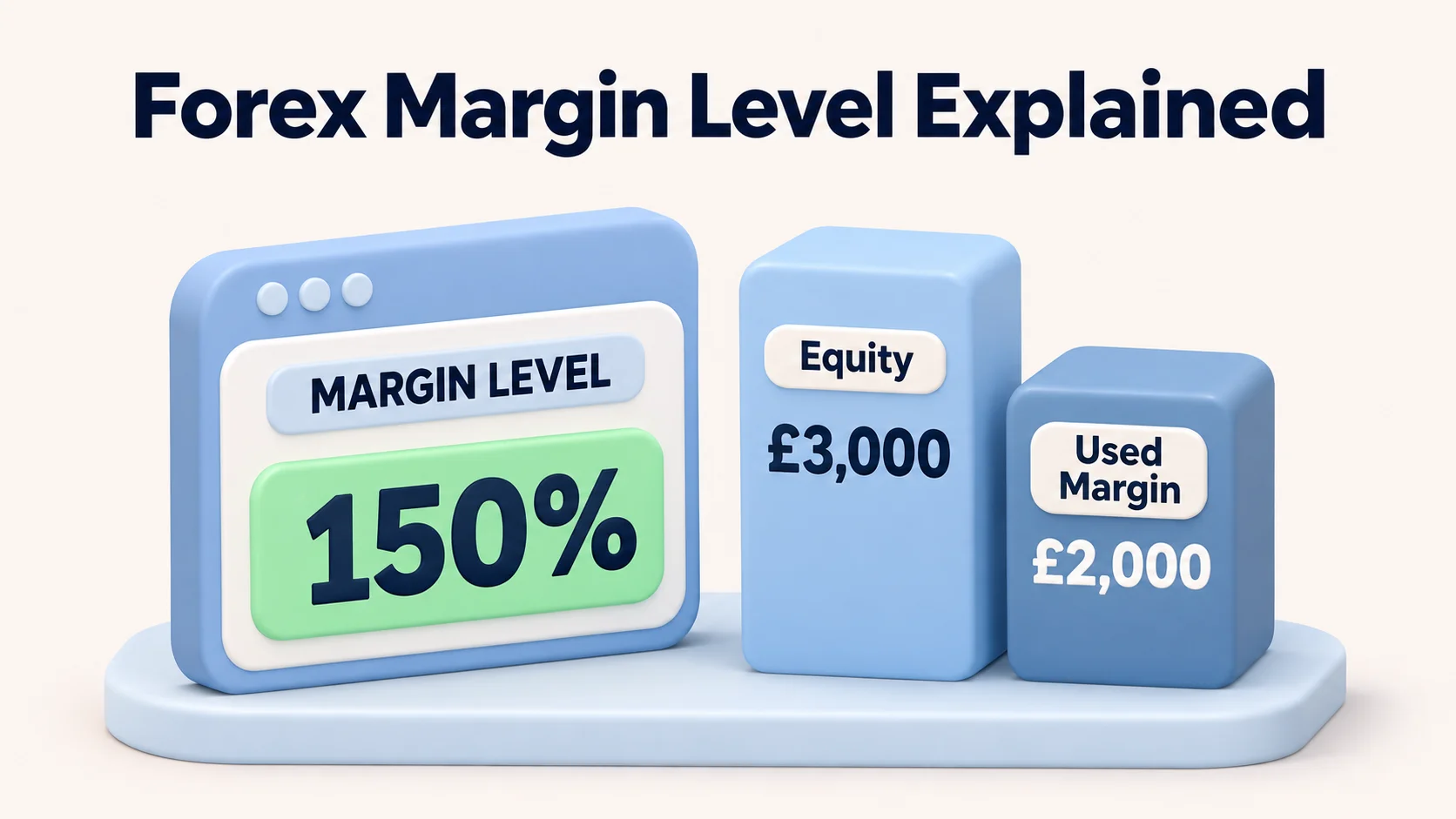
Forex margin level is the percentage obtained by dividing an account's equity by the margin currently required for its open positions, then multiplying by 100. It shows how much equity backs the margin requirement. For example, if equity is £3,000 and required margin is £2,000, the margin level is 150%.
That figure is useful because unrealised trading losses can reduce equity, while changes to required margin can also move the percentage. A falling margin level means the account has less room to absorb adverse changes. It is not the percentage loss on a trade, an interest rate, or a universal forecast of when the broker will close a position.
How to calculate forex margin level
The simple formula is:
Margin level (%) = (account equity ÷ required or used margin) × 100.
In this context, equity means the cash balance plus unrealised profit or loss and any other adjustments counted under the account terms. Required or used margin is the collateral the dealer currently counts against open positions. FOREX.com UK's margin explanation uses net equity divided by total margin requirement, multiplied by 100, for its platform indicator. Exact platform definitions and the treatment of open orders, hedges, other account segments or credits differ between accounts.
The formula is meaningful when there is a positive margin requirement. With no margined position open, the denominator is zero, so platforms use different display conventions, including a dash or an infinite value. Do not interpret that display as a trading signal.
Margin, equity, free margin and margin level: the difference
These terms answer different questions. They can also change while a trade is open, even if no cash is deposited or withdrawn.
| Term | What it tells you | Illustrative figure |
|---|---|---|
| Account balance | Cash amount after settled transactions; it does not by itself reflect every open trade's changing value. | £3,000 |
| Equity | Account value after including open-position profit or loss, subject to the account's calculation rules. | £3,000 before any open loss |
| Required/used margin | Collateral currently allocated or required for open positions. | £2,000 |
| Free/available margin | In a basic model, equity minus required margin; additional account restrictions also apply in some cases. | £1,000 |
| Margin level | Equity relative to required margin, expressed as a percentage. | 150% |
Free margin is an amount of money; margin level is a percentage. If free margin is £1,000, that does not mean the margin level is 1,000%. A trader can have positive equity but little or no free margin because a large share of the account is required to maintain positions.
For a separate explanation of how the original margin requirement arises, see our forex leverage and margin guide. Our margin and leverage calculator estimates opening margin; it does not calculate a live broker-account margin level or determine when a position will be liquidated.
Worked example: how a falling margin level changes an account
Assume a UK-style leveraged forex CFD account has one position worth £40,000, a flat 5% required-margin rate and £3,000 initial equity. The model requires £2,000 margin (£40,000 × 5%). It assumes no additional positions, no funding adjustments, no changes to margin rates and no spread, commission, financing or currency-conversion costs. Figures are hypothetical, not observed trades or a broker's live quote.
| Scenario | Equity | Required margin | Free margin (equity − margin) | Margin level |
|---|---|---|---|---|
| Starting point | £3,000 | £2,000 | £1,000 | 150% |
| £500 unrealised loss | £2,500 | £2,000 | £500 | 125% |
| £1,000 unrealised loss | £2,000 | £2,000 | £0 | 100% |
| £1,500 unrealised loss | £1,500 | £2,000 | −£500 | 75% |
| £2,000 unrealised loss | £1,000 | £2,000 | −£1,000 | 50% |
The table illustrates the arithmetic as if the position remained open throughout. In practice, the provider can reject new orders, demand more margin or liquidate positions before the lower rows are reached. Closing trades also changes the required margin, so the percentage need not follow this simple path in a real account.
Under the fixed-exposure assumptions, an adverse 2.5% movement on £40,000 creates roughly £1,000 of gross trading loss, bringing equity to £2,000 and the margin level to 100%. A 5% move produces about £2,000 of gross loss, with equity at £1,000 and the model margin level at 50%. Actual forex prices, contract sizes, position currency and fees can change the relationship between price movement and account equity.
What do 200%, 150%, 100% and 50% margin levels mean?
Higher percentages normally indicate more equity relative to the current margin requirement; lower percentages indicate less. They are not universal safety ratings. In the simple model, 200% means equity is twice used margin, 150% means 1.5 times, and 100% means equity equals used margin and basic free margin is zero. At 50%, equity is half the margin requirement. None of these figures tells you how much you could lose on the next market move.
Platforms differ on when they warn, prevent new orders or start closing positions. As one provider-specific illustration, FOREX.com UK's market and product FAQs describe reducing trading permissions below 100% and ordinarily starting automatic closing around 50%, with qualifications for account and leverage settings. Those levels must not be applied mechanically to another firm's account.
Margin close-out rules for UK retail forex CFDs
The UK's Financial Conduct Authority requires a margin close-out mechanism for in-scope CFDs and CFD-like products sold to retail clients. Its CFD rules summary describes close-out when account funds fall to 50% of the margin needed to maintain covered open positions. The requirements also include leverage restrictions and negative-balance protection at the applicable account level.
The 50% requirement is a regulatory safeguard, not a guarantee that a platform will show exactly 50%, issue an advance warning or fill exits at a fixed price. Dealers can act sooner under their terms, and pricing gaps can cause execution after equity has fallen further. The precise margin basis on a broker's screen can also differ from the regulatory calculation. Check the actual legal entity, product, account terms and whether the client is classified as retail; professional and offshore accounts should not be assumed to have the same protections.
Negative-balance protection for a covered UK retail CFD account limits the client's account-level liability as specified by the rules. It does not prevent the loss of the account's funded capital. Risk can be substantially different for other jurisdictions, products or classifications.
What makes margin level change?
- Open-position gains and losses: changing market prices increase or decrease equity while the position remains open.
- Spreads and execution costs: a wider spread can immediately worsen the mark-to-market value of a position; commissions and realised trading costs can also reduce equity.
- Overnight financing and conversions: financing charges and account-currency conversion effects can change equity, depending on the instrument and account terms.
- Extra positions or larger trades: more required margin can lower the percentage even if equity has barely changed.
- Revised margin requirements: tiered schedules, instrument volatility, hedging rules or a broker's risk controls can increase or decrease the denominator.
- Deposits, withdrawals and partial closures: funding changes equity, while closing exposure can change both equity and used margin; neither action ensures a particular future margin level.
For example, equity of £3,000 against £2,000 required margin produces 150%. If the provider increases required margin to £2,500 while equity stays £3,000, the percentage drops to 120% even without a new market loss. Treat margin level as a moving account measure, not a fixed property of the currency pair.
How to check and manage margin level in practice
- Find the account figures. Locate equity, required or used margin, free margin and margin level in your trading platform. Check whether the figures apply to the whole account or a particular segment.
- Read the provider's trigger rules. Identify the warning, reduce-only, top-up and close-out conditions for your actual retail or professional account. Do not assume another broker's 100% or 50% levels apply.
- Assess total exposure. Add up overlapping currency positions and their effects on your equity. A GBP/USD and EUR/USD trade can both lose money on the same market move.
- Leave a buffer. Consider how spread widening, gaps and rising margin requirements could change the percentage before you can react. Holding spare funds does not guarantee you will avoid a close-out.
- Reduce exposure deliberately. Closing some positions may release margin, although realised losses and execution prices still matter. Adding funds changes equity but puts more capital at risk, so it is not automatically the best response.
- Review exits and costs. A normal stop-loss can slip or fill worse than requested. Compare the planned loss, spread, overnight financing and any permitted guaranteed-stop conditions before opening a trade.
Common margin-level mistakes
- Confusing initial margin percentage (such as a 5% deposit against a position) with margin level (such as 150% of required margin).
- Using the cash balance instead of equity when an open position has an unrealised loss.
- Assuming a 100% margin level automatically means liquidation, or that 50% is the trigger for every broker worldwide.
- Reading a higher margin percentage as proof that a trade is profitable or suitably sized.
- Assuming a platform warning, a stop-loss or negative-balance protection prevents the loss of deposited funds.
- Calculating opening margin with a generic online tool and treating the result as the broker's live maintenance requirement.
Bottom line
Forex margin level is the account's equity-to-required-margin ratio. It is valuable for monitoring the pressure that open positions place on an account, but the number alone cannot determine the next trade's risk or a guaranteed close-out price. Calculate it from your platform's definitions, compare it with your actual broker agreement, and size trades for realistic losses rather than the maximum margin displayed as available.
Risk warning: Leveraged forex and CFDs can cause rapid, substantial losses. Markets can gap, spreads can widen and ordinary stop orders can execute at a worse price. Covered UK retail CFD accounts have particular regulatory safeguards, but these do not protect deposited capital from trading losses. Other products, legal entities and client classifications can have materially different loss-liability rules.
FAQs
What is a forex margin level of 150%?
It means account equity is 1.5 times the required or used margin. For instance, £3,000 equity divided by £2,000 required margin, multiplied by 100, is 150%. It is not the profit on the trade.
How is forex margin level calculated?
For a positive used-margin amount, divide account equity by the broker’s current required or used margin and multiply by 100. Verify the platform’s definition of each input.
What is the difference between free margin and margin level?
In a basic account model, free margin is the monetary amount left after subtracting required margin from equity. Margin level expresses equity divided by required margin as a percentage. One is an amount; the other is a ratio.
Is a 100% margin level a margin call?
Not necessarily. In a simple model it means equity equals required margin. Whether the broker warns, stops new orders or liquidates trades depends on the specific account, product and contract.
Will my forex trade close automatically at 50% margin level?
Not in every account. A 50% account-level margin close-out requirement is part of the UK retail CFD framework, but platforms may calculate margin differently, impose earlier actions or close positions after a price gap. Check your actual dealer’s terms.
Can I improve margin level without depositing more money?
Reducing or closing positions can release required margin, although realised loss and execution costs affect equity. A favourable price movement can also raise equity. Neither outcome is guaranteed; adding capital exposes more money to risk.
Can negative-balance protection stop a margin call?
No. For covered UK retail CFD accounts it limits negative account liability under applicable rules, but it does not stop margin calls or automatic close-out and does not safeguard the deposit against trading losses.

Amy Baily
Amy Baily is a Forex education writer with over nine years of experience in trading and market analysis. She focuses on risk management, trading psychology, and the importance of maintaining a disciplined approach to the markets.