A forex trading signal is an alert suggesting a possible trade in a currency pair. It may specify a direction, entry level, stop-loss level and profit target. A signal is not an executed order, proof of a profitable strategy or permission to ignore position sizing. A useful signal gives enough detail to assess the idea before deciding whether it suits your account and risk limits.
Signals can come from a trader, a chart indicator, a software model or a paid alert service. Some are educational prompts; others connect to software that places orders. The important differences are who generates the idea, what evidence supports it, how it reaches your account and what the full cost is after execution.
What is a forex signal?
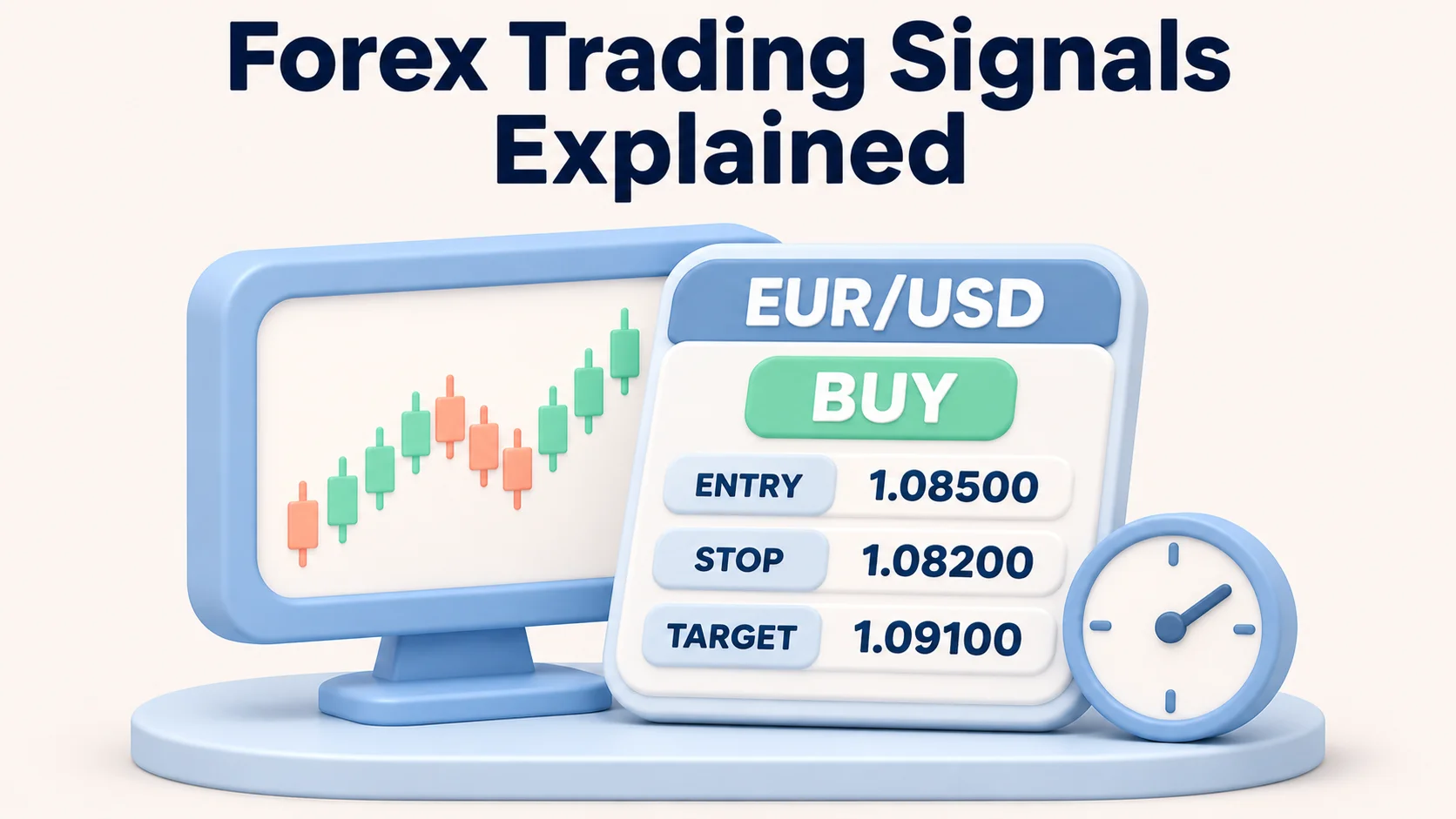
A forex signal is a time-sensitive proposal to buy or sell a currency pair under stated conditions. For example, an alert might recommend buying EUR/USD after a breakout, placing an ordinary stop at a specified level and reviewing the trade before a scheduled economic release. It describes a trading hypothesis, not a forecast that must come true.
Signals often have an expiry time or a price range. If the market has moved beyond the planned entry, the idea may no longer have the same risk-to-reward relationship. A message saying only “Buy EUR/USD now” is difficult to evaluate because it does not explain the entry assumptions, exit plan or maximum intended exposure.
What a complete signal should show
- Instrument and direction: the precise currency pair, and whether the proposed position is a buy or sell.
- Entry condition: a market-price indication, pending-order level or price range, plus the quote type if relevant.
- Time: original issue timestamp with time zone, intended holding period and when the alert expires.
- Exit plan: a stop-loss level, one or more targets, and a rule for cancelling or updating the idea.
- Risk assumptions: a method for sizing the trade and any event or liquidity condition that could invalidate it.
- Attribution and record: the provider's identity or strategy name and an immutable way to see subsequent changes.
A stop level is a planning tool. For an ordinary stop, the trigger price and executed fill can differ when liquidity is thin or prices gap. Learn the distinction in our forex order types guide.
Where forex signals come from
The production method matters because it affects how to evaluate the signal and what can fail.
| Signal source | How it works | Main limitation to examine |
|---|---|---|
| Human technical analysis | A trader interprets trends, price levels, indicators or chart patterns. | Subjective decisions, selective publication and delayed updates. |
| Rule-based indicators or algorithms | Software generates alerts when predefined conditions occur. | Overfitting, poor out-of-sample results and different live execution. |
| Fundamental or event analysis | A researcher considers economic data, interest rates or central bank decisions. | Fast repricing, revised expectations and slippage around news. |
| Social or community alerts | Traders share ideas in groups, feeds or messaging channels. | Weak identity checks, unverifiable results and potential promotion. |
| Copy or automated execution feeds | A connection translates a provider's trades or rules into orders on another account. | Different fills, position sizes, leverage, connectivity and permissions. |
Technical signals and trading algorithms overlap, but they are not identical. An automated indicator may only notify you, while a separate system has authority to place or close trades. Our algorithmic trading guide explains the additional need for backtesting and execution controls.
How signals are delivered and turned into trades
Common delivery channels include charting-platform notifications, broker analysis feeds, email, mobile push alerts, apps and messaging groups. Delivery does not establish reliability. A reputable-looking app or a busy public channel can still circulate untested or misleading calls.
Manual alerts versus copy trading and automated execution
With manual signals, you receive an idea and decide whether, when and how to place an order. This preserves control but adds decision time. With copy trading, a system attempts to reproduce another account's activity, usually with size or allocation settings; your entries and exits may differ from the original account. With automated signal execution, software creates orders based on received alerts or rules, subject to its connectivity, broker permissions and safeguards.
Before allowing any automation, establish whether it can withdraw funds, change leverage, alter stops, continue trading when you are offline or recover sensibly after a disconnected session. A provider asking for trading-account passwords or unrestricted remote access presents a serious security concern. Use only appropriately scoped broker-supported permissions where available and retain the ability to disable execution.
Why alert time and execution price can change the result
A signal's quoted entry is not a reserved fill. Between its creation, transmission, receipt and order acceptance, the bid and ask can change. The result depends on the account's spreads, commissions, slippage, order type, liquidity and whether the trade is accepted at all. A fast alert is not the same thing as an executable price.
Consider a hypothetical EUR/USD buy signal with an intended executable entry of 1.08500, an ordinary stop at 1.08200 and a target at 1.09100. The plan shows 30 pips to the stop and 60 pips to the target, or 2:1 reward to risk before transaction costs. If the order actually fills at 1.08530 while the stop and target remain unchanged, the distance to the stop becomes 33 pips and the distance to the target becomes 57 pips, approximately 1.73:1. The signal itself has not changed, but the trade offered to the follower has.
| Illustrative EUR/USD buy | Planned entry | Later fill |
|---|---|---|
| Entry price | 1.08500 | 1.08530 |
| Stop / target | 1.08200 / 1.09100 | 1.08200 / 1.09100 |
| Distance to stop | 30 pips | 33 pips |
| Distance to target | 60 pips | 57 pips |
| Reward-to-risk before costs | 2.00:1 | 1.73:1 |
These figures assume the stated entries are executable buy prices, not midpoint chart quotes, and assume a fill at the stop or target for arithmetic only. Actual closes can differ. Spread may already be reflected in an executable entry and exit quote, so do not add it twice when comparing broker statements. Commissions, financing and paid subscription costs are additional where applicable.
The delay problem is especially important for very short-lived scalp signals, thin markets, rollover periods and major data releases. If a signal has expired or the new entry materially changes its stop distance, skipping it is more consistent with a risk limit than chasing the displayed price. No service can eliminate adverse fills or trading losses.
How to check a provider's track record
A screenshot of winning trades, a percentage printed in an advertisement or a few enthusiastic testimonials do not establish an investable record. Request data that can be checked and that reflects the way a subscriber would actually trade.
- Check the full sequence. Look for every issued alert, including cancelled, unfilled, revised and losing ideas, with their original timestamps. A record assembled only from completed winners is not representative.
- Separate actual from hypothetical results. A live broker transaction history is different from a demo account, a chart backtest or results calculated from prices seen after the fact. Ask which data underpins each figure.
- Examine net returns and drawdown. Compare gross and net profit, average win and loss, worst losing run, maximum drawdown, trade count and observation period. A high win percentage alone says little about risk.
- Verify the pricing assumptions. Does the record include contemporaneous bid and ask quotes, spreads, commissions, overnight financing, missed entries, stop slippage and subscription fees? Ask how news and weekend gaps are handled.
- Look for independent corroboration. Where available, use read-only broker-linked records or third-party verification that clearly states what it actually checks. A dashboard badge or exported spreadsheet is not automatically independent proof.
- Test fit, not just history. Compare trade duration, time zone, instruments, leverage and position sizing with your broker and account. One provider's fill prices do not transfer automatically to another account.
For US readers, the CFTC's advisory on internet trading systems specifically warns about hypothetical performance, missing independent verification and systems marketed with high profits and little risk. The NFA's guidance for covered member promotional material also describes hindsight and execution limitations. Those specific member rules should not be assumed to govern every unregistered alert seller in the same way.
Why a high win rate is not enough
Imagine ten completed trades: seven win 10 pips each and three lose 30 pips each. The win rate is 70%, yet the combined result is minus 20 pips before costs (70 pips gained, 90 pips lost). Conversely, a strategy can win less often and still be viable if average gains sufficiently exceed average losses. Look at the distribution of outcomes and the amount risked, not the advertised percentage.
Also distinguish a provider's maximum drawdown on a model account from the drawdown of a follower using different leverage or position sizes. Substantial gains from increasing exposure after losses are not evidence of a reliable edge.
What do free and paid forex signals really cost?
Free alerts are not necessarily independent. A channel can earn money from referral links, a broker sign-up, order volume, advertising, selling an upgraded tier or directing followers to affiliated products. A paid subscription can create the same incentives while also charging a fixed or recurring fee. Neither payment model proves whether signals work.
For a clear comparison, calculate total net cost: subscription or one-time fee, spread, any commission, overnight financing, payment conversion charges and the effect of execution delay. For example, a hypothetical $60 monthly subscription used for ten executed trades adds an allocated $6 cost per trade before trading expenses. At a 10,000-unit EUR/USD position, where one pip is roughly $1 when USD is the quote currency, that subscription allocation is equivalent to about six pips per executed trade. It does not mean every trade loses six pips on the account statement; it shows the cost a subscriber must recover to break even after paying for the service.
Read the renewal, cancellation and refund terms, including whether a free trial turns into a paid plan. Ask whether a provider is paid more when followers trade more frequently or use a particular broker. These conflicts can encourage excessive turnover even where the individual alerts look plausible.
Claims of guaranteed returns, affiliate incentives and US regulatory checks
The CFTC's forex fraud guidance warns that offers involving secret trading signals, bots and high or guaranteed returns are common scam patterns. It also warns that online tips, testimonials and promotions may come from paid affiliate marketers. A separate CFTC retail forex advisory identifies hidden incentives among influencers and salespeople whose compensation depends on customer referrals. A disclaimer does not transform an unsubstantiated guarantee into a realistic performance claim.
For US-facing endorsements, the FTC's endorsement guidance explains why material payment or affiliate relationships need clear disclosure. When examining a signal service, ask who pays the publisher, whether commissions depend on deposits or trade volume, and whether the relationship is disclosed close to the recommendation.
Before transferring money or giving any party trading authority, check the legal name and relevant activity. The CFTC registration-check guidance directs US customers to the NFA BASIC database for registration and disciplinary information. Not every signal publisher or system promoter is necessarily required to register; the requirement depends on its conduct, products, compensation and any exemption. Do not assume a lack of registration alone settles that legal question, or that registration guarantees performance. The entity actually taking custody of funds or executing OTC forex trades must be assessed separately from an alert-only publisher.
Requests to send funds to an unfamiliar offshore platform, deposit only in crypto assets, promise fixed monthly gains, or move immediately into a private chat are serious reasons to stop and independently verify the people and institutions involved. The CFTC's social-media scam advisory addresses misleading signal and software promotions specifically.
A practical checklist before following a forex signal
- Understand the idea. Can you explain the trade thesis, instrument, entry rule, invalidation and exit without relying on the seller's confidence?
- Confirm the age. Is the original timestamp, time zone and expiry visible? Has the market already moved through the intended entry?
- Check your actual account. Are bid and ask, spread, instrument availability, minimum trade size and order types suitable for the proposed trade?
- Size risk independently. Use your own equity and loss limit; do not blindly copy a provider's lot size or leverage.
- Account for worst cases. Allow for slippage, spread changes, margin calls, order rejection and gaps beyond ordinary stops.
- Inspect the history and interests. Demand an appropriately complete results record and a clear statement of subscriptions, referrals and broker relationships.
- Start without real-money execution. Log timestamped alerts and compare them with your own demo or observation records, including skipped signals and realistic costs. Demo fills cannot prove live performance.
The decision to use an alert should follow a written trading plan. If you cannot independently assess the entry, the total exposure or who benefits financially from your participation, the signal is not sufficiently documented for a trade. Choosing not to trade is a legitimate outcome.
Are forex trading signals worth using?
Signals can be useful as research prompts, educational examples or rule-based reminders when their methodology and limitations are transparent. They are a poor substitute for learning how position size, margin, execution and stop orders work. The more a service promises automatic income with minimal oversight, the less credible its risk story becomes.
For most readers, the strongest initial use is to examine why a signal appeared, record it before the market moves, and evaluate its performance against real transaction costs. Treat provider selection as a separate due-diligence exercise. This guide does not rank or endorse signal sellers and does not claim that any provider has been tested.
Risk warning: Leveraged forex trading can cause rapid and substantial losses, including losses exceeding initial funds in some circumstances depending on the product, jurisdiction and account protections. Trading signals, copy trading, software and stop-loss orders cannot guarantee profits or a fixed maximum loss. Past or hypothetical performance does not predict future results. Trade only with risk capital you can afford to lose, and read the terms and disclosures for your actual broker and legal entity.
FAQs
What is a forex trading signal?
A forex trading signal is a proposal to buy or sell a currency pair under stated conditions. A useful alert includes the instrument, direction, entry, timing, exit plan and risk assumptions; it is not an executed order.
Are forex signals accurate or guaranteed to work?
No signal can guarantee a correct forecast or profitable execution. Even a valid strategy can lose because of changing markets, spreads, slippage, fees and position sizing. The CFTC warns against systems promoted with guaranteed or unusually high returns.
Are free forex signals better than paid signals?
Neither price model proves quality. Compare complete timestamped results and net costs. Free channels can earn referral commissions or advertising income, while paid services add subscription expenses and may also have broker incentives.
How can signal-provider results be verified?
Request the original unedited alert history and distinguish live transactions from demo and backtested outcomes. Review net performance, drawdown, missed trades, commissions and independently corroborated records where available.
What is the difference between signals and copy trading?
A signal provides information that a trader may act on manually. Copy trading attempts to replicate another account’s trades automatically or semi-automatically, which introduces account-size, execution, connectivity and permission risks.
Why do follower results differ from the published signal?
The price may move before your order reaches your broker, while spread, commissions, order type, execution conditions, leverage and trade sizing differ. An ordinary stop can also fill away from its trigger price.
Do US forex signal sellers have to be registered?
Requirements depend on the service, activities, products, compensation and exemptions. Not every publisher of trading signals is necessarily required to register. Check any claimed authorization and applicable registration or disciplinary history through CFTC and NFA resources; examine the executing dealer separately.
Should beginners follow forex signals with real money?
Beginners should first learn forex mechanics and use alerts to practice checking entries, stops, costs and trade records without live capital. Demo performance does not establish what would happen in a live account.

Jake Robins
Jake Robins is a Forex and cryptocurrency education contributor with over 10 years of experience helping readers better understand the financial markets. His work covers risk management, technical analysis, trading psychology, broker platforms, and scam awareness. Through clear, practical guidance, Jake helps traders approach the markets with greater discipline, caution, and confidence.