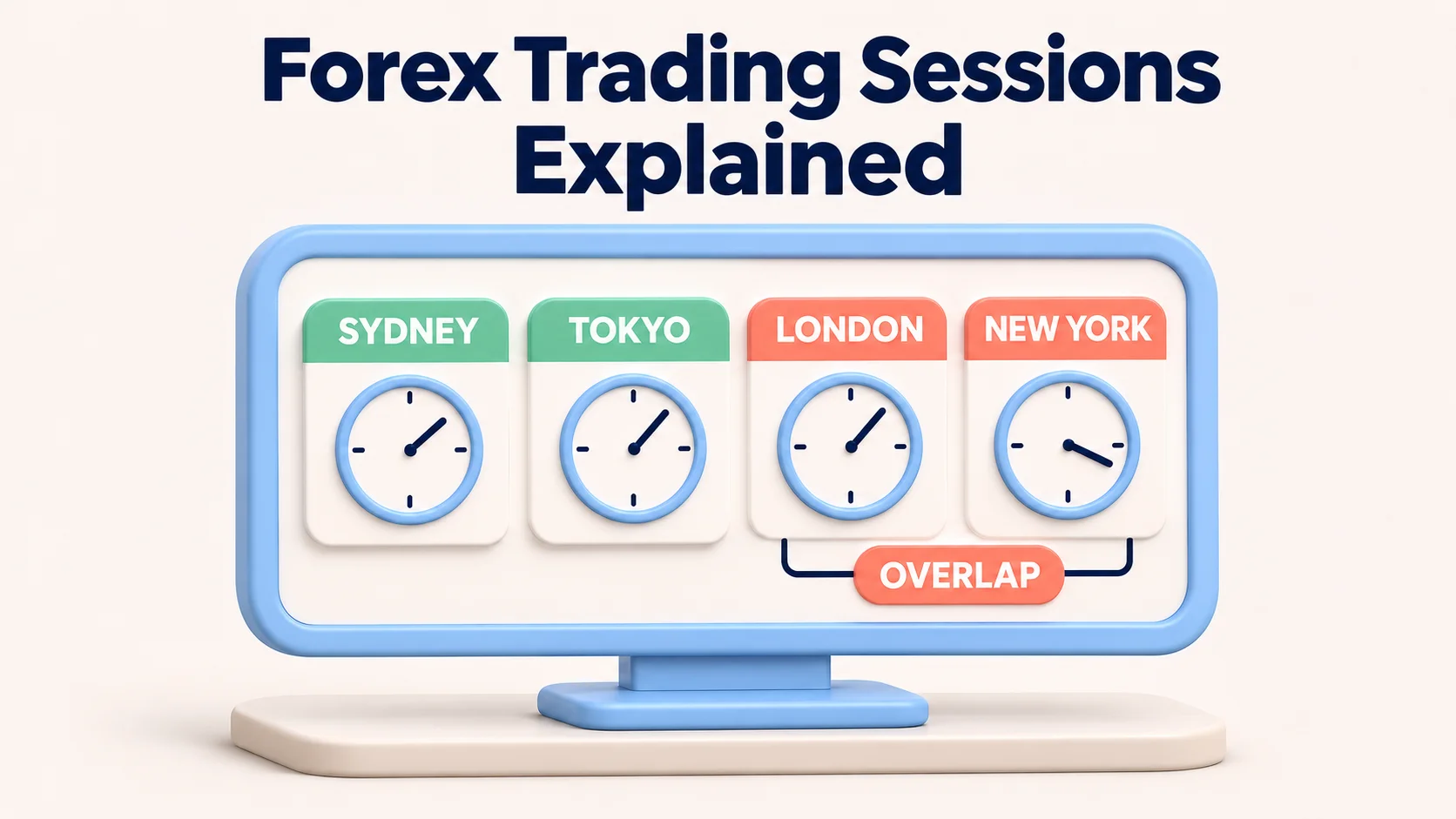
Forex trading sessions describe the periods when banks, brokers, companies and other participants are active across major financial centres. The four names most traders encounter are Sydney, Tokyo, London and New York. Together, they explain how a currency pair can trade quietly at one hour and move sharply at another.
The key distinction is that a session is a market-activity convention, not a universal exchange opening bell. Spot foreign exchange is decentralised. The hours displayed by an individual broker, including any maintenance break, can differ from the session times in an educational chart. Session overlap may improve liquidity in a major pair, but it does not make execution or profits predictable.
Risk warning: Forex trading carries a substantial risk of loss, especially when leverage magnifies price movements. Spreads, slippage, news releases, liquidity gaps and weekend market closures can change the price at which an order executes. Trading during an active session does not protect against loss, and an ordinary stop-loss order does not guarantee an exact fill.
How the Forex Trading Day Works
Unlike a single stock exchange, the global forex market passes from one regional business day to the next. Asia-Pacific activity begins as the week starts, European markets become active later, and North American participants take over before the cycle repeats. For many retail forex products, the typical weekly trading window runs from Sunday evening to Friday evening in New York time.
That broad description is not the same as continuous access to every instrument. For example, FOREX.com's US forex schedule lists a typical Sunday 5:00 p.m. to Friday 5:00 p.m. Eastern Time window, while OANDA's US hours specify a 5:05 p.m. Sunday opening, a 4:59 p.m. Friday close and short daily breaks for many FX products. These are broker-specific examples, not interchangeable promises for all accounts or pairs.
The four session labels describe where the business day is concentrated, not where every FX trade is executed. Singapore, Hong Kong and other centres also matter. The Bank for International Settlements' April 2025 FX survey found that UK, US, Singapore and Hong Kong sales desks together accounted for about three-quarters of measured global turnover. That is a geographic turnover measure, not a promise of trading volume for a particular pair at a particular minute.
Sydney, Tokyo, London and New York Session Hours
The table shows commonly used illustrative local session hours and how those hours translate to Coordinated Universal Time (UTC) in January and July. Sydney is represented by 7:00 a.m. to 4:00 p.m. local time; other educational schedules use a later start. All rows refer to weekday business activity rather than a guaranteed broker opening or closing time.
| Session | Illustrative local hours | January, UTC | July, UTC |
|---|---|---|---|
| Sydney | 07:00 to 16:00 Sydney time | 20:00 to 05:00* | 21:00 to 06:00* |
| Tokyo | 09:00 to 18:00 Japan time | 00:00 to 09:00 | 00:00 to 09:00 |
| London | 08:00 to 17:00 UK time | 08:00 to 17:00 | 07:00 to 16:00 |
| New York | 08:00 to 17:00 Eastern Time | 13:00 to 22:00 | 12:00 to 21:00 |
*Sydney's UTC opening falls on the previous calendar day. January assumes Australian Eastern Daylight Time (AEDT, UTC+11); July assumes Australian Eastern Standard Time (AEST, UTC+10). January and July represent typical seasonal positions, not the transition weeks in March, April, October and November. UTC rows are approximate session markers, not tradable market-hour guarantees.
Two details matter when using this table. First, ET means New York's current Eastern Time, which alternates between EST (UTC-5) and EDT (UTC-4). Writing every US session hour as EST all year creates errors. Second, Japan does not shift its clocks seasonally, but the relationship between Tokyo and other sessions still changes when those other locations change time.
Sydney: The Early Asia-Pacific Period
The Sydney session is the first of the four commonly named periods in the daily sequence. Traders often watch AUD and NZD pairs as Australian and New Zealand businesses and banks become active. Sydney also illustrates why a fixed UTC timetable is unreliable: its daylight saving schedule runs during the southern-hemisphere warmer months, roughly opposite to the UK and US.
Australia's clock rules are not uniform across every state. The New South Wales government daylight saving calendar provides the relevant dates for Sydney. A clock labelled simply “Australian time” is therefore not precise enough to schedule a trade.
Tokyo: The Core Asian Session
Tokyo is often used as the reference point for the Asian session, especially for USD/JPY and other yen crosses. Japan Standard Time (JST) remains UTC+9 throughout the year. Major Japanese data and Bank of Japan announcements can alter activity within the session. Neither the presence of JPY in a pair nor an open Tokyo session guarantees a large move.
For a deeper look at individual pairs, see FXRanking's guide to forex pairs during the Asian session. That pair-focused guide complements, rather than replaces, the four-session timetable here.
London: The European Trading Day
London is a central hub for FX dealing, with substantial participation in EUR, GBP and USD markets. When London begins its business day, European economic releases, market openings and institutional order flow can change spreads and price movement. The UK observes GMT in winter and BST in summer, so the London session's UTC hours shift even though its local business hours remain about the same.
London's importance does not mean every currency pair is most liquid at its opening. Emerging-market currencies, regional holidays and scheduled events can produce quite different patterns.
New York: The North American Trading Day
New York brings US data, Federal Reserve developments and North American financial activity into focus. EUR/USD, GBP/USD, USD/JPY and USD/CAD are among the pairs traders commonly monitor, with the relevant catalyst depending on the day. The opening part of New York overlaps with London, but later in the day European participation normally declines.
New York time also anchors many retail broker schedules and daily financing or rollover calculations. Confirm the exact cutoff with the account provider: a broker's rollover time is not the same as the end of the global forex market.
What Happens When Forex Trading Sessions Overlap?
An overlap occurs when the illustrative business hours of two centres coincide. More participants are often quoting or trading, particularly in frequently traded currency pairs. That can support deeper liquidity and tighter spreads under normal conditions. It can also coincide with major data releases, faster price changes and unexpected slippage.
| Overlap | Illustrative January UTC | Illustrative July UTC | Why it matters |
|---|---|---|---|
| Sydney and Tokyo | 00:00 to 05:00 | 00:00 to 06:00 | AUD, NZD and JPY-related flows coincide |
| Tokyo and London | 08:00 to 09:00 | 07:00 to 09:00 | Asian activity winds down as Europe opens |
| London and New York | 13:00 to 17:00 | 12:00 to 16:00 | Two leading FX centres are active together |
Overlap windows use the session conventions in the first table. They are not fixed contractual market hours. During periods when US and UK clocks change on different Sundays, the illustrative London and New York overlap can last about five hours instead of four.
Why the London and New York Overlap Gets Attention
London and New York combine two of the largest centres in global FX. The BIS survey recorded roughly 38% of FX turnover at UK sales desks and 19% at US sales desks in April 2025. The figures explain why their shared business hours attract attention, but they do not measure the percentage of all trading completed within the overlap itself.
For a liquid pair such as EUR/USD, a busy overlap often brings more competitive quotes than a thin period. However, the release of US inflation or employment data can temporarily widen spreads and move prices faster than orders can be filled. A high-volume time window is not automatically a low-risk entry.
How Daylight Saving Time Changes Forex Session Times
Forex session tables often become inaccurate because US, UK and Australian clock changes do not happen together. The US National Institute of Standards and Technology explains the US change in March and November; the UK government's clock calendar shows changes in March and October. Sydney's October and April adjustments follow the NSW schedule, while Tokyo remains on JST.
For example, when New York has switched to daylight time but London is still on GMT, the standard illustrative London opening remains 08:00 UTC while New York's is 12:00 UTC. Both are active from about 12:00 to 17:00 UTC. Once the UK changes to BST, London's corresponding hours become 07:00 to 16:00 UTC and the typical overlap shortens to four hours. Similar temporary differences can arise after the UK's autumn clock change and before the US change.
Use a named time zone, not a fixed abbreviation. Choose America/New_York, Europe/London, Asia/Tokyo or Australia/Sydney in a time-zone-aware calendar or converter, then check the selected date. Avoid treating GMT, UTC and BST as synonyms or assuming a broker's server clock follows your local time.
Are Forex Market Hours the Same as Broker Trading Hours?
No. “The forex market is open” describes the broad availability of global currency trading, while a retail account offers access only during the hours its broker quotes and accepts orders for the particular product. A broker may have a Sunday opening delay, a daily maintenance interval, instrument-level restrictions or separate holiday arrangements.
Before relying on a session schedule, inspect the actual account's product specification and trading-hours notice. In particular, check whether the broker lists the schedule in ET, UTC, local exchange time or server time. This matters if you trade from an automated system, place a time-sensitive order or hold positions across a weekend.
- Order acceptance: Can new positions be opened, and can existing positions be closed during the listed period?
- Maintenance and rollover: Does the broker pause quoting or order execution around its daily cutoff?
- Individual symbols: Do exotic currency pairs or other instruments carry different restrictions?
- Weekend and holiday notices: Has the provider announced a different opening, early close or reduced service?
- Execution terms: Can spreads widen, orders be rejected or stop orders fill away from their trigger?
Do not copy forex hours from a gold, index, stock or crypto product into an FX timetable. Product types and legal entities can have different hours and permissions, even when they use the same trading platform.
How Liquidity, Volatility and Trading Costs Change by Session
Liquidity describes how readily trades can be executed at available prices. Volatility describes the size and speed of price movements. They are related, but not identical: a volatile news announcement can attract heavy activity while still producing wide spreads and poor fills.
A trader targeting a small move must account for the bid-ask spread, any commission and execution slippage. For example, if a strategy targets 8 pips but incurs a 2-pip spread and a further 1 pip of adverse slippage on entry, those costs use up a substantial share of the potential gross move before any exit costs. This is an illustration, not a prediction of session-specific spreads or slippage.
Different pairs respond to different market participants. Yen crosses can react to Japanese data during Tokyo hours. EUR/USD and GBP/USD frequently draw attention around the London and New York overlap. AUD and NZD pairs may respond to local releases during Asia-Pacific hours. None of those tendencies guarantees a profitable trading setup, and scheduled events can override the usual session pattern.
The market's weekly reopening and the period around many brokers' daily rollover deserve particular care. Trading can be thin, quotes can widen and stops may fill at a different price from the trigger after a gap. The FOREX.com US market-hours notice specifically flags illiquid conditions around the weekly open and potential holiday-related liquidity changes.
Do Holidays Close the Forex Market?
A public holiday does not automatically close all global currency dealing. Major centres may operate with reduced staffing, settlement arrangements may differ, and some brokers may still offer trading. Other dates, especially around Christmas and New Year, may involve market or provider closures. A market can technically be open while trading conditions are unusually thin.
Look at the currency pair, the countries involved, the financial calendar and the actual broker notice. A US public holiday may matter more to some USD pairs than to an unrelated regional cross, while a Japanese holiday can change the character of Asian trading even though other markets remain active. Don't infer that normal spreads, order execution or funding dates will apply just because the trading platform displays a price.
A Practical Method for Planning Around Forex Sessions
- Choose the pair and reason for watching it. Identify relevant local economic releases and trading centres rather than selecting a session by name alone.
- Convert on the date you intend to trade. Use named time zones that apply daylight-saving rules automatically. Recheck around March, April, October and November.
- Confirm your broker's instrument hours. Review order-entry times, maintenance, daily rollover, holiday changes and restrictions for your legal entity and account.
- Check the economic calendar. Note central-bank announcements, employment, inflation and other events that may change liquidity and spreads.
- Calculate the full trade cost. Include spread, commission, expected financing if held overnight and the possibility of adverse slippage.
- Define a loss limit before entry. Size the position for the amount at risk, recognise that ordinary stops are not guaranteed fills and skip trades when the conditions do not suit the plan.
A session clock is useful for scheduling attention, not for generating an automatic buy or sell signal. Traders who cannot monitor a volatile overlap are often better served by a different approach than trying to trade every active period.
Key Takeaways
- Sydney, Tokyo, London and New York are useful labels for global FX activity, not four centrally enforced exchange schedules.
- Tokyo remains on JST; Sydney, London and New York shift relative to UTC on different daylight-saving calendars.
- The London and New York overlap is important for many major pairs, but active trading can still bring high volatility, spreads and slippage.
- January and July UTC tables are examples. Verify the trading date, especially in transition weeks and on public holidays.
- A broker's actual FX instrument hours and execution rules take precedence over an indicative session timetable.
Use these forex trading sessions as a framework for understanding when market participants are active in 2026. A current time-zone conversion, the applicable economic calendar and the exact broker schedule matter more for placing a real order than a static global session chart.
FAQs
What are the four main forex trading sessions?
The four commonly used session labels are Sydney, Tokyo, London and New York. They describe major financial-centre business hours in a decentralized foreign exchange market, not fixed exchange opening bells.
What time does the forex market open and close?
Many retail forex brokers provide access from around 5:00 p.m. Eastern Time on Sunday until 5:00 p.m. Eastern Time on Friday. Exact times, daily maintenance breaks, instrument exceptions and holiday schedules depend on the broker and account.
When do the London and New York forex sessions overlap?
Using the illustrative 08:00 to 17:00 local business-hour model, the overlap is usually about four hours, 13:00 to 17:00 UTC in January and 12:00 to 16:00 UTC in July. It can be about five hours during US and UK daylight-saving transition mismatches.
Does Tokyo change its forex session hours for daylight saving time?
Japan does not observe seasonal daylight saving time, so an illustrative Tokyo 09:00 to 18:00 JST session corresponds to 00:00 to 09:00 UTC year-round. Its overlap with London still changes when the UK shifts its clocks.
Is the London and New York overlap the best time to trade forex?
The overlap often brings substantial liquidity in major currency pairs, but there is no universally best or safest time. Economic releases can increase volatility and slippage. Compare spreads, news risk and your strategy before trading.
Do forex trading hours change on public holidays?
They can. A currency market may remain technically open while liquidity is thin, or a broker may alter trading hours for certain instruments. Check the financial calendar and the broker’s current account-specific holiday notice.
Are forex session hours and broker trading hours the same?
No. Session hours are indicative periods of activity in financial centres. The broker sets the order-acceptance and trading availability for each account and product, sometimes including short daily breaks or special weekend opening times.

Jake Robins
Jake Robins is a Forex and cryptocurrency education contributor with over 10 years of experience helping readers better understand the financial markets. His work covers risk management, technical analysis, trading psychology, broker platforms, and scam awareness. Through clear, practical guidance, Jake helps traders approach the markets with greater discipline, caution, and confidence.