Forex brokers make money from the prices and fees attached to trading, including bid-ask spreads, broker mark-ups, commissions, overnight financing and some account charges. A broker that acts as your counterparty may also have gains or losses on the market risk it retains. That last point depends on what the firm hedges, not simply whether it operates a dealing desk.
For traders, the useful distinction is between what you pay, what the broker keeps and what happens to the broker's risk after your order is filled. A narrow headline spread is not proof of a cheap account, and a claim of straight-through processing is not proof that the broker has no conflicts. The examples below focus mainly on leveraged over-the-counter (OTC) forex and forex CFDs, including UK retail products where specified. Exchange-traded currency futures, physical currency exchange and other legal entities can have different arrangements.
Where a forex broker's revenue comes from
These are common income streams, but they are not universal. Some accounts use a wider spread with no separate commission; others show a smaller spread plus a transaction charge. The price and fee schedule for the specific account and contracting entity is more useful than a brand-wide claim of low fees. The UK's Financial Conduct Authority (FCA) review of CFD pricing examines spreads, commissions and overnight funding together because traders can pay all three.
| Income or charge | How the trader encounters it | What to check |
|---|---|---|
| Bid-ask spread | The buy quote is above the sell quote. You face that difference when entering and exiting at the quoted prices. | Typical, not just minimum, spread for your pair, size and trading hours. |
| Broker price mark-up | The broker adds a margin to a price obtained from a liquidity provider or benchmark; it is usually already inside the quoted spread. | Pricing methodology, whether the firm discloses the mark-up and how it sources quotes. |
| Commission | A separately stated charge per side, lot or traded notional, often on a raw-spread account. | Both sides of a trade, the billing currency, minimums and volume tiers. |
| Overnight financing or swap | A debit or credit on open positions held through the broker's rollover cut-off. | Long and short rates, reference rate, broker adjustment and multi-day rollover. |
| Other account or service fees | Potential currency conversion, inactivity, withdrawals, data or optional order-protection charges. | Whether each fee applies to your entity and whether the broker or a payment provider receives it. |
| Retained trading exposure | Potential profit or loss to a principal-dealing firm if it does not fully hedge offsetting client exposure. | Order-execution and conflicts policies, hedging approach and conduct safeguards. |
Revenue is not the same as net profit. The quoted spread can include a price-source spread and payments to external liquidity providers. Commissions and financing receipts must also cover technology, staff, compliance, liquidity, capital and hedging costs. Conversely, a broker's revenue stream does not tell you whether any given client trade was hedged.
Spreads and mark-ups: similar to the trader, different for the broker
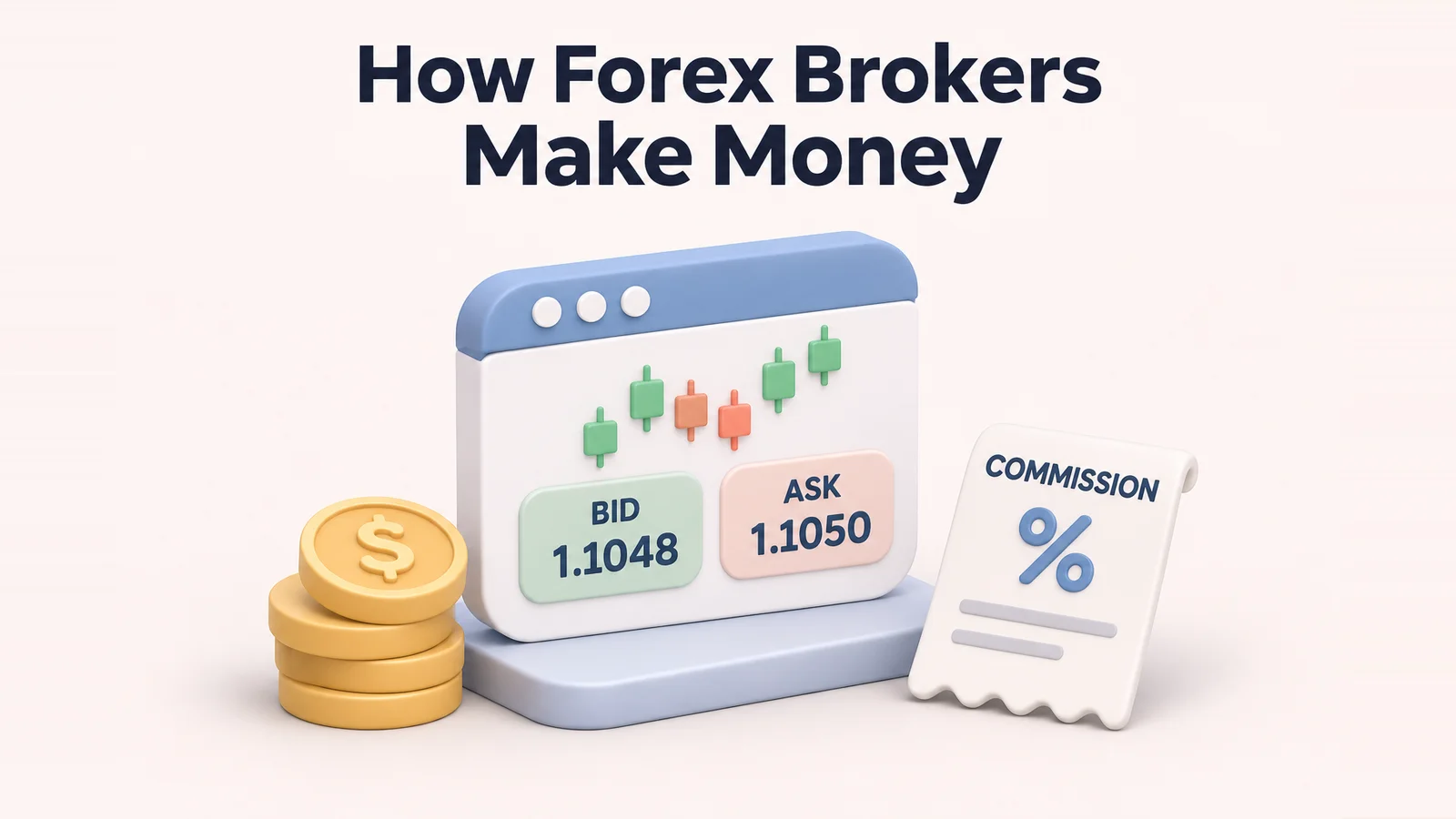
The bid is the price at which you can sell a currency pair; the ask is the price at which you can buy it. If EUR/USD is quoted at 1.08500/1.08512, the spread is 0.00012, or 1.2 pips. A standard EUR/USD lot of 100,000 EUR has a pip value of approximately $10 when USD is the account's profit-and-loss currency. At that quote, a 1.2-pip spread corresponds to about $12 of initial spread cost for one standard lot, assuming the prices and position size do not change.
A mark-up is one possible component of that spread. Suppose a broker receives a hypothetical reference quote with a 0.4-pip bid-ask spread, then presents a 1.2-pip quote to a client. The additional 0.8 pip represents a wider client-facing spread, but it is not necessarily all retained as broker profit. Liquidity costs and the firm's pricing arrangements still matter. Do not add 0.8 pip again to the 1.2-pip quote: it is already part of the price you see.
The European Securities and Markets Authority's CFD guidance (2017, section 3) explains the distinction between the underlying 'core' spread and the provider's mark-up, and identifies asymmetric or inconsistent mark-ups as a potential warning sign. This older regulatory guidance is useful for understanding the mechanics, not evidence of a particular firm's current pricing. In a published UK charges explanation, IG explicitly describes adding its own spread on top of the underlying market spread for many products. That disclosure concerns the products and account terms described on IG's UK page, not every IG legal entity worldwide.
A broker with fixed or low minimum spreads can still be expensive when spreads widen around news, commissions apply or orders fill at worse prices. Ask for historical or typical spreads during the hours you actually trade rather than judging a single minimum quote.
Commissions: why a raw spread is not automatically cheaper
Commission-based forex accounts may quote spreads close to the external reference price while billing a separate amount per trade. 'Zero spread' normally means a quoted minimum that is possible under certain conditions, not a guarantee that the spread will always be zero or that trading is free.
For a concrete UK example, CMC Markets' UK FX Active schedule advertises spreads from 0.0 pips on six major pairs with a fixed commission of 0.0025% per transaction (shown as US $2.50 per US $100,000). This describes an advertised schedule, not an observed fill. CMC's UK CFD documents page identifies CMC Markets UK plc as the relevant firm for those UK CFD terms. Rates, availability and product access must still be checked at account opening.
Here is an illustration, not a live broker quote, showing how to compare one round-trip EUR/USD trade of 100,000 EUR, using an approximate pip value of $10 and assuming unchanged spreads and no slippage:
| Illustrative account | Spread cost | Commission for open and close | Combined trading cost |
|---|---|---|---|
| Spread-only: 1.2 pips | 1.2 × $10 = $12 | $0 | $12 |
| Raw-spread: 0.2 pip plus $3 per standard lot per side | 0.2 × $10 = $2 | $3 + $3 = $6 | $8 |
The raw-spread account is $4 cheaper in this example. It stops being cheaper if the effective spread rises enough, the commission currency conversion increases the bill, or a different size incurs a minimum commission. A round trip generally incurs entry and exit execution costs, but the simple spread formula above estimates the total bid-ask crossing cost at a constant mid-price, not a promise about the second fill.
Commission schedules can refer to a side, a round trip, a standard lot or a quantity of notional currency. Those are not interchangeable. Compare the same trade size, currency pair, platform and account denomination across brokers.
Overnight funding, rollover and non-trading charges
Forex swaps and financing
Holding a leveraged spot-style forex or forex CFD position beyond the rollover time can result in a financing debit or credit. For FX positions, providers often start with a tom-next rate reflecting the relevant currencies and then apply a broker-specific adjustment. Rates may differ for long and short positions, and a positive theoretical interest differential does not guarantee a credit after charges. The CMC Markets UK forex FAQ explains its tom-next treatment and added charge on forex holding costs.
Weekend settlement can lead to three days of financing being applied on a particular rollover day. Some forward-style contracts incorporate holding costs into their pricing instead of showing a separate daily finance debit. Review the product's financing formula and actual long/short rates, not merely the overnight fee label.
Funding deserves more attention than a one-off spread if you routinely hold positions for days or weeks. In guidance published on 15 October 2026, the FCA said it remained concerned about the level and transparency of some CFD overnight charges, including charges applied to clients holding simultaneous offsetting buy and sell positions. That is a documented sector concern, not a finding that every broker's funding fee is unfair. Broker hedging and a client's two opposite open positions are also different concepts; the latter may still incur spread and financing costs on both trades.
Account, conversion and optional charges
Depending on the firm, charges can include account inactivity, withdrawals, currency conversion, premium guaranteed stop-loss orders or paid market data. Some brokers charge no account fee at all. A charge paid directly to an intermediary or bank is a cost to you but is not automatically revenue retained by your broker.
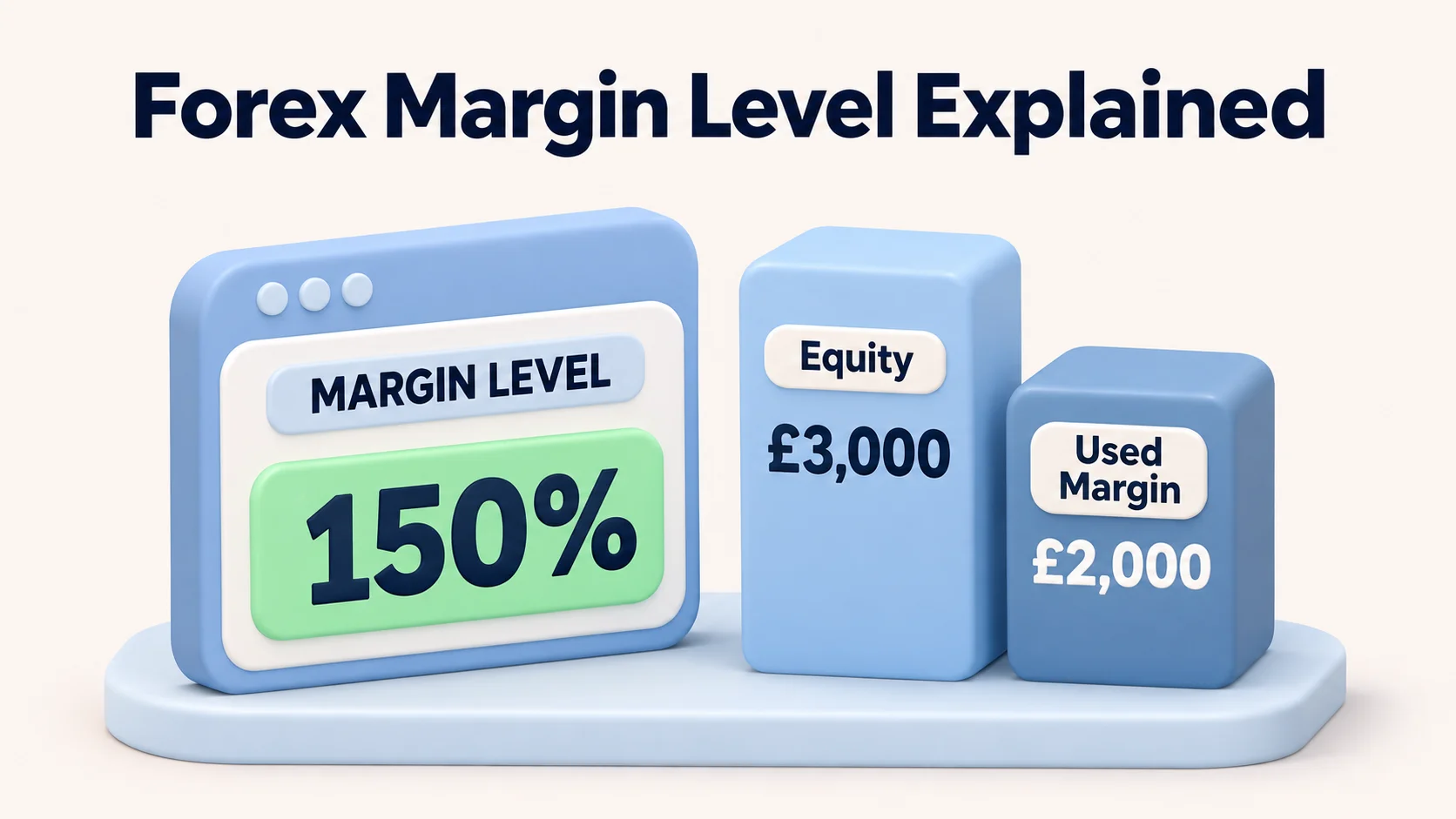
Margin is not a fee: margin is collateral needed to support a leveraged position. It is not the same as the spread or commission. Trading profit and loss is calculated on the full exposure, so financing costs can be large relative to the margin deposit. Broker interest earned on client cash, where permitted and under the applicable arrangements, is another potential business benefit that requires separate disclosure and should not be assumed.
Does a forex broker make money when you lose?
Sometimes a broker can gain from an unhedged client loss, but a client loss is not automatically broker revenue. In an OTC forex or CFD trade the dealer may be the contractual counterparty even if it hedges the market exposure elsewhere. Whether a broker keeps material directional risk is a separate question from whether it quotes prices as principal.
The US Commodity Futures Trading Commission's retail OTC forex advisory explains that customers generally trade against their dealer rather than on an open exchange and warns about the dealer's incentives. This is a US retail OTC forex explanation; it should not be applied without qualification to exchange-traded futures, the UK CFD regime or every international broker entity.
Three ways a principal-dealing firm can manage customer risk
| Handling of market exposure | What happens | Main issue to assess |
|---|---|---|
| Fully hedged / back-to-back | The dealer contracts with the customer and offsets the exposure with a liquidity provider, individually or in aggregated positions. | Hedge costs, pricing, slippage and external counterparty quality; the dealer can still earn spread mark-ups or commissions. |
| Internalised / unhedged | The firm retains some or all of the market exposure rather than offsetting it externally. | Client and firm trading outcomes can be opposed, requiring serious conflict controls and fair-pricing scrutiny. |
| Hybrid / partially hedged | The firm offsets part of its customer exposure or hedges when risk thresholds are reached. | How risk limits work and whether execution standards differ by order or client group. |
These descriptions concern market-risk handling. They are not reliably established by retail marketing labels such as 'ECN', 'STP', 'A-Book', 'B-Book' or 'no dealing desk'. A platform may route an external hedge automatically while the trader still has a bilateral contract with the dealer. Nor does a dealing desk label establish that trades are manipulated. Read the relevant order-execution policy, identify the contracting company and ask how prices are benchmarked and conflicts are managed.
ESMA's detailed CFD guidance distinguishes fully hedged, unhedged and partly hedged principal models. It treats models dependent on client losses as a particularly serious conflict and discusses execution duties even where the firm acts as principal. This is not a blanket endorsement of any model: an unhedged book can create more direct financial opposition between firm and client, while a hedged book still faces conflicts over mark-ups, counterparties and execution.
Conflicts of interest: what matters in practice
Conflicts arise when a firm's incentives diverge from fair treatment of its customers. They do not prove wrongdoing in an individual trade. The test is whether a broker identifies, manages and discloses conflicts and provides fair pricing and execution under the rules that apply to its entity and product.
- More volume, more charges. A firm earning per-trade spreads or commissions benefits when a customer trades more often. That creates an incentive to encourage unnecessary activity even if the broker hedges every position.
- Retained market risk. A principal firm that leaves exposure unhedged may gain when the offsetting client position loses and may lose when it wins. This can heighten the incentive to influence pricing or order treatment. It does not establish that such conduct occurred.
- Asymmetric slippage or rejections. If a broker passes adverse price changes to customers but does not pass favourable changes consistently, the outcome can be unfair. Compare disclosed positive and negative slippage statistics where available, alongside rejected-order and re-quote policies.
- Opaque finance rates. A low spread may mask a high ongoing funding adjustment. Two opposite client positions may continue accruing costs even when their net market exposure is close to zero.
- Order-handling discretion. A broker may determine its quoted prices, select a liquidity provider or choose when to hedge. Clear benchmarks, objective order-cancellation rules, monitoring and complaints procedures matter more than a slogan about the desk.
The FCA's CFD sector expectations recognise structural conflicts and regulatory conduct requirements. Its 2026 review specifically warns that providers have discretion over dealing spreads and ongoing charges. Neither finding means that every market maker breaches the rules. Read the firm's conflicts disclosures against the applicable FCA standards if you are dealing with a UK-regulated firm.
How to compare a broker's real cost and incentives
- Find the legal entity. Match the full company name on the agreement to the regulator's register and check the product it is permitted to offer. For example, the CMC Markets UK plc document index applies to its specified UK CFD service, not every CMC-branded entity.
- Write down your usual trade. Record the pair, position size, account currency, hours traded and likely holding period. A scalper and a three-week position trader do not face the same mix of costs.
- Calculate round-trip spread plus commission. For EUR/USD, one 100,000-EUR lot is approximately $10 per pip in USD terms. Multiply the expected spread by the pip value and add both commission sides, then adjust for fills and currency conversion.
- Add overnight finance realistically. Use the broker's applicable long or short rollover table and an actual holding-period scenario. Do not count a financing credit as guaranteed.
- Read execution and conflict policies. Check who is the counterparty, whether the broker hedges or internalises exposure, the pricing source, slippage treatment, order-rejection conditions and complaint route.
- Compare like with like. Start with FXRanking's broker comparison hub, its fees and commissions methodology and its ECN/raw-spread broker comparison. Check current broker documents before relying on figures shown on an editorial page.
Before selecting any firm, ask two separate questions: What will this trading pattern cost? and what incentives or discretion sit behind the prices and fills? The cheapest published minimum spread answers neither question by itself. A fuller guide to choosing a broker and a separate no-dealing-desk comparison are related editorial topics, but they should be linked only after their final public URLs are confirmed.
The bottom line
Most traders encounter broker income through spread pricing, commissions, rollover adjustments and sometimes account charges. A broker's decision to hedge all, some or none of its customer exposure is a different issue that can change its trading profit and the conflicts it must manage. Compare complete costs and enforceable execution disclosures for the actual account entity, not labels such as 'commission-free' or 'no dealing desk'.
Risk warning: Leveraged forex and forex CFDs are high-risk products. Leverage magnifies losses as well as gains; spreads, slippage and financing can erode an account even when a trade has not moved far. Losses can reach the full amount deposited and, for some products, jurisdictions or professional classifications, may exceed it. UK retail CFD protections do not automatically apply to overseas or professional accounts. Regulatory supervision, hedging by a broker and a narrow spread do not remove market or counterparty risk. Check whether trading these products is appropriate for you.
FAQs
How do forex brokers make money if they advertise zero commission?
Usually through the bid-ask spread, which can contain a broker mark-up, and potentially through financing or other account charges. Zero commission does not mean zero total cost. Compare typical spreads and the complete account fee schedule.
Do forex brokers profit when clients lose trades?
A dealer retaining unhedged market exposure can gain from an offsetting client loss, but brokers that hedge can still earn spreads and commissions regardless of trade outcome. Being a contractual counterparty alone does not show whether or how the firm hedged the position.
What is the difference between a spread and a broker mark-up?
The spread is the total difference between the bid and ask quote offered to the client. A mark-up is a broker-added pricing component that may be included within that quoted spread, on top of a core price-source spread. Do not count it a second time when calculating the total cost.
Are raw-spread accounts always cheaper than standard forex accounts?
No. Raw-spread accounts normally add a separate commission, often charged on opening and closing. Compare the effective spread plus full round-trip commission for the same currency pair, lot size and account currency, including any currency conversion.
Is a no-dealing-desk forex broker free of conflicts?
No. An STP, ECN or no-dealing-desk label does not establish how a specific entity contracts with clients, sets quotes, chooses liquidity or handles a hedge. A broker can face conflicts through spread mark-ups, volume incentives, slippage or financing even when its exposure is fully hedged.
Is overnight forex financing the same as a broker fee?
Overnight rates may reflect market interest differentials or tom-next costs plus a broker adjustment. The trader may be charged or credited depending on the position and current rates. Read the formula, long and short rates and rollover timetable, because the gross cashflow is not automatically the firm’s retained profit.
Which documents matter before opening a forex broker account?
Identify the legal company and authorisation for your product. Then read the account pricing schedule, order-execution policy, conflicts-of-interest policy, overnight funding schedule and non-trading fees. Compare the full cost of your typical trade and check independent regulator guidance.

Nathan Wong
Nathan Wong is a Forex education contributor with 15 years of trading and market-analysis experience. He specializes in broker platforms, cryptocurrency, risk management, and trading psychology, creating practical content that helps readers make informed decisions and develop realistic expectations.