A managed forex account lets someone else make currency trades with authority over your account, but it does not remove your market risk. The first decision is not which manager advertises the highest return. It is whether the manager is legally permitted to act for you, who actually holds the money, how much leverage the manager can use, and whether you can see and stop the activity.
For US retail investors, the distinction is particularly important. The National Futures Association (NFA) forex regulatory guide separates an account manager who exercises trading authority from the authorised forex counterparty that holds customer funds. A manager's overseas PAMM or MAM technology does not, by itself, satisfy those requirements. If the provider cannot identify its regulator, contractual company, custodian and specific authority, do not fund the account.
What is a managed forex account?
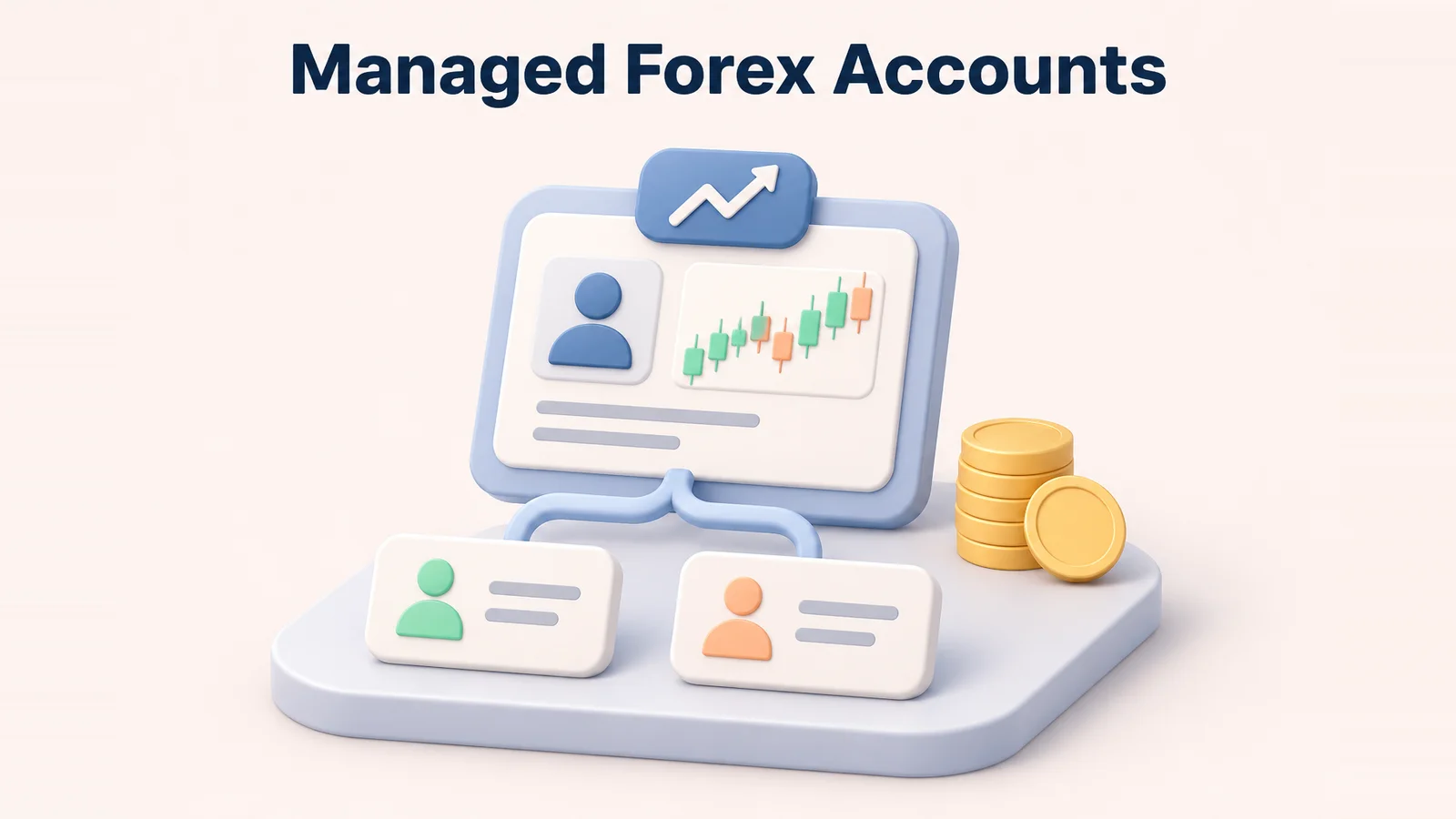
A managed forex account is an arrangement in which a trader or investment manager places foreign-exchange trades under agreed authority for a client. In a conventional separately held managed account, the customer opens an account with a broker or other permitted counterparty, signs a limited trading authorisation, and receives account statements. The manager decides when to trade within the mandate; the customer remains exposed to the gains, losses and costs.
That is different from paying for a signal service or subscribing to copy trading, where an investor may retain different execution controls, and different again from buying units in a pooled investment fund. Marketing materials sometimes call all four arrangements "managed accounts." A name on a brochure does not settle the legal structure.
Who controls each part?
- Investor: contributes capital, agrees a risk mandate, receives statements and should know the process for revoking trading permission and requesting withdrawals.
- Manager: chooses positions, sizes and timing under the written mandate. A trading-only power of attorney should not automatically grant control over withdrawals or transfers.
- Broker or authorised counterparty: opens and maintains the trading account, executes the resulting transactions and charges its own dealing and financing costs. A manager's licence is not a substitute for a permitted counterparty.
- Custodian or pool operator, where applicable: the person or institution legally responsible for assets depends on whether this is an individual account, a custodial arrangement or a fund. Ask for the exact legal names and governing documents.
The distinction changes the risk. Trading authority gives a manager enough power to lose money through poor decisions, even when the manager cannot transfer the balance to a personal bank account. Conversely, retaining a withdrawal button does not guarantee prompt access while positions are open, margins are insufficient or contractual restrictions apply.
PAMM vs MAM vs individual managed accounts
PAMM commonly means a percentage or proportional allocation module. MAM generally means a multi-account manager setup that applies trading decisions across linked accounts, sometimes using selectable lot-size, equity or other allocation rules. Both are technology or allocation descriptions, not universal legal categories. Exact calculations, rounding, minimum position sizes and whether profits accrue in distinct client accounts depend on the broker's documents.
| Arrangement | How trades are assigned | Key question before investing |
|---|---|---|
| PAMM | A manager trades through an allocation system; gains, losses and exposure are generally distributed to participants by stated percentages or equity ratios. | Does each investor hold an individual account, or do assets legally belong to a pool? Ask for the allocation formula and account agreement. |
| MAM | A master order or strategy is applied to linked client accounts, potentially through different sizing or allocation settings. | Can the manager select unequal risk per account? What happens to tiny accounts, partial fills and different leverage limits? |
| Individually managed forex account | The manager trades directly under an individual mandate, which may or may not use allocation software. | Who has trading and transfer authority, and is the customer the named account holder? |
| Pooled forex fund | An operator gathers investors' capital in a legal fund or pool and trades on behalf of the vehicle. | Who operates the pool, holds assets, values units and processes redemptions? Fund regulation may be different from individual-account regulation. |
| Copy trading or signals | Transactions may be duplicated automatically or proposed for client approval, depending on the service. | Does anyone have discretionary authority? Who executes and may override or stop a copied trade? |
For a concrete illustration, Dukascopy Bank's published PAMM specification describes a limited trading power of attorney and percentage allocation across managed accounts. FxPro's PAMM explanation describes proportional copying into sub-accounts and also discusses MAM accounts. The terminology overlaps across providers. Neither page proves that a particular manager is licensed in your country or that the service is available to you.
US managed forex accounts: licensing and custody first
For US retail off-exchange forex, the NFA guide says a person exercising trading authority generally must register as a commodity trading advisor (CTA), subject to stated exceptions. The guide also says the manager cannot receive or hold customer funds; the relevant futures commission merchant (FCM) or retail foreign exchange dealer (RFED) counterparty must hold them. Different rules and exemptions may apply to banks and other otherwise regulated entities, eligible contract participants or particular advisers. Do not treat a general registration label as proof of eligibility for your exact account.
A genuine investment pool is a different question. The same guide says that, subject to exceptions, someone operating a relevant pooled retail forex vehicle must register as a commodity pool operator (CPO). A PAMM program is not automatically a CPO pool merely because the platform uses the word "pool." Legal documents and the way investors' assets are held determine whether the pooled-investment rules apply.
Before signing, check the manager's exact legal name, CFTC registration, NFA membership and forex approval where applicable in NFA's investor background-check guidance and BASIC database. Check the individual principals and disclosed regulatory actions as well. Separately verify the forex counterparty. Confirm that the manager's claimed exemption actually covers its conduct and your investor category. An overseas regulated company is not automatically authorised to solicit or manage US retail off-exchange forex accounts.
For a registered CTA where a disclosure document is required, request the current document before signing. The NFA's CTA disclosure FAQs explain filing and acceptance requirements and recognise exemptions for some qualified eligible persons. Acceptance of a disclosure document is not an endorsement of profitable trading.
UK and Australian rules are not the same as US rules
| Client location | Minimum verification | Why it matters |
|---|---|---|
| United States | Manager's CTA status or documented applicable exemption; NFA forex approval where required; lawful FCM/RFED or other permitted counterparty; any CPO status for an actual pool. | Separate the right to direct trading from the legal right to hold customer funds. |
| United Kingdom | Exact FCA-authorised firm, permissions that cover the offered investment management activity and product, contractual entity, and applicable client-money and complaint arrangements. | FCA authorisation for one service does not establish permission for all managed forex products. |
| Australia | AFS licensee or authorised representative, permissions covering the service, and whether the arrangement is a managed discretionary account (MDA) or another structure. | ASIC explains that an MDA may fall within its regulatory definition regardless of the industry's product label. |
| Other countries | Regulator in the client country, local solicitation rules, actual broker entity, manager's authority, custody and withdrawal terms. | One group's offshore licence, PAMM product page or headline leverage cannot confirm local access. |
The UK's FCA investment-manager guidance identifies managing investments among the activities for which permission may be needed. Use the FCA Firm Checker and Financial Services Register to confirm permissions and contact details, not merely a logo or firm reference number. In Australia, ASIC's MDA guidance describes individual portfolios managed at the provider's discretion, and its professional registers help investors check licensed activities.
Licensing is an initial filter, not insurance against trading losses. Compensation, ombudsman access and negative-balance protection depend on the legal entity, product, account classification and the circumstances of failure or complaint. Do not assume ordinary trading losses are covered.
How managed forex account fees work
The real cost has two layers. The broker charges spread, commission, overnight financing or swap, possible conversion fees and other account charges. The manager may charge an additional fixed or percentage management fee, a fee for profitable performance, a trade-volume fee, or a combination. A broker's tight spread does not compensate for a manager who turns over the account excessively to earn volume-based compensation.
- Management fee: often assessed on assets, but some agreements use a fixed amount, minimum or one-off charge. Read the exact base, timing and refund terms.
- Performance fee: a share of defined gains. Check whether it is calculated before or after dealing costs, how cash deposits or withdrawals affect it, and whether losses must be recovered first through a high-water mark.
- Dealing costs: repeated spreads, commissions and overnight financing can apply even while the strategy loses money.
- Introducer, rebate or volume payment: a manager paid for trading activity has an incentive to trade more; disclose who receives each payment and whether it comes from the client's pricing.
- Exit and administration: check notice periods, withdrawal fees, performance-fee crystallisation, close-out costs and any minimum-balance requirement.
An illustrative $10,000 managed-account fee calculation
Suppose an account starts with $10,000 and ends a month at $10,700 before the manager's fees, after the broker has deducted $90 of trading charges. The agreement in this example charges a 1% annual management fee assessed monthly on the original $10,000 balance and a 20% performance fee on the $700 gain after broker charges and before manager fees, with no prior losses or deposits. These are hypothetical terms, not a provider's quoted charges.
| Illustrative item | Calculation | Amount |
|---|---|---|
| Trading gain before broker charges | $700 gain after charges + $90 broker costs | $790 |
| Broker costs | Already deducted to reach the $10,700 balance | $90 |
| Monthly management fee | $10,000 × 1% ÷ 12 | $8.33 |
| Performance fee | $700 × 20% | $140 |
| Ending balance after manager fees | $10,700 − $8.33 − $140 | $10,551.67 |
The manager takes $148.33 on top of $90 paid through the broker. For this exact illustration, the client's net monthly gain is $551.67, or approximately 5.52%, not the $790 pre-cost trading gain. A differently defined fee base, daily management accrual or high-water mark changes the calculation. Ask the manager to reproduce its charges on a losing month and a recovery month as well.
A high-water mark means the manager generally does not take a new performance fee until the account exceeds its relevant previous fee-paying peak, adjusted according to the agreement. It is not automatic. A manager who charges 20% on every profitable month after a severe loss can collect fees while the investor is still down overall.
Can you trust a managed-account track record?
Prefer independently reconcilable live customer-account records to a screenshot of a monthly-return chart. Ask for a dated performance history that identifies the specific strategy, start date, all relevant accounts and closures, deposits and withdrawals, realised and unrealised profit or loss, and the fees included. A track record from one personal demonstration account does not establish results achieved for paying clients.
- Check the denominator: profits shown in dollars without account capital, margin usage and cash flows are not a comparable return series.
- Look for closed accounts: a list showing only surviving profitable accounts may omit clients who withdrew after major losses.
- Read maximum drawdown: a strategy with a 30% peak-to-trough loss needs approximately a 42.9% gain to recover to its previous account value before fees.
- Distinguish actual from hypothetical: backtests, model portfolios and selectively joined accounts do not establish what an investor could have earned at live spreads and execution prices.
- Check fee treatment: ask whether returns are gross or net of management and trading costs, and whether the fee history matches the current proposal.
- Check independent evidence: obtain broker-issued statements where practicable and reconcile the opening and closing equity, account currency and trade activity.
The NFA's disclosure guidance differentiates actual and hypothetical results and requires qualified disclosures in relevant CTA documents. An audited or regulator-filed record can improve confidence in the accuracy of the figures, but neither proves that a trading system will remain profitable.
Leverage, trade limits and drawdown rules
A discretionary manager can take much greater risk than a passive client expects. A $10,000 balance supporting $200,000 in currency exposure has 20:1 exposure-to-equity leverage. Ignoring all fees and changes in position size, a 1% adverse movement across that exposure represents about $2,000 in loss, or 20% of the initial account. The example is arithmetic, not an observed strategy return. Correlation, gaps and financing can add to losses.
Write maximum exposure, per-trade risk, permitted pairs, use of expert advisers, hedging rules, maximum overall drawdown, trading around news, and whether the manager may increase risk after a losing period into the mandate. A stop-loss or equity threshold is a trigger for attempted action, not a guarantee of execution at the selected value.
A strategy described as "low drawdown" deserves particular scrutiny if it averages down losses, runs a grid without a defined maximum, or keeps large losing positions open while presenting closed-trade win rates. An investor needs the full account-equity curve, not just a high percentage of winning trades.
Withdrawals and power of attorney: the questions that decide control
Before depositing, request the account-opening contract, manager agreement and any limited power of attorney (LPOA). Confirm in writing whether the manager has trade-only permission, whether trading authority can be revoked immediately, and which person is authorised to move cash. Never send funds to a manager's personal account simply because the manager provides a broker login link.
Ask exactly what happens if you want to withdraw during open trades. Some systems reduce your allocated exposure; others require settlement or enforce notice periods. A right to close positions can still result in slippage, financing charges or realised losses, and an account statement alone is not proof that money is freely withdrawable.
Dukascopy Bank's PAMM FAQ illustrates the practical details: it describes an investor-set equity stop-loss, the ability to deactivate management, and proportional exposure reduction when withdrawing with open positions. Those are features of its own documented arrangement. They should not be attributed to all PAMM or MAM systems, and they do not guarantee an exit price.
A provider example, not a list of approved managers
Dukascopy Bank SA, Switzerland: Its externally managed account material describes investor-appointed managers, account reporting and trading deactivation tools. Its PAMM FAQ describes manager onboarding and a published broker volume commission of $25 per $1 million traded, alongside possible client-negotiated manager charges including a performance fee. These figures are service-specific published terms, not a complete all-in price or a promise that any given applicant qualifies.
US eligibility limit: the same Dukascopy Bank FAQ explicitly lists the USA among countries whose residents cannot open Dukascopy Bank accounts. This Swiss example therefore cannot be ranked as a US retail managed-forex option. Dukascopy also disclaims responsibility for an external manager's trading decisions and performance. The manager's individual legal status, compensation terms and customer-country permission require separate checks.
Rather than publish a generic "best managed forex accounts" leaderboard, the responsible comparison is a short list of legally eligible managers and brokers after the regulator, contracting entity, current account documentation, performance basis and full costs have been verified. No named US manager has been independently established as eligible and suitable by this guide. A provider's technology page should not be mistaken for an endorsement of its managers.
Managed forex account due-diligence checklist
- Verify the parties. Get the manager's and broker's exact registered entities, regulator references, country of incorporation and the name on the receiving account.
- Confirm the service is lawful for your location. For a US investor check the applicable CTA, NFA forex and counterparty requirements or documented exemptions. Do not rely on a foreign licence alone.
- Read the authority. Make sure the LPOA, investment mandate, withdrawal rights and termination method match what was advertised.
- Demand net, dated performance. Reconcile gross/net returns, fee treatment, drawdowns, deposits, closed accounts and whether figures are hypothetical.
- Request a complete fee schedule. Put manager charges beside broker spread, commission, swaps, conversion costs, rebates and exit costs.
- Set loss limits that reflect actual leverage. Establish the maximum exposure and what the manager can do during a drawdown, including emergency suspension.
- Test the administration process without assuming returns. Review sample statements, login permissions, trading deactivation and withdrawal procedure before committing meaningful funds.
- Keep records. Save the signed mandate, promotional claims, statements and communications, and identify the appropriate regulator or dispute route before there is a problem.
The CFTC and NASAA forex fraud alert warns against low-risk, high-return promises and pressure to send money quickly. The FCA's forex scams guidance likewise describes fake managed accounts that show initial gains to induce further deposits. Profit guarantees, withdrawal "tax" demands paid to a new wallet, hidden corporate identities and refusal to provide contracts are reasons to stop.
Is a managed forex account worth it?
It is only a defensible option for someone who understands the likely loss range, can evaluate an authorised manager and counterparty, and accepts paying extra for decisions they will not control. It is not a passive equivalent of a cash deposit, a guaranteed-income service or an easy workaround for local retail forex restrictions. A regulated account with a poor mandate, excessive turnover or opaque fees remains a poor choice.
For beginners, a trust and safety check, a conventional self-directed account with an appropriately regulated firm, or simply deciding not to use leveraged forex is often easier to assess than handing authority to an unknown trader. US residents can use the US forex broker guide as a starting point for identifying trading counterparties, but availability of an ordinary broker account does not establish that it supports lawful discretionary forex management.
Risk warning: Managed forex trading can rapidly lose a substantial part or all of your capital because of leverage, concentration, trading decisions, slippage, financing costs and fees. Stop-loss thresholds may execute at worse prices during gaps; some arrangements can create losses beyond deposited funds depending on the product and jurisdiction. Registration and account segregation cannot guarantee returns, immediate withdrawals or reimbursement of market losses. Never grant transfer access or invest money you cannot afford to lose.
Guide for traders reviewing managed forex accounts in 2026. Fees, permitted products, managers and eligibility depend on the current signed agreements, investor classification and legal jurisdiction.
FAQs
What is a managed forex account?
It is a forex trading account or investment arrangement where an authorised manager makes trading decisions for a client under an agreed mandate. Who holds the assets and who may withdraw funds depend on the legal documents, not the label.
Are managed forex accounts legal in the United States?
They can be lawful when the parties meet the applicable rules. For relevant US off-exchange retail forex, managers generally need CTA registration unless an exception applies, while the customer funds must be held by a permitted counterparty. Verify the specific manager, broker, account and any exemptions.
What is the difference between PAMM and MAM?
PAMM usually allocates trades and results by an agreed percentage or equity ratio. MAM uses a master strategy across multiple linked accounts and may support alternative allocation methods. Neither label guarantees licensing, individual custody or investor protection.
Can a forex manager withdraw client money?
Trading-only authorisation should be narrower than authority to transfer cash, but rights depend on the signed power of attorney and account terms. Confirm who can request transfers, revoke access and withdraw proceeds before depositing.
How much do managed forex accounts cost?
Costs can include spread, commission, overnight financing, conversion and broker charges plus management, performance or volume-based manager fees. Demand an all-in scenario showing both a profitable and a losing month.
Is a 20% performance fee reasonable?
A headline percentage is not enough to decide. Examine the fee base, net-of-costs calculation, high-water mark, payment frequency and whether other charges or rebates create conflicts. An investor can pay a performance fee while still recovering earlier losses if the agreement lacks effective loss carryforward.
How do you verify a forex manager's performance?
Ask for dated live account statements that reconcile net returns, capital additions and withdrawals, losing accounts, all fees and maximum equity drawdown. Separate independently verified client results from backtests, sample portfolios and screenshots.
Are PAMM accounts safe for US residents?
PAMM technology does not establish lawful US availability. Check the manager's applicable registration and forex permissions and the legal counterparty. Dukascopy Bank's published Swiss PAMM example explicitly excludes US residents from opening accounts with that bank.
Can investors stop a forex manager from trading?
Some arrangements let the investor deactivate management or revoke a limited trading authorisation. Others have notice requirements, open exposures or different transfer processes. Written exit terms and the broker's actual controls are essential; an equity stop is not a guaranteed exit price.

Jake Robins
Jake Robins is a Forex and cryptocurrency education contributor with over 10 years of experience helping readers better understand the financial markets. His work covers risk management, technical analysis, trading psychology, broker platforms, and scam awareness. Through clear, practical guidance, Jake helps traders approach the markets with greater discipline, caution, and confidence.