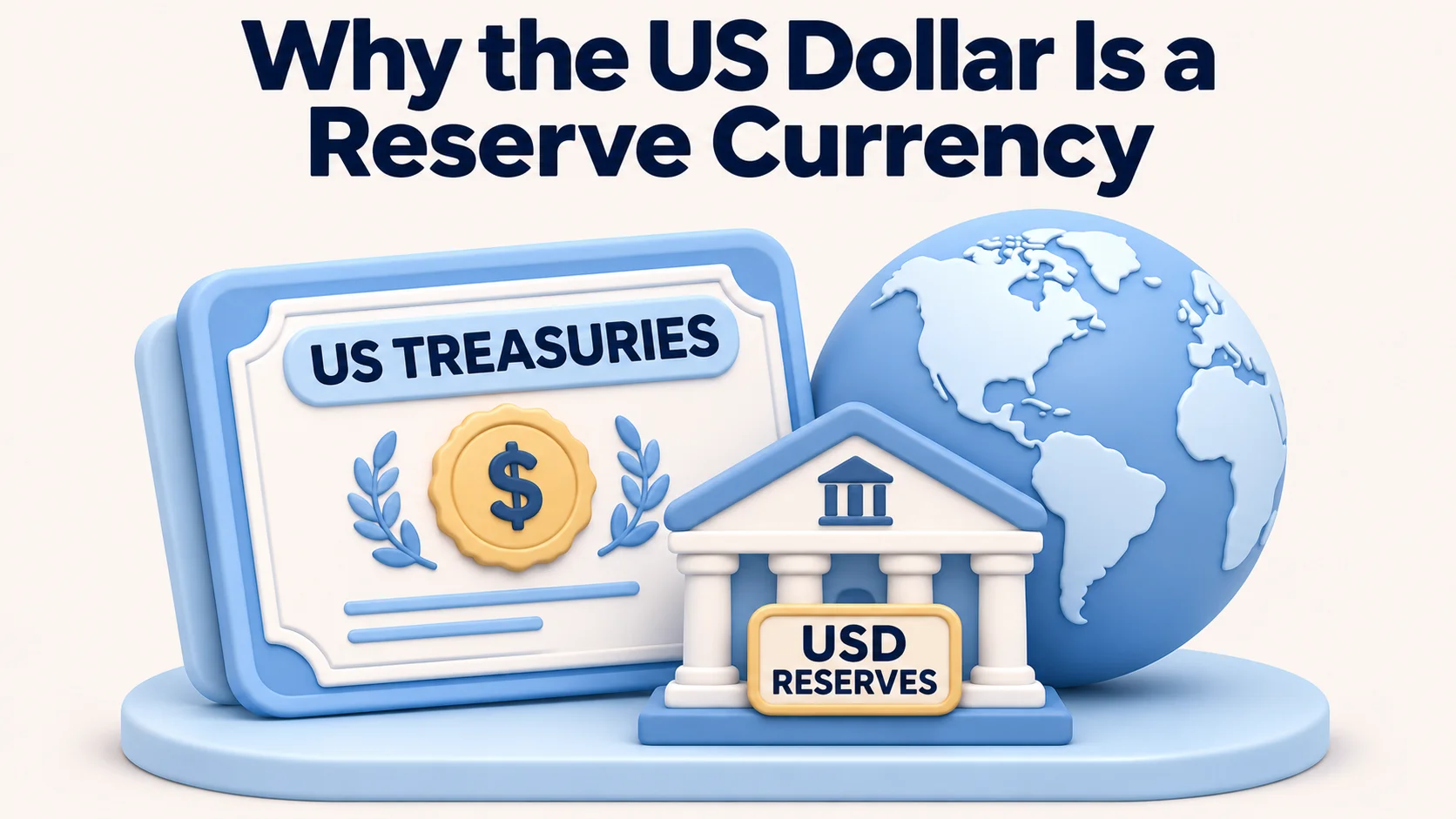
Why is the US dollar the world's leading reserve currency? Central banks, governments, banks and businesses use dollars because dollar-denominated assets can be held, borrowed against and traded in large markets, especially the market for US Treasury securities. The dollar also plays a central role in international invoices, debt contracts and foreign-exchange transactions. These uses reinforce one another, although reserve-currency status does not make the dollar permanently strong or remove exchange-rate risk.
The distinction matters for forex traders. According to the IMF's September 30, 2026 COFER release, US dollar assets represented 56.70% of world official foreign-exchange reserves in Q2 2026. Separately, the BIS 2025 Triennial Survey found the dollar on one side of about 89.2% of global OTC FX trades in April 2025. These figures describe different activities at different times; neither predicts the next move in EUR/USD or USD/JPY.
What is a reserve currency?
A reserve currency is a foreign currency that monetary authorities hold as part of their official reserves. Central banks typically hold foreign currency in the form of deposits and tradable financial assets, not banknotes in a vault. Those reserves help a country pay for urgent foreign-currency needs, meet international obligations, or intervene in its currency market when policy permits.
Imagine an economy that imports essential equipment priced in dollars. If private access to dollar funding suddenly becomes difficult, its central bank may be able to supply dollars from reserves to domestic banks or the market. That is a reason to hold liquid foreign assets ahead of time; it is not a promise that intervention will succeed or that exchange rates will remain stable.
Reserve assets can be held in euros, yen, sterling, renminbi and other currencies as well as US dollars. The currencies and proportions chosen depend on a country's liabilities, trade exposures, liquidity needs, confidence and investment objectives. Gold and the IMF's Special Drawing Rights are also official reserve assets, but they are not part of the foreign-exchange-reserve currency shares discussed in IMF COFER.
Reserve holdings, payments and forex turnover are not the same thing
Three commonly quoted measures of dollar dominance answer three different questions:
| Measure | What it tells you | What it does not prove |
|---|---|---|
| Official reserve share (IMF COFER) | How world foreign-exchange reserve assets are distributed by currency at a quarter-end | How much of global trade is invoiced in dollars or the dollar's expected return |
| FX turnover by currency (BIS) | How often a currency is on either side of sampled wholesale OTC FX transactions during the survey month | That 89.2% of wealth, reserves or invoices is held in dollars |
| International trade, borrowing or payments usage | How businesses and financial institutions use a currency in particular contracts and transactions | A single universal share: measures vary by activity, region and dataset |
A transaction can involve dollars without anyone permanently holding dollars as a reserve. For example, a dealer exchanging euros for dollars and then dollars for yen may use the dollar as a funding and settlement intermediary. Conversely, a central bank can hold a US Treasury bond for years without executing a new forex trade every day.
How did the dollar become the world's main reserve currency?
The dollar's modern position reflects history as well as market size. Under the Bretton Woods arrangements established in 1944, participating countries generally fixed their exchange rates against the dollar, while the United States committed to convert dollars held by foreign monetary authorities into gold at a fixed official rate. That framework encouraged central banks to hold dollar assets.
The direct dollar-gold convertibility arrangement ended in 1971, and the international monetary system subsequently moved toward more flexible exchange rates. The dollar nevertheless remained widely used because financial markets, cross-border contracts and established trading relationships had already developed around it. Switching the invoicing currency of contracts or replacing a deep reserve-asset market carries costs. History helps explain the dollar's persistence; it does not mean its status is guaranteed.
Why do central banks and global businesses continue to use dollars?
Deep, liquid markets for dollar assets
US Treasury securities are widely traded and available in large volumes across maturities. A reserve manager often needs assets that can be sold or pledged during a funding shock without accepting an unusually large discount. That need favors securities with many buyers, established market infrastructure and reliable settlement. Treasuries still have interest-rate, market-price and inflation risks; deep liquidity does not make their prices fixed.
Confidence in institutions and payment arrangements
Investors assess whether contracts can be enforced, transactions can settle, funds can move across borders and an issuer can meet obligations. Long-established US financial and legal infrastructure supports dollar use, but fiscal pressures, policy uncertainty, sanctions and payment restrictions can change perceptions. A reserve currency's reputation is maintained by continued use and confidence, not by a formal global declaration that it must remain dominant.
Network effects in trade, borrowing and hedging
When exporters quote goods in dollars, importers need dollars to pay them; banks then provide dollar deposits, loans, forward contracts and swaps. The more counterparties that use the currency, the more useful it is to the next business. Large pools of dollar borrowing and investment also generate demand for currency hedging. These self-reinforcing networks can slow a shift to another currency even when governments seek to diversify.
How large is the dollar's role in global reserves and forex markets?
The following are dated official observations, not live market readings or forecasts.
| Official source and period | Reported figure | How to interpret it |
|---|---|---|
| IMF COFER, Q2 2026 | US dollar 56.70% of world official FX reserves; euro 20.60% | Quarter-end asset shares under IMF's current global composition methodology |
| IMF COFER, Q1 2026 | US dollar 57.18% | Previous-quarter comparison; a share decline is not the same as a dollar-asset selloff |
| IMF COFER, Q2 2026 | Total world FX reserves $13.22 trillion, up from $13.10 trillion in Q1 | Total measured stock; its change cannot be attributed to a single currency |
| BIS Triennial Survey, April 2025 | US dollar on one side of 89.2% of OTC FX trades; total OTC FX turnover about $9.6 trillion daily | Survey-month transaction activity across FX instruments, not central-bank reserve holdings |
In its September 2026 release, the IMF said dollar-denominated claims were largely unchanged in Q2 even as the dollar's share declined from Q1. Holdings in euros and some other currencies increased. That illustrates a crucial point: a falling percentage share does not, by itself, establish that central banks sold dollars. Shares reflect changes in both the numerator and the total reserve portfolio, including asset prices, exchange-rate valuation and allocation decisions.
The BIS figure needs a different caution. Every FX trade has two currencies, so BIS currency participation percentages total 200%, not 100%. The 89.2% figure means the dollar was involved on at least one side of those surveyed transactions. It does not mean 89.2% of central-bank reserves are dollars, nor that a US retail trading account can reach the full institutional market. The BIS survey measures activity in April 2025, when market volatility was unusually elevated; it is not a current broker-spread benchmark.
What benefits and trade-offs come with reserve-currency status?
Consistent international demand for dollar assets can support funding conditions for US borrowers and allow some US companies to conduct more cross-border business in their domestic currency. A widely used financing currency can also make it easier for non-US firms to borrow, save and hedge in dollars. Those benefits depend on market conditions and financing terms rather than being guaranteed discounts.
There are costs and tensions, too. A stronger dollar generally makes imported goods cheaper for US buyers but can reduce the overseas price competitiveness of US exporters. Foreign borrowers with dollar debts but local-currency revenues may face a higher repayment burden when the dollar appreciates. For countries dependent on dollar funding, a shortage of dollars during market stress can become a liquidity problem, even if their longer-term economic prospects have not changed.
A dollar's reserve role is therefore relevant to international credit and trade, not merely to spot forex speculation. It is possible for dollar use to remain extensive while the dollar weakens against the euro for months, or for dollar financing to become tight during a temporary crisis.
Could the dollar lose reserve-currency dominance?
Yes, its share can change and there is no permanent guarantee of leadership. Central banks may diversify into other currencies to spread currency and issuer risks, better match future liabilities, or reduce dependence on one payment system. Confidence in US fiscal policy and institutions, sanctions exposure, relative yields and the availability of alternative liquid assets may influence those decisions.
But replacing a reserve currency is harder than introducing an alternative payment channel. The euro is the second-largest currency in COFER; its markets and institutions are substantial, although its government-bond market is spread across multiple national issuers. The Chinese renminbi also appears in global reserves and trading, but capital controls and market-access arrangements limit its substitutability for freely convertible reserve assets. Other currencies can gain share without any single one becoming a direct, full-scale replacement.
Terms such as de-dollarization may refer to trade invoicing, financing, payment rails, reserve diversification or sanctions exposure. These processes can move at different speeds. A bilateral trade agreement to settle some invoices in local currencies does not prove that the dollar has been replaced in central-bank portfolios or global FX dealing.
What does the dollar's reserve role mean for forex traders?
Reserve status helps explain why the dollar appears in major currency pairs and why dollar funding conditions can influence markets. It does not provide a reliable directional trading signal. Currency prices respond to changes in expected interest rates, inflation, growth, risk appetite, external balances and positioning relative to the other currency in the pair.
Example: why EUR/USD can rise while the dollar remains the leading reserve currency
Suppose markets come to expect a faster decline in US interest rates than in euro-area rates. Investors may reprice expected returns, allowing EUR/USD to rise even while central banks continue holding substantial dollar reserves. A hypothetical move from 1.0800 to 1.1000 means one euro buys more dollars; it says nothing by itself about a quarterly change in COFER holdings. Conversely, a rush for dollar funding could temporarily strengthen the dollar without permanently raising its reserve share.
A practical checklist before trading a dollar pair
- Identify the two currencies in the pair and which economic surprises may affect each; a dollar headline can affect EUR/USD and USD/JPY differently.
- Distinguish structural reserve demand from this week's interest-rate expectations or liquidity shock. Slow-moving reserve data should not be treated as a live signal.
- Check the dated release and methodology before quoting a share or turnover statistic. Use an official source rather than an old headline.
- Calculate the full trade risk and cost: leverage, bid-ask spread, commission, potential slippage and overnight financing can matter more to the outcome of a short-term position than the dollar's reserve status.
- Confirm which instrument and legal entity are available to the actual account. Global interbank turnover does not establish US retail product access or execution quality.
For pair selection and the distinction between interbank turnover and retail trading conditions, see FXRanking's most-traded forex pairs guide. For event risk, use the forex economic calendar guide.
How to read the IMF and BIS data correctly
IMF COFER: The International Monetary Fund compiles quarterly global foreign-exchange reserve currency composition. It covers monetary authorities' foreign-currency assets such as deposits, securities and other eligible claims; gold, SDRs and the IMF reserve position are outside this particular currency-composition measure. The IMF receives voluntary reports and keeps individual-country currency allocations confidential. From its 2025 Q3 release, with historical revisions, it introduced estimates for the previously unallocated share so the published global composition covers 100% of foreign-exchange reserves. As a result, historical comparisons should use a consistent revised series rather than mixing old 'allocated reserves' figures with the newer full-composition shares. Foreign-currency assets are valued using end-of-period exchange rates.
BIS Triennial Survey: The Bank for International Settlements collects OTC foreign-exchange activity through participating monetary authorities and reporting dealers. Its April 2025 snapshot includes spot, forwards, swaps and options; daily turnover is a flow, not a stock of reserve assets. Overall turnover is adjusted for double-counting between reporting dealers, but currency participation still counts both sides of each transaction, so currency percentages sum to 200%. See the IMF COFER definitions and methodology and the BIS survey summary.
The Federal Reserve Bank of St. Louis's February 2026 reserve-currency explainer provides useful historical context and explains why exchange-rate moves can change portfolio percentages without an equivalent change in the holdings of dollar assets. Its older snapshots should not be substituted for the IMF's later Q2 2026 release.
Risk warning: Leveraged retail forex trading can produce rapid losses. Spreads, financing charges, slippage, gaps, forced liquidation and counterparty risks can materially change results; losses can exceed initial margin depending on the product and jurisdiction. A currency's reserve status does not reduce these risks or establish that a particular instrument is suitable for a US retail customer.
Bottom line: The dollar's reserve-currency role rests on liquid assets, established institutions and widespread international use. It is still the leading reserve currency in the cited official data, but its share can shift. Reserve shares, trade settlement and FX turnover are not interchangeable, and none eliminates the risks of trading leveraged currency products.
FAQs
Why is the US dollar the world's main reserve currency?
Central banks value the availability of liquid dollar assets, notably US Treasuries, while international trade, borrowing and established financial infrastructure make the dollar widely usable. Its leadership is supported by these features, not guaranteed by law.
What percentage of global reserves are held in US dollars?
The IMF COFER release dated September 30, 2026 reported a 56.70% US-dollar share of global official foreign-exchange reserves at the end of Q2 2026. This is not a measure of all reserve assets, which also include categories such as gold.
Why does the BIS say the dollar is involved in about 89% of forex trades?
The BIS April 2025 survey found the dollar on one side of 89.2% of surveyed OTC FX transactions. Each currency pair has two currencies, so the currency-participation percentages across all currencies sum to 200%. This is unrelated to the 56.70% reserve share.
Does a falling dollar reserve share mean central banks are selling US dollars?
Not necessarily. A percentage can fall when holdings of other reserve currencies rise or when valuation changes alter portfolio values. The IMF reported largely unchanged dollar claims in Q2 2026 even as the dollar share fell.
Are foreign-exchange reserves just cash in central-bank vaults?
No. Foreign-exchange reserves are primarily liquid foreign-currency claims such as deposits and securities. US Treasury securities are an important way to hold dollars. Gold, SDRs and the IMF reserve position are different reserve-asset categories outside IMF COFER currency shares.
When did the dollar become the leading reserve currency?
Its position grew during and after World War II, especially through the Bretton Woods system set up in 1944. The dollar remained widely used after the dollar-gold convertibility arrangement ended in 1971 because of established capital markets, contracts and payments networks.
Could the euro or Chinese renminbi replace the dollar?
Other currencies can gain market share, and the dollar has no guaranteed permanent status. However, differences in liquidity, issuer markets, convertibility, payment arrangements and institutional access make a rapid, complete replacement difficult.
Does reserve-currency status mean the dollar will rise against the euro?
No. EUR/USD responds to relative interest-rate expectations, inflation, growth, positioning, market liquidity and other events. Reserve usage is structural context, not an entry signal or prediction of returns.
How often are reserve and FX trading statistics updated?
IMF COFER is quarterly, subject to revisions and reporting-method changes. The BIS Triennial Central Bank Survey is conducted every three years and reports trading activity for a surveyed month. Always check the period and methodology before comparing figures.

Nathan Wong
Nathan Wong is a Forex education contributor with 15 years of trading and market-analysis experience. He specializes in broker platforms, cryptocurrency, risk management, and trading psychology, creating practical content that helps readers make informed decisions and develop realistic expectations.