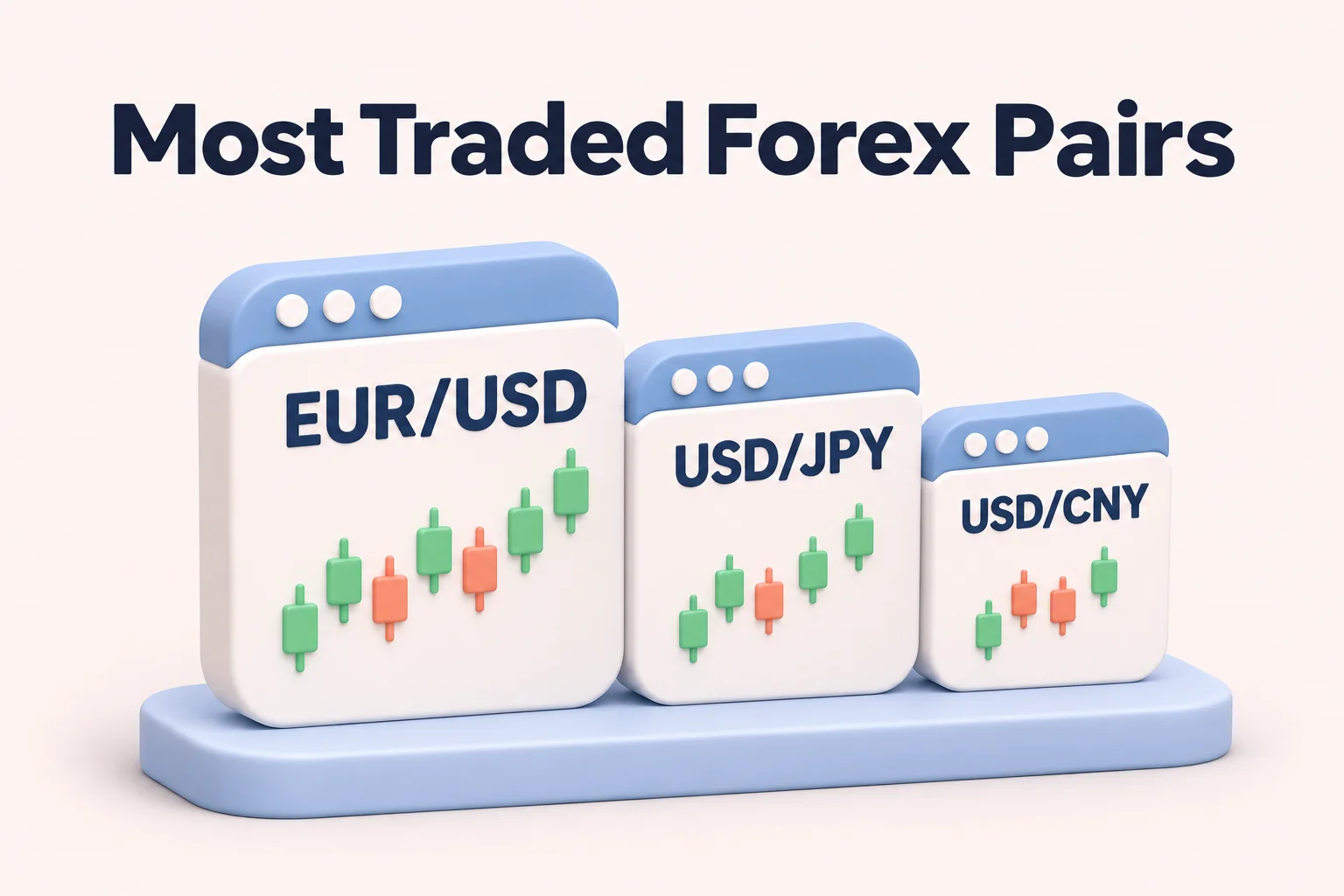
EUR/USD and USD/JPY are the two most actively traded currency pairs in the global over-the-counter (OTC) foreign exchange market. The next pair by turnover in the Bank for International Settlements (BIS) April 2025 survey was USD/CNY, ahead of GBP/USD. That institutional ranking is a useful measure of market activity, but it is not a list of the lowest-spread pairs available to every retail trader.
For a practical forex watchlist, turnover is only the starting point. The right comparison also considers when a pair is active, how wide the executable bid-ask spread is, whether the account can trade the instrument, and how much an adverse move would cost at the intended position size. If the terminology is new, start with the beginner roadmap to forex trading.
Which Forex Pairs Have the Most Trading Volume?
The BIS 2025 Triennial Survey final detailed tables, released in June 2026, record approximately $9.51 trillion in average daily OTC FX turnover during April 2025, including spot transactions, forwards, swaps and options. Spot accounted for about $2.95 trillion, or 31% of the total. The figures were collected from reporting dealers globally and adjusted for interdealer double-counting. They are not real-time trading volumes, retail platform statistics or a ranking of today's spreads.
In its analysis of the 2025 survey, the BIS identifies EUR/USD as first, USD/JPY as second and USD/CNY as third among currency pairs measured across the survey's FX activity. The US dollar was involved in roughly nine of every ten OTC FX transactions. The extraordinary market volatility during April 2025 also affected the size of that month's turnover; one survey month should not be mistaken for a permanent market ranking.
| Pair | What drives attention | Practical trade-off |
|---|---|---|
| EUR/USD | Euro and US dollar policy, inflation, employment and cross-border flows | Typically deep liquidity during London and New York hours; sharp repricing around economic releases |
| USD/JPY | US and Japanese interest-rate expectations, yen flows and official-policy headlines | Active in Tokyo and US hours; yen volatility and intervention risk can overwhelm an initially narrow spread |
| USD/CNY | China-related trade, investment and hedging flows | Third by the BIS April 2025 OTC measure, but onshore CNY is not interchangeable with offshore USD/CNH or an ordinary US retail forex quote |
| GBP/USD | UK and US data and central-bank decisions | Often well traded in London and New York; event-driven swings can be abrupt |
| USD/CHF | Swiss franc safe-haven demand and Swiss and US monetary policy | Frequently traded, but sensitive to sudden franc repricing and Swiss policy decisions |
| AUD/USD | Australian data, Chinese growth expectations and risk sentiment | Useful to monitor in Asia-Pacific hours; liquidity and movement change with the session |
| USD/CAD | Canadian and US data, rates and energy-related sentiment | Often most relevant during North American trading; data releases can widen costs |
The BIS top-three observation concerns all surveyed OTC FX instruments, including transactions used by banks and institutional investors for hedging and funding. A retail broker may offer a different instrument set, execution arrangement or dealer quote. High institutional turnover does not guarantee a particular spread or the ability to trade the onshore currency.
Major, Cross and Emerging-Market Currency Pairs
Major pairs contain the US dollar
Retail education usually groups EUR/USD, USD/JPY, GBP/USD, USD/CHF, USD/CAD, AUD/USD and NZD/USD as the seven majors. Different educational sources may use a slightly different list. They are called majors because of the currencies and established trading networks involved, not because every major always has a low spread or a stable price. A pair quotes one currency in units of another: for example, EUR/USD at 1.0800 means one euro is worth 1.0800 units of USD.
More dealers tend to quote frequently traded majors, particularly while the relevant financial centres are open. That usually supports competitive prices, but a headline CPI release, unexpected rate decision or poor rollover liquidity can still produce wide spreads and slippage.
Cross pairs do not include the US dollar
EUR/GBP, EUR/JPY and GBP/JPY are examples of currency crosses. Some, especially major-currency crosses, can be actively traded. Others have less direct liquidity, and their prices may be derived from two dollar pairs. A cross does not automatically offer diversification: long EUR/JPY and long EUR/USD, for example, share exposure to a stronger euro. GBP/JPY can experience particularly sharp moves because it combines sterling and yen risks.
Emerging-market pairs need an extra eligibility check
USD/MXN, USD/ZAR and USD/TRY pair the dollar with the Mexican peso, South African rand and Turkish lira. Their spreads, rollover charges, market access and gap risks can differ materially from those of widely traded developed-market pairs. Interest-rate differences can dominate the holding cost, and seemingly small position sizes can carry substantial currency risk.
USD/CNY deserves separate treatment. The onshore Chinese renminbi (CNY), offshore renminbi (CNH) and non-deliverable forward (NDF) markets have different trading arrangements. The BIS notes that currency controls can fragment onshore and offshore liquidity. Seeing USD/CNY high in an institutional turnover ranking does not show that a US retail customer can trade the same product, access that liquidity or obtain a comparably tight USD/CNH quote. Check the exact instrument, dealer entity and permitted jurisdiction before interpreting its price.
Does More Volume Mean Better Liquidity and Lower Spreads?
Often, but not automatically. Turnover measures how much business was transacted over a period. Liquidity concerns how readily a trade can be executed near the quoted price without moving the market. The spread is the difference between the broker's current ask and bid. The figures can move in different directions: a surge in volatility can raise both trading volume and execution costs.
A useful comparison separates four costs: the live bid-ask spread, any explicit commission, execution slippage, and financing or rollover for positions kept open across the broker's cut-off. Check them at the intended trading time and for the actual account type. Advertised minimum spreads alone do not describe the full transaction cost.
Worked example: what a changing spread costs
Assume a 100,000 EUR position in EUR/USD, a hypothetical exchange rate of 1.0800 and a USD-denominated account. On that position, a normal EUR/USD pip (0.0001) is worth $10 before costs. The following numbers are invented solely to demonstrate spread arithmetic, not observed quotes from any broker:
- At a 0.8-pip spread, the approximate entry-to-exit spread cost is $8 (0.8 × $10), assuming unchanged conditions.
- At a 2.3-pip spread, that cost is $23 (2.3 × $10) on the same position.
- If the account also charges a hypothetical $7 round-trip commission, the respective example totals become $15 and $30, before slippage or financing.
That $15 difference results from the spread change, not a change in the currency pair's long-run turnover. The calculation also does not assume that a stop-loss fills at its requested price. For a deeper explanation of pip measurement, price increments and position-size conversion, see a dedicated pip guide when its URL is approved and published.
Which Trading Session Matters for Each Pair?
FX dealing takes place across overlapping financial centres rather than on one centralized stock exchange. The relevant session depends on the currencies, local news releases and the broker's quote stream. The broad relationships below are more useful than a fixed promise of the cheapest hour:
| Session or overlap | Pairs commonly watched | What to verify |
|---|---|---|
| Tokyo and wider Asia-Pacific hours | USD/JPY, AUD/USD, NZD/USD, EUR/JPY | Japanese or Australian releases, available liquidity and the broker's spread |
| London and broader European hours | EUR/USD, GBP/USD, EUR/GBP, USD/CHF | European and UK data, opening volatility and order execution |
| London-New York overlap | EUR/USD, GBP/USD, USD/CHF and many other dollar pairs | Usually active dealer participation, but also major US news releases |
| North American hours | USD/CAD, USD/MXN, EUR/USD, USD/JPY | US and Canadian data, market depth and the dealer's actual instrument hours |
There is no single best time for every pair. A JPY-focused approach may pay more attention to Tokyo, while euro and sterling traders often watch London. Even within an active session, thin moments around daily rollover, holidays or unexpected announcements may worsen fills. FXRanking's Asian-session forex pair guide covers the trade-offs for that regional window in more detail.
How to Choose a Pair Without Treating Popularity as a Trade Signal
- Identify the actual product. Confirm whether the symbol is deliverable spot, rolling OTC retail forex, a CFD, an NDF or another derivative. Instrument rules and US customer eligibility differ.
- Compare executable prices. Record the bid, ask, commission and minimum trade size for the account at the time you would trade. Repeat during normal and volatile conditions rather than relying on a single advertised minimum.
- Map the event calendar. Identify which central banks and data releases can move both currencies. A liquid pair can still move quickly around scheduled announcements.
- Convert price risk into account currency. A 20-pip movement is not always the same dollar amount across EUR/USD, USD/JPY or USD/MXN. Pip size, quoted currency and position units determine the monetary change.
- Set exposure before placing an order. For example, at 10,000 EUR of EUR/USD exposure, one pip is approximately $1. A 20-pip adverse move is about $20 before spread, commission, slippage and financing. Increasing the position to 100,000 EUR multiplies that price exposure by ten.
- Review the dealer and its legal terms. US retail OTC forex operates through dealer counterparties, not direct access to the entire BIS-tracked market. The CFTC's customer advisory explains counterparty, fees, margin and registration checks.
Bottom line: EUR/USD and USD/JPY dominate the global turnover comparison, but liquidity, spread and suitability must be checked on the instrument and account you can actually trade. USD/CNY's prominence in institutional data is a reminder that the busiest market segment is not always a directly comparable retail product. A short watchlist with known session behaviour and measured costs is more useful than trading every high-volume symbol.
Risk warning: Leveraged forex and related derivatives involve substantial risk, including rapid losses, widening spreads, slippage, forced position liquidation and potential losses beyond initial margin depending on the product, contract and jurisdiction. The examples above use hypothetical prices and fees, not trade recommendations or verified live dealer quotes. Check the legal entity, instrument eligibility, disclosures and full costs before trading.
FAQs
What is the most traded forex pair?
EUR/USD led the BIS April 2025 OTC FX turnover survey, which covers institutional spot and derivative transactions rather than a live retail broker ranking.
Are the seven major forex pairs the seven most traded pairs?
The usual retail major-pair list is a convention, not an official ranking by turnover. In the BIS April 2025 survey, USD/CNY ranked ahead of GBP/USD, although those products are not interchangeable for retail access.
Is EUR/USD always the cheapest pair to trade?
Its spread can be competitive during active sessions, but costs depend on the dealer, account, time, volatility and any commission or financing.
What is the difference between a major pair and a cross?
Major pairs conventionally include the US dollar; crosses such as EUR/GBP and EUR/JPY do not. Neither label guarantees a particular spread or level of risk.
Why does USD/CNY rank highly in institutional FX data?
The BIS includes bank and other institutional OTC flows, including forwards and swaps. Onshore CNY, offshore CNH and NDF instruments follow different rules, so this is not a straightforward US retail trading comparison.
Which pairs are more active in the Asian session?
Traders often watch USD/JPY, AUD/USD, NZD/USD and yen crosses. Actual liquidity and spreads depend on market news, dealer quotes and session conditions.
Does high liquidity make forex trading safe?
Liquidity does not prevent rapid moves, slippage, leverage-driven losses or wider quotes at news and rollover times.

Stephen Bennet
Stephen Bennet is a Forex reviewer and financial analyst with more than 25 years of experience in the financial markets. He specializes in reviewing brokers, evaluating trading platforms, and explaining the Forex market in a clear and practical way. Through independent, trader-focused analysis, Stephen helps readers compare providers, understand key risks, and choose platforms with greater confidence.