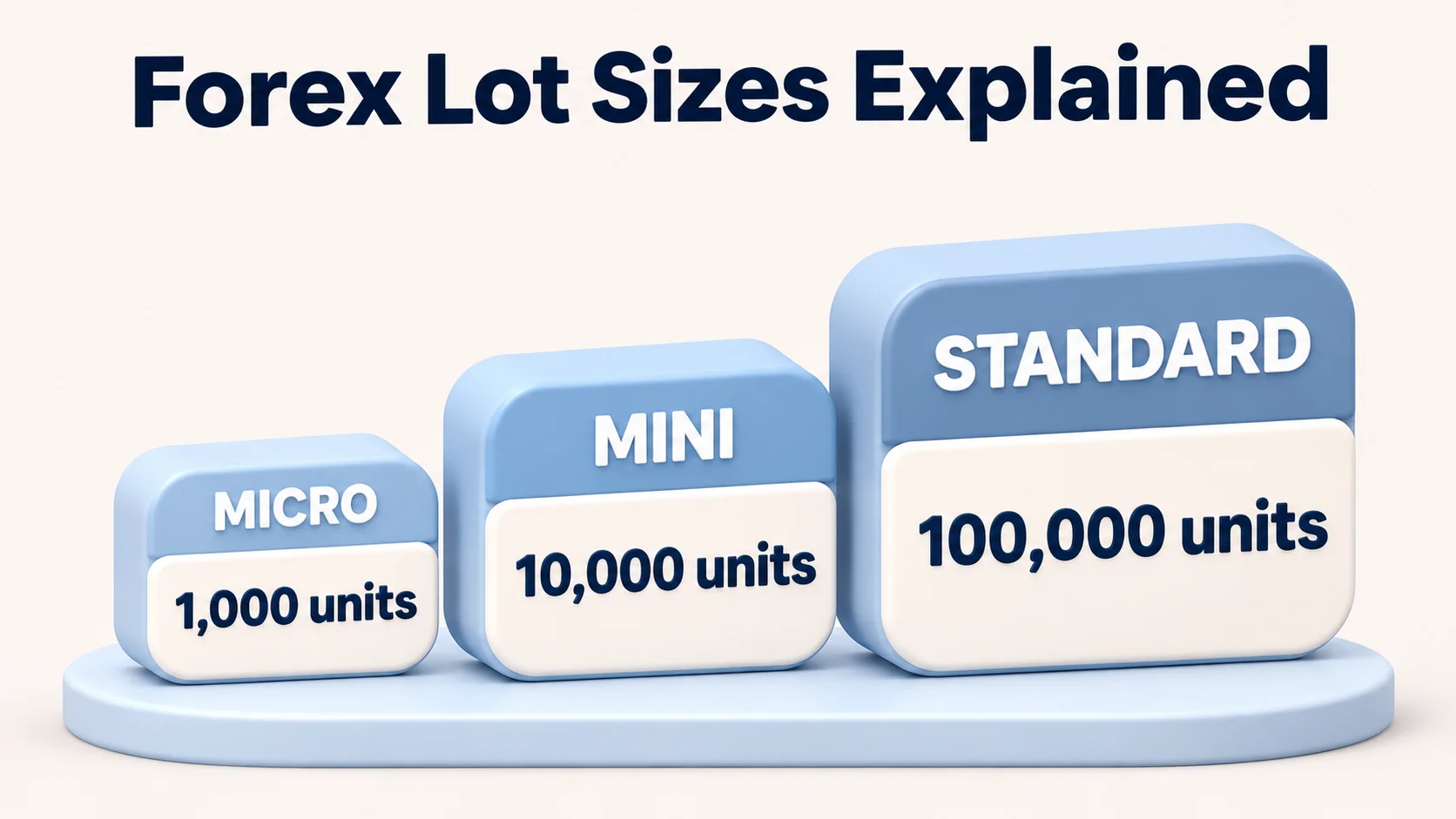
A forex lot measures how many units of the first currency in a pair you trade. One standard lot usually means 100,000 base-currency units, a mini lot 10,000 and a micro lot 1,000. Lot size sets the scale of your exposure, but it does not by itself tell you how much you will gain or lose. The pair, pip value, account currency and distance to an exit price all matter.
For a EUR/USD position, one pip is worth $10 per standard lot, $1 per mini lot or $0.10 per micro lot because the US dollar is the quote currency. Those figures do not automatically apply to USD/JPY, EUR/GBP or an account funded in another currency. Here is how to calculate the differences and size a trade from a risk budget rather than from available margin.
Standard, mini and micro forex lots compared
| Lot type | Platform volume in standard lots | Base-currency units | EUR/USD value of 1 pip, in USD |
|---|---|---|---|
| Standard | 1.00 | 100,000 | $10.00 |
| Mini | 0.10 | 10,000 | $1.00 |
| Micro | 0.01 | 1,000 | $0.10 |
On EUR/USD, the base currency is the euro. A 0.01-lot trade therefore represents 1,000 euros, not $1,000. At a hypothetical EUR/USD price of 1.1000, a standard lot has a quote-currency notional value of $110,000, a mini lot $11,000 and a micro lot $1,100. Notional value describes exposure, not an upfront cash purchase or a guaranteed maximum loss.
The same size relationships appear in OANDA Corporation's US lot-size FAQ. That source also illustrates why the trading interface matters: its unit-based OANDA platform permits sizing in individual base-currency units, while its MetaTrader 4 lot field expresses 100,000 units as 1.00, 10,000 as 0.10 and 1,000 as 0.01. These are specific descriptions of OANDA Corporation's US platform arrangements, not a promise that every broker, instrument or customer account supports identical increments.
Some services offer nano lots of 100 units or allow unit-by-unit sizing. Others set a larger minimum volume or a different increment. Check the specific instrument's contract size, minimum trade, volume step and available order types before translating the word lot into an order ticket.
Lot size versus pip size versus pip value
These three measurements answer different questions:
- Lot size is the position quantity. For EUR/USD, 0.20 standard lot means 20,000 euros.
- Pip size is the normal price increment. It is 0.0001 for most commonly quoted forex pairs and 0.01 when Japanese yen is the quote currency.
- Pip value is the profit or loss corresponding to a one-pip price movement for the actual position quantity, before trading charges and any account-currency conversion.
The starting formula for a conventional forex pair is:
Pip value in quote currency = base-currency units × pip-size increment.
A fifth decimal digit in EUR/USD, or a third in USD/JPY, is normally a fractional pip, also called a pipette, rather than a full pip. The FOREX.com US forex lesson explains those decimal conventions. Contract specifications take precedence for unusual symbols or non-forex products.
Example 1: EUR/USD pip value for three lot sizes
Assume a EUR/USD quotation of 1.1000 and no conversion requirement because the account measures profit and loss in USD. One pip is a 0.0001-dollar movement per euro:
- 1.00 lot: 100,000 EUR × $0.0001 = $10.00 per pip.
- 0.10 lot: 10,000 EUR × $0.0001 = $1.00 per pip.
- 0.01 lot: 1,000 EUR × $0.0001 = $0.10 per pip.
For an illustrative 25-pip move, the price-based gain or loss is $250, $25 or $2.50 respectively, before spreads, commissions, swaps or conversion charges. A trade's direction determines whether the move is favourable. The lot size alone does not.
Example 2: USD/JPY pip value is first measured in yen
Take an illustrative USD/JPY rate of 150.00 and an account denominated in US dollars. Because JPY is the quoted currency, one pip is ¥0.01 per US dollar of base-currency exposure. The resulting pip values are ¥1,000 for 100,000 USD, ¥100 for 10,000 USD and ¥10 for 1,000 USD.
Converting those amounts at the assumed rate of ¥150 per $1 gives approximately $6.67, $0.67 and $0.07 per pip. For example, a mini lot moving 30 pips against the position produces a ¥3,000 price difference, approximately $20 at that conversion rate, before costs.
Those dollar values are estimates at the stated exchange rate. If USD/JPY changes, the USD equivalent of a fixed yen pip value changes too. Calculate realised account-currency profit or loss using the applicable conversion rate and any broker adjustment at the time of settlement, rather than treating $6.67 as a fixed value for every USD/JPY quote.
Example 3: EUR/GBP traded in a USD account
Suppose EUR/GBP trades at 0.8500 and a GBP/USD quote reads 1.2500. Both are hypothetical, independently calculated conversion inputs, not live quotes. For a micro lot of 1,000 EUR, one pip of EUR/GBP is £0.10. Converting at $1.25 per pound produces $0.125 per pip, or 12.5 US cents.
| EUR/GBP size | Value per pip in GBP | USD equivalent at $1.25 per pound |
|---|---|---|
| 1,000 EUR (micro) | £0.10 | $0.125 |
| 10,000 EUR (mini) | £1.00 | $1.25 |
| 100,000 EUR (standard) | £10.00 | $12.50 |
The general rule is to calculate pip value in the quote currency first, then convert into the account currency. When the conversion quote is GBP/USD, multiply pounds by that rate to obtain dollars. When converting JPY into USD using USD/JPY, divide yen by that rate. Use the correct conversion direction and the price applicable to the calculation. A platform may apply a conversion spread or different valuation method.
How to calculate your forex lot size from a stop distance
A sensible sizing calculation starts with the amount of account equity you are prepared to put at risk under an assumed stop execution. It does not start with the maximum leverage available. This method estimates the loss if the trade exits at the specified stop price, before additional costs or slippage.
Position size in standard lots = planned cash risk ÷ (stop distance in pips × account-currency pip value of one standard lot).
- Choose a cash risk budget. As an illustration, 1% of a $5,000 account is $50. One percent is a calculation example, not a universally appropriate risk limit.
- Measure the stop distance from the intended entry fill to the intended exit price. Assume a EUR/USD buy at 1.1000 and a stop exit at 1.0975: 25 pips. For a live order, account for the bid/ask side that triggers and executes the stop.
- Find the pip value in the account currency. For EUR/USD in a USD account, a standard lot is $10 per pip.
- Divide and check the trade volume. $50 ÷ (25 × $10) = 0.20 standard lot, or 20,000 EUR. A 25-pip adverse movement on that volume is a $50 price difference if filled at the stated prices.
- Confirm costs, margin and allowable trade increments. Commissions, dealing spreads not already captured by the entry/exit prices, conversion charges and slippage can increase the eventual loss. If those would breach the budget, reduce the position or reject the setup rather than assume the calculated amount is a hard cap.
A common mistake is to add the quoted spread as an extra cost after already measuring the loss between the actual buy and sell fill prices. Count the spread once, not twice. When working from a chart midpoint instead of executable bid and ask prices, the adjustment may need to be incorporated into the assumed fill or stop distance.
What if the broker only allows 0.01-lot steps?
Suppose a $500 account sets an illustrative 1% price-risk budget of $5, with a 40-pip EUR/USD stop. The exact formula gives $5 ÷ (40 × $10) = 0.0125 lot. If the platform requires increments of 0.01 standard lot, 0.0125 cannot be entered.
Rounding down to 0.01 lot puts the 40-pip price-based exposure at $4. Rounding up to 0.02 lot would make it $8, which exceeds the original $5 budget even before charges or slippage. If the platform's minimum is 0.10 lot, the setup cannot meet that illustrative budget with the stated stop. Another instrument, a platform offering finer unit sizing, or no trade may be more appropriate.
For an external calculation cross-check, Myfxbook's position-size calculator includes fields for pair, account currency, account size, risk percentage and stop distance. It is a third-party tool, not a confirmed FXRanking calculator or a substitute for checking the execution contract and trade-size increments. Any result remains a hypothetical risk estimate.
Lot size is not the same as margin or leverage
Margin is the collateral required to support a leveraged trade. Leverage determines the relation between the notional exposure and the margin requirement. Neither one changes the amount of base currency represented by a lot.
Take the earlier 0.20-lot EUR/USD example. At a hypothetical 1.1000 EUR/USD rate, the 20,000 EUR position has a $22,000 notional value. Under a purely illustrative 20:1 leverage assumption, the initial margin would be $22,000 ÷ 20 = $1,100. That figure is not the 25-pip planned loss of $50, and it is not a maximum-loss guarantee. Real margin rates, account eligibility and liquidation rules vary by the exact dealer, jurisdiction and product.
Do not select the largest lot permitted by available margin. A trader can have sufficient margin to open a position whose ordinary price movement exceeds a sensible risk budget. The FXRanking beginner forex roadmap covers leverage, margin and trade orders, while the FXRanking forex risk-management guide develops position sizing, correlated positions and stop execution in more detail.
Why a stop-loss does not guarantee the calculated loss
Using a stop distance to choose lot size is a planning technique, not a promise that the trade will be closed at that price. An ordinary stop may become a market order after its trigger and fill at the next available executable price. Gaps, thin liquidity, volatile news events, changing bid/ask spreads and platform or dealer execution conditions can push the actual loss beyond the worked estimate.
OANDA Corporation's US margin explanation specifically warns that stop orders are not guaranteed and price gaps can lead to worse fills. The US Commodity Futures Trading Commission's retail forex advisory also describes leverage, OTC dealer and fee risks. The regulatory discussion concerns US retail OTC forex and does not establish that a particular product, entity or trading platform is available to every reader.
Where a provider offers a separately designated guaranteed stop, its eligibility, premiums, trigger rules and exclusions require a contract-specific check. An ordinary stop order should never be described as guaranteed. A stop may also fail to prevent a margin closeout if the account cannot support the position before the intended exit.
Practical checks before entering a lot size
- Read the contract: identify the base currency, contract units, lot increment and minimum size of the exact pair and trading account.
- Use executable prices: measure the planned stop distance from the actual entry side to the intended exit side; include realistic dealing costs only once.
- Convert to the account currency: a pip value calculated in yen or pounds is not yet a dollar risk amount.
- Round down when required: an invalid volume step should not be rounded up past the risk budget.
- Check combined exposure: two positions sharing currency risk can move against the account together, even if each has its own stop.
- Verify legal and account scope: retail permissions, available leverage, execution conditions and protection rules depend on the contracting entity and jurisdiction. A US educational example does not establish eligibility with any named broker.
For most beginners, micro lots give a smaller unit of exposure than mini or standard lots, making it easier to align a position with a modest cash risk budget. They are not automatically low risk: an unusually wide stop, several correlated trades or excessive leverage can still produce material losses. Finer unit sizing is helpful only when the instrument, quote conversion and execution costs have also been checked.
Risk warning: Leveraged retail forex trading can cause rapid and substantial losses, potentially more than the initial amount deposited depending on your account and applicable protections. Lot-size and stop-distance calculations describe hypothetical price exposure, not a guaranteed loss limit. Ordinary stop-loss orders may execute beyond the requested price because of slippage, market gaps or liquidity conditions. Consider all costs, legal-entity protections and the possibility of losing trading capital before opening a position.
Bottom line: Convert the lot into base units, convert each pip into the account currency, then size from the distance to the intended exit and an affordable cash-risk budget. Compare the resulting lot with the minimum trade step and the margin requirement. A smaller lot is useful only when the full risk calculation still works under realistic execution conditions.
FAQs
What is 0.01 lot in forex?
For a conventional forex pair with a 100,000-unit standard lot, 0.01 lot is a micro lot of 1,000 base-currency units. On EUR/USD, it is 1,000 euros, and one standard pip is worth $0.10 before any account-currency conversion or charges. Check the instrument’s contract specification and platform minimums.
How much is a standard lot worth per pip?
One 100,000-unit standard lot of EUR/USD is $10 per 0.0001 pip when USD is the reporting currency. On USD/JPY, a 0.01-yen pip is ¥1,000 for the same base-unit quantity. That amount must then be converted if the account is denominated in another currency.
Is a mini lot always safer than a standard lot?
A mini lot has one-tenth the base-currency units of a standard lot and therefore one-tenth the pip value for the same pair. Whether the trade fits the risk budget still depends on the stop distance, the account balance, trading costs, leverage, other open trades and execution conditions.
How do you find the correct lot size for a 25-pip stop?
Divide the planned cash risk by 25 times the account-currency pip value of one standard lot. For a $50 hypothetical risk budget on EUR/USD in a USD account, that is $50 ÷ (25 × $10) = 0.20 lot. The result assumes execution at the intended prices and excludes additional costs or slippage.
Can a stop-loss limit a forex trade to exactly 1% of the account?
A stop and matching lot size can target a 1% loss at an assumed exit price, but an ordinary stop does not guarantee that fill. Market gaps, spread changes, slippage, fees and conversion differences may cause a larger realised loss. Any special guaranteed-stop terms must be checked separately.
Why does the USD value of a pip change on USD/JPY?
For USD/JPY, one pip on a standard lot is a fixed ¥1,000 price difference, not a fixed dollar amount. Convert the yen value by dividing by the applicable USD/JPY exchange rate. The converted dollar amount changes as the exchange rate changes.

Stephen Bennet
Stephen Bennet is a Forex reviewer and financial analyst with more than 25 years of experience in the financial markets. He specializes in reviewing brokers, evaluating trading platforms, and explaining the Forex market in a clear and practical way. Through independent, trader-focused analysis, Stephen helps readers compare providers, understand key risks, and choose platforms with greater confidence.