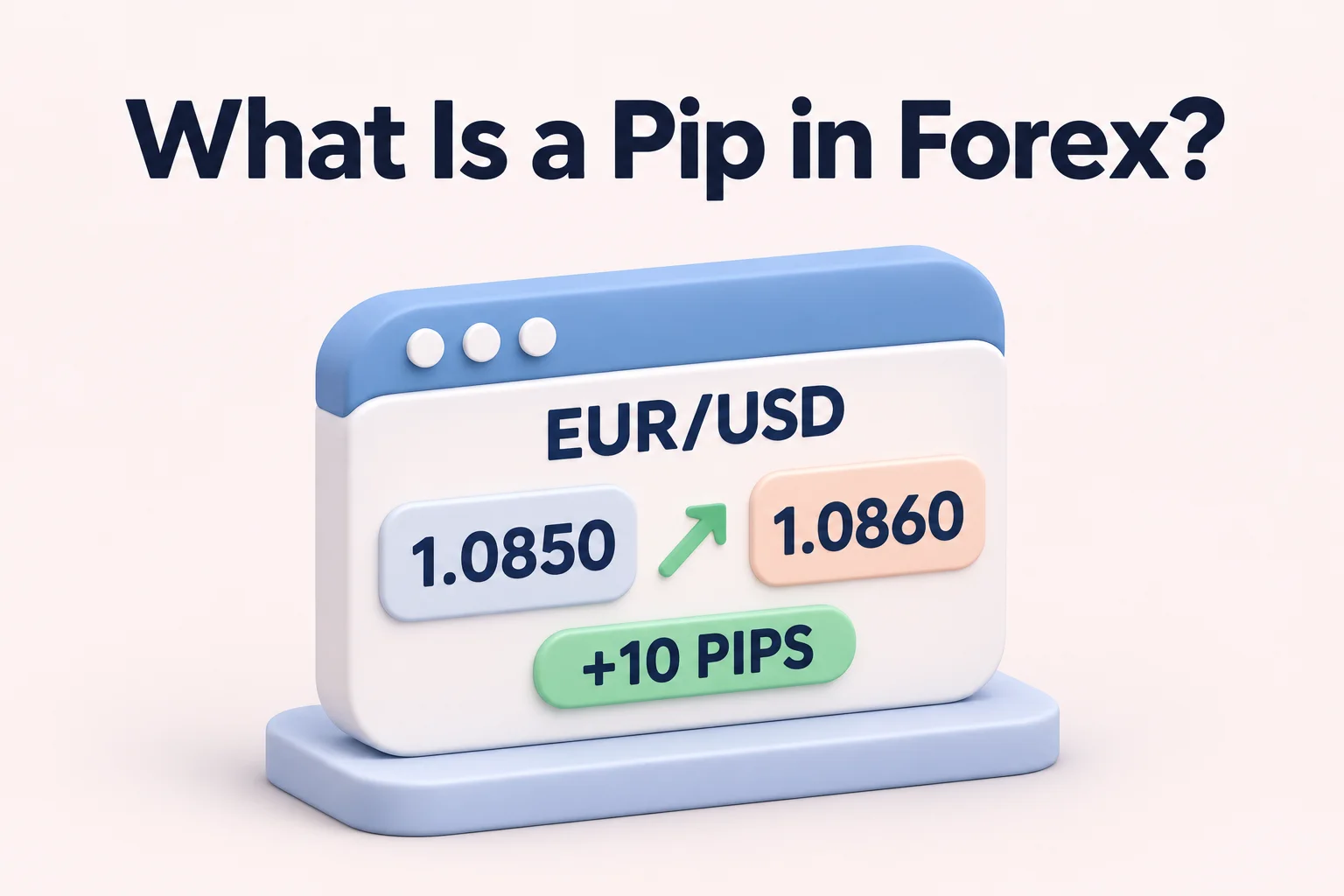
A pip is the standard unit used to describe a small exchange-rate move in forex. For most currency pairs, one pip is 0.0001 of the quoted rate. When the Japanese yen is the quote currency, one pip is normally 0.01. Pips help traders compare price moves, but they do not tell you the dollar profit, loss or trading cost until the position size and currency conversion are known.
For example, if EUR/USD rises from 1.0850 to 1.0860, that is 10 pips, not 100. For USD/JPY, a rise from 150.00 to 150.10 is also 10 pips. The two changes use different decimal increments, even though each counts as 10 pips.
The introductory forex trading beginner roadmap explains where pips fit alongside currency pairs, bid and ask prices, and lot sizes. Here the focus is on counting pips and converting them into a realistic trading-cost and risk calculation.
How Many Decimal Places Make One Pip?
Read a currency pair as base currency/quote currency. In EUR/USD, EUR is the base and USD is the quote: a price of 1.0850 means one euro is quoted at $1.0850. A pip measures a change in that quote, rather than a fixed fraction of your account balance.
- Most pairs, such as EUR/USD, GBP/USD and EUR/GBP: 1 pip = 0.0001, the fourth decimal place.
- JPY-quoted pairs, such as USD/JPY and EUR/JPY: 1 pip = 0.01, the second decimal place.
- Pipettes (fractional pips): 1 pipette = 0.1 pip. That is 0.00001 on a typical non-JPY quote and 0.001 on a JPY-quoted pair.
A five-decimal EUR/USD quote such as 1.08543 has 1.0854 as its four-decimal pip level and a final digit of 3 representing three pipettes, or 0.3 pip. Likewise, the last digit in USD/JPY 150.127 represents 0.7 pip beyond 150.12. A quote moving from 1.08543 to 1.08548 has moved 0.5 pip, not 5 full pips.
The FOREX.com US pip explainer also distinguishes standard pips from fractional pips. These conventions are common for spot-style forex quotations, but check your trading instrument's contract specification: other asset classes and some nonstandard symbols use different tick or point sizes. The familiar JPY rule specifically concerns JPY as the quoted currency, not every conceivable pair with JPY in its name.
How to Calculate Pips Between Two Exchange Rates
For a price move, use this simple calculation:
Pips moved = (ending exchange rate − starting exchange rate) ÷ pip size.
A positive result means the quoted exchange rate rose; a negative result means it fell. Whether that move produced a gain or loss depends on whether you bought or sold the pair. The formula describes a price move before accounting for bid/ask execution.
| Pair | Starting quote | Ending quote | Calculation | Move |
|---|---|---|---|---|
| EUR/USD pair | 1.08420 | 1.08570 | 0.00150 ÷ 0.0001 | +15 pips |
| USD/JPY | 149.800 | 150.050 | 0.250 ÷ 0.01 | +25 pips |
| EUR/GBP | 0.8520 | 0.8512 | −0.0008 ÷ 0.0001 | −8 pips |
A long EUR/GBP position loses from an 8-pip decline in the quoted price before trading costs; a short position benefits from that move before costs. Do not confuse the number of displayed digits with the direction or value of a trade.
What Is a Pip Worth in Forex?
Pip value is the cash change in a position for a one-pip move. It depends on the base-currency units traded and the size of the pip. Before any conversion into your account currency, the arithmetic is:
Pip value in quote currency = base-currency units traded × pip size.
A standard lot is commonly 100,000 units of the base currency, a mini lot is 10,000 and a micro lot is 1,000. Some platforms allow arbitrary unit sizes and use different contract conventions, so the position displayed on your trade ticket is more reliable than a label alone.
| Position | EUR units | USD value of one pip | USD value of 20 pips |
|---|---|---|---|
| 1 standard lot | 100,000 | $10.00 | $200.00 |
| 0.10 lot (mini) | 10,000 | $1.00 | $20.00 |
| 0.01 lot (micro) | 1,000 | $0.10 | $2.00 |
Here USD is the quote currency, so no additional conversion is needed for a USD account. A 20-pip move on a 0.10-lot EUR/USD position is $20 before spread, commission, slippage and any financing. The common claim that a pip is always worth $10 is only correct for a 100,000-unit position when the quote currency is USD and the account is measured in USD.
How Do You Convert Pip Value to Your Account Currency?
Start with the amount in the quote currency, then convert that amount to the currency in which your account reports profit and loss. The conversion rate matters whenever those currencies differ.
Example 1: USD is the quote currency
With 10,000 EUR of EUR/USD, one pip equals 10,000 × 0.0001 = $1.00. In a USD account, that is already the answer. In an EUR account, if EUR/USD is hypothetically 1.1000, the same $1 pip value is about €0.91 ($1 ÷ 1.1000). The euro value changes when the conversion rate changes.
Example 2: USD is the base currency, JPY is the quote currency
With 10,000 USD of USD/JPY, one pip equals 10,000 × 0.01 = ¥100. At an illustrative USD/JPY rate of 150.00, convert yen to dollars by dividing: ¥100 ÷ 150.00 = approximately $0.67 per pip. At a different USD/JPY exchange rate, the USD value of that same ¥100 will differ. It is not $1 or $10 per pip just because USD appears in the pair.
Example 3: Neither currency in the pair is USD
With 10,000 EUR of EUR/GBP, one pip equals 10,000 × 0.0001 = £1. If a hypothetical GBP/USD conversion rate is 1.2500, that is $1.25 per pip in a USD account (£1 × 1.2500). A GBP account would show £1 directly. For other account currencies, obtain a consistent quote-to-account conversion rate from the trading platform.
These rates are chosen for transparent arithmetic and are not current or executable prices. A broker's P&L display can use its own conversion side, time and fees, so the statement value may differ slightly from a simplified calculation.
How Pips Become Spread Costs
The bid is normally the price at which a trader can sell the base currency, while the ask is the price at which a trader can buy it. Their difference is the spread, commonly expressed in pips or fractional pips. A tight-looking quote does not mean the round-trip trade is free.
Suppose the illustrative EUR/USD bid is 1.10500 and the ask is 1.10512. The spread is 0.00012 ÷ 0.0001 = 1.2 pips. For a 20,000-EUR position worth $2 per pip, the spread's approximate round-trip cost is 1.2 × $2 = $2.40, assuming no underlying price move and an unchanged spread. It is one spread for the complete open-and-close comparison, not two separately added full spreads.
Commissions are an additional cost on commission-based pricing. Financing or rollover may apply to an overnight position; execution slippage and conversion charges can also change the final amount. Spreads themselves move with liquidity and volatility, so a displayed spread is not a guaranteed execution cost.
Worked EUR/USD trade: count the executable-price move
A trader buys 10,000 EUR/USD at the ask of 1.10520 when the bid is 1.10500, a 2-pip spread. Later, the trader closes the long position at a bid of 1.10620. The executable entry-to-exit difference is 1.10620 − 1.10520 = 0.00100, or 10 pips. At $1 per pip, the trade earns $10 before commission or other charges.
For comparison, the bid increased by 12 pips from 1.10500 to 1.10620. The extra 2 pips do not belong to the trader's gain because the long was opened at the ask. This is why treating a chart move as identical to net trading profit can overstate the result.
Using Pips and Position Size to Set a Risk Limit
A stop-loss distance has no useful cash meaning until it is multiplied by the value per pip. For a first estimate, use:
Planned price-move loss = stop distance in pips × pip value at the chosen position size.
Consider a $5,000 account with an illustrative 1% planned risk budget of $50. If a EUR/USD trade has a 25-pip executable entry-to-stop distance, the maximum pip value to fit that price-move budget is $50 ÷ 25 = $2 per pip. For EUR/USD in a USD account, that corresponds to 20,000 EUR (0.20 standard lot).
This is only the price-move component, not a guaranteed $50 maximum loss. The risk budget must leave room for commission, any spread not already reflected in the executable entry-to-stop calculation, and slippage or gaps that can cause the actual stop fill to differ. A stop order does not guarantee an exact exit price. If the extra costs make the total planned loss too high, reduce the position size.
Common Pip Mistakes to Avoid
- Calling the fifth decimal a full pip: in EUR/USD a fifth-decimal move of 1 is usually 0.1 pip, not 1 pip.
- Using 0.0001 for USD/JPY: the usual JPY-quoted pip is 0.01, so moving from 150.00 to 150.01 is one pip.
- Assuming identical cash values: a 10-pip move is not the same dollar result across different lots, currencies or conversion rates.
- Ignoring bid and ask: count executable entry and exit prices when estimating a real trade's gain or loss.
- Comparing spreads without commissions: a low quoted spread is not the all-in trading cost.
- Equating pips with a percentage of account risk: pip distance says nothing about how much of the account is at risk until position size is included.
Check the Numbers With a Pip-Value Calculator
The BabyPips pip-value calculator provides fields for the currency pair, rate, position size and account currency. It is a useful independent cross-check for the manual steps above. Verify its inputs, the rate used for conversion and the actual lot or unit convention on your broker's trade ticket before relying on the result. A published calculator does not confirm an account's actual spread, permitted product or executable price.
For beginners, the correct sequence is to read the quote, count the pips, work out their cash value for the intended size, then add spreads and other costs before placing the order. Position size and execution price determine the money at risk; the number of pips alone does not.
Risk warning: Leveraged retail forex trading is high risk. Small exchange-rate moves can cause substantial losses relative to margin, and a stop-loss may execute at a worse price than requested. Depending on the instrument, agreement and jurisdiction, losses can exceed deposited margin. The US Commodity Futures Trading Commission's retail forex advisory explains OTC counterparty, leverage and fee risks. Educational pip calculations are not a promise of profit or a substitute for checking the legal entity and risk disclosures that apply to your account.
FAQs
What does pip mean in forex trading?
A pip is the standard increment for expressing a forex price change. For most currency pairs it is 0.0001 of the quote; when JPY is the quote currency it is typically 0.01. Pip value in money depends on the position size and account currency.
What is the difference between a pip and a pipette?
A pipette is one-tenth of a pip. On a typical five-decimal EUR/USD quote it is 0.00001; on a three-decimal USD/JPY quote it is 0.001. Ten pipettes equal one pip.
How much is 1 pip worth on EUR/USD?
For a USD-denominated account with EUR/USD as the instrument, one pip is $10 for 100,000 EUR, $1 for 10,000 EUR and $0.10 for 1,000 EUR, before transaction costs. The currency value differs when the account is not in USD.
How do you calculate pip value on USD/JPY?
Multiply the USD position units by 0.01 to get the value in JPY, then divide by USD/JPY to express it in USD. A 10,000-USD position is worth ¥100 per pip, or about $0.67 when the illustrative rate is 150.00.
Is a 10-pip profit always the same amount of money?
No. Ten pips on 10,000 EUR/USD units equals $10 in quote-currency profit before costs, but a larger position or a different pair changes the cash amount. The spread, commission and execution prices affect the actual outcome.
Does a 1.2-pip spread cost 2.4 pips when opening and closing?
Not under a simple unchanged-market and unchanged-spread comparison. Opening at the ask and closing at the bid produces a round-trip cost of one 1.2-pip spread, plus any commission or other charges. The actual spread can vary during the trade.
Are pips the same as ticks or points?
Not always. A pip is a forex quotation convention; tick and point definitions can depend on the trading platform or instrument. Check the contract specification, especially for metals, indices, crypto and nonstandard forex symbols.

Stephen Bennet
Stephen Bennet is a Forex reviewer and financial analyst with more than 25 years of experience in the financial markets. He specializes in reviewing brokers, evaluating trading platforms, and explaining the Forex market in a clear and practical way. Through independent, trader-focused analysis, Stephen helps readers compare providers, understand key risks, and choose platforms with greater confidence.