Estimate the result of a hypothetical currency trade with side-specific entry and exit prices, currency conversion, spread, slippage and fees.
What this calculator measures
For a buy, price profit in the quote currency is (exit − entry) × base units; for a sell it is (entry − exit) × base units. In midpoint mode the engine estimates adverse bid/ask execution at opening and closing, subtracts spread and slippage impacts, converts the resulting quote-currency P/L at the user-entered rate, then applies an illustrative conversion markup, round-trip commission and signed financing adjustment.
Worked example
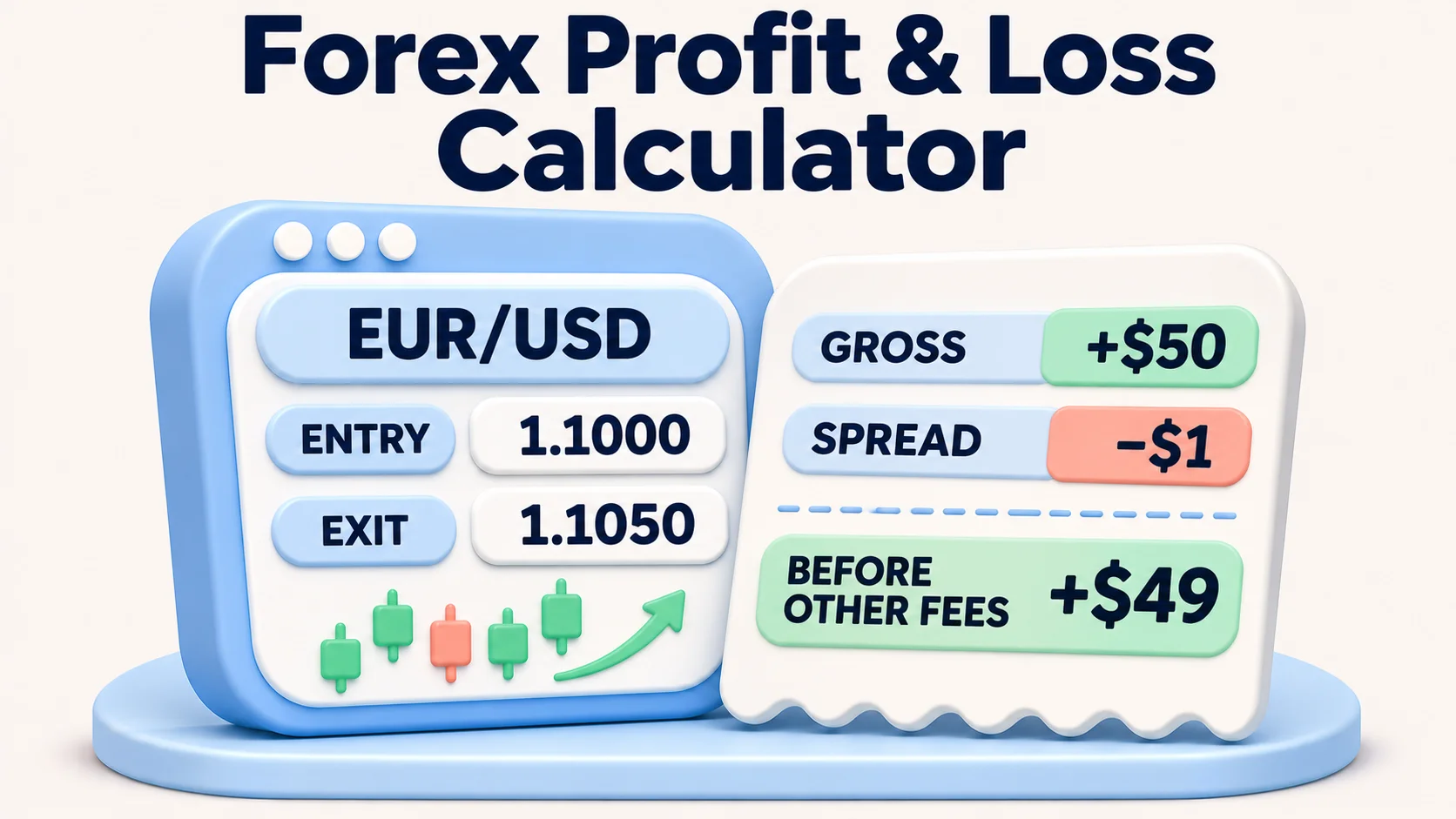
Buy 10,000 EUR/USD at a hypothetical 1.1000 entry midpoint and sell at a 1.1050 exit midpoint. With a 1-pip spread at each point of execution, no slippage and a USD account, the raw 50-pip midpoint gain is $50. Deducting a combined 1-pip spread effect of $1 gives $49 before separate commissions, financing and conversion costs. Your actual result can differ because executable buy and sell quotes, trading fees and conversion rules differ.
Assumptions, risks and limits
- Conventional forex currency-pair units, not futures, options, crypto, metal or CFD contract multipliers. Lot size and tick rules may vary by provider.
- In midpoint mode spreads are charged half at entry and half at exit. When entering already executed fills, the spread and slippage are presumed reflected in those fill prices; do not subtract them twice.
- Conversion is manual and never validated against a live broker feed. A missing or old observation date triggers a warning. The same manually entered quote-to-account factor applies to the whole scenario; some brokers apply side-specific settlement rates or other conversion charges.
- Commission is total for opening and closing, in account currency. Financing is a manually entered signed total, not an automatically estimated overnight rate. Taxes, platform fees, margin interest and broker-specific rules are otherwise excluded.
- This computes the result for an assumed exit, not the probability of reaching it. Stops can slip, liquidity may disappear and leveraged retail forex can lose more than the intended amount or initial margin.
Related tools and dated sources
Use the FXRanking position-size calculator to plan units from an intended risk budget, or the pip-value calculator to estimate the money value of one pip. For method checks: OANDA US P/L examples, FOREX.com US pip conventions, and CFTC retail forex risk advisory.
FAQs
How do I calculate forex profit or loss?
For a long trade, multiply (exit price minus entry price) by the number of base-currency units. For a short trade, reverse the price difference. The result is in the pair’s quote currency. Convert it into the account currency and account for relevant trading charges.
Why can a profitable price move still produce a net trading loss?
Bid/ask spread, adverse execution slippage, commissions, conversion charges and financing can exceed a small gross price gain. The calculator shows the assumptions separately, but your broker’s actual fees and fills determine the recorded P/L.
What is different for USD/JPY?
A standard USD/JPY pip is commonly 0.01 JPY rather than 0.0001 in the quote currency. A USD-denominated account generally needs to convert the JPY P/L into USD using an applicable settlement exchange rate.
Should I enter midpoints or executed prices?
Use actual entry and exit fills when they are known; the spread and execution effects are already reflected in those prices, so avoid subtracting them again. Use midpoint mode for an illustrative scenario, entering estimated spreads and adverse slippage separately.
Are the calculator’s exchange rates live or guaranteed?
No. All example prices and conversion factors are hypothetical, and the tool has no live market feed. If the quote currency differs from your account currency, enter a rate consistent with your broker’s conversion method and review its observation date.
Does this calculator determine margin or a guaranteed maximum loss?
No. It does not calculate opening margin, liquidations, gaps, portfolio risk or worst-case losses. Leverage can amplify account losses, and the actual result depends on prices, contract specifications and execution conditions.

Nathan Wong
Nathan Wong is a Forex education contributor with 15 years of trading and market-analysis experience. He specializes in broker platforms, cryptocurrency, risk management, and trading psychology, creating practical content that helps readers make informed decisions and develop realistic expectations.