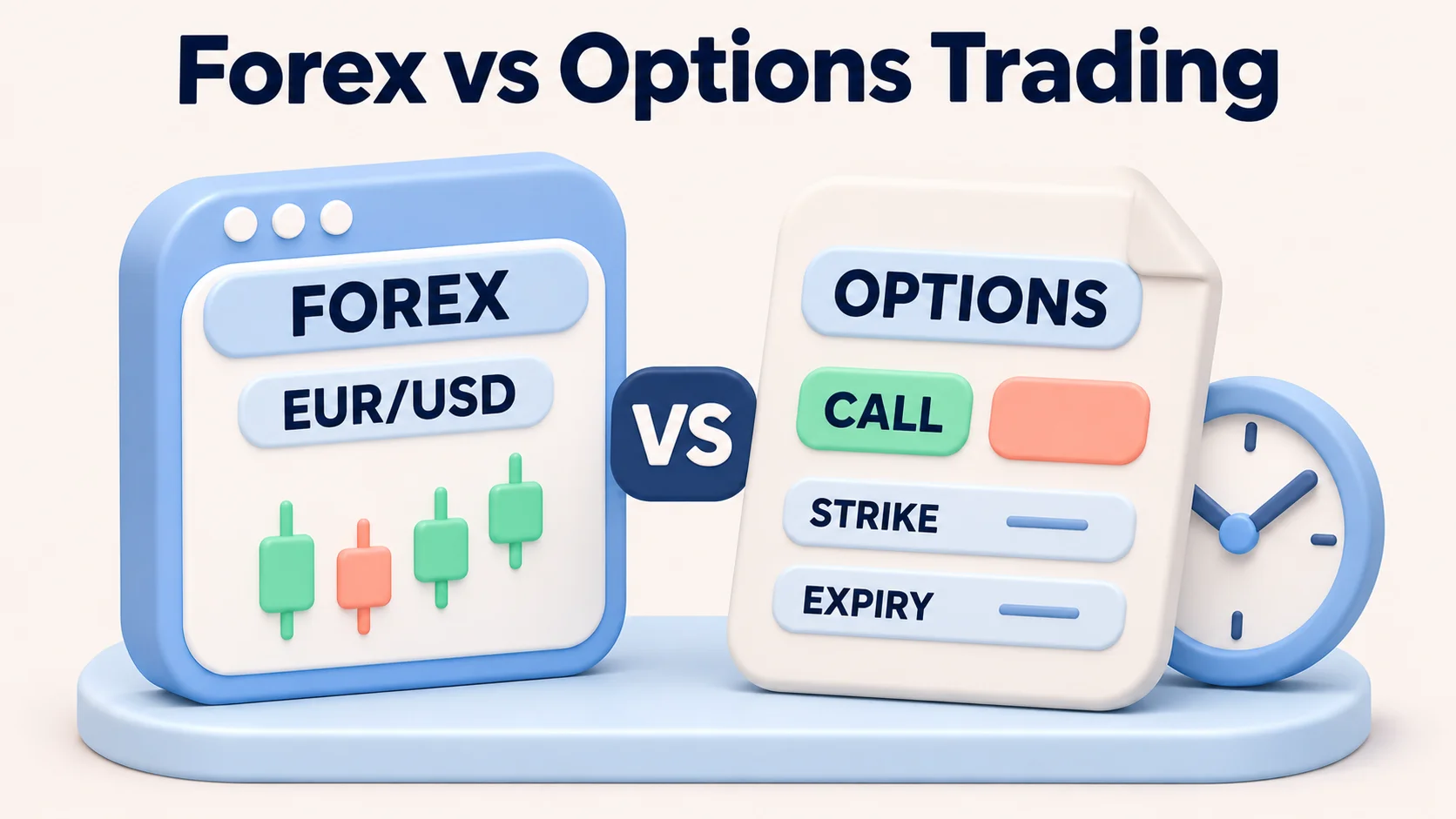
Forex and options are not two versions of the same trade. In the United States, retail forex commonly means taking a leveraged position in a currency pair with an over-the-counter (OTC) dealer. An option is a contract with an underlying asset, strike price and expiry: a buyer pays a premium for a right, while a seller accepts an obligation. A stock option, a currency option and an option on a currency futures contract are different instruments. Knowing which one is being offered matters more than choosing the label with the most attractive advertised returns.
The short answer: a currency position generally responds directly to exchange-rate changes, while an option's value also depends on time remaining, expected volatility and the strike price. Buying a conventional option can cap the loss on that purchased contract at its premium plus dealing costs; writing options can involve far larger losses. Leveraged OTC forex may also create losses beyond initial collateral. Neither market is automatically safer, cheaper or easier to make profitable.
Risk warning: Leveraged forex and options can cause rapid and substantial losses. A stop is not a guaranteed exit price. An option buyer can lose the entire premium; an uncovered option seller may face unlimited losses. Exercise, assignment, and conversion into a futures or stock position can create additional obligations. Product availability and protections depend on the exact US account, firm and contract.
Forex vs options: the key differences
The common search phrase “forex vs options trading” usually compares OTC currency trading with listed stock options. But traders looking for options on EUR/USD may mean listed options on FX futures. The comparison below deliberately keeps those separate.
| Feature | Retail OTC forex position | Listed US stock option | CME-listed FX option on futures |
|---|---|---|---|
| Exposure | Exchange-rate movement in a currency pair | Right or obligation linked to shares of a named company | Right or obligation linked to a currency futures contract |
| Where the trade happens | With the retail forex dealer as counterparty, not on a central exchange | On securities-options exchanges, with standardized clearing arrangements | On a regulated derivatives exchange, with clearing |
| Entry funding | Required margin/security deposit; not the maximum loss | Long option: premium; short option: collateral or margin may be required | Long option: premium; short option: exchange/broker margin rules apply |
| Expiry | Rolling positions generally have no fixed option-style expiration; financing and closeout rules apply | Specified expiration and strike; exercise and assignment rules apply | Specified expiration and strike; CME's listed FX options are European-style |
| What happens at exercise | No option exercise; the dealer offsets or closes the currency position under account terms | Usually creates a stock purchase/sale obligation for standard physically settled stock options | In-the-money CME FX options can deliver an underlying FX futures position |
| Main ongoing risk | Leverage, quote changes, spread, overnight financing, slippage and dealer exposure | Premium decay for buyers; assignment and potentially substantial seller liabilities | Premium decay, liquidity, expiration mechanics and resulting futures exposure |
These are product structures, not a ranking of exchanges or firms. An exchange-traded currency future itself is also distinct from an OTC forex position. CME's FX options overview and contract guide set out the exchange-listed version.
How forex trades work compared with options
Retail OTC forex: a position in the exchange rate
Suppose EUR/USD is trading around 1.1000. Buying EUR/USD means taking exposure to a stronger euro relative to the US dollar. If EUR/USD rises, the long position gains before costs; if it falls, the position loses. The reverse applies to selling the pair. Your dealer quotes buying and selling prices, holds required collateral and applies its execution, financing and liquidation rules.
For US retail OTC forex, the CFTC explains that the customer's counterparty is the dealer, rather than an exchange's central order book. A quoted low spread does not eliminate financing, commission or adverse execution risk. See the CFTC's forex customer advisory and FXRanking's forex spread guide.
Buying a stock option: paying for a time-limited right
A conventional call gives its holder the right to buy the underlying asset at the strike price under the contract's exercise rules. A put gives its holder the right to sell. The option itself has a market price, called the premium. For a standard US listed equity option, the contract commonly represents 100 shares, although adjustments and other products can differ.
Options are not simply leveraged bets on today's price. An option can lose value while the underlying stock moves in the expected direction if the move is too small or too late. Time value usually erodes as expiry approaches, while changes in implied volatility may increase or decrease the option's price. Buyers often sell an option before expiry instead of exercising it; sellers who remain short can be assigned under the applicable terms. The SEC's options introduction explains these basic mechanics.
Writing an option: accepting an obligation, not buying a cheaper right
When an investor sells to open a call or put, the premium received is compensation for taking on a contractual obligation. A covered call, a cash-secured put, an uncovered call and a multi-leg spread have different capital requirements and risk profiles. An uncovered call on shares can incur theoretically unlimited losses because the share price has no fixed upper bound. The premium received is not a guaranteed net profit. Margin requirements and the ability to close the option before assignment also matter.
Read the Options Clearing Corporation's standardized options disclosure before considering listed options; it covers long and short positions, exercise, assignment and complex strategies.
Forex margin vs option premium: worked examples
These are constructed arithmetic examples to compare mechanics, not current prices, executable quotes, a broker account test or evidence that the positions have equal market risk.
Example 1: a leveraged EUR/USD position
Assume a US retail forex dealer permits a 10,000 EUR long position at an illustrative EUR/USD price of 1.1000. The USD notional value is $11,000. For a qualifying euro transaction, NFA Financial Requirements Section 12 specifies a minimum 2% security deposit for Forex Dealer Members, meaning $220 of initial collateral in this simplified illustration. Actual account requirements can be higher or change with conditions.
| Scenario | EUR/USD move | Price-based P&L on 10,000 EUR | Meaning |
|---|---|---|---|
| Market rises 100 pips | 1.1000 to 1.1100 | +$100 | Before spread, commission, financing and execution costs |
| Market falls 100 pips | 1.1000 to 1.0900 | −$100 | Loss equals about 45% of the illustrative $220 collateral, not 45% of the notional |
| Market falls 300 pips | 1.1000 to 1.0700 | −$300 | Price loss exceeds the illustrative initial collateral; liquidation may occur earlier or at a worse fill |
A 100-pip move is 0.0100 in EUR/USD, so 10,000 × 0.0100 = $100. The collateral is not a stop loss or an insurance policy. The dealer may increase margin requirements or liquidate the account under its terms, and an adverse market gap can frustrate a planned exit. The underlying deposit rule is in NFA's Financial Requirements, Section 12.
Example 2: buying one listed stock call
Suppose a stock is $50 and an investor buys one standard 100-share call with a $50 strike for a hypothetical premium of $2.50 per share. The premium paid is $250, before broker fees. This call expires on a specified date; the following figures show its expiration value, not what it could trade for earlier.
| Stock price at expiry | Intrinsic value of one call | Net result after $250 premium, before fees |
|---|---|---|
| $49 | $0 | −$250 |
| $52 | $200 | −$50 |
| $55 | $500 | +$250 |
The expiry break-even is $52.50 ($50 strike plus $2.50 premium), excluding fees. If the contract expires worthless, the buyer loses the entire $250 premium. That limit applies to the purchased call itself; an exercised or assigned position in shares can require additional funds and carry different risks. A purchase of the option does not fund the shares that might be acquired on exercise. Always check brokerage exercise and auto-exercise rules.
Why the examples are not an apples-to-apples risk comparison
The forex example refers to €10,000 of exposure with a moving spot-style price and required collateral. The stock option represents rights on 100 shares, and its premium is a paid cost, not collateral. A $100 loss in one and a $250 premium in the other do not show which is safer, because the underlyings, volatility, time horizons and position sizes differ. Match notional exposure, holding period, worst plausible scenario and total charges before comparing a specific strategy.
Where do currency options fit in?
FX options are options whose value depends on currencies. Some are OTC agreements with specific counterparties and negotiated terms; others are standardized exchange-traded contracts. They are not the same thing as stock calls and puts merely because both use option terminology.
As a US-listed example, CME's euro FX options are options on euro FX futures. CME's 2026 FX product guide specifies a 125,000-euro contract size for its EUR/USD option family, European-style exercise and delivery into the underlying futures contract under applicable expiration rules. The futures position then has its own margin and expiry obligations. Contract size, tick value, strike and expiration must be checked for the exact listing.
If an option on 125,000 euros were hypothetically quoted at $0.0075 per euro, its premium would be $937.50 (125,000 × $0.0075), excluding fees. That number only illustrates the contract multiplier; it is not a live CME premium. An option buyer could lose that full premium before fees if the option expires without value, and exercising into a futures position creates a separate exposure. A trader who only wants a small currency position may find standardized contract size and expiry mechanics unsuitable.
Some products branded “FX options” are off-exchange contracts with different settlement, exercise and counterparty terms. US product permissions cannot be inferred from the fact that a website offers them outside the United States. Likewise, OTC retail forex access does not automatically approve an account for listed futures options.
Costs, liquidity, expiration and other risks
| Cost or risk | What to check for forex | What to check for options |
|---|---|---|
| Price paid at entry | Bid–ask spread and commission; quote at intended size | Premium paid at the ask; the bid–ask spread affects resale, plus commissions and contract fees |
| Cost of time | Overnight financing/rollover on a held leveraged position | Time value and implied-volatility change; the premium may decay without a large underlying move |
| Liquidity | Pair, trading session and dealer execution; stop slippage | Specific strike, expiry and contract; a wide option spread can make exit expensive |
| Expiry or forced closure | Margin shortfall and dealer liquidation rules, even without a preset expiry | Expiry, exercise/assignment, settlement and potential delivery of shares or futures |
| Loss magnitude | Leverage can magnify losses relative to initial collateral | Long premium at risk; short obligations may be much greater or theoretically unlimited for uncovered calls |
Options are not automatically cheaper because their premium looks small. A buyer can pay a modest amount but lose 100% of it quickly. An investor who sells an option may collect premium but must budget for the obligation. Forex traders can trade without a contract expiration, but financing can become significant over many nights and dealers may change margins or execution terms.
Beware of the word leverage: in forex it often means controlling a larger currency position with a security deposit, while in options it often describes the non-linear sensitivity of a contract whose price is smaller than its underlying exposure. Neither description makes returns predictable. Option buyers also need a view on when the move will happen, not simply its direction.
US rules, account approvals and provider checks
Check the product first, then the firm and account. The US has different rules and intermediaries for retail OTC forex, securities options and exchange-traded futures options. A familiar group brand, offshore licence, trading app or demo mode does not establish access to a legally offered product for a US retail resident.
- For OTC retail forex: Check the exact dealer's current CFTC/NFA status and background in CFTC's registration-check guide and NFA BASIC. Read the account's contracting entity, permitted currency product, margin schedule and withdrawal terms.
- For listed stock options: Use a US securities brokerage account approved for the relevant options strategies. Approval is not automatic; the SEC's options-account bulletin explains the review of investment experience, financial circumstances and strategy permissions. Read the OCC options disclosure.
- For listed FX options on futures: Confirm the futures intermediary, account permissions, clearing and contract specification. CME's contract guide is a starting point for contract size and expiry; it does not establish an individual broker's onboarding eligibility or fees.
- For OTC FX options, CFDs or binary options: Do not assume rules for a standard US stock option or regulated futures contract apply. Establish the exact issuer, product definition, US eligibility and legal framework first. An offshore offer is not proof a US retail account may trade it.
FXRanking's beginner forex roadmap introduces currency pairs and risk, while its US broker guide is a starting point for questions about serving entities. Any named recommendation there still requires up-to-date legal-entity and product checks; the guide is not proof of eligibility. A separate US CFDs-versus-futures comparison should be read only when its final page has been published and verified.
Which fits a particular trading goal?
A trader seeking direct EUR/USD exposure may find a regulated currency product easier to model than a collection of option Greeks, but leverage, the dealer relationship, financing and forced liquidation remain serious constraints. A longer holding period makes rollover costs especially important.
An investor hedging an existing stock position may find a purchased put or carefully constructed option strategy useful because its payoff can be tailored to a strike and expiry. This requires understanding the premium, possible loss of that premium and the underlying share position; it is not a free guarantee against every loss.
A trader looking specifically for currency options should compare an actual CME FX futures option with the proposed OTC alternative, including size, settlement, exercise rules and broker authorization. For some small accounts, one standard listed FX option may represent too large an exposure or too complex an expiration workflow.
A beginner without a defined risk budget has a stronger reason to learn the instruments before choosing either. A demo account can teach order entry but cannot prove live fills or realistic losses. The useful decision is not “forex or options—which wins?” but “what exact contract is this, what must happen by when, what is the maximum and likely loss in my account, and what would it cost to exit?”
FAQs
Is forex trading the same as options trading?
No. Retail OTC forex generally gives direct exposure to an exchange rate through a dealer. An option is a strike- and expiry-specific right for its buyer and an obligation for its seller. Stock options and currency futures options have different underlyings and settlement rules.
Is forex or options trading better for beginners?
Neither is universally better. Leveraged forex can lose more than initial collateral, while options require understanding premiums, expiry and assignment. Start by identifying the exact product, funding requirement, potential loss and US account permissions.
Can you lose more than you deposit trading forex?
Yes, depending on the product and dealer terms. Margin is collateral, not a loss cap. A gap, leverage and forced liquidation can produce losses exceeding an illustrative opening deposit. Contractual closeout protections vary.
Can you lose more than the option premium?
A purchased conventional call or put normally limits the loss on that long option to premium and dealing costs. Written options can create much larger obligations; exercising or being assigned can also create a separate stock or futures position.
Do forex trades expire like options?
Rolling OTC retail forex positions generally do not have a fixed option-style expiry, although rollover, margin and forced-closure rules apply. Options have stated expirations; some are exercised or settled automatically under product rules.
Are forex options and stock options the same thing?
No. Stock options are typically rights relating to company shares, whereas FX options relate to currencies or currency futures. The exchange, contract size, clearing, exercise and account approval can differ.
What is an option on a forex futures contract?
It is an exchange-listed option on an underlying currency futures contract. For example, CME lists European-style FX options with specified strike and expiry; an in-the-money option can create an underlying futures position at expiry. Check the precise listing and brokerage permissions.
How do forex spreads compare with option premiums?
A forex spread is the buy/sell quote difference, often alongside commissions and rollover costs. An option premium is the purchase price. The option’s bid and ask affect the prices for entering and exiting, while commissions can add costs; these are not equivalent charges.
Can US residents trade forex options?
Some properly offered exchange-traded currency options are available through approved US futures accounts. OTC FX options are a separate legal and counterparty question. Eligibility depends on the exact contract, firm, account and client status; an offshore platform listing is not proof.
Does buying a call guarantee a profit when the underlying rises?
No. A call buyer needs a sufficiently favorable move relative to strike, premium, time remaining and transaction costs. At expiration a call can still lose money even if the underlying rose from the purchase date.

Nathan Wong
Nathan Wong is a Forex education contributor with 15 years of trading and market-analysis experience. He specializes in broker platforms, cryptocurrency, risk management, and trading psychology, creating practical content that helps readers make informed decisions and develop realistic expectations.