A forex spread is the gap between the bid price at which a trader can sell a currency pair and the ask price at which the trader can buy it. It is part of the cost of trading even if an account has no separate dealing commission. A spread is commonly measured in pips; its cash value also depends on position size and the currencies involved.
Compare the entire entry-and-exit cost rather than focusing on the narrowest advertised spread. Commissions, changing quotes, slippage, currency conversion and financing can all affect the result. A 0.0-pip minimum is neither a typical spread nor a guaranteed execution price.
Risk warning: Leveraged retail forex trading can produce rapid and substantial losses, particularly when spreads widen or prices gap. Margin is collateral, not a maximum-loss cap. Account eligibility, product rules and possible loss protections depend on the customer, country and contracting company. Only risk money you can afford to lose.
Review update
What's New Since Our Last Update
This revision makes the bid-versus-ask decision at each trade stage easier to see and clarifies the cost of an unchanged-price EUR/USD round trip without changing the guide's core structure.
- Buy and sell quotes clarified: A four-case table maps long and short entries and exits to the bid or ask, with order-execution qualifications.
- Spread arithmetic sharpened: The 1.2-pip EUR/USD example shows why an immediate 10,000-unit round trip loses $1.20 before commissions, without double-counting the spread.
- Broker costs connected: The guide links directly to the related explanation of broker spreads, mark-ups and commissions, so readers can distinguish quote mechanics from total trading costs.
What is the spread in forex?
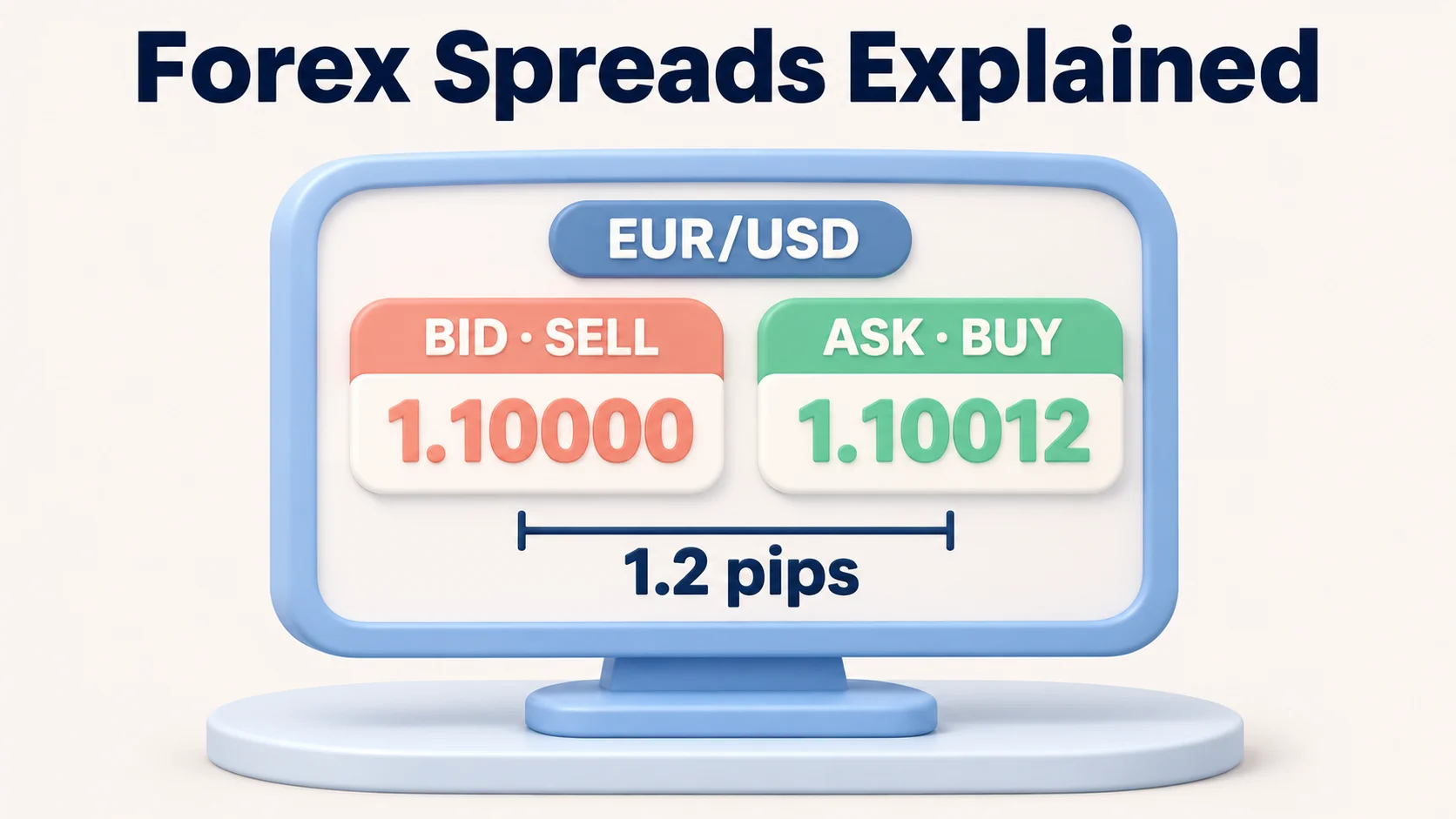
Currency pairs are quoted in two dealing prices. EUR is the base currency in EUR/USD, and USD is the quote currency. The bid is what a dealer offers for one euro when you sell EUR/USD; the ask is what you pay in dollars for one euro when you buy it. The ask is normally above the bid, and the difference is the spread.
| EUR/USD quotation | Illustrative price | What it means to the trader |
|---|---|---|
| Bid | 1.10000 | Sell EUR/USD at 1.10000 |
| Ask | 1.10012 | Buy EUR/USD at 1.10012 |
| Spread | 0.00012 = 1.2 pips | Difference between the two quoted dealing prices |
These numbers are constructed for illustration, not observed market prices or executable broker quotes. Under unchanged prices, immediately buying at 1.10012 and selling at 1.10000 captures a one-spread loss before commission; selling first and buying back creates the same initial disadvantage in reverse. The full spread is not automatically charged twice on that round trip.
Bid price vs ask price: which side do you use?
The relevant price depends on the direction of your trade and whether you are opening or closing it. Here is the same quote viewed from the trader’s side, not the dealer’s side:
| Position or action | Order direction | Quote side usually used | EUR/USD illustration |
|---|---|---|---|
| Open a long (buy EUR/USD) | Buy | Ask | Pay 1.10012 |
| Close a long | Sell | Bid | Receive 1.10000 if unchanged |
| Open a short (sell EUR/USD) | Sell | Bid | Sell at 1.10000 |
| Close a short | Buy | Ask | Buy back at 1.10012 if unchanged |
A dealer normally shows an ask above the bid because the two-sided quote embeds a dealing difference. That does not mean every order fills exactly at the price shown when it was submitted. Market orders can slip, while stop orders may trigger on a broker-defined quote side and fill later or at a different price. Always check the platform’s order and trigger conventions.
For the US retail-forex quote definition, see FOREX.com’s US pricing FAQ; it also distinguishes the platform’s midpoint-based regulatory cost measure from the simple displayed bid-ask gap.
How to calculate a forex spread in pips
Subtract the bid from the ask and divide by the pip size: spread in pips = (ask − bid) ÷ pip size. For most pairs, a pip is 0.0001; when JPY is the quote currency, a pip is usually 0.01. Many platforms display a smaller decimal unit called a pipette, equal to one-tenth of a pip.
| Example pair | Bid / ask | Price gap | Spread |
|---|---|---|---|
| EUR/USD | 1.10000 / 1.10012 | 0.00012 | 1.2 pips |
| GBP/USD | 1.25005 / 1.25013 | 0.00008 | 0.8 pip |
| USD/JPY | 150.245 / 150.262 | 0.017 | 1.7 pips |
All three quotes are hypothetical. The EUR/USD spread is 0.00012 ÷ 0.0001 = 1.2 pips; the USD/JPY spread is 0.017 ÷ 0.01 = 1.7 pips. Fractional-pip digits improve display precision but do not change the number of currency units in the position.
How much does a spread cost in dollars?
With EUR/USD positions and USD-denominated profit and loss, 0.0001 USD per euro is the value of one pip. That works out to $0.10 for 1,000 EUR, $1 for 10,000 EUR and $10 for 100,000 EUR. The table assumes a constant midpoint, unchanged bid and ask, and no separately charged fees:
| EUR/USD position | Value of 1 pip | 0.8-pip spread | 1.2-pip spread | 2.5-pip spread |
|---|---|---|---|---|
| 1,000 EUR | $0.10 | $0.08 | $0.12 | $0.25 |
| 10,000 EUR | $1.00 | $0.80 | $1.20 | $2.50 |
| 100,000 EUR | $10.00 | $8.00 | $12.00 | $25.00 |
Worked example: a 10,000 EUR/USD long position
- A hypothetical dealing quote shows 1.10000 bid and 1.10012 ask. The difference is 0.00012, or 1.2 pips.
- Buying 10,000 EUR opens the long at the ask of 1.10012. An immediate sale at an unchanged bid of 1.10000 produces (1.10000 − 1.10012) × 10,000 = −$1.20, before separate commissions.
- If both sides of the quote rise by 3.0 pips and the spread stays at 1.2 pips, the new quote is 1.10030 bid and 1.10042 ask.
- Closing the long at 1.10030 then produces (1.10030 − 1.10012) × 10,000 = +$1.80, before commissions and other charges—not $3.00.
The midpoint in the last scenario rises by 3.0 pips, but the trade earns only 1.8 pips after entry at the ask and exit at the bid. The initial 1.2-pip spread has already been reflected in the difference between those two execution prices; adding another full spread would double-count it. If the spread or midpoint changes differently before the exit, the result changes. Bid-only or midpoint charts can hide the other side of the quote.
Why a one-pip spread does not always cost $10
The $10-per-pip shorthand applies to a 100,000 EUR/USD position with USD quoted as the P&L currency. At 10,000 units of USD/JPY, one pip (¥0.01 per USD) represents ¥100 and a 1.7-pip spread represents ¥170, before converting the result into the account currency. Cross-currency pairs and accounts settled in other currencies need their own pip-value and conversion calculations.
Spread, commission and the actual round-trip trading cost
A spread-only account usually embeds its dealing charge in the buy and sell quotes. A raw-spread or commission-based account can show a tighter spread but also debit a commission on opening and closing the position. Neither model is necessarily cheaper: compare the same instrument, order size and time under both fee structures.
For an illustrative unchanged-price round trip, the simplified total is (spread in pips × pip value) + opening commission + closing commission. This is not a live fill estimate, and the spread should not be added twice. Actual outcomes can include wider quotes, adverse or favorable slippage, financing and conversion fees.
| Hypothetical model | EUR/USD spread | Spread cost at 10,000 EUR | Total commission | Illustrative total |
|---|---|---|---|---|
| A: spread only | 1.0 pip | $1.00 | $0.00 | $1.00 |
| B: tighter quote plus commission | 0.2 pip | $0.20 | $1.40 | $1.60 |
| C: wider quote plus commission | 0.8 pip | $0.80 | $1.40 | $2.20 |
The $1.40 two-way commission assumes $0.70 on entry and $0.70 on exit for 10,000 units. This charging structure appears in OANDA Corporation’s US Core spreads and commission explanation, which separately uses a hypothetical 0.2-pip EUR/USD quote to illustrate $1.60 in total. It is a product illustration, not a promise of a currently available spread or proof that a given reader is eligible for Core pricing. Compare the current US account requirements and minimums before treating it as an account offer.
The basis of a fee matters: commissions quoted per side, per 100,000 units of base currency or per $100,000 of USD notional are not interchangeable. For the broker’s side of the pricing model, read how forex brokers make money from spreads, mark-ups and commissions. A lowest-spread broker guide is useful for comparing fee structures, but neither an advertised minimum nor an editorial category proves the cheapest executable cost.
Fixed spreads vs variable spreads
Fixed-spread pricing offers a stated width under specified conditions; it can help with normal cost estimates but may have exceptions around unusual market events, platform rules or certain hours. Variable spreads respond to liquidity, volatility and provider pricing; they can be narrower in liquid periods and much wider when trading becomes difficult. Neither label guarantees the actual fill price.
| Feature | Fixed spread | Variable spread |
|---|---|---|
| Normal quoted width | Stated for specified conditions | Changes with market and provider quotes |
| Main benefit | More predictable normal quote width | Can be narrower in liquid periods |
| Main limitation | Exceptions, requotes and execution terms may apply | Can widen quickly in stressed conditions |
| What to check | Hours, restrictions and order handling | Typical distributions, spikes and execution results |
Compare terms for the actual account and legal entity. For example, FOREX.com’s US FAQ says its US forex offering does not have fixed spreads. An offshore or overseas brand page does not demonstrate a US customer can access the same product.
Why do forex spreads widen?
Spreads often widen around major economic releases, unexpected news, market opening or closing periods, and less liquid trading sessions. Less liquid currency pairs may have relatively wide quotes even in calm conditions. OANDA’s US spread guidance identifies market transitions, significant events and volatility among conditions associated with wider quotes.
What spread widening does to stops and trading plans
If an illustrative EUR/USD spread increases from 1.2 pips to 4.0 pips at the same midpoint, the unchanged-price cost for a 10,000-unit position rises from $1.20 to $4.00. The additional $2.80 can be important to a strategy targeting only a few pips. For an existing long position, a lower bid can worsen the liquidation value even if the midpoint is unchanged; the reverse-side ask matters for covering a short.
Stop orders can be triggered by a broker-defined bid or ask price even when a chart displays the other side or a midpoint. A stop is not a guaranteed fill at its trigger price. Prices can gap and execution can slip, especially around fast-moving events; check the account’s order rules rather than relying on a single visible chart line.
Other costs the spread does not show
- Rollover and overnight financing: Holding a leveraged position past the provider’s rollover time can incur a charge or, sometimes, a credit. Rates differ by pair, direction, date and account.
- Execution and slippage: The actual fill can differ from the displayed quote or stop trigger, favorably or adversely.
- Currency conversion: P&L and fees in another currency may be converted at a rate containing a markup or separate fee.
- Account and payment fees: Inactivity, deposit or withdrawal-related charges affect the total account cost, even though they are not part of the bid-ask spread.
- Margin and forced closeout: Margin is not itself a trading fee. A forced liquidation or price gap can produce losses far greater than the initial spread estimate.
The US investor bulletin on foreign currency trading explains why an account can have meaningful trading costs even when a commission is not separately advertised, and why leveraged forex exposure deserves caution.
How to compare forex spreads fairly
- Check the exact provider and product: Confirm which legal entity serves your residence and whether the product is US retail forex, a foreign CFD or something else.
- Use matched comparisons: Compare the same pair, position size and trading hours; avoid comparing one firm’s minimum quote with another firm’s typical spread.
- Count both commissions: Confirm per-side rates, charging units, currency and minimums, then avoid counting the quoted spread twice.
- Examine execution quality: Look for time-stamped quotes, stated historical averages and relevant slippage disclosures. A displayed quote is not evidence of a fill.
- Include the holding period: Consider financing if holding overnight, P&L conversion, account charges and stop-order risks.
For applicable US retail forex dealers, NFA Compliance Rule 2-36(p) addresses transaction-level cost disclosures. A midpoint spread-cost measure in a confirmation can differ from the quote-width arithmetic shown here; use the broker’s definitions when reconciling the numbers.
What matters most for beginners?
Start with the quote side used for your order: ask to buy, bid to sell. Work out the pip size, the cash value for your position, and the potential loss from opening and closing at an unchanged midpoint. Then add any two-sided commission and consider how spreads, stops and slippage behave in volatile trading. A demo account can help you learn quote mechanics, but simulated orders are not proof of live execution costs.
A narrow spread will not make a leveraged position safe or compensate for unclear fees, unsuitable products or loss of access to funds. The forex beginner roadmap covers order types, leverage and basic risk-management decisions alongside spread calculations.
FAQs
What is a spread in forex trading?
The spread is the difference between the bid (the trader’s sell price) and the ask (the trader’s buy price) for a currency pair. It is a price-based trading cost even with no separate commission.
How do you calculate a forex spread?
Subtract the bid from the ask and divide by pip size. A hypothetical EUR/USD bid of 1.10000 and ask of 1.10012 have a difference of 0.00012, or 1.2 pips when one pip is 0.0001.
How much is a 1-pip spread on EUR/USD?
With USD-denominated P&L, one pip on EUR/USD equals $1 for 10,000 EUR or $10 for 100,000 EUR of exposure. Other currency pairs and account currencies can require conversion.
Do you pay the spread when opening and closing a trade?
Both dealing prices affect the round trip, but you should not simply double the displayed spread. At unchanged bid, ask and midpoint, an immediate buy at the ask and sale at the bid loses one full spread before separate commissions.
Are fixed forex spreads better than variable spreads?
Neither is universally better. Fixed pricing may make the stated normal width easier to anticipate but can have exceptions; variable pricing can be narrow in liquid markets and widen during volatile periods.
Is a zero-pip forex spread free to trade?
No. Zero may be a temporary advertised minimum, and a raw-spread account may charge commissions on entry and exit. Rollover, slippage and conversion can add to the cost.
Why are spreads higher during forex news?
Liquidity and dealer pricing can change quickly around releases or unexpected events. Wider dealing prices can make entries and exits more expensive and affect stops and execution.
What is the difference between a pip and a pipette?
A pip is generally 0.0001 in pairs such as EUR/USD or 0.01 when JPY is the quote currency. A pipette is one-tenth of a pip, allowing fractional-pip quotes.
How can US traders check reported forex trading costs?
Compare matched quotes and fees, and inspect trade confirmations. Applicable NFA cost disclosure can use a midpoint measure that differs from a simple bid-ask spread calculation.

Jake Robins
Jake Robins is a Forex and cryptocurrency education contributor with over 10 years of experience helping readers better understand the financial markets. His work covers risk management, technical analysis, trading psychology, broker platforms, and scam awareness. Through clear, practical guidance, Jake helps traders approach the markets with greater discipline, caution, and confidence.