












































































































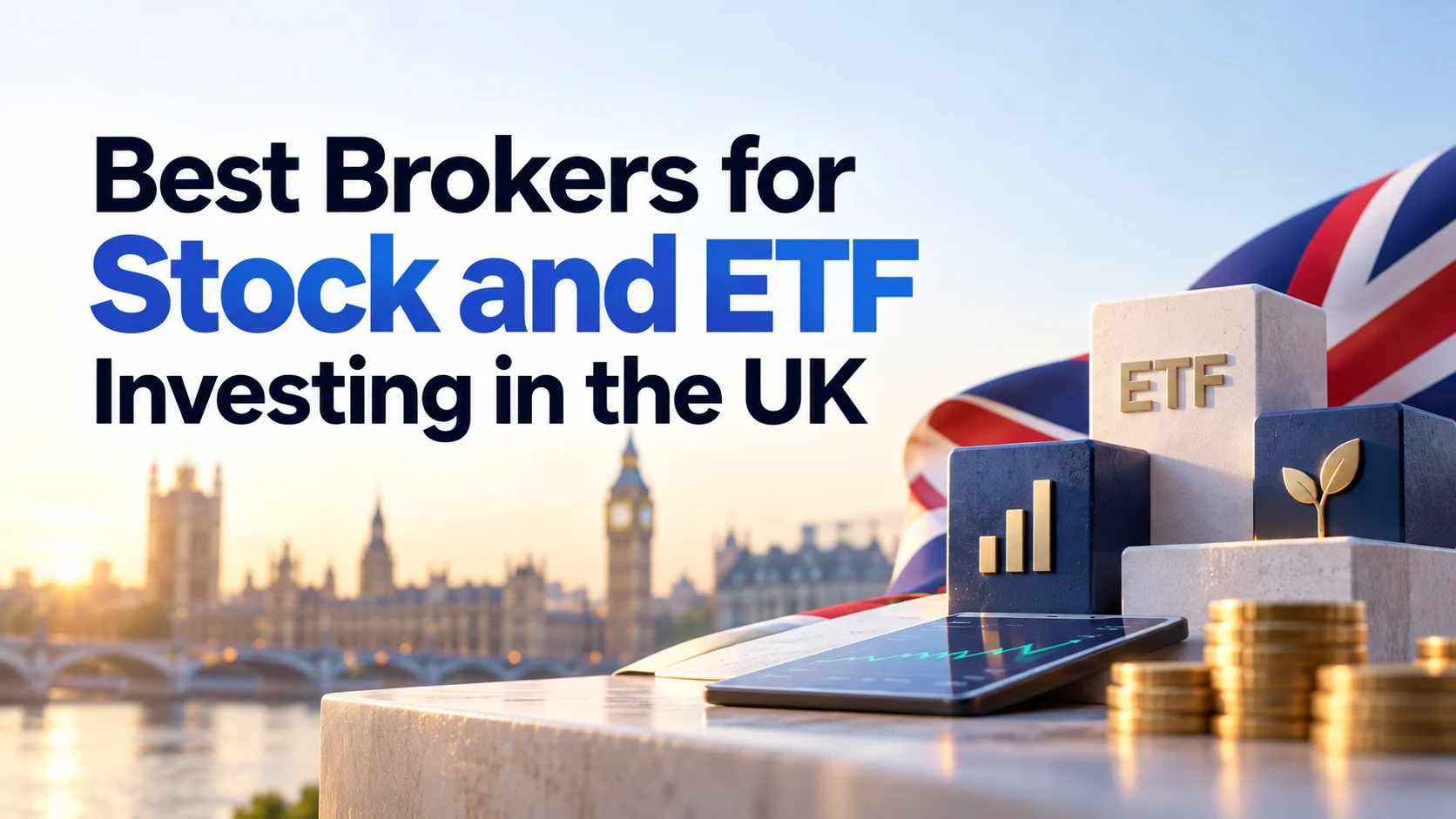
Best Brokers for Stock and ETF Investing in the UK, Quick Comparison
There is no single winner for every investor. Someone putting £200 into an ETF each month has very different priorities from someone managing a six-figure portfolio of international shares. The following comparison highlights where each broker makes the most sense.
| Broker | Best for | Stocks & Shares ISA | Main drawback |
|---|---|---|---|
| Trading 212 | Low-cost regular investing | Yes | Limited professional tools |
| Interactive Brokers | International stocks and ETFs | Yes | Complexity and ISA minimum charges |
| IG | Broad UK share dealing | Yes | Foreign-exchange costs |
| XTB | Automated investment plans | Yes | Investment Plans unavailable in ISA |
| CMC Invest | Flexible account tiers | Paid plans | Subscription and FX costs |
| Trading.com | Commission-free shares and ETFs | Yes | Fractional holdings cannot be transferred |
| Saxo | Research and advanced portfolios | Yes | Custody and transfer fees |
| eToro | Social investing | Yes | Product complexity |
Broker suitability depends on the specific investment account, available instruments and applicable charges. The comparisons concern genuine securities investing, not CFD trading performance.
How the Brokers Were Evaluated
Choosing a stock broker calls for a different set of priorities from choosing a forex trading platform. Tight CFD spreads and sophisticated charting tools are less important to someone planning to hold an ETF for ten years. What matters is access to the intended securities, transparent ownership arrangements and costs that remain reasonable as the portfolio grows.
This comparison considers genuine share and ETF access, dealing and ongoing fees, UK account availability, international markets, custody arrangements and practical investing features.
The assessments use UK account conditions and fee schedules alongside standardised investment-cost calculations.
Risk warning: Stocks and ETFs can rise or fall in value, and investors may get back less than they invest. Past performance does not reliably predict future results. This article provides general information and independent comparisons, not personalised investment advice.
Best UK Brokers for Stocks and ETFs — Detailed Reviews
1. Trading 212: Best for Low-Cost Stock and ETF Investing
Trading 212 gets the basics right. Buying shares is inexpensive, building a portfolio is straightforward, and regular contributions don't require much effort once everything is set up.
Its Invest and Stocks ISA accounts offer commission-free trading without custody charges. Currency conversion costs 0.15%, which is competitive against many UK share-dealing platforms.
The real attraction is Pies. Investors can divide their money between selected stocks and ETFs, assign a percentage to each holding and use AutoInvest to make regular contributions. Fractional investing also helps when allocating smaller amounts across several securities.
There is a catch. Pie purchases use the account's primary currency, meaning overseas investments can still trigger conversion fees even when multi-currency facilities are available elsewhere in the account. The cost isn't excessive, but it is worth understanding before setting up frequent purchases of US shares.
Trading 212 also lacks some of the more sophisticated order controls and research facilities found at Interactive Brokers and Saxo. That will matter to experienced investors, although many long-term ETF investors will have little reason to miss them.
The verdict: Trading 212 is one of the easiest brokers to recommend for a straightforward long-term portfolio. It keeps routine investing simple and inexpensive without making investors pay for features they may never use.
2. Interactive Brokers: Best for International Investing
Interactive Brokers operates on a different level when it comes to international markets. Its exchange coverage, multi-currency functionality and range of order types make it a serious choice for investors whose portfolios extend well beyond the London Stock Exchange.
Its foreign-exchange pricing is a particular strength. Automatic currency conversion can cost approximately 0.03%, making a noticeable difference when purchasing larger overseas positions.
The trade-off is complexity. There are more settings, more account decisions and more information to absorb than on a typical beginner-focused investment app. The additional control is valuable, but it can feel unnecessary when all that's required is a monthly purchase of a broad-market ETF.
The Stocks and Shares ISA also carries a £3 monthly minimum activity charge. For someone who barely trades, that recurring expense can undermine the advantage of the broker's otherwise competitive pricing.
Interactive Brokers is therefore not necessarily the cheapest place for small UK ETF purchases. Its real advantage emerges when investors use the international access and currency facilities that simpler brokers cannot match.
The verdict: An excellent choice for internationally diversified portfolios and experienced investors. Those making modest, occasional investments may find it unnecessarily complicated and expensive.
3. IG: Best for Broad UK Share Dealing
IG is still widely associated with leveraged trading, but its share-dealing service deserves to be judged independently. For investors buying genuine securities, it offers a substantial investment range alongside familiar UK account options.
Qualifying share-dealing, ISA and SIPP accounts benefit from commission-free online trading in shares and ETFs. That makes IG a credible alternative to dedicated investing apps, especially for people concentrating on UK-listed investments.
The weak point is currency conversion. Its standard 0.70% FX charge can become expensive when buying international shares. A £5,000 conversion at that rate would cost approximately £35 before considering other applicable charges.
This creates a clear dividing line. For a portfolio of GBP-traded ETFs, IG can be economical. For repeated purchases of US stocks, the savings from commission-free dealing can disappear surprisingly quickly.
The broad range of IG products also makes it important to choose the correct account. Its share-dealing service provides a different investment experience from the company's spread betting and CFD operations.
The verdict: IG is a strong all-round share-dealing broker, particularly for UK-focused investors. Its foreign-exchange pricing is the main reason to look elsewhere for a heavily international portfolio.
4. XTB: Best for Automated Investment Plans
XTB has become a more interesting option for investors who want something beyond manual stock purchases. Its Investment Plans offer a practical way to organise a portfolio and contribute to it regularly.
Investors can choose allocations across eligible securities and automate contributions. Real stocks and ETFs are commission-free up to monthly turnover equivalent to €100,000, while currency conversion generally costs 0.50% when required.
A significant limitation is that Investment Plans cannot currently be used within XTB's Stocks and Shares ISA.
That means someone who wants automatic ETF purchases and ISA tax benefits has to choose which feature matters more. Trading 212 handles that combination more effectively.
Investors with substantial portfolios should also pay attention to XTB's custody fee threshold, while occasional users should check the inactivity conditions. Neither issue makes the broker uncompetitive, but both complicate the zero-commission proposition.
The verdict: XTB works well for building a disciplined investment portfolio through a general account. Its automated tools are genuinely useful; their separation from the ISA is what holds it back.
5. CMC Invest: Best for Investors Seeking Different Account Tiers
CMC Invest takes a different approach to pricing. Instead of offering every feature through one account, it divides the service into Core, Plus and Premium tiers. That creates flexibility, although it also makes costs less straightforward.
Core has no monthly subscription and offers commission-free investing. The limitation is that a Stocks and Shares ISA requires a paid tier. Plus costs up to £6.99 per month, while Premium costs up to £10.99.
More expensive tiers also reduce foreign-exchange charges. Core carries a 0.99% FX fee, compared with 0.50% for Plus and 0.39% for Premium during applicable market hours.
This pricing structure makes the decision more interesting than it first appears. Investors who regularly purchase foreign shares might save on conversion fees by upgrading. But those savings need to outweigh the subscription.
For someone investing only a few hundred pounds each month, paying an annual subscription for ISA access can feel disproportionate when other brokers provide comparable tax wrappers without that particular fixed cost.
The verdict: CMC Invest is a reasonable platform with a flexible service structure. However, the paid tiers need to deliver something the investor will actually use. Otherwise, the subscription is simply another drag on returns.
6. Trading.com: Best for Simple Stock and ETF Investing
Trading.com offers a UK Investment Account for buying real shares and ETFs, separate from its forex and CFD services. The account provides access to UK, US and European stocks, alongside UCITS ETFs, with zero dealing commissions and a £50 minimum deposit. Its published fee schedule does not include a separate annual custody charge.
Currency conversion costs 0.25%, placing Trading.com below IG's standard 0.70% rate but above Trading 212's 0.15%. On a £2,000 conversion, that represents approximately £5 before other applicable costs. The difference is worth considering for investors making regular overseas purchases.
Fractional investing is available on eligible securities, although fractional holdings cannot be transferred directly to another broker. Trading.com also offers an optional programme for earning variable returns on uninvested balances through money market funds. These carry investment risk and should not be confused with protected bank deposits.
The UK Investment Account operates through FCA-regulated Trading.com Markets UK Limited, with securities held through custody arrangements. The platform has a shorter track record in direct share investing than several competitors.
The verdict: Trading.com provides a low-cost option for investing in real stocks and ETFs, particularly through its commission-free dealing and 0.25% currency conversion fee. Fractional investing adds flexibility, although transfer restrictions and a less established investment platform are worth considering.
7. Saxo: Best for Research and Advanced Investors
Saxo is aimed at investors who want more than a basic app for buying shares. Its research, international market coverage and portfolio tools provide a more sophisticated investment environment.
The distinction between SaxoInvestor and SaxoTrader is useful. The former keeps everyday investing relatively accessible, while the latter provides more detailed trading and analytical functionality.
Yet Saxo is difficult to justify purely on price. Its Classic account carries a 0.12% annual custody charge on shares and ETFs, with dealing commissions and foreign-exchange fees applying where relevant.
On a portfolio worth £50,000 throughout the year, that custody percentage represents approximately £60 before additional charges. Transfers out can also attract fees calculated per security line.
These costs are not necessarily unreasonable for investors making extensive use of Saxo's research and market access. They are harder to defend when the portfolio consists of two ETFs that could be held elsewhere without a comparable custody charge.
The verdict: Saxo offers impressive investment capabilities, but it is not a natural choice for someone whose main priority is keeping expenses as low as possible. The extra tools need to justify the extra cost.
8. eToro: Best for Social Investing
eToro has a different appeal from the other brokers in this comparison. Its investment community, portfolio-following features and emphasis on discovering trading ideas make it more interactive than a conventional stock brokerage.
That approach can be engaging, but it has limitations. Following an investor with an impressive performance history does not mean receiving the same entry prices or future returns. Popular portfolios can also be far more concentrated than they initially appear.
The distinction between real investments and CFDs needs particular care. Some instruments that look like ordinary ETF investments may be available to UK clients only as CFDs. Checking the instrument classification before placing an order is essential.
eToro's UK Stocks and Shares ISA offers commission-free dealing, although non-GBP investments can incur a 0.70% currency conversion charge. Its ISA is also structured differently from the ordinary trading account, so features should not be assumed to carry across automatically.
The verdict: eToro is worth considering for investors who enjoy discovering companies and discussing investment ideas. It is less persuasive as a straightforward long-term brokerage solution, particularly when product clarity and low international investing costs are the priorities.
How Much Does Stock and ETF Investing Cost in the UK?
Dealing commission is only one part of the bill. A broker can charge nothing for the trade itself and still make money through currency conversion, custody fees or a monthly account subscription. The balance between these charges changes depending on how someone invests.
Foreign-Exchange Fees Compared
Currency conversion deserves particular attention when buying US shares. On a small transaction, the difference may seem trivial. Multiply it across a year of purchases, however, and it becomes much harder to ignore.
| Broker / account | Indicative FX fee | Cost on £2,000 |
|---|---|---|
| Interactive Brokers (automatic conversion) | 0.03% | £0.60 |
| Trading 212 | 0.15% | £3.00 |
| Trading.com | 0.25% | £5.00 |
| XTB | 0.50% | £10.00 |
| IG (standard rate) | 0.70% | £14.00 |
| CMC Invest Core | 0.99% | £19.80 |
| CMC Invest Plus | 0.50% | £10.00 |
| Saxo Classic | 0.60% | £12.00 |
| eToro Stocks and Shares ISA | 0.70% | £14.00 |
The figures reveal an important difference between brokers offering commission-free dealing. Trading.com, for example, charges approximately £5 to convert £2,000, compared with £14 at IG's standard rate and £19.80 at CMC Invest Core.
That makes Trading.com a competitive option for investors buying international shares without requiring the complexity of Interactive Brokers. Trading 212 remains marginally cheaper for the same percentage-based conversion.
These calculations exclude dealing commissions, minimum charges, exchange-rate spreads and other transaction expenses. Actual costs depend on the account and order conditions.
What Does Investing £200 a Month Actually Cost?
Consider a beginner investing £200 each month into an eligible GBP-traded ETF. After twelve months, £2,400 has been contributed, before investment gains or losses.
At Trading 212, qualifying purchases would incur no dealing commission or standard custody charge. IG, XTB and Trading.com can also provide commission-free purchases under their respective conditions.
Interactive Brokers' ISA minimum activity charge, by contrast, would represent approximately £36 across a full year. CMC Invest Plus could cost up to £83.88 in annual subscription fees.
Put another way, those fixed charges represent approximately 1.5% and 3.5% of the year's new contributions respectively. They are not percentages of the overall portfolio or investment return.
This example excludes fund ongoing charges, market spreads, taxes and other applicable costs. It also assumes that the fee conditions remain unchanged throughout the year.
The broader lesson is that fixed fees hit smaller portfolios disproportionately hard. A subscription might be reasonable for someone investing substantial amounts, but poor value for a beginner making modest monthly contributions.
Other Charges That Matter
Investors should also account for the ongoing expenses of ETFs, potential custody and transfer fees, and transaction taxes. Chargeable UK share purchases commonly attract 0.5% Stamp Duty Reserve Tax, while ETF purchases are generally exempt.
A broker's long-term value is best assessed using the investments and transaction sizes the account will actually handle, rather than a promotional commission rate in isolation.
What Matters When Choosing a Broker for ETFs?
ETF investors don't necessarily need access to every fund in the market. A reliable selection of eligible, competitively priced ETFs is often enough to build a diversified portfolio.
UK-listed UCITS ETFs can provide exposure to markets such as the S&P 500 and MSCI World without requiring investors to purchase US-domiciled funds directly. Choosing a GBP-traded ETF may also avoid a separate broker-level currency conversion on each purchase.
That does not eliminate currency risk. A fund trading in sterling can still hold American, European or Asian shares whose values are affected by exchange-rate movements.
For regular ETF investing, automatic contributions and fractional purchases can be more useful than advanced order types. For larger international portfolios, exchange coverage and currency management become more important.
The final check is ownership. A genuine ETF holding is not the same as a CFD referencing that ETF's price. Brokers offering both products should make the distinction clear in the order details.
Stocks and Shares ISAs vs General Investment Accounts
Account type can change the economics of an investment considerably. A Stocks and Shares ISA generally shelters eligible dividends and capital gains from UK tax, making it an attractive option for long-term investing.
The annual ISA subscription allowance for 2026/27 is £20,000. However, investors should not assume that every broker provides the same securities, tools or pricing inside its ISA.
A general investment account can offer additional flexibility, particularly where a chosen security or feature is not available through an ISA. The trade-off is that investment income and realised gains may create tax liabilities outside the wrapper.
The right account is therefore not always the one with the most features. Its tax treatment, costs and investment restrictions need to fit the investor's circumstances.
How Safe Are UK Stock and ETF Brokers?
A recognised broker name is reassuring, but it is not a substitute for understanding who actually holds the account and how the investments are protected.
Many international brokers operate through multiple legal entities. UK investors should check the company responsible for their account using the FCA Firm Checker.
Shares and ETFs are commonly held through nominee or custody arrangements. Such arrangements can still provide genuine securities ownership, although investors should understand how their holdings are recorded and transferred.
Eligible investment claims may be covered by the Financial Services Compensation Scheme up to £85,000 per person, per firm, subject to the applicable rules. That protection is conditional and does not cover ordinary losses caused by falling market prices.
Before transferring significant investments, it is also worth checking whether securities can be moved to another provider without being sold. Transfer restrictions can be frustrating when leaving a broker, particularly for fractional positions or unsupported instruments.
Final Verdict: Choosing the Right UK Investment Broker
Trading 212 is a strong overall choice for UK investors building long-term stock and ETF portfolios. Its low fees, straightforward platform and automated investing features make it particularly suitable for regular contributions. Interactive Brokers offers greater flexibility for experienced investors, especially those buying securities across multiple international markets.
IG provides a solid share-dealing service with a broad investment selection, although its currency conversion fees can make overseas investing more expensive. XTB is worth considering for its Investment Plans, but the inability to use them within an ISA is a notable drawback.
CMC Invest offers a flexible range of accounts, though its paid tiers are harder to justify for smaller portfolios. Trading.com provides commission-free access to real stocks and ETFs, with a competitive 0.25% FX fee and fractional investing. Saxo is better suited to investors who will make use of its extensive research and advanced tools, as its additional charges may be difficult to justify for simple portfolios. eToro takes a different approach through social investing, although users need to distinguish carefully between underlying securities and CFDs.
Ultimately, the right broker depends on how and where an investor intends to invest. Low fees matter, but so do investment choice, account features and the costs of holding securities over time. A platform suited to occasional ETF purchases may be less appropriate for an investor who frequently trades international shares.
FAQs
Can UK investors buy US stocks and ETFs?
UK residents can buy many US-listed shares through international brokers. Access to US-domiciled ETFs is more restricted for ordinary retail investors, although eligible UCITS ETFs can provide exposure to many of the same markets.
Can fractional shares be transferred between brokers?
Not always. Some brokers allow whole securities to be transferred but require fractional positions to be sold first. Trading.com, for example, does not support transferring fractional holdings to another provider.
Does commission-free investing mean there are no costs?
No. Currency conversion, ETF expenses, market spreads, account charges and relevant taxes may still apply. The absence of dealing commission is useful, but it does not establish the total cost of investing.
Can a broker hold real shares through a nominee?
Yes. Nominee custody is common in securities investing and does not automatically turn a shareholding into a CFD. The legal ownership and beneficial rights depend on the relevant custody arrangements.
What happens if an investment broker fails?
The outcome depends on how client assets have been held, whether any shortfall exists and the applicable regulatory protections. Properly segregated investments may be transferred or returned, although the process can take time and involve administrative costs.

Amy Baily
Amy Baily is a Forex education writer with over nine years of experience in trading and market analysis. She focuses on risk management, trading psychology, and the importance of maintaining a disciplined approach to the markets.