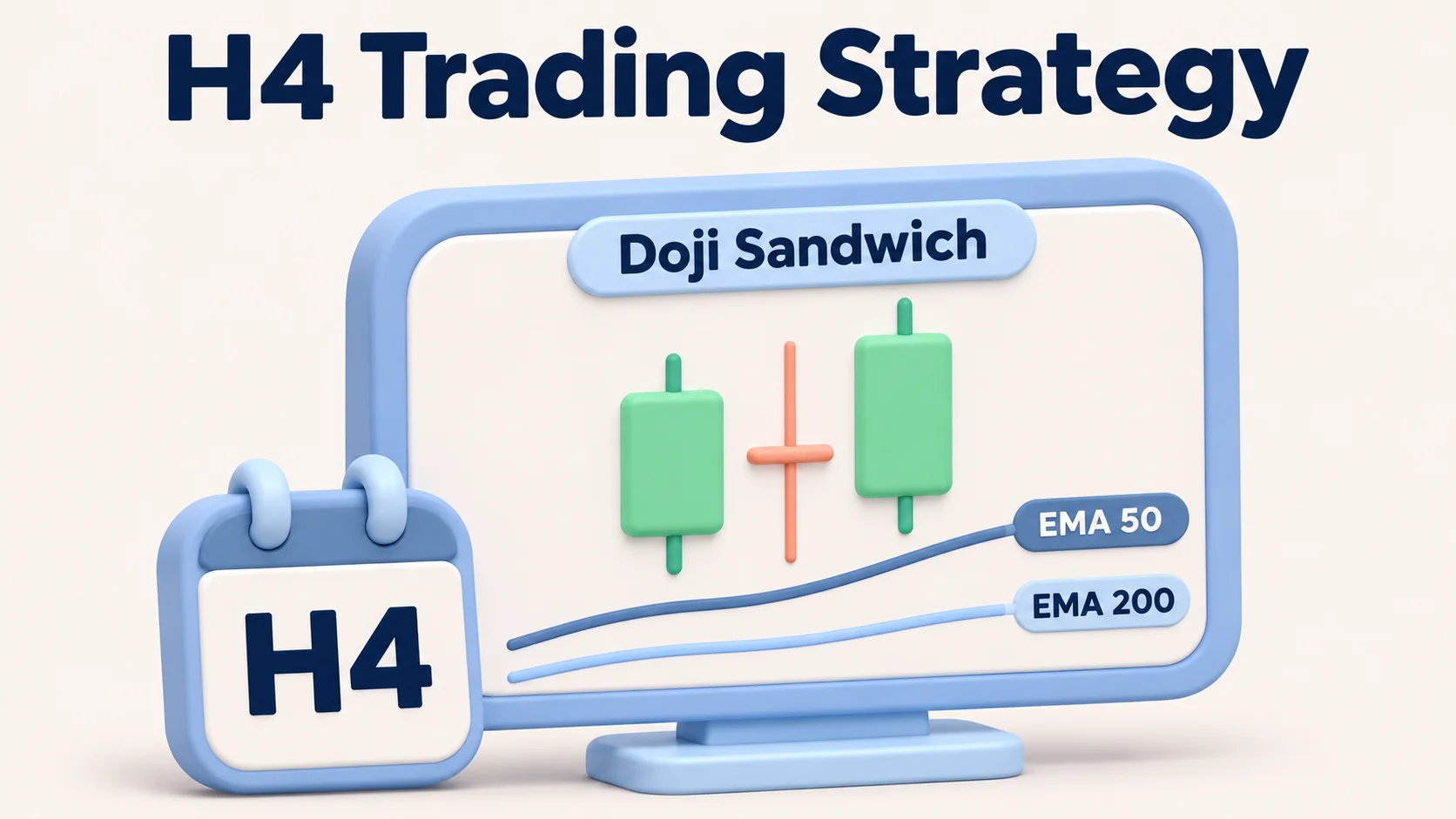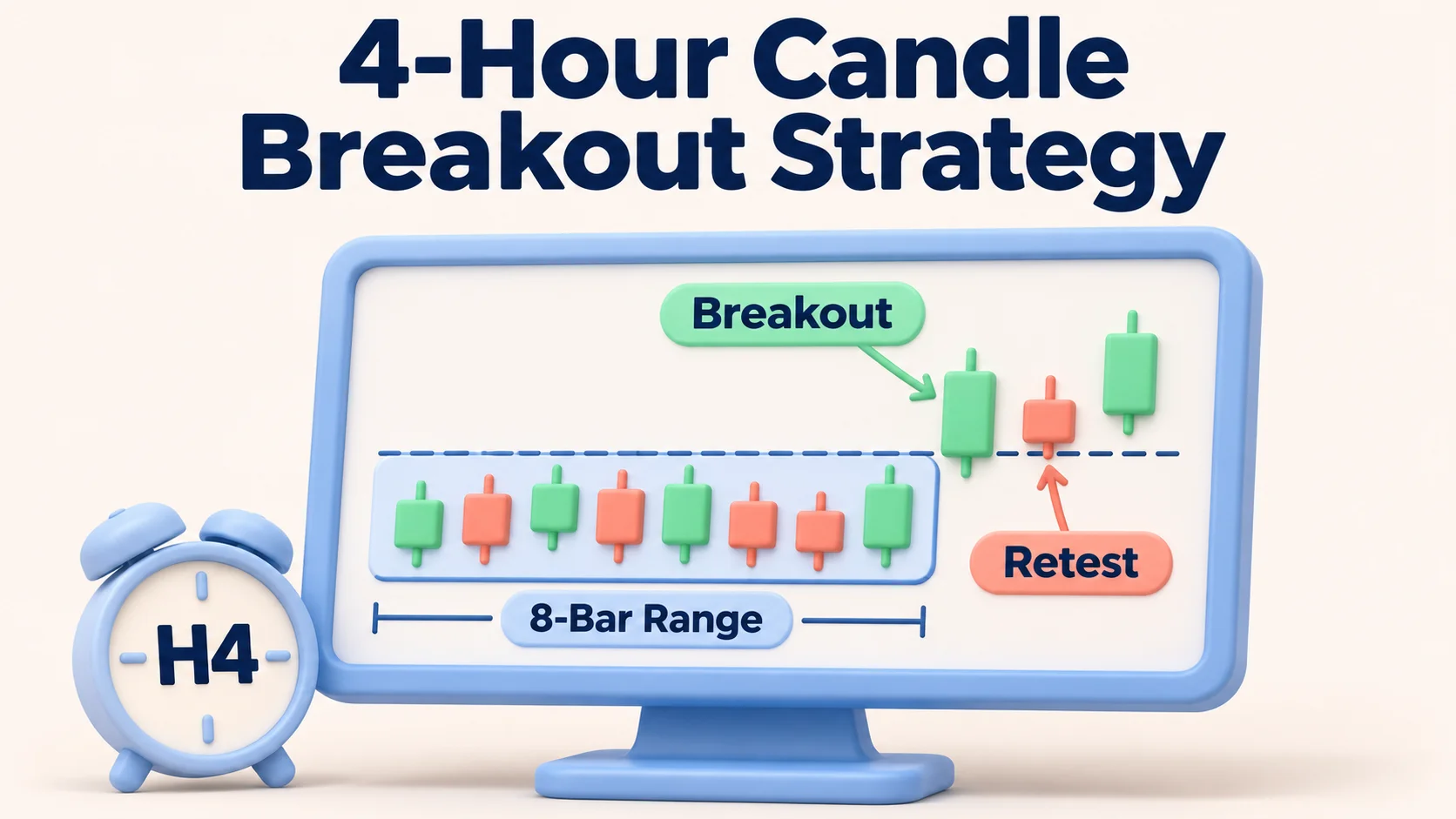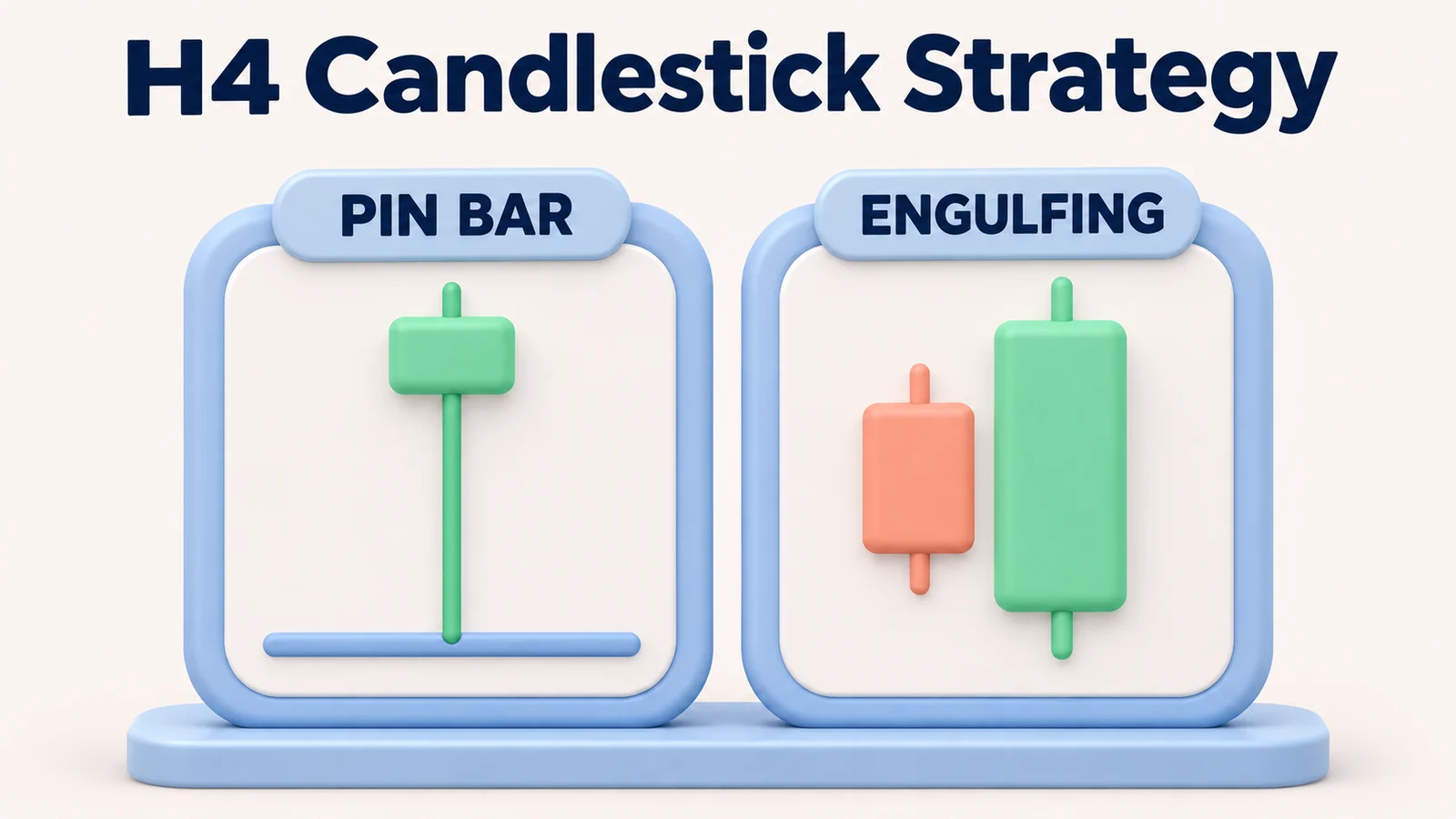
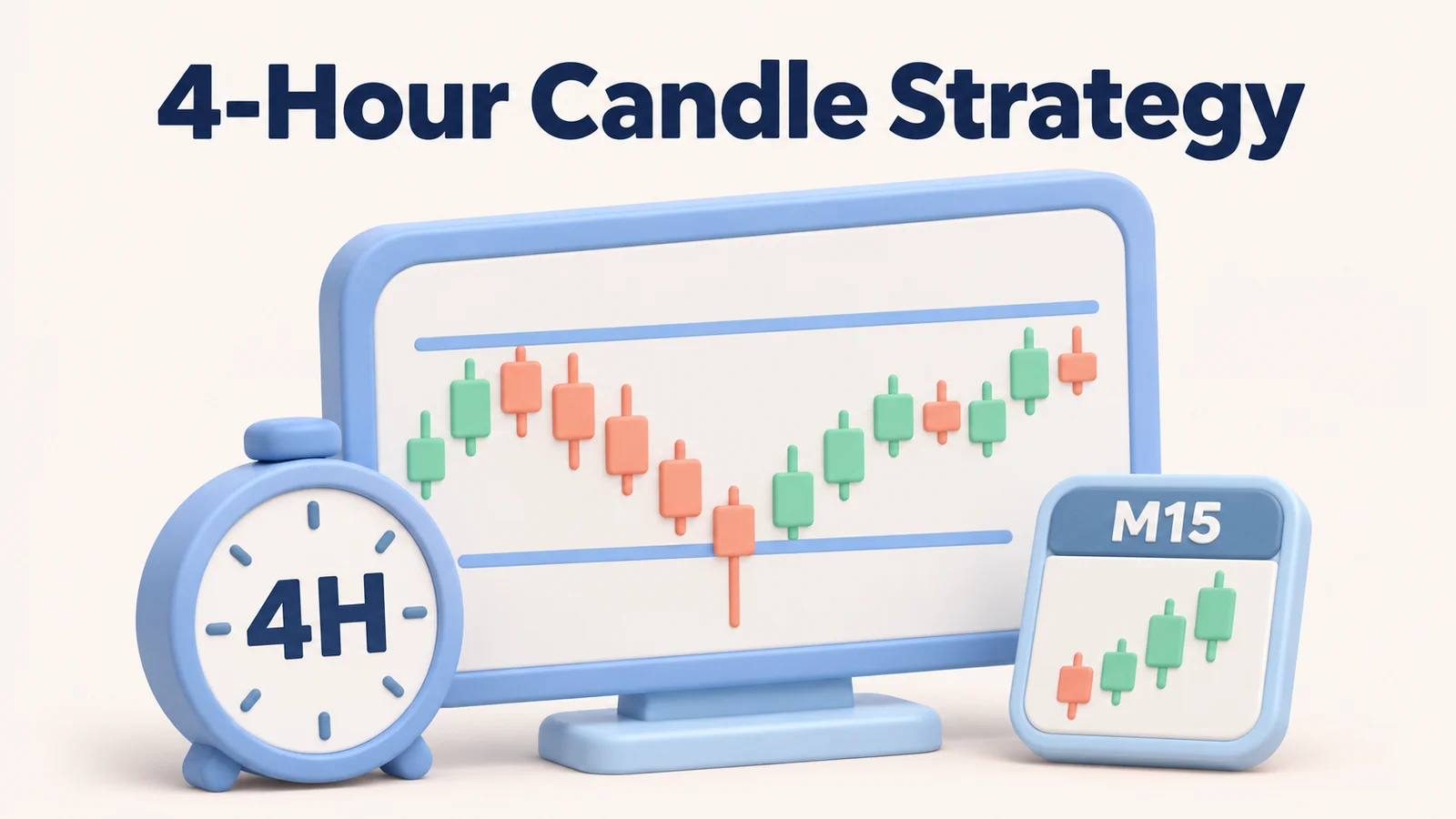
A 4-hour candle strategy uses the price action inside a four-hour (H4 or 4H) bar to plan a trade around a defined range, a possible false break, and a subsequent move. One popular framework is the Power of Three (PO3), which describes a possible sequence of accumulation, manipulation, and distribution. The terminology is closely associated with Michael J. Huddleston’s Inner Circle Trader (ICT) methodology; it describes a trading framework, not verified institutional intent. Traders also use OLHC (open → low → high → close) and OHLC (open → high → low → close) to describe two possible paths through a candle.
Those paths are not signals on their own. A finished H4 candle does not tell you which extreme occurred first, and a move through a previous high or low does not prove that a market participant deliberately manipulated price. A useful approach is to define what must happen on a shorter chart, what invalidates the idea, and when no trade is the right outcome.
A testable version begins with one completed H4 range, then waits for a sweep and reclaim on shorter candles. The example below uses hypothetical GBP/USD prices, explicit entry and exit rules, and a position-size calculation. It is not a record of executed trades or proof of profitability.
The 4-hour candle strategy at a glance
| Component | The decision |
|---|---|
| Reference | Mark the bid-price high and low of one completed H4 candle, selected before the potential setup. |
| Possible setup | The M15 bid price sweeps a boundary by at least 2 pips and a completed bid candle closes back inside the range. |
| Confirmation | The immediately next completed bid M15 candle closes beyond the reclaim candle's high (long) or low (short). |
| Entry | Use the next executable ask to buy or bid to sell, strictly before 12:00 UTC; no assumed fill at the candle close. |
| Invalidation | Long stop: below the setup’s bid low, triggered on bid. Short stop: above its ask high, triggered on ask. |
| Target | Require gross 2R on the exit quote side (bid for long, ask for short) with clearance to the first opposing level. |
| Constraints | One UTC reference and entry window; cancel same-bar double sweeps; verify the bid/ask feed, spread, news and entry deadline. |
The framework is meant to answer a narrow question: did price move outside a known H4 range, fail to remain there, and then confirm a move back toward the opposite side? It is different from a generic trend-pullback system or an indicator-driven H4 setup. This is one application of price action trading: the reaction to a recorded price level matters more than a prediction about the next candle.
What information does a 4-hour candle actually contain?
Each completed H4 candle records four prices for its interval:
- Open: the first recorded price of the interval.
- High: the highest recorded price.
- Low: the lowest recorded price.
- Close: the last recorded price before the interval ends.
The candle's body is the distance between its open and close; its wicks mark the additional distance to the high and low. A long lower wick can be consistent with a decline that later reversed, but it cannot establish why the reversal occurred. If the candle is still forming, its high, low and eventual close can change.
The distinction becomes important when a strategy requires a sweep before a recovery. A completed candle tells you that a level was reached, not the order of every move inside it. That order has to come from an intrabar price series such as 15-minute candles or tick data. Shorter intervals can help establish when a move occurred, but each smaller candle still summarizes a fixed period. Tick data may be needed to determine the order of events inside a single M15 candle.
OHLC and OLHC: identical candle, different sequence
In ordinary chart terminology, OHLC is simply the list of open, high, low and close data fields. In some Power of Three discussions, however, the same letters are used informally as a path: open → high → low → close. OLHC means open → low → high → close.
Consider an imaginary H4 candle with open 1.2620, high 1.2660, low 1.2600 and close 1.2650. Both paths below produce the same completed bullish candle:
| Possible path | Sequence within the four hours | What the H4 candle alone confirms |
|---|---|---|
| OLHC | 1.2620 → 1.2600 → 1.2660 → 1.2650 | All four OHLC values; not that the low occurred first. |
| OHLC | 1.2620 → 1.2660 → 1.2600 → 1.2650 | The same values; not that the high occurred first. |
A trader who sees only the finished bullish H4 candle cannot infer the sequence by looking at its green body or lower wick. This is why an intrabar PO3 entry needs lower-timeframe evidence, and why historical tests based only on H4 candles may introduce look-ahead bias. Even familiar candlestick patterns describe completed price shapes, not the sequence of every trade inside them.
How Power of Three applies to a four-hour candle
Power of Three, commonly abbreviated PO3, interprets price through three phases, often shortened to AMD:
- Accumulation: price trades within a relatively contained range. For this model, that is the previous completed H4 candle's high-to-low range. Calling it accumulation does not prove that anyone is building a position.
- Manipulation: price breaks one side of the range and then reverses. Here, the observable event is a sweep followed by a close back inside. The label describes a chart pattern, not established intent by banks or other traders.
- Distribution: price expands away from the swept side. In a bullish scenario, the movement would be upward after a downside sweep; in a bearish scenario, downward after an upside sweep. It may never occur.
Some PO3 interpretations place these phases across three separate candles; others describe an early wick and subsequent body forming within one four-hour candle. Neither pattern is mechanically guaranteed. They become useful for testing only after their boundaries and confirmation rules are specified.
Reversal and continuation are different outcomes
| Scenario | Price behavior | What the model does |
|---|---|---|
| Bullish sweep and reclaim | Trades below a previous H4 low, then closes back above it on M15 | Looks for an additional completed bullish confirmation before considering a long. |
| Bearish sweep and reclaim | Trades above a previous H4 high, then closes back below it on M15 | Looks for an additional completed bearish confirmation before considering a short. |
| True breakout / continuation | Price moves beyond the reference range and continues to close outside it | Does not take a reversal entry. A breakout is a separate strategy with different rules. |
| Range-bound or incomplete setup | No meaningful break, no reclaim, or no follow-through | Stays flat. |
A break that keeps moving in its original direction is not necessarily a “failed manipulation.” It may be a breakout. Since breakout trading requires a different confirmation and exit plan, it should be tested separately rather than folded into a reversal rule.
The H4 sweep-and-reclaim strategy: exact entry rules
The following rules describe one version of a four-hour candle strategy, not a proven profitable system. They intentionally use a completed H4 candle to set the reference range and completed 15-minute candles for the signal. This avoids requiring knowledge of how the still-open H4 candle will finish.
Step 1. Fix the market, data source and reference candle
Choose a currency pair and a single source of timestamped, synchronized bid and ask quotes. For the baseline, construct the H4 reference candle and all M15 price-pattern candles from bid prices only; retain the matching ask quotes for short-side stops and targets, spread checks and execution. Do not substitute mid-price candles or infer the ask from a constant assumed spread without labeling that as an approximation. For the worked example, use GBP/USD and the bid H4 candle covering 04:00–08:00 UTC as the reference. The next window, 08:00–12:00 UTC, is the only period in which this version may create a new entry.
Both windows are illustrative UTC-anchored intervals, not universal broker candle times or a claim about the exact London open. Confirm that the chart actually creates a four-hour candle with the chosen timestamps. If it does not, build the range from lower-timeframe bars with a consistent UTC clock, or choose a different explicitly documented reference schedule. An H4 chart in MetaTrader 4 still follows the broker’s configured server clock; choosing H4 does not automatically set the interval to UTC.
Record the bid H4 high, bid H4 low and full bid-range width in pips. Also retain the matching ask H4 low for a short trade’s ask-side target-room check. Do this after the reference candle closes and before watching the proposed setup. Do not switch to whichever earlier candle happens to make a later trade look attractive. A dataset containing bid OHLC alone cannot establish the baseline’s full short-side execution or spread-filter results.
Step 2. Wait for a downside or upside sweep
During the entry window, assess completed M15 bid-price candles. For a possible long, the bid low must reach at least 2 pips below the reference bid H4 low; for a possible short, the bid high must reach at least 2 pips above the reference bid H4 high. In GBP/USD, two pips equal 0.0002. The distance is an example threshold, not a demonstrated optimum, and may be small relative to the spread.
The sweep is a setup condition, not an instruction to enter. A sweep and reclaim may occur within the same completed M15 candle, provided that candle does not meet both sweep thresholds. An unfinished candle is not sufficient evidence for a historical signal.
Same-bar double-sweep rule: If one M15 bid candle reaches both qualifying H4 thresholds, cancel the entire entry window. M15 OHLC alone does not establish which boundary was crossed first, so no initial direction is assigned. Apply this cancellation even if finer quotes happen to be available; it is a fixed rule of the baseline model, not a case-by-case inference.
Otherwise, the first qualifying one-sided sweep locks the direction. If the bid price later reaches the opposite qualifying sweep threshold before the entry is filled, cancel the window; do not reverse direction or take a second setup. A sweep of the opposite boundary after entry does not alter the original stop or target.
Step 3. Require a completed 15-minute reclaim candle
The reclaim is the first completed M15 bid candle, starting with the qualifying sweep candle if applicable, that closes strictly inside the bid H4 range: above the reference low and below the reference high. For a long this is the return after a downside sweep; for a short it is the return after an upside sweep. A wick returning inside the range without a completed close does not qualify. If no such close appears before expiry, there is no trade.
For reproducibility, use the following fixed price and execution convention for this baseline; stop and take-profit prices are trigger levels, not promises of an exact fill.
| Decision | Quote side used |
|---|---|
| Reference H4 high/low, qualifying sweep, M15 reclaim and confirmation | Bid OHLC throughout |
| Long entry (buy) | First executable ask quote after confirmation |
| Short entry (sell) | First executable bid quote after confirmation |
| Long stop and long take profit (sell to close) | Trigger on bid; long stop derives from the setup’s bid low |
| Short stop and short take profit (buy to close) | Trigger on ask; short stop derives from the setup’s ask high |
A short stop may be triggered by the ask even when a bid chart’s high remains below the stop. A fixed four-pip buffer above a bid high would not necessarily be four pips above the ask high. The short-side stop in Step 5 therefore uses observed ask prices rather than the bid-chart high.
Step 4. Require one more candle of confirmation
The immediately next completed M15 bid candle must close strictly above the reclaim candle’s bid high for a long, or strictly below the reclaim candle’s bid low for a short. If it does not, cancel the setup rather than extending the waiting period until a favorable-looking candle appears. The confirmation candle must close before 12:00 UTC; a close at exactly 12:00 UTC is too late.
This two-close approach can miss a fast reversal. That is a trade-off, not a defect to repair with hindsight. A trader who instead enters after the first reclaim close is testing a different rule set.
Step 5. Use the next executable price; define the stop from the sweep
After a qualifying confirmation close, the entry is the first executable quote after that close, subject to all filters and the strict 12:00 UTC deadline. A long buys at the ask; a short sells at the bid. Do not assume a fill at the just-completed candle’s closing bid price. If that first post-confirmation quote fails the spread, news, stop-distance or target-room filters, cancel the entry rather than waiting for a later, more favorable quote. Reject a new trade if the quote has already passed its proposed protective stop.
For this GBP/USD baseline, freeze the setup extreme using synchronized quotes from the first qualifying sweep through the confirmation candle’s close, inclusive. The long stop is the lowest recorded bid over that interval minus 4 pips and triggers when bid reaches or falls below it. The short stop is the highest recorded ask over that same interval plus 4 pips and triggers when ask reaches or exceeds it. Do not calculate the short stop by adding four pips to the bid-chart high and ignoring the spread. Long take profits trigger on bid; short take profits trigger on ask. These four-pip buffers are illustrative reproducibility parameters, not established optima; predefine symbol-specific values for any other pair.
For the illustrative GBP/USD test, observe the contemporaneous spread (ask minus bid) at the proposed entry and reject the trade if it exceeds 1.0 pip or 10% of the planned entry-to-stop distance, whichever is smaller. Both conditions must pass. The planned distance uses ask entry minus bid stop for a long and ask stop minus bid entry for a short. These are example filters, not universal thresholds; set instrument-specific caps before testing other pairs. Use one economic-calendar source in UTC and skip a new entry if an event marked high impact for GBP or USD is scheduled within 30 minutes before or after the planned entry. Examples include central-bank rate decisions, inflation/CPI, employment and GDP releases. For other pairs, apply the same predeclared news rule to either currency. Record the calendar source, event time and observed entry spread for every window.
These filters apply to new entries only. Because this version has no forced time exit, an open position may remain exposed to later announcements; record that exposure and include it in results. Closing before scheduled news creates a different exit rule and must be tested separately.
If a gap or a wider spread makes the actual risk too large or eliminates the required target room, skip the order rather than moving the stop to force a lot size. When setting stop-loss and take-profit levels, remember that stop triggers do not guarantee the stop-price fill, and trading costs or slippage may worsen the outcome.
Step 6. Check room to the first obstacle and cap the risk
Define the first opposing level objectively using the 20 completed M15 candles immediately before entry. A confirmed swing high exceeds the highs of the two completed candles immediately before and after it; a confirmed swing low is below the lows of the two candles on either side. Only count pivots for which all four comparison candles have closed before entry. For long target-room screening, calculate swing highs from bid M15 bars and select the nearest confirmed swing high above the contemporaneous bid at entry. Compare it with the bid H4 high and use the closer overhead level. For short screening, calculate swing lows from ask M15 bars and select the nearest confirmed swing low below the contemporaneous ask at entry. Compare it with the ask H4 low and use the closer underlying level. If no qualifying swing exists, use the applicable H4 opposite-side level; if that H4 boundary is already at or behind the entry-side quote, skip the trade. The ask H4 low and ask M15 lows are only for short-side exit-room checks; the sweep/reclaim reference remains bid-based.
Set a gross 2R target on the quote used to close the trade. For a long, planned R = ask entry − bid stop and the bid-side target = ask entry + 2R. For a short, planned R = ask stop − bid entry and the ask-side target = bid entry − 2R. For a long, the bid target must be at least 2 pips below the first bid-side opposing level; for a short, the ask target must be at least 2 pips above the first ask-side opposing level. Reject the trade if either gross 2R or that price-side clearance cannot be met. The two-pip clearance is an illustrative GBP/USD parameter, not an optimized value.
Size the position using the entry-to-stop distance measured on the actual buy/sell quote sides and an account-currency risk budget. In the example below, the planned price-risk limit is 0.5% of account equity; it is illustrative, not a recommendation for every account. The example’s $50 is a planned quoted-price loss if fills occur exactly at the stated prices, not a guaranteed all-in loss cap. Since the long’s ask-entry-to-bid-stop distance (and the short’s bid-entry-to-ask-stop distance) already reflects the assumed quote-side spread, do not add that same spread a second time when computing price risk. Reserve separately for commissions, adverse slippage, financing, spread changes or other costs not captured by the quoted trigger distances. If the intended 0.5% is an all-in limit and those additions cannot be estimated, size smaller or skip. Assess correlated positions and margin requirements separately. Spreads, commissions and overnight financing are distinct trading costs that need to be considered alongside forex risk management.
Step 7. Set an entry-window limit and keep the outcome rules consistent
The entry window is 08:00 UTC inclusive to 12:00 UTC exclusive, with one entry attempt per chosen window. Both the confirmation candle’s close and the next executable entry must occur strictly before 12:00 UTC. A confirmation that completes at 12:00 UTC does not qualify, even if the next quote is immediately available; an entry quote timestamped at 12:00 UTC or later is also ineligible. Unfilled or unconfirmed setups expire without rollover to another window.
Once filled, the baseline holds its original stop and target until one executes and has no additional time-based exit. The position may remain open beyond 12:00 UTC, across sessions or overnight. Include financing, rollover costs and gap risk in the test. Do not open another position in the same pair while the previous one remains open; skip later windows until it closes.
When one completed M15 candle’s relevant quote series touches both the stop and target (bid for a long, ask for a short) but finer quotes cannot establish their order, assume the stop was hit first. This rule is distinct from the same-bar double H4 sweep, which cancels a setup before entry. Apply both rules uniformly, use finer quote data where available for exits, and do not invent favorable intrabar paths.
The method can produce many no-trade windows. Record them. Filtering for attractive completed H4 candles after the fact will overstate the actual opportunity set.
Worked example: a hypothetical GBP/USD Power of Three setup
Suppose the selected completed 04:00–08:00 UTC bid-price H4 GBP/USD candle has a bid high of 1.2660 and a bid low of 1.2610—a 50-pip reference range. During the next window, an M15 bid low of 1.2602 lies eight pips below the reference low. This meets the two-pip downside sweep threshold, but it does not yet justify a buy. Assume no M15 candle crosses both qualifying H4 sweep thresholds.
A completed M15 bid reclaim candle closes at 1.2612, inside the reference range, with a bid high of 1.2614. The immediately following M15 bid candle closes at 1.2616, above 1.2614. Suppose the first executable ask for a long entry is 1.2618, before 12:00 UTC. If 1.2602 remains the lowest bid from the first qualifying sweep through confirmation, a four-pip buffer places the proposed bid-triggered sell stop at 1.2598. The illustrative bid-triggered take profit is 1.2658. These numbers are synthetic; the entry’s simultaneous bid and hence its actual spread are not supplied. This example demonstrates price arithmetic and does not establish that the spread, news, swing-level or other live-execution filters all passed; the before-12:00 entry timing is an illustrative assumption, not a verified fill timestamp.
| Event | Price or time | Meaning under the stated rules |
|---|---|---|
| Bid reference H4 candle | 04:00–08:00 UTC | Predetermined reference window, now complete. |
| Bid reference range | 1.2610–1.2660 | 50-pip bid high-to-low range. |
| Bid sweeps below low | 1.2602 | Eight bid pips below the bid range low; no entry yet. |
| Completed bid M15 reclaim | Bid close 1.2612; bid high 1.2614 | Close returns inside the previous H4 range. |
| Next completed bid M15 confirmation | Bid close 1.2616 | Closes above the reclaim candle's high. |
| Illustrative ask buy entry | 1.2618 | First executable ask after confirmation; contemporaneous bid/spread not shown. |
| Bid-side sell stop | 1.2598 | Four pips beneath the lowest pre-entry bid, assumed 1.2602. |
| Bid-side sell target | 1.2658 | 40 pips above ask entry, two pips below the bid H4 high. |
The planned quoted-price loss distance is ask entry 1.2618 − bid stop 1.2598 = 0.0020 = 20 pips. The planned target distance is bid target 1.2658 − ask entry 1.2618 = 0.0040 = 40 pips, producing a gross 2:1 reward-to-risk ratio only if both closing orders fill exactly as assumed. The difference between an ask buy and a bid sell already uses the appropriate quote sides; it must not be charged for the same spread twice. The trade would also require a 20-bar M15 bid scan finding no confirmed bid swing high closer than the 1.2660 bid H4 high, plus acceptable observed entry spread and all remaining filters—none of which are established by these synthetic numbers alone. A target below a prior high does not guarantee a fill.
Calculate the lot size without overstating the risk control
Imagine a $10,000 USD account and a 0.5% planned quoted-price risk budget, or $50. With GBP/USD quoted in USD, one standard lot (100,000 GBP) has a pip value of $10. A one-pip movement equals a 0.0001 change in the GBP/USD exchange rate. This assumes the conventional spot-forex contract definition. Platforms may show quantities in units or specify different contract terms, so verify the broker’s specifications before calculating position size.
Position size = $50 ÷ (20 pips × $10 per pip per standard lot) = 0.25 standard lots.
At 0.25 lots, one pip is worth $2.50. If the assumed ask entry and bid stop fill at 1.2618 and 1.2598 respectively, the 20-pip difference implies a $50 planned quoted-price loss. A bid target filled at 1.2658 would imply $100 before additional charges. The spread is already reflected in this cross-quote arithmetic at the assumed levels, but the example does not give an observed entry spread or show the spread filter passing. Commissions, slippage, changing quotes, financing and other execution costs can worsen outcomes; realized losses can exceed $50. Verify contract details before using a forex position size calculator.
The example fails if the next candle does not confirm
If the reclaim candle closes above 1.2610 but the following M15 candle closes at or below 1.2614, the model cancels the setup. It also skips the trade if the hypothetical entry moves so far that a 2R target would cross the reference high, or if a nearer resistance level leaves insufficient room. The ability to reject a setup is part of the strategy's definition.
Bearish example: sweep above the previous H4 high
The bearish version mirrors the logic rather than inventing a different pattern:
- Mark the selected completed bid H4 high.
- During the predefined window, a completed M15 bid high reaches at least 2 pips above that H4 high; a same-bar double sweep cancels the window.
- A completed M15 bid candle closes strictly inside the bid H4 range.
- The immediately next completed bid M15 candle closes below the reclaim candle’s bid low, strictly before 12:00 UTC.
- Sell at the next executable bid, before 12:00 UTC, with the buy stop four pips above the highest ask recorded from sweep through confirmation; it triggers on ask.
- Use the ask to trigger the short take profit; reject the short if the nearest ask-side opposing support leaves insufficient room for 2R and two-pip clearance, or if costs, spread, news or timing conditions fail.
For example, if the bid range high is 1.2660 and the bid reaches 1.2668 before a candle closes back inside the range, the move is a possible upside sweep—not a short entry. The ask high over the setup must be separately observed to set the buy stop. Without the subsequent confirming bid M15 candle and a complete executable risk plan, the model stays flat.
A strong upward breakout that continues closing above 1.2660 is not a successful bearish reversal setup. It may belong to a breakout system, but the rules above must not be rewritten mid-trade to accommodate it.
Session timing: why the “8 AM four-hour candle” can be misleading
Some online examples attach special significance to the 08:00 four-hour candle or the London open. Those expressions are not interchangeable. London normally starts its business day around 08:00 local time, but its UTC equivalent changes with British daylight saving time:
| London clock | UTC equivalent | What it means for a UTC-based 04:00–08:00 H4 bar |
|---|---|---|
| 08:00 GMT (UK standard time) | 08:00 UTC | The 04:00–08:00 UTC reference candle ends around the illustrative London local opening. |
| 08:00 BST (UK summer time) | 07:00 UTC | London local opening occurs inside the 04:00–08:00 UTC reference candle, not at its end. |
This is a clock conversion, not a claim that every broker's market opens then, or that trading patterns occur predictably at those times. A platform aligned to a different server hour may divide the same price history into different H4 bars. Holiday schedules and product-specific trading breaks can also change the visible chart.
If your actual hypothesis is about the London local opening, define a reference range based on London time and translate it separately for each date. If your hypothesis is about a fixed UTC H4 candle, keep the UTC window fixed and describe it that way. Do not combine the two definitions when reviewing historical results. For a setup tied to the London open, check the trading session times for each date rather than assuming one fixed UTC window always covers the same local market hours.
The same caution applies to the New York opening and to session times quoted in Eastern Time: local clock changes and differences between US and UK daylight-saving dates can temporarily shift the overlap. Check the forex economic calendar using its displayed timezone before assuming a release belongs to one candle rather than another.
What makes a four-hour candle setup invalid?
A simple candle narrative becomes risky when it supplies reasons to enter but no reasons to stand aside. Under the stated model, any of the following is a no-trade decision:
- The reference candle was not selected before the possible setup, or its closing time cannot be verified.
- Price never sweeps the chosen boundary by the predefined minimum distance.
- The M15 reclaim candle does not close back inside the reference range.
- The immediately next completed M15 candle fails to confirm in the stated direction.
- The confirmation candle closes at or after 12:00 UTC, or the next executable entry quote arrives at or after 12:00 UTC.
- The quote-side stop distance and available target room cannot support the required gross 2R.
- A high-impact GBP or USD release is scheduled within 30 minutes before or after the planned entry, or the GBP/USD spread exceeds either predeclared limit (1.0 pip or 10% of the planned stop distance, whichever is smaller).
- A single M15 bid candle crosses both qualifying H4 sweep thresholds, or an opposite qualifying bid sweep occurs before the entry is filled.
- The bid long target or ask short target lacks two-pip clearance to its same-side first opposing level.
- The simultaneous ask/bid quotes needed to verify execution and spread are unavailable; a position in the same pair is already open; or broker constraints prevent the planned execution.
- The data show a breakout away from the range rather than a reclaim into it.
| Rejected example | What happens | Rule-based outcome |
|---|---|---|
| No reclaim | Price sweeps below 1.2610 but the completed M15 candle closes at or below 1.2610. | No long setup; remain flat. |
| Failed follow-through | The reclaim candle closes at 1.2612 with a high of 1.2614, but the next M15 candle closes at or below 1.2614. | Cancel the setup; do not wait for a later candle. |
| Two-sided sweep | After a downside bid sweep, a later bid quote also reaches the opposite qualifying threshold before entry. | Cancel the entire window; do not reverse into a short. |
| Same M15 candle sweeps both sides | Its bid high reaches the upper H4 threshold and its bid low reaches the lower threshold. | Cancel the whole window; no first sweep direction can be assigned from M15 OHLC. |
| Confirmation at the cutoff | A confirmation M15 bar closes at exactly 12:00 UTC. | No entry: the confirmation was not completed before the deadline. |
| Insufficient target room | The nearest confirmed swing high is too close for a 2R target with the required 2-pip clearance. | Skip the trade even if the candle pattern looks valid. |
Two additional mistakes deserve attention. First, a screenshot showing a beautiful H4 lower wick after the session has ended may hide many failed intrabar reversals. Second, naming the move “manipulation” does not establish who traded, whether orders were intentionally triggered, or what price should do next. The only reliable evidence in this model is the specified sequence of recorded prices.
How to test a Power of Three candle strategy without hindsight
The historical performance of this rule set has not been established. Synthetic price examples cannot show how often setups qualify, or their win rate, expectancy, drawdown and net results. Demonstrating an empirical advantage requires a genuine test using dated, synchronized bid/ask data, documented execution assumptions, trading costs and scheduled-news records, followed by out-of-sample validation.
The most difficult part of PO3 testing is avoiding knowledge of a future candle while pretending to make a past decision. To make the example reproducible:
- Freeze the reference schedule. State the symbol, broker/timezone, reference H4 interval, allowable entry window, and whether daylight-saving adjustments apply. Do not change them after seeing the results.
- Preserve both quote sides. Store UTC-timestamped bid and ask quotes sufficient to build bid H4/M15 reference and signals, ask-side short stops/targets, real spread at entry and next executable quotes. H4 OHLC alone—and bid candles with no ask data—cannot reproduce these assumptions.
- Fix every rule beforehand. Set the bid-side two-pip sweep, strict inside-range reclaim, immediately next bid confirmation, four-pip side-specific stop buffer, quote-side 2R target, 20-bar confirmed-swing scan, spread/news caps and same-bar cancellation. Require confirmation and entry strictly before 12:00 UTC.
- Model executable triggers and fills. Long entries use ask and long exits bid; short entries use bid and short exits ask. Include next-quote entries, commission, slippage, weekend gaps and financing, without double-counting the spread embedded in quote-side price distances. If the relevant M15 exit-side candle touches both stop and target and finer data cannot establish the order, assume the stop first.
- Count every eligible window and rejection. Report no sweep, same-bar double sweep, sequential opposite sweep, no reclaim, failed next-candle confirmation, cutoff expiry, spread/news exclusion, inadequate 2R room, pre-existing position and actual executed entry separately.
- Compare out-of-sample periods. Split development and validation data, include different volatility and trend environments, then measure whether the setup survives costs and parameter changes.
- Publish auditable results. At minimum give the data provider and dates; total eligible windows; count of each rejection type; completed entries and exits; gross and net R, win rate, average win/loss, expectancy, maximum drawdown, commissions, financing, spread/slippage assumptions, and separate out-of-sample results with sensitivity to session time and costs.
Until those counts and results are measured, do not describe the rule set as statistically validated or profitable. A positive historical chart pattern may be an artifact of the chosen timestamps or a small sample. Detailed records make that easier to detect. Apply the same rules consistently during historical backtesting. Record the reference range, screenshots, rejected setups and executed fills in a forex trading journal so each result can be reviewed.
Quick checklist before a possible 4H candle trade
| Question | Required answer |
|---|---|
| Was the H4 reference candle completed and predefined? | Yes |
| Did a completed M15 bid candle sweep one boundary without sweeping both? | Yes |
| Did the first qualifying M15 bid reclaim candle close strictly inside the bid range? | Yes |
| Did the immediately next completed bid M15 candle confirm strictly? | Yes |
| Did both confirmation and the executable entry occur before 12:00 UTC? | Yes |
| Was there no same-bar double sweep or opposite qualifying bid sweep before entry? | Yes |
| Is the stop four pips beyond the setup’s bid low (long) or ask high (short)? | Yes |
| Does the exit-side bid target (long) or ask target (short) have two-pip clearance to a same-side opposing level? | Yes |
| Were synchronized bid/ask entry quotes available, and did spread and scheduled-news filters pass? | Yes |
| Is there no other open position in the same pair? | Yes |
| Have commissions, slippage, financing and position sizing been checked? | Yes |
If an answer is no, the rule-based response is no trade. That makes the method repeatable, even when no position is opened.
Final takeaway
A four-hour candle can help define a meaningful reference range, but a completed H4 candle is not a replay of its internal price path. Power of Three supplies a vocabulary for a possible range, false break and expansion; it does not prove deliberate manipulation or predict the next move.
The testable version is more modest: preselect the bid H4 range, verify the sweep and reclaim with completed bid M15 candles, cancel ambiguous same-bar double sweeps, require follow-through and an entry before 12:00 UTC, and apply ask/bid execution and exit triggers before deciding whether there is sufficient target room. The historical performance of these rules remains unverified. A realistic, cost-aware backtest and later forward observation are needed to assess their merit for a given market and data source.
FAQs
What is a 4-hour candle strategy?
It uses four-hour bars to define conditions such as a range, rejection or breakout. This exact illustrative model fixes a completed bid-price H4 range and looks for a bid M15 sweep, strict reclaim and immediate next-candle confirmation, with executable bid/ask rules and a strict entry deadline.
What is Power of Three (PO3) in forex trading?
Power of Three, closely associated with Michael J. Huddleston’s Inner Circle Trader (ICT) methodology, describes accumulation, manipulation and distribution: a range, a possible false move outside it, and a potential expansion. These descriptive labels neither prove intentional manipulation nor establish a trading edge.
What do OHLC and OLHC mean in a four-hour candle?
OHLC usually names the open, high, low and close data. In some price-path discussions, OHLC also means open → high → low → close, while OLHC means open → low → high → close. A finished candle can have identical OHLC values under either intrabar sequence.
Can a completed H4 candle show whether the high or low happened first?
No. A completed H4 candle records its extremes but not when they occurred. To establish sequence, check appropriately timestamped shorter-timeframe bars or tick data. This matters when testing a sweep followed by a reclaim.
Is the 8 AM four-hour candle always the London open?
No. London typically begins its local business day around 08:00, which corresponds to 08:00 UTC in UK winter time and 07:00 UTC during British Summer Time. Broker-server chart boundaries may differ, so a fixed 08:00 UTC candle and a London-local opening are not automatically the same event.
Does Power of Three work on every H4 candle?
No. Many candles never meet a predefined sweep, reclaim or confirmation rule; some break out without reversing. No win rate or profitability is established for this example, and any claim of an edge requires historical testing with executable quote sides, costs and out-of-sample data.
Can I trade a 4-hour candle strategy using only the H4 chart?
A completed-candle H4 model is possible, but this intrabar sweep-and-reclaim strategy needs bid M15 candles for its signal, synchronized ask quotes for short stops and targets, and executable bid/ask pricing for realistic entries and risk checks. H4 OHLC alone is not sufficient.
Where should the stop-loss go in the sweep-and-reclaim example?
For a long, place the stop four pips below the lowest bid recorded from first qualifying sweep through confirmation; the sell stop triggers on bid. For a short, place the buy stop four pips above the highest ask in that interval, and trigger it on ask—not on the bid-chart high. These are example parameters, not proven optima. The entry/stop quote-side difference determines planned risk; an ordinary stop does not guarantee its fill price.
How many four-hour candles are in one day?
There are six four-hour intervals in 24 hours. A broker chart may display a different count on a particular date because of weekends, trading breaks, server-time configuration or partial sessions.
What is the win rate of the 4-hour Power of Three strategy?
No reliable universal win rate exists, and no historical win rate has been established for these exact rules. Any result would depend on the predefined reference window, entry/exit quote sides, news and spread filters, data source, costs and out-of-sample period; synthetic numbers do not establish performance.
What happens if both sides of the H4 reference range are swept in one entry window?
If a single completed M15 bid candle crosses both qualifying H4 thresholds, cancel the entire window without assigning an initial direction: M15 OHLC does not establish the order. Otherwise, the first one-sided sweep locks direction, and a later opposite qualifying sweep before entry cancels the window. No reversal or second entry is permitted.
How should spread, economic news and ambiguous stop or target fills be handled?
Use contemporaneous ask minus bid at entry; reject GBP/USD entries when spread exceeds 1.0 pip or 10% of the planned quote-side stop distance, whichever is smaller. Exclude high-impact GBP/USD events within 30 minutes either side of entry. Long exits trigger on bid, short exits on ask; if a relevant M15 exit-side bar touches both stop and target with unknown order, assume the stop first. These are illustrative test parameters.
Which bid and ask prices does this H4 strategy use?
Build the reference H4 and sweep/reclaim/confirmation M15 candles from bid prices. Buy long at the next ask and sell short at the next bid. Long stop and take-profit orders close on bid; short stop and take-profit orders close on ask. Calculate long stops from the setup’s bid low, short stops from its ask high, and short-side target room from ask data.
Can I enter if the confirmation candle closes exactly at 12:00 UTC?
No. The 08:00–12:00 UTC entry window excludes 12:00. Both the completed M15 confirmation close and the next executable entry must be strictly before 12:00 UTC. A candle closing at the cutoff is too late and the setup expires.

Nathan Wong
Nathan Wong is a Forex education contributor with 15 years of trading and market-analysis experience. He specializes in broker platforms, cryptocurrency, risk management, and trading psychology, creating practical content that helps readers make informed decisions and develop realistic expectations.