







































































































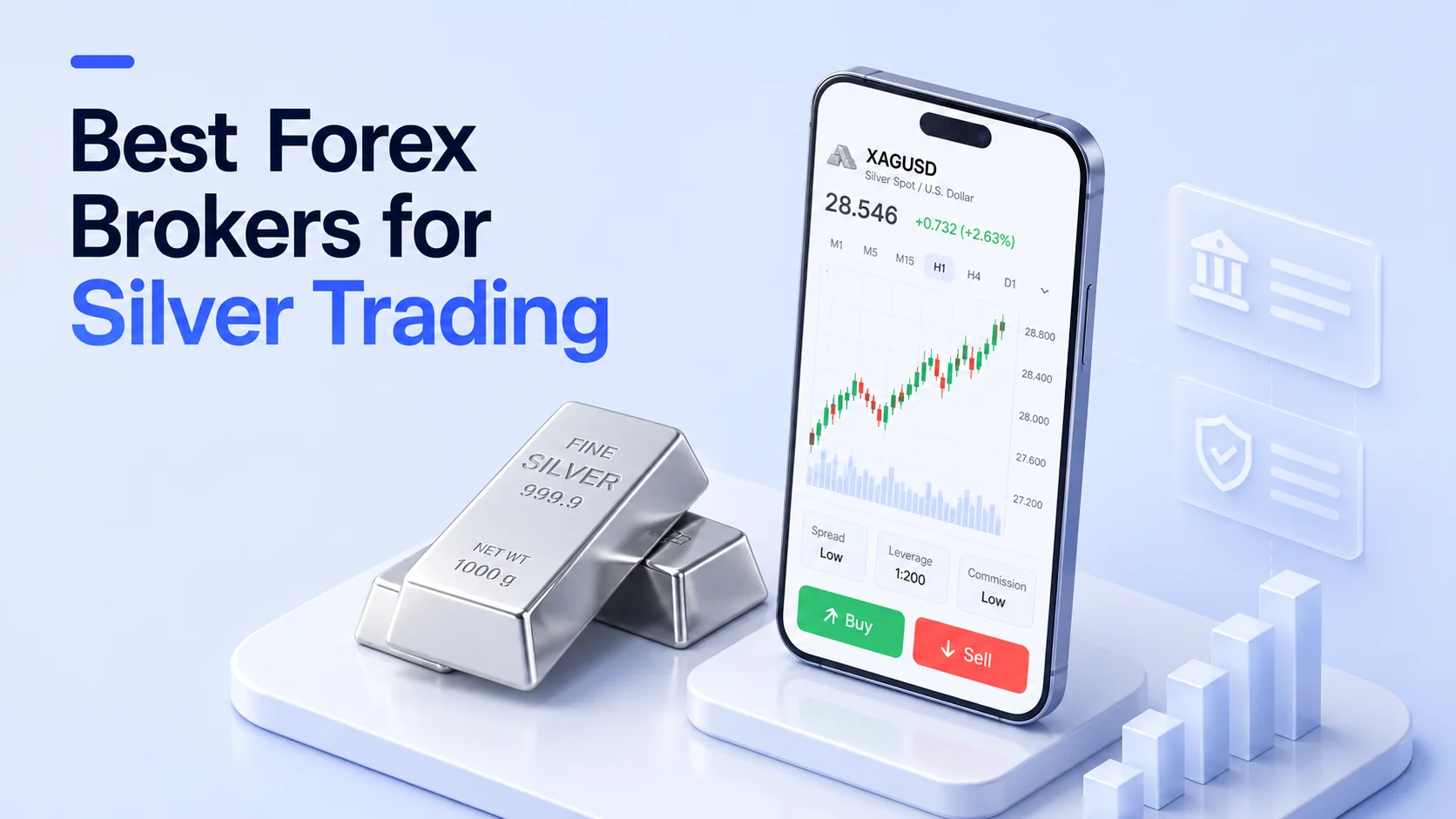
For 2026, Pepperstone has the strongest overall balance of pricing, execution and platform choice. Capital.com is easier to approach for beginners, IG gives experienced traders more ways to express a silver view, and CMC Markets stands out for technical trading. XTB keeps the experience simple through xStation, while FXGlory, Capitalcore and UnitedPips appeal more to traders looking for high leverage. Traders comparing precious metals can also review the best brokers for gold trading.
Top Picks (Quick Summary)
- Pepperstone: Best overall. Its combination of a tight silver spread, fast execution and five major platforms works well for active XAG/USD trading.
- Capital.com: Best for beginners. Quantity-based sizing and 0% commission make the mechanics easier to follow than a traditional lot-based setup.
- IG: Best for professionals. Traders can move beyond spot silver into futures, options, ETFs, ETCs and silver mining shares.
- CMC Markets: Best for advanced charting. The main strength is the trading environment itself, with detailed charting, strong order tools and fast CFD execution.
- XTB: Best for xStation users. Silver trading is kept inside one streamlined proprietary platform with clear margin and pricing information.
- FXGlory: Best for maximum leverage. Silver leverage reaches 1:3000, with positions starting from 0.01 lot.
- Capitalcore: Best for fixed-spread high-leverage trading. A fixed silver spread and leverage up to 1:2000 create a predictable cost model.
- UnitedPips: Best for swap-free silver trading. Its fixed spread, swap-free structure and 1:1000 maximum leverage suit traders who want simple high-leverage conditions.
Comparison Table of Top Silver Trading Brokers
| Broker | XAG/USD spread | Commission | Overnight swap/financing | Minimum deposit | Maximum leverage | Trading platforms | Regulation | Silver instruments |
|---|---|---|---|---|---|---|---|---|
| Pepperstone | From $0.018 per troy ounce on Spot Silver | $0 on silver CFDs | Daily financing on spot. No separate overnight fee on silver forwards | $10 | 1:400 | Pepperstone Platform, MT4, MT5, cTrader, TradingView | CMA | Spot Silver CFDs, silver forward CFDs, spread betting where available |
| Capital.com | $0.05 per troy ounce on Silver Spot | 0% | Long: -0.05242%. Short: +0.04420% | $20 | 1:100 | Web platform, mobile app, TradingView, MT4, MT5 | SCB | Spot Silver CFDs, silver futures CFDs, silver-related ETF CFDs |
| IG | 2 points on Spot Silver, equal to $0.02 per troy ounce. 3 points on silver futures, equal to $0.03 per troy ounce | No separate commission on spot and futures | Daily funding on spot. No separate overnight funding on futures | $0 | 1:125 | IG Trading, MT4, MT5, ProRealTime, TradingView | BMA | Spot Silver, futures, options, ETFs, ETCs, mining shares |
| CMC Markets | From 2.5 points on Silver Cash | $0 on commodity CFDs | Daily holding cost on cash silver | $0 | 1:200 | CMC platform, MT4, MT5, TradingView | FCA | Silver Cash CFDs, forwards and related market products |
| XTB | $0.12 per troy ounce Standard Transaction Spread on Silver CFD | $0 | Daily swap financing | $0 | 1:67 | xStation 5 | FSC Belize | Silver CFD, silver-related ETFs and ETF CFDs |
| FXGlory | 4 pips, equivalent to $0.04 per troy ounce under its listed XAG/USD quote format | $0 on Standard, Premium and VIP accounts | Swap-free option available | $1 | 1:3000 | MT4, MT5, MegaTrader | IFSA | XAG/USD and silver quoted against EUR |
| Capitalcore | $0.04 per troy ounce fixed | $0 | Swap-free | $10 | 1:2000 | MegaTrader Web, mobile app | IFSA | Silver CFD and SilverEUR CFD |
| UnitedPips | 4 pips fixed | $0 | Swap-free | $10 | 1:1000 | MegaTrader Web, mobile app | IFSA | XAG/USD |
Note: Silver leverage changes with the broker entity and client classification. Retail accounts under stricter regulators usually have lower limits.
Key Costs & Pricing Snapshot
Pepperstone has one of the tightest published raw-price spreads in this comparison. Its minimum Spot Silver spread of $0.018 per troy ounce means the ask price can be $0.018 above the bid price at the published minimum. On a full 5,000 troy ounce silver lot, that price difference represents $90 in spread value before any change in market pricing.
Capital.com's international Silver Spot spread is $0.05 per troy ounce. If the bid were $60.73 per troy ounce, for example, an ask around $60.78 would represent a $0.05 per troy ounce spread.
XTB's 0.12 figure works the same way. Because its Silver CFD follows the price of one troy ounce of silver, the 0.12 Standard Transaction Spread represents a $0.12 per troy ounce difference in the XAG/USD quote.
IG uses points instead. On its silver contract, one point represents $0.01 per troy ounce. A 2-point Spot Silver spread therefore equals $0.02 per troy ounce, while the 3-point silver futures spread equals $0.03 per troy ounce.
CMC Markets also publishes Silver Cash pricing in points. Its listed minimum is 2.5 points. Keeping the broker's own point unit is more accurate than forcing the figure into a dollar conversion without using the exact contract specification applied to the account.
FXGlory lists a typical spread of 4 pips. Its silver quote specification uses a 0.001 point size, and its displayed XAG/USD bid and ask prices show that the 4 pip spread corresponds to about $0.04 per troy ounce under its current quote format.
Capitalcore publishes the silver spread directly in US dollars. A $0.04 Silver spread therefore represents a $0.04 difference in the XAG/USD quote, or $0.04 per troy ounce. UnitedPips keeps its pricing in pips and lists a fixed 4 pip spread.
Overnight financing can be more important than the entry spread when a silver position stays open for several days. Capital.com applies -0.05242% of the full position value per day to a long position and +0.04420% per day to a short position. The adjustment is calculated from the full leveraged exposure, not only from the cash margin deposited.
Pepperstone and IG give traders a different route for longer holding periods. Their silver forward or futures products do not carry a separate daily spot financing charge because the cost is reflected in the contract pricing. Capitalcore and UnitedPips use swap-free structures, while FXGlory provides a swap-free account option.
Why These Silver Brokers Made the List
The main test was simple: how well does each broker handle silver specifically? A strong EUR/USD account says little about XAG/USD if the metal spread is wide, the minimum trade size is awkward or overnight costs are high.
Execution mattered because silver can move sharply during US inflation data, Federal Reserve decisions and payroll releases. Pepperstone publishes execution from 50 milliseconds with a 99.32% fill rate. CMC Markets reports a 0.009 second median CFD execution time on its web and mobile platforms.
Platform quality also separates the group. Pepperstone, IG and FXGlory give traders several established choices, while CMC Markets leans heavily on its own charting environment. XTB goes in the opposite direction with one tightly integrated platform. Capitalcore and UnitedPips are more focused on proprietary software and straightforward account structures.
Best Silver Trading Brokers: Detailed Reviews
Pepperstone: Best Overall for Active Silver Traders
Overview
Pepperstone works particularly well for traders who treat silver as a fast-moving trading market rather than a long-term investment. The $0.018 minimum Spot Silver spread is competitive, and there is no separate commission on the commodity CFD.
The broader platform choice also matters in practice. A discretionary trader can work from TradingView or cTrader, while automated strategies can run through MT4 or MT5. This makes it easier to keep the same broker when the trading style changes.
Longer-term silver positions can be handled through the silver forward CFD instead of the spot contract. The forward structure removes a separate daily funding charge because the financing component is built into the contract price.
Key facts
- Maximum silver leverage: 1:400
- UK retail silver leverage: 1:10
- Reference contract size: 5,000 troy ounces
- Minimum deposit: $10
- Execution: from 50 milliseconds
Pros
- Very tight silver pricing
- Five trading platforms
- Spot and forward contracts
Cons
- Spot positions carry overnight financing
- Retail leverage is much lower under stricter entities
Best for: Active traders, technical traders and algorithmic XAG/USD strategies.
Capital.com: Best for Beginners
Overview
Capital.com removes some of the complexity that often makes metal CFDs confusing for beginners. Instead of forcing new traders to think immediately in full standard lots, its Silver Spot contract starts from a traded quantity of 1.
The margin structure is also easy to read. International accounts use a 1% requirement, which equals 1:100 leverage, while UK retail accounts use 10%, equal to 1:10.
The main practical consideration is overnight financing. Short-term trades are easy to price, but multi-day positions need the funding rate included in the trade plan.
Key facts
- Maximum international leverage: 1:100
- Minimum traded quantity: 1 CFD contract
- Minimum deposit: $20
Pros
- 0% commission
- Spot, futures-based and ETF-based silver exposure
- Strong regulatory coverage
Cons
- Spot positions carry overnight financing
- Financing rates change over time
Best for: Beginners who want straightforward silver CFD sizing and a clear margin structure.
IG: Best for Professional and Multi-Instrument Silver Traders
Overview
IG stands apart because silver does not stop at one XAG/USD CFD. Traders can move between spot silver, futures, daily options, ETFs, ETCs and silver mining shares depending on strategy and holding period.
That flexibility is useful when the market view stays the same but the trade structure changes. A short-term directional setup may fit Spot Silver, while a longer trade can be moved into futures to avoid a separate daily spot funding charge.
The wider product range does make IG more complex than a simple CFD account, but experienced traders may see that as an advantage rather than a drawback.
Key facts
- Reference contract size: 5,000 troy ounces
- International minimum size: 0.04 contracts
- Maximum international leverage: 1:125
- UK retail leverage: 1:10
Pros
- Broadest silver product range in this list
- Five trading platforms
- Strong global regulation
- Good fit for multi-asset strategies
Cons
- More complex product range for beginners
- Spot Silver carries daily funding
Best for: Experienced traders who want several ways to trade the silver market.
CMC Markets: Best for Advanced Charting and Execution
Overview
CMC Markets is less about headline leverage and more about the quality of the trading environment. The proprietary platform gives technical traders detailed charting, broad order control and fast execution, which matters when XAG/USD starts moving quickly.
Its European schedule lists Silver Cash with a 2.5-point minimum spread. Retail leverage is limited, but professional clients can access significantly more margin capacity.
The broker's published 0.009 second median CFD execution time is especially relevant around fast market events, when delays become more noticeable.
Key facts
- European retail leverage: 1:10
- Professional commodity leverage: up to 1:200
- Minimum Silver Cash trade size: 0.001 units
- Commission: $0 on commodity CFDs
- Minimum deposit: $0
Pros
- Advanced charting
- Cash and forward silver exposure
- Strong regulatory network
Cons
- Retail leverage is limited under major entities
- The platform can feel complex for beginners
Best for: Technical traders and professional clients who want deep charting and fast execution.
XTB: Best for xStation Silver Trading
Overview
XTB takes a more focused route. Instead of spreading the experience across several terminals, silver trading sits inside xStation 5, where charts, orders, market information and account controls are handled in one place.
The International Silver CFD carries a 0.12 Standard Transaction Spread and leverage of 1:67. Silver-related ETFs and ETF CFDs add another route for traders who want exposure without using the main leveraged XAG/USD contract.
Key facts
- International leverage: 1:67
- CySEC retail leverage: 1:10
- Reference contract size: 5,000 troy ounces
- Minimum deposit: $0
- Platform: xStation 5
Pros
- Simple proprietary platform
- No separate silver commission
- Silver-related ETF access
Cons
- Only one main trading platform
- Daily swap costs apply to Silver CFDs
Best for: Traders who prefer managing analysis and execution inside one platform.
FXGlory: Best for Maximum Silver Leverage
Overview
FXGlory is built around margin flexibility. With leverage reaching 1:3000 on silver and minimum positions from 0.01 lot, traders can control exposure with very little required margin.
That is useful when position size stays disciplined. The low margin requirement can make an oversized XAG/USD trade look deceptively affordable, even though the underlying market risk has not changed.
MT4 and MT5 make the broker familiar to traders already using expert advisors or custom indicators, while the $1 starting deposit lowers the entry barrier further.
Key facts
- Maximum leverage: 1:3000
- Minimum order size: 0.01 lot
- Minimum deposit: $1
- Commission: $0 on major account types
Pros
- Highest leverage in the comparison
- Low minimum deposit
- MT4 and MT5 available
Cons
- Fewer silver instrument choices than larger multi-asset brokers
Best for: Experienced high-leverage traders who use strict position sizing.
Capitalcore: Best for Fixed-Spread High-Leverage Silver Trading
Overview
Capitalcore is easier to judge on cost because the silver spread is fixed at $0.04. Traders know the quoted spread in advance instead of watching it expand and contract with market conditions.
The account structure also removes two other common cost variables: commission is $0 and the trading setup is swap-free, and combined with leverage up to 1:2000.
Key facts
- Maximum leverage: 1:2000
- Minimum trade size: 0.01 lot
- Minimum deposit: $10
- Commission: $0
Pros
- Fixed silver pricing
- High leverage
- Swap-free structure
- Low starting deposit
Cons
- Silver trading is limited to CFDs rather than a wider range of futures, options, or exchange-traded silver products
Best for: Traders who value predictable silver costs and high leverage.
UnitedPips: Best for Swap-Free Fixed-Spread Silver Trading
Overview
UnitedPips keeps the silver proposition simple. XAG/USD carries a fixed 4 pip spread, there is no commission, and positions do not accumulate swap charges.
The maximum leverage of 1:1000 gives traders substantial margin flexibility, while the 0.01 lot minimum makes smaller position sizes possible.
Key facts
- Maximum leverage: 1:1000
- Minimum trade size: 0.01 lot
- Minimum deposit: $10
- Commission: $0
Pros
- Fixed silver spread
- Swap-free pricing
- High leverage
Cons
- Narrower silver product range than IG or CMC Markets
Best for: Traders who want a simple fixed-cost silver account without overnight swap charges.
How Silver Leverage, Spread and Trade Size Work in Practice
Leverage changes how much margin is required to open a trade. It does not change the market value of the position itself.
Take a $10,000 silver position. At 1:10 leverage, the required margin is $1,000. At 1:100, it falls to $100. At 1:1000, just $10 is needed. If the market then moves 1% against the position, the loss is still about $100 before trading costs.
This is why very high leverage should be viewed as margin flexibility rather than a trading advantage by itself. The danger comes from using the lower margin requirement to open a position that is too large.
Contract size can change the risk just as much. A standard silver lot at several major brokers represents 5,000 troy ounces. A 0.01 lot trade on that contract represents 1% of the full size, or exposure based on 50 ounces.
Spread units need similar care. Pepperstone quotes a raw price difference, IG and CMC Markets use points, while FXGlory and UnitedPips describe costs in pips. Those numbers only become comparable after the trader converts them into the actual cash cost for the chosen position size.
Time in the market is the final piece. A day trader mainly feels the spread and execution quality. A swing trader also pays attention to financing, which is why futures, forwards and swap-free structures can become more attractive over longer holding periods.
Who Should Choose Which Option?
| Trader type | Best match | Reason |
|---|---|---|
| Active XAG/USD trader | Pepperstone | Tight pricing, fast execution and broad platform choice |
| Beginner | Capital.com | Simple sizing and clear margin structure |
| Professional silver trader | IG | Wider range of silver instruments |
| Advanced technical trader | CMC Markets | Deep charting and fast execution |
| xStation user | XTB | Integrated proprietary platform |
| Maximum leverage trader | FXGlory | Leverage up to 1:3000 |
| Fixed-spread trader | Capitalcore | Predictable pricing with no swap |
| Swap-free high-leverage trader | UnitedPips | No swap charge and leverage up to 1:1000 |
How to Choose the Right Silver Trading Broker
Start with the silver instrument itself. Spot CFDs suit short-term directional trading, while futures and forwards can make more sense when a position will remain open for several days.
Translate the spread into money. Raw price differences, points and pips are not directly comparable. Contract size and position size determine the actual trading cost.
Look at margin before chasing leverage. Higher leverage can free up capital, but it also makes it easier to take more exposure than the account can safely absorb.
Pay attention to minimum trade size. Smaller increments make risk management easier, particularly for accounts that cannot comfortably absorb the movement of a large silver contract.
Match the platform to the strategy. MT4 and MT5 suit automated trading, cTrader works well for active execution, and TradingView remains strong for chart-based discretionary setups. Proprietary platforms can be more convenient when everything is kept in one interface.
Final Verdict
There is no single silver broker that fits every trading style, but the differences between these eight brokers are clear once pricing, leverage, execution and product range are viewed together.
Pepperstone is the strongest all-round choice for active XAG/USD trading. Its execution is fast, and traders can work through MT4, MT5, cTrader, TradingView or the Pepperstone platform.
Capital.com is the more practical choice for beginners. The minimum traded quantity of 1, 0% commission and clear 1% international margin requirement make silver position sizing easier to understand. It is better suited to traders who want a simpler entry into leveraged silver without starting with traditional lot calculations.
IG is the better fit for experienced traders who want more than Spot Silver. Its advantage is that traders can move between spot, futures, options, ETFs, ETCs and silver mining shares, which makes IG more flexible for different holding periods and market views.
CMC Markets stands out for technical traders. Its charting environment and small minimum trade size make it well suited to traders who rely on precise entries and detailed technical analysis.
XTB offers the entire silver trading process inside xStation 5, with a clear $0.12 per troy ounce spread. FXGlory, Capitalcore and UnitedPips are aimed more directly at traders who prioritize leverage. FXGlory, Capitalcore and UnitedPips are better suited to traders who prioritize higher leverage and lower margin requirements. FXGlory offers the highest leverage at 1:3000, while Capitalcore combines 1:2000 leverage with a fixed $0.04 per troy ounce spread and swap-free pricing. UnitedPips provides up to 1:1000 leverage with fixed spreads. These conditions can make margin use more flexible, but they also make careful position sizing essential because losses can increase quickly when large positions are opened.
Our Review Process & Updates
This comparison focuses specifically on silver trading rather than the brokers' broader forex conditions.
The assessment covers XAG/USD pricing, commission, leverage, contract size, minimum trade size, overnight financing, execution, platforms, silver market range and regulation.
Where legal entities apply different conditions, the higher international limit and stricter retail limit are separated. Floating spreads, financing rates and margin requirements can change, especially when silver volatility rises.
Risk Warning
Silver CFDs and other leveraged products involve risk, especially when the market moves quickly. Leverage can increase both potential gains and potential losses, so position size and margin use should be managed carefully.
Trading conditions, leverage limits and account protections vary by broker entity and client classification. Silver CFDs also do not provide ownership of physical silver.
FAQs
How much leverage is available for silver trading?
Silver leverage varies widely by broker and legal entity. In this comparison, maximum leverage ranges from 1:67 at XTB International to 1:3000 at FXGlory.
What is the minimum trade size for silver?
The minimum depends on the broker and contract structure. Several brokers use a 5,000 troy ounce standard silver lot and allow trading from 0.01 lot, which represents 50 troy ounces of exposure. Capital.com instead uses a minimum traded quantity of 1 on its Silver Spot CFD.
Is Spot Silver better than silver futures for short-term trading?
Spot Silver is usually more straightforward for short-term XAG/USD trading because there is no contract expiry. Futures and forward contracts can be more suitable for longer holding periods because they do not use the same daily spot financing structure.
Do silver CFDs charge overnight fees?
Many Spot Silver CFDs apply daily financing when a position stays open overnight. The exact rate depends on the broker and can change over time. Some brokers use futures, forwards or swap-free account structures that handle overnight costs differently.

Chad Powell
Chad Powell has spent more than five years trading Forex and cryptocurrency, building a practical understanding of how markets move and the challenges traders face. He writes about technical analysis, risk management, trading discipline, broker platforms, crypto security, and fraud prevention.