






















































































































What Is XAU/USD in Forex?
XAU/USD represents the price of gold in US dollars. XAU commonly refers to one troy ounce of gold, while USD is the US dollar.
If XAU/USD is quoted at 2,500.00, one troy ounce of gold is worth about $2,500. A move from 2,500 to 2,520 means gold gained $20 per ounce; a move to 2,470 means it lost $30.
Is XAU/USD Really a Forex Pair?
XAU/USD is traded alongside currency pairs on many forex platforms, but gold is a precious metal rather than a conventional currency. Depending on the broker and jurisdiction, exposure may come through spot-metal products, CFDs, or other derivatives.
Contract size, margin, leverage, trading hours, spreads, commissions, and overnight financing can vary, so always check your broker’s product specifications.
How Trading Gold in Forex Works
Trading gold on a forex platform means speculating on whether XAU/USD will rise or fall. A trader expecting gold to rise may open a long (buy) position; one expecting it to fall may open a short (sell) position.
What Moves Gold Prices?
Gold responds to several forces at once, including the US dollar, interest rates, inflation expectations, Federal Reserve policy, investor positioning, and global risk.
US Dollar Strength
Because gold is priced in US dollars, a stronger dollar can make it more expensive for buyers using other currencies, while a weaker dollar can support demand. Gold and the dollar often move in opposite directions, but this relationship is not guaranteed.
Interest Rates and Bond Yields
Gold does not pay interest, so rising bond yields can make income-producing assets more attractive and pressure gold. Falling yields can have the opposite effect.
Federal Reserve Policy
Fed decisions influence both the dollar and interest-rate expectations. Traders watch rate decisions, FOMC statements, press conferences, projections, and officials’ comments. Markets often react more to whether the Fed is more hawkish or dovish than expected than to the rate decision alone.
Inflation Expectations
Gold is sometimes used as an inflation hedge, but higher inflation can also push yields higher if markets expect tighter policy. Inflation is therefore best considered together with rates, yields, and Fed expectations.
Geopolitical and Financial Risk
Gold can attract defensive demand during conflicts, financial stress, political uncertainty, or economic shocks. However, it does not automatically rise on negative news; positioning, liquidity, the dollar, and yields also matter.
Central-Bank Gold Demand
Central banks hold gold as a reserve asset. Changes in official-sector buying and selling can affect longer-term demand, though short-term traders usually combine this with macroeconomic and price data.
Understanding XAU/USD Lot Sizes
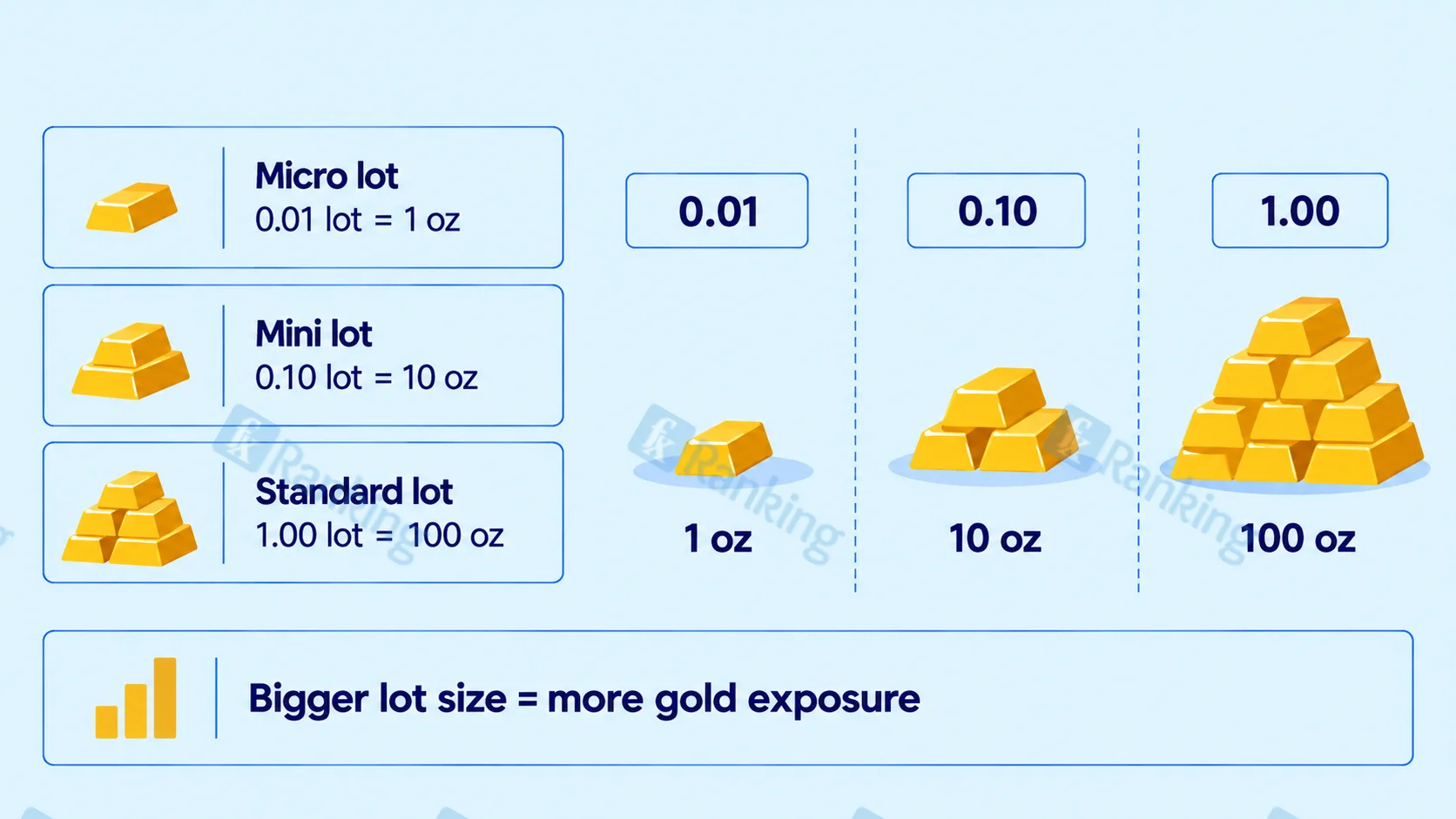
Position size determines how strongly a gold-price move affects your account. On many retail platforms, 1.00 XAU/USD lot represents 100 troy ounces, although this is broker-specific.
Under that common structure:
1.00 lot = 100 ounces
0.10 lot = 10 ounces
0.01 lot = 1 ounce
A $1 move in gold would therefore change position value by about $100, $10, or $1, respectively.
These are simplified examples and exclude spread, commission, slippage, financing, and currency conversion. Always confirm your broker’s contract size.
When Is the Best Time to Trade Gold?
XAU/USD trades through much of the global trading week, but liquidity and volatility often increase when major European and US markets are active.
London Trading Hours
London is a major precious-metals center, and liquidity often increases as European institutions become active.
New York Trading Hours
New York is important because major US data and Federal Reserve events are released during this period, including inflation, employment, GDP, retail sales, and rate announcements.
London-New York Overlap
When London and New York are both active, participation can be high. This may improve liquidity but can also produce sharp volatility around major releases.
How Forex Gold Traders Analyze XAU/USD
Gold traders commonly combine three perspectives: fundamentals, technical analysis, and market sentiment.
Fundamental Analysis
Fundamental analysis examines the economic forces affecting gold. Key questions include whether the US dollar and Treasury yields are rising or falling, what markets expect from the Fed, whether major US data is due, and whether geopolitical or financial risk is increasing.
Technical Analysis
Technical analysis focuses on price behavior. Common tools include support and resistance, previous highs and lows, trend structure, breakouts, pullbacks, moving averages, and momentum indicators.
These tools do not predict the market with certainty; they help organize price information, identify possible trade locations, and define where an idea becomes invalid.
Market Sentiment
Sentiment reflects investors’ willingness to take or avoid risk. Traders may monitor the dollar, bond markets, stock indices, volatility measures, and geopolitical headlines for context.
How to Trade Gold Using Support and Resistance
Support is an area where buying has previously slowed or reversed a decline; resistance is an area where selling has slowed or reversed an advance.
Support and Resistance Example
If XAU/USD repeatedly falls toward 2,480 and rebounds, traders may view that area as support. If it repeatedly rises toward 2,520 and falls, 2,520 may act as resistance.
Traders can then watch how price behaves when it returns to those areas. Support and resistance are zones of interest, not guaranteed reversal points.
How to Trade XAU/USD Breakouts
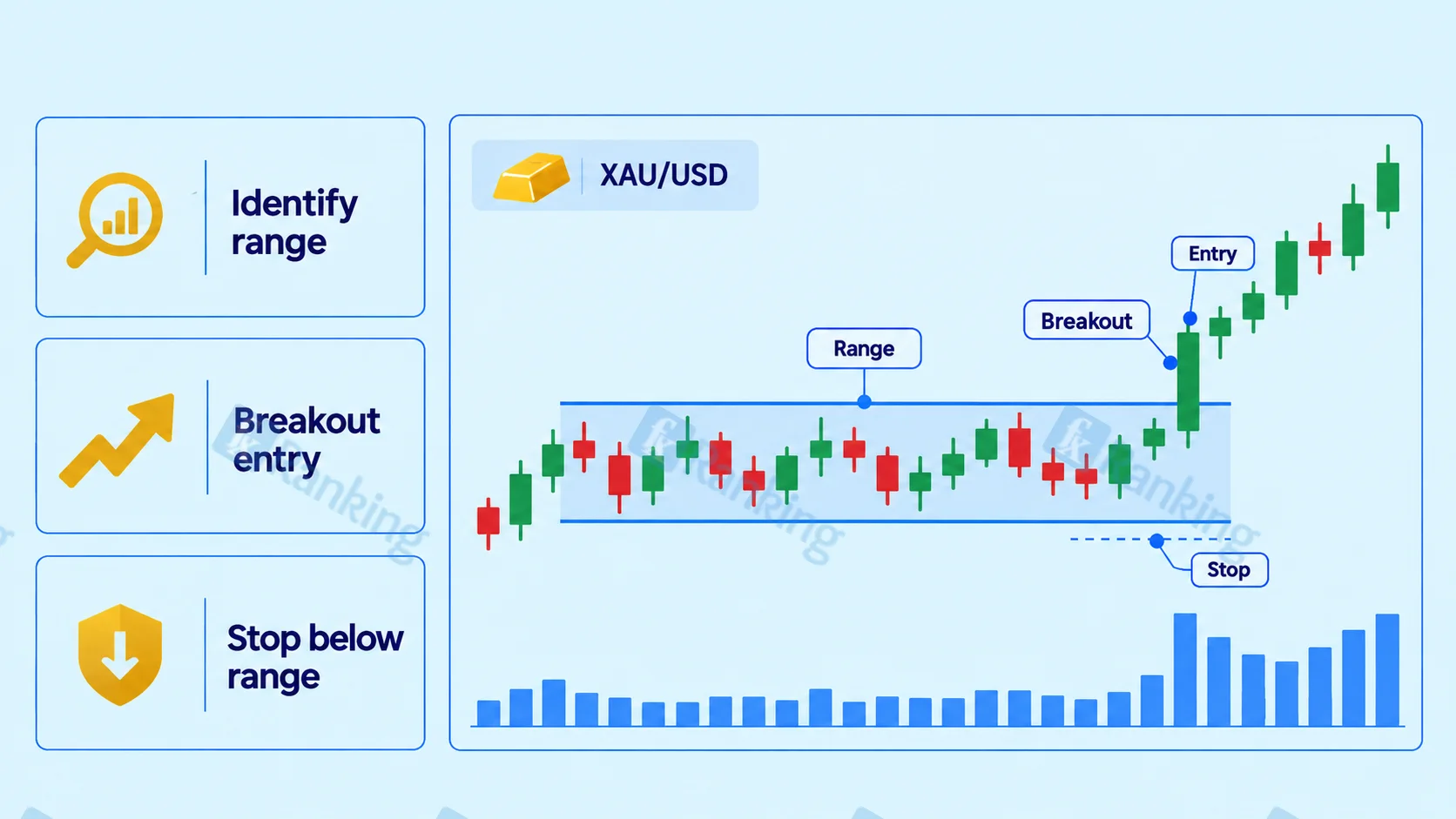
A breakout occurs when gold moves beyond an established trading range. For example, if XAU/USD trades between 2,490 support and 2,510 resistance, a move above 2,510 may signal a bullish breakout, while a move below 2,490 may signal a bearish one.
Not every breakout continues. Gold can briefly move beyond a level and reverse, creating a false breakout. Traders may look for confirmation such as a candle close beyond the level, a retest, higher-timeframe support, strong momentum, or a relevant fundamental catalyst.
Confirmation can reduce poor entries but cannot remove risk.
How to Trade Gold Trends and Pullbacks
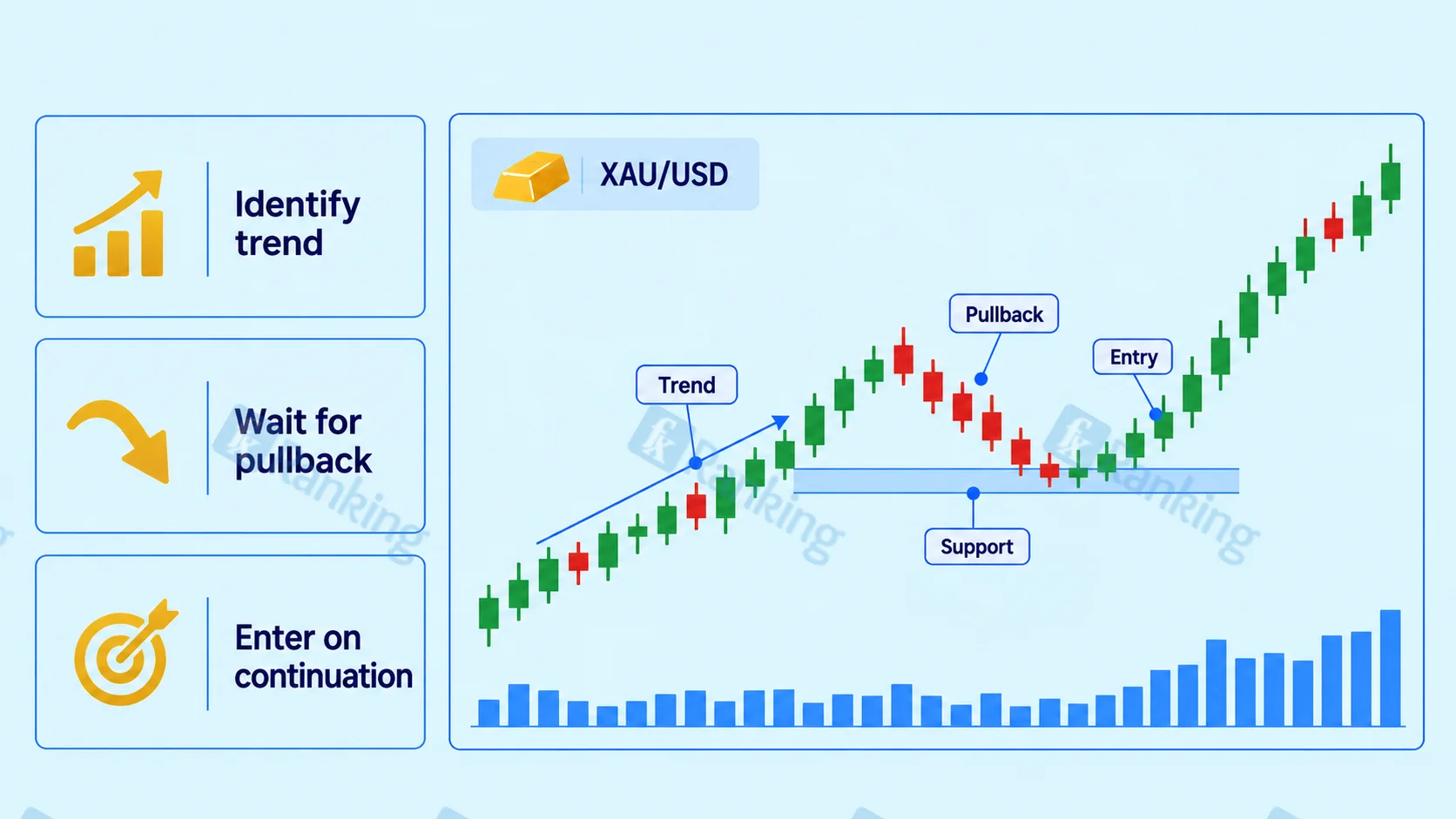
Gold can develop strong directional trends. An uptrend generally forms higher highs and higher lows; a downtrend forms lower highs and lower lows.
Rather than entering after an extended move, some traders wait for a pullback.
Gold Pullback Example
Suppose XAU/USD rises from 2,450 to 2,520, then pulls back to 2,495, an area that previously acted as resistance. If buyers defend it, traders may watch for former resistance to become support.
The setup still needs an invalidation point because trends do not continue indefinitely.
Using Moving Averages in a Forex Gold Trading Strategy
Moving averages smooth historical price data and can help identify trend direction. Common periods include 20, 50, 100, and 200.
Price holding above a rising moving average may support a bullish trend view, while price below a falling average may support a bearish one.
Because moving averages are based on past prices, they lag the market and should be used as analytical tools rather than automatic buy or sell signals.
Risk Management When Trading Gold
Gold can move quickly, so risk should be defined before a trade is opened.
Define Risk Before Entering
Decide how much of the account you are willing to lose if the trade fails. For example, 1% of a $5,000 account is $50. Position size and stop distance should be built around that limit.
Use Stops That Match Market Structure
Place a stop where the trade idea becomes invalid rather than at an arbitrary distance. If a trade depends on support holding, a decisive break below that area may invalidate the setup.
Adjust Position Size for Volatility
Wider price swings generally require smaller positions to keep account risk controlled.
Understand Slippage
A stop-loss is not always filled at the exact requested price. During fast markets, economic announcements, or sudden geopolitical events, XAU/USD may move through a stop level before an order can be executed. This difference between the requested and actual execution price is known as slippage.
Important Economic Events for Gold Traders
Traders involved in forex trading gold should pay close attention to the US economic calendar.
Important events can include:
- Federal Reserve rate decisions
- US Consumer Price Index data
- Personal Consumption Expenditures inflation data
- Nonfarm Payrolls
- US unemployment data
- US GDP
- Retail sales
- Purchasing Managers' Index reports
- Federal Reserve speeches
The headline number alone is not enough. Markets usually react to how the result compares with expectations and how it changes the outlook for rates, Treasury yields, the dollar, and Fed policy.
Common Mistakes When Trading XAU/USD
Using Too Much Leverage
Oversized positions can turn normal gold volatility into large account losses.
Chasing Large Candles
Entering after an extended move can mean buying near a temporary high or selling near a temporary low just before a pullback.
Ignoring the Macro Environment
Charts alone can miss important drivers such as the US dollar, Treasury yields, and Federal Reserve expectations.
Trading Major News Without Understanding the Risk
Major releases can cause wider spreads, slippage, rapid reversals, and false breakouts.
Assuming Gold Is Always a Safe Haven
Gold often attracts defensive demand during uncertainty, but it does not rise in every crisis. A stronger dollar, higher yields, or a rush for cash can offset safe-haven demand.
Advantages of Trading Gold in Forex
XAU/USD is widely followed, available on many forex and CFD platforms, and can produce substantial intraday movement. Traders can usually speculate on both rising and falling prices and analyze gold using both technical and fundamental methods.
These features create trading opportunities, but volatility also increases the speed and size of potential losses.
Limitations and Risks of Forex Gold Trading
XAU/USD can move sharply, and leverage magnifies both gains and losses. Trading costs and conditions also vary by broker.
Before trading, verify the contract size, minimum trade size, margin requirement, leverage, spread, commission, overnight financing, and trading hours. These details can differ across brokers and jurisdictions.
How to Trade Gold in Forex: Key Takeaways
- XAU/USD is gold priced in US dollars.
- The dollar, rates, yields, Fed policy, inflation expectations, central-bank demand, and global risk can affect gold.
- Contract size varies by broker, so position sizing must be checked carefully.
- Support and resistance, trends, pullbacks, breakouts, and moving averages are common technical tools.
- News can cause rapid moves, slippage, and false breakouts.
- No indicator, strategy, correlation, or pattern guarantees profitable trades.
Conclusion
Trading XAU/USD requires understanding both the forces that move gold and the effect of those moves on your position. Technical analysis can help identify trade locations, while macroeconomic context helps explain changing volatility.
The priority is risk control: know your broker’s contract specifications, size positions carefully, and define your exit before entering.
FAQs
What does XAU/USD mean in forex?
XAU/USD represents the price of gold in US dollars. XAU commonly refers to one troy ounce of gold, while USD represents the US dollar. If XAU/USD is quoted at 2,500, one troy ounce of gold is worth approximately $2,500.
Is XAU/USD a forex currency pair?
XAU/USD is commonly traded on forex platforms, but it is not a traditional currency pair like EUR/USD. Gold is a precious metal, and traders may access it through spot-metal products, CFDs, or other derivatives depending on their broker and jurisdiction.
What causes XAU/USD prices to move?
Gold prices can be influenced by the US dollar, interest rates, Treasury yields, Federal Reserve policy, inflation expectations, central-bank demand, and geopolitical or financial uncertainty. These factors often interact, so no single indicator consistently determines where gold will move.
What is the best time to trade XAU/USD?
Gold often experiences higher liquidity and price movement when European and US markets are active. The London session, New York session, and especially their overlap are commonly watched by traders. Volatility can increase further around major US economic releases and Federal Reserve announcements.
How much is one lot of XAU/USD?
On many retail trading platforms, 1.00 lot of XAU/USD represents 100 troy ounces of gold. However, contract sizes can vary between brokers. Traders should always check their broker’s contract specifications before calculating position size or potential profit and loss.
How can traders manage risk when trading gold?
Traders can manage risk by deciding how much of their account they are willing to lose before entering a trade, choosing an appropriate position size, placing stops where the trade idea becomes invalid, and accounting for volatility and possible slippage. Gold can move quickly, particularly around major economic news.

Nathan Wong
Nathan Wong is a Forex education contributor with 15 years of trading and market-analysis experience. He specializes in broker platforms, cryptocurrency, risk management, and trading psychology, creating practical content that helps readers make informed decisions and develop realistic expectations.